Need help with B2B Marketing?
Let the smarketers’ team drive your pipeline with data-led campaigns and AI-powered growth strategies.
Account-Based Marketing has evolved from a niche strategy to a cornerstone of B2B growth. As we move into 2026, the landscape is shifting dramatically—no longer is ABM simply about targeting high-value accounts with personalized campaigns. Today’s leaders are leveraging AI and smart automations to scale what was once a resource-intensive, manual process into a predictive, agile engine that drives measurable revenue.
The question isn’t whether to adopt AI in your ABM strategy, but how to scale ABM with AI effectively while maintaining the precision and personalization that makes account-based marketing so powerful.
The Evolution to ABM 3.0
We’re entering what industry experts call “ABM 3.0″—a fundamental shift from static segmentation to predictive precision. This evolution represents more than incremental improvement; it’s a complete reimagining of how marketing and sales teams identify, engage, and convert their most valuable accounts.
| ABM Generation | Approach | Key Characteristics |
|---|---|---|
| ABM 1.0 | Manual Research | Labor-intensive, static lists, broad assumptions |
| ABM 2.0 | Data-Driven | Multi-channel orchestration, segmentation |
| ABM 3.0 | Predictive & AI-Powered | Real-time optimization powered by machine learning and predictive analytics |
This transformation is already delivering remarkable results: Gartner cites a 28% increase in account engagement and a 25% improvement in MQL-to-SAL conversion, while Forrester reports 58% larger deal sizes with advanced ABM tactics versus traditional methods.
The shift to ABM 3.0 isn’t just about adopting new technology—it’s about fundamentally changing how your revenue teams operate.
Top ABM Trends for 2026
Trend #1: Hyper-Personalization at Scale
One of the most pressing challenges in ABM has always been the tension between personalization and scale. How can AI enable hyper-personalization at scale in ABM campaigns for 2026? The answer lies in intelligent automation that goes far beyond simple mail merge.
What’s Different in 2026:
Modern AI platforms can now analyze thousands of data points about each account—from technographic signals to content consumption patterns to organizational changes—and automatically generate tailored messaging for every stakeholder in the buying committee.
The key is moving beyond account-level customization to contact-level precision. Different members of the buying committee have different concerns:
- CFO: ROI, risk mitigation, budget justification
- IT Director: Integration, security, technical feasibility
- VP of Operations: Efficiency gains, workflow improvements
- C-Suite: Strategic alignment, competitive advantage
AI-powered content engines can now create dynamic variations that address these distinct perspectives and requirements without requiring your marketing team to create a dozen versions manually.
Real-world example:
By using AI to sharpen account targeting and personalize messaging at the stakeholder level, Snowflake’s ABM team saw a 2.3× increase in qualified meetings and a 54% rise in click-through rates. The key outcome wasn’t just higher engagement, but better efficiency—proving that hyper-personalization at scale can improve engagement without inflating budgets.
AI-enabled personalization focuses on crafting genuine narratives that resonate with individual decision-makers’ priorities and pain points.
Trend #2: Intent Data as the Strategic Foundation
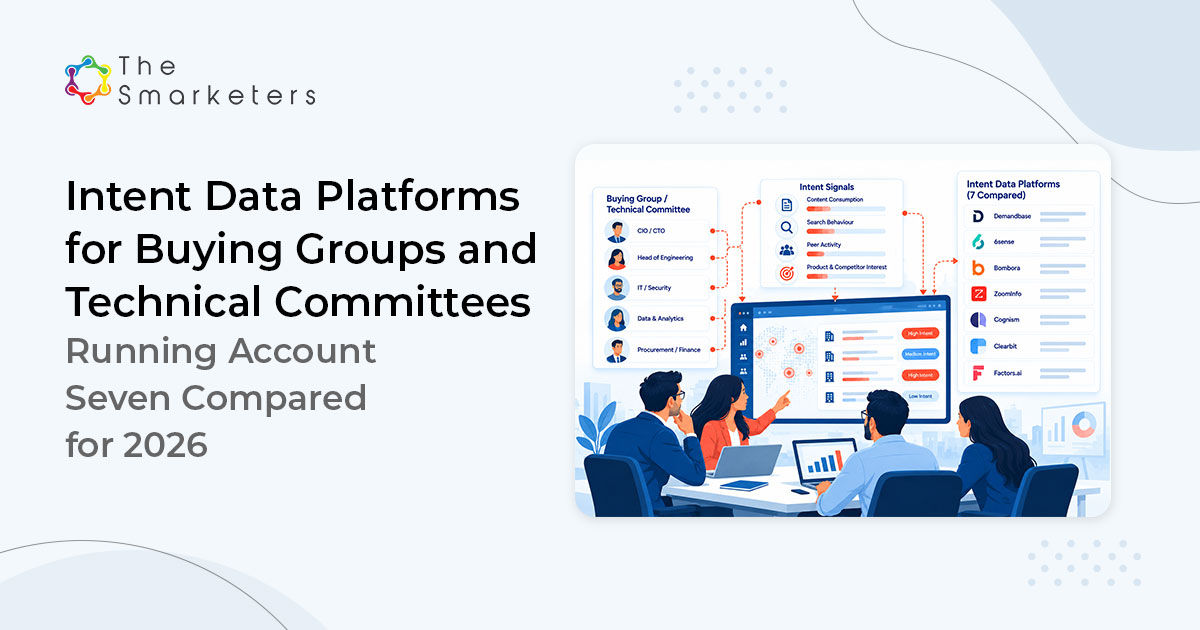
Intent data has emerged as the bedrock of effective ABM strategies in 2026. Rather than relying on firmographic fit alone, forward-thinking teams are using behavioral signals to identify accounts actively researching solutions in their category.
What role does predictive intent modeling play in prioritizing target accounts?
It transforms ABM from educated guessing into scientific targeting. Predictive models analyze patterns across millions of buyer interactions to identify which accounts are most likely to enter a buying cycle—and when.
Types of Intent Data:
First-Party Intent: Signals from your own digital properties
- Website visits and page views
- Content downloads and engagement
- Email opens and clicks
- Product demo requests
Third-Party Intent: Behavioral signals across the web
- Topic research and content consumption
- Competitor comparisons
- Review site activity
- Industry publication engagement
Best Practices for 2026:
- Combine first-party and third-party intent for comprehensive account visibility
- Refresh intent data every 45 days to maintain accuracy
- Use predictive scoring to prioritize accounts showing the strongest buying signals
- Share intent insights across sales, marketing, and customer success teams
AI-enabled ABM platforms like 6sense now claim to achieve nearly 85% accuracy in predicting which accounts will convert (by analyzing large datasets of behavioral data), allowing teams to dedicate their efforts and resources toward high-value accounts.
Trend #3: Smart Automations Integrated with RevOps
In what ways do smart automations integrate with RevOps to boost ABM ROI?
By connecting marketing, sales, and customer success workflows into a shared RevOps framework.
Revenue operations has become the connective tissue that aligns these functions around shared metrics and unified workflows. Smart automation turns intent data into coordinated actions, improves timing across teams, and reduces leakage between stages—directly translating alignment into higher ABM ROI. For instance, when marketing detects a buying signal, sales receives a data-rich alert with context; when a deal closes, customer success automatically receives the engagement history to inform onboarding.
The Traditional Problem:
Marketing generates a qualified account → Critical context gets lost in handoff → Sales starts relationship-building from scratch → Inefficiency and poor experience
The AI-Powered Solution:
Marketing detects buying signal → Automated enrichment adds context → Sales receives full intelligence → Personalized outreach begins immediately → Seamless experience
Automated Workflows That Drive Results:
Journey orchestration platforms can now automatically trigger the right action at the right time based on account behavior:
- High-value account visits pricing page 3x in one week → Alert sales rep + Trigger personalized email sequence + Serve targeted ads
- Account downloads competitor comparison guide → Enrich with competitive intelligence + Schedule executive outreach
- Multiple stakeholders engage with ROI content → Flag for executive-level engagement + Prepare custom business case
Organizations implementing these integrated workflows can achieve 60-70% cost savings by reducing manual effort, while also improving conversion rates through faster, more relevant responses to real buying signals
Trend #4: Agentic AI for Autonomous Campaign Management
Agentic AI represents the cutting edge of ABM evolution. Unlike traditional rule-based automation, agentic AI systems can make autonomous decisions, learn from outcomes, and continuously improve campaign performance without constant human oversight.
What Agentic AI Can Do:
- Identify emerging accounts based on predictive signals
- Craft personalized outreach messaging
- Optimize budget allocation across channels
- Test and refine messaging variations
- Adjust targeting parameters based on performance
- Predict optimal timing for outreach
The Human-AI Partnership:
AI integration in ABM calls for a strategic human-in-the-loop approach:
| AI Handles | Humans Handle |
|---|---|
| Data analysis and pattern recognition | Strategic planning and vision |
| Execution at scale | Relationship building |
| Real-time optimization | Creative direction |
| Workflow orchestration | Emotional intelligence |
| Performance monitoring | High-stakes negotiations |
The system learns which messages resonate with specific account segments and automatically refines its approach, freeing human executives to focus on high-level planning and relationship-building.
Trend #5: Dynamic Content Generation for Buying Committees
Understanding how LLMs generate dynamic content variations for buying committees is central to how modern ABM teams achieve scalable personalization. Large language models have transformed content creation by making role-specific messaging possible without sacrificing speed or consistency.
Modern LLMs can analyze an account’s industry, challenges, competitive landscape, and recent business developments, then generate tailored content that speaks directly to their situation.
Example: SaaS Sale to Enterprise Account
For different stakeholders within the same organization, AI can generate different content formats:
| Stakeholder | Content Type | Focus Areas |
|---|---|---|
| IT Team | Technical Whitepaper | Security protocols, API integration, data architecture |
| Finance | ROI Calculator | Cost savings, efficiency gains, budget impact |
| Executive Leadership | Strategic Brief | Business objectives, competitive advantage, transformation |
| Operations | Process Guide | Workflow optimization, team adoption, scalability |
Each piece maintains brand consistency while addressing the unique concerns of its intended audience. This level of customization was previously impossible at scale.
The Human Quality Control:
However, the human element remains critical. The most successful implementations:
- Use AI to generate drafts and variations
- Always include human review for accuracy and appropriateness
- Require human verification for all customer-facing content
- Maintain brand voice and strategic alignment
Trend #6: Full-Funnel Lifecycle Tracking and Attribution
ABM success measurement has evolved beyond vanity metrics to embrace true revenue impact throughout the entire customer journey.
What metrics best measure ABM success when using AI-driven workflows?
While early ABM programs focused on engagement metrics—account reach, content downloads, website visits—2026’s leaders are adopting revenue-focused measurements:
Critical ABM Metrics for 2026:
- Pipeline Velocity: How quickly accounts move through buying stages
- Multi-Touch Attribution: Understanding which touchpoints truly influence decisions
- Account Expansion Rate: Growth within existing customers (upsell/cross-sell)
- Predictive Pipeline Forecasting: AI-powered projections of future revenue
- Cost Per Acquired Account: Total investment divided by closed deals
- Customer Lifetime Value: Long-term account value, not just initial sale
These metrics provide a holistic view of ABM effectiveness while enabling continuous optimization. AI platforms can now track these KPIs in real-time, automatically adjusting campaigns to maximize performance.
From Campaign Metrics to Business Impact:
| Old Metrics (Activity-Based) | New Metrics (Revenue-Based) |
|---|---|
| Email open rates | Pipeline velocity |
| Website visits | Account expansion rate |
| Content downloads | Predictive conversion likelihood |
| Event attendance | Customer lifetime value |
| Social engagement | Multi-touch revenue attribution |
The shift toward full lifecycle tracking means ABM success is measured not just at the point of sale but through customer lifetime value. This broader perspective ensures alignment between acquisition strategies and long-term account growth.
Trend #7: True Sales and Marketing Alignment
Perhaps the most significant impact of AI and automation in ABM is making genuine sales and marketing alignment not just aspirational but achievable.
How AI Enables Alignment:
- Shared Intelligence: Both teams access the same real-time data about account status, engagement, and conversion likelihood
- Automated Handoffs: Seamless transitions with full context preservation
- Objective Scoring: Predictive models remove subjective debates about account quality
- Unified Goals: Revenue-focused KPIs that both teams contribute to
Expanding Beyond Sales and Marketing:
Many organizations are extending this alignment to customer success teams as well. When all revenue-focused functions work from the same data and toward shared goals, organizations can deliver cohesive experiences that accelerate deals and improve retention.
This even includes incorporating local market nuances into global ABM programs, ensuring that automation and personalization account for regional differences in buyer behavior and preferences.
Building Your Foundation: Data Infrastructure
None of these AI capabilities matters without a solid data infrastructure. The ABM trends for 2026 all point to one reality: data quality determines outcomes.
Essential Components:
- Unified Account Profiles
- Aggregate data from CRM, marketing automation, intent providers, and technographic databases
- Create a single source of truth for each account
- Break down data silos across systems
- Composable Tech Stack
- Integrate best-of-breed solutions rather than relying on single-platform approaches
- Maintain flexibility to adapt as new capabilities emerge
- Choose optimal tools for each function
- Data Governance
- Ensure accuracy and compliance
- Establish clear ownership and processes
- Regular audits and quality checks
- Continuous Enrichment
- Refresh account databases every 45 days minimum
- Use AI-powered enrichment tools for firmographic and technographic updates
- Monitor for organizational changes and trigger events
Outdated information leads to missed opportunities and wasted resources. Leading organizations treat data infrastructure as a strategic investment, not a technical afterthought.
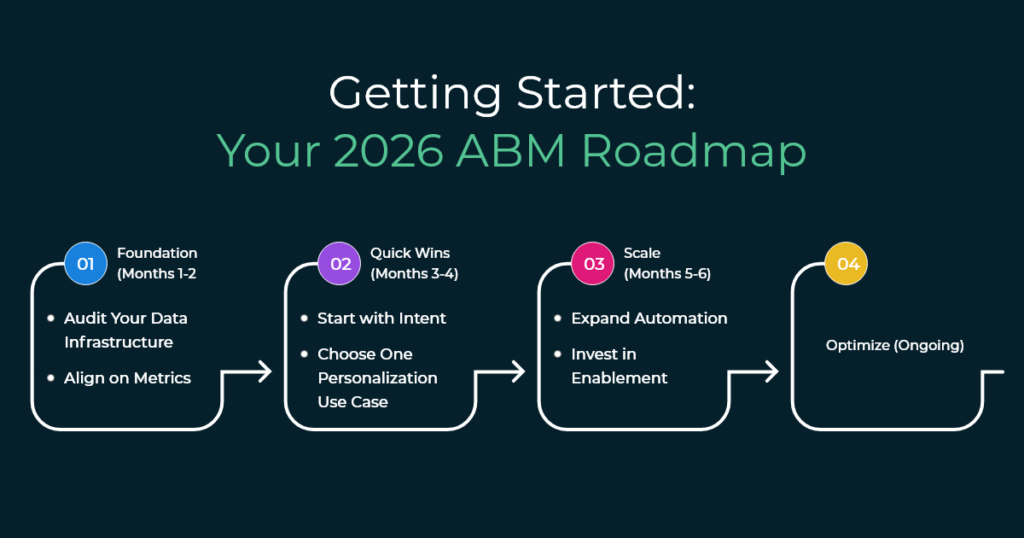
Getting Started: Your 2026 ABM Roadmap
For organizations looking to embrace these ABM trends, here’s your practical action plan:
Phase 1: Foundation (Months 1-2)
Audit Your Data Infrastructure
- Identify gaps in data quality and integration
- Document current tech stack and data flows
- Invest in unifying account data across systems before layering on AI
Align on Metrics
- Bring sales, marketing, and customer success together
- Agree on shared KPIs and measurement methodology
- Establish baseline performance benchmarks
Phase 2: Quick Wins (Months 3-4)
Start with Intent
- Implement intent data monitoring to identify in-market accounts
- Create alert systems for high-priority signals
- Demonstrate ROI for further investment
Choose One Personalization Use Case
- Select a high-impact touchpoint (email sequences, ad creative, landing pages)
- Perfect AI-driven customization in this area
- Measure results and iterate
Phase 3: Scale (Months 5-6)
Expand Automation
- Build workflows that connect marketing, sales, and customer success
- Implement journey orchestration for key account segments
- Enable agentic AI for routine optimizations
Invest in Enablement
- Train teams on AI tools and best practices
- Create playbooks for human-AI collaboration
- Establish quality control processes
Phase 4: Optimize (Ongoing)
- Monitor performance against revenue-focused KPIs
- Continuously refine predictive models
- Expand successful tactics to additional segments
- Stay current with emerging AI capabilities
Overcoming Implementation Challenges
While the benefits of AI-powered ABM are compelling, successful implementation requires addressing common obstacles head-on.
Data Fragmentation and Quality Issues
Many organizations struggle with scattered data across multiple platforms. Before deploying advanced AI capabilities, invest time in data consolidation and cleaning. Poor data quality will undermine even the most sophisticated algorithms.
Change Management and Team Adoption
The shift to AI-driven ABM represents a significant change in how teams work. Focus on enablement and training to help your sales and marketing teams understand not just how to use new tools, but why these changes matter for their success.
Technology Integration Complexity
Building a composable tech stack sounds straightforward, but it can become complex quickly. Start with core integrations between your CRM, marketing automation, and intent data platforms before adding specialized tools.
Measuring True ROI
With new metrics and longer attribution windows, proving ROI requires patience and sophisticated tracking. Establish clear benchmarks early and commit to measuring results over quarters, not weeks.
The organizations seeing the greatest success aren’t necessarily those with the biggest budgets—they’re the ones that approach implementation systematically, learn from early results, and continuously optimize their approach.
Conclusion: The Competitive Imperative
The ABM trends for 2026 represent a fundamental shift in how B2B organizations identify, engage, and convert their most valuable accounts. AI is scaling ABM from a resource-intensive manual process to a predictive, automated system while maintaining—and even enhancing—the precision and personalization that makes account-based marketing effective.
What are ABM trends 2026 showing us?
The best AI tools for account-based marketing combine predictive intelligence with executional precision. That’s how AI personalizes ABM campaigns to deliver real business results.
Organizations that embrace these trends stand to gain significant competitive advantages:
- Faster identification of in-market accounts
- Deeper personalization at scale
- More efficient resource allocation
- Shorter sales cycles
- Higher conversion rates
- Improved customer lifetime value
If you’re still figuring out the basics of AI-enabled ABM, you risk falling behind competitors who can move faster, personalize deeper, and convert more efficiently.
We can help you bridge the gap!
Our ABM experts at The Smarketers specialize in helping B2B organizations build and scale account-based marketing programs with smart automations and predictive intelligence at their core.
For more information, talk to a Smarketer today!
Frequently Asked Questions
Do I need to replace my entire tech stack to adopt AI-powered ABM?
No. The most successful approach is building a composable tech stack that integrates best-of-breed solutions. Start by ensuring your CRM, marketing automation platform, and intent data provider can share data effectively. You can then layer on AI capabilities without ripping and replacing your existing systems.
What skills does my team need to manage AI-powered ABM campaigns?
Your team needs a blend of traditional marketing skills and data literacy. Key capabilities include: understanding how to interpret intent signals, setting up and monitoring automated workflows, analyzing predictive scores, and collaborating effectively with AI tools. Most importantly, invest in training to help teams understand when to rely on AI and when human judgment is essential.
How do I balance automation with personalization?
The goal isn’t to choose between automation and personalization—it’s to use automation to enable deeper personalization at scale. AI handles the analysis, content generation, and workflow orchestration that would be impossible manually, freeing your team to focus on strategic relationship-building and high-stakes interactions where human judgment is essential.
How do I ensure AI-generated content maintains our brand voice?
Implement a robust quality control process where AI generates drafts and variations, but humans always review for accuracy, brand consistency, and strategic alignment. Many successful organizations require human verification for all customer-facing AI-generated content and create detailed brand guidelines that inform AI content generation.
What’s the minimum account base size needed for AI-powered ABM?
While traditional ABM often required at least 100+ target accounts to justify the investment, AI-powered ABM can be effective with smaller account lists—even 25-50 high-value accounts—because automation reduces the per-account cost. The key is ensuring those accounts represent significant enough revenue potential to warrant the technology investment.
Can small and mid-sized companies compete with enterprises in AI-powered ABM?
Absolutely. In fact, smaller organizations often have advantages: less legacy infrastructure, faster decision-making, and more organizational agility. Many AI-powered ABM tools now offer tiered pricing that makes advanced capabilities accessible to companies of all sizes. The key is starting with focused use cases rather than trying to implement everything at once.
How do I measure the ROI of AI investments in ABM?
Move beyond traditional marketing metrics to revenue-focused measurements: pipeline velocity, multi-touch attribution, account expansion rate, predictive pipeline forecasting, and cost per acquired account. Track both leading indicators (engagement, intent signals) and lagging indicators (closed revenue, customer lifetime value). AI platforms can monitor these KPIs in real-time and show the impact on business outcomes.
Is AI-powered ABM only for B2B tech companies?
While B2B tech companies were early adopters, AI-powered ABM is now being successfully implemented across industries, including manufacturing, financial services, healthcare, professional services, and more. Any B2B organization with complex sales cycles, multiple stakeholders, and high-value accounts can benefit from these strategies.

Enoch Pakanati
CEO