Need help with B2B Marketing?
Let the smarketers’ team drive your pipeline with data-led campaigns and AI-powered growth strategies.
In 2022, digital PR for B2B was a nice-to-have. You earned a few media mentions, shared them on LinkedIn, and the SEO team tracked backlinks. The value was real but modest.
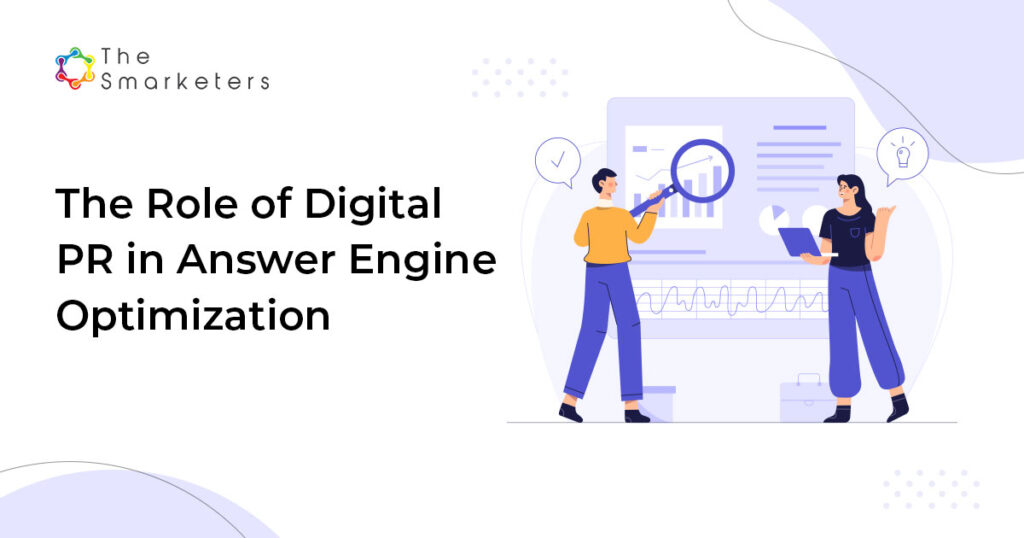
In 2026, digital PR is the highest-leverage AEO tactic we know of. Not because journalists became more influential, but because AI engines use third-party citations as the primary signal generative engine optimization for which brands to cite themselves. A mention in Reuters or Bloomberg does not just produce one-time traffic; it compounds across hundreds of AI engine responses over the following 18 months.
The brands winning at AEO right now are the brands that figured out this feedback loop early. Here is how it works and how to run it.
Brands with 10+ high-authority media citations in the past 12 months (Reuters, Bloomberg, WSJ, HBR, Gartner, Forrester, top-tier trade press) have 4.6x the AI citation volume of brands with fewer than 3 (The Smarketers GEO Audit Q1 2026). The correlation is among the strongest predictors of AEO performance in B2B.
Why AI engines reward third-party authority
When ChatGPT or Perplexity generates a response, it uses retrieval-augmented generation: retrieve candidate sources, score them, generate a synthesised answer citing the top sources. The scoring mechanism weighs heavily toward sources that other authoritative sources reference.
If Bloomberg cites you as an expert on supply chain AI, ChatGPT treats you as a more credible source than your competitor who has no such citations. The media mention acts as a transitive authority signal. The logic is the same as Google’s PageRank but applied to entity authority instead of page authority.
The implication: earning a single mention in a Tier 1 publication is worth more for AEO than 50 self-published blog posts. Not always for SEO (where volume still matters) but for AEO specifically.
The 4 tiers of digital PR value
Tier 1: Tier-1 publications and analyst reports
Reuters, Bloomberg, WSJ, Financial Times, HBR, Economist. Plus Gartner, Forrester, IDC, McKinsey reports that cite your brand. Each mention drives 2 to 5x AI citation lift on category queries. These are the most valuable and hardest to earn.
Tier 2: Major trade press and major tech publications
TechCrunch, The Verge, Wired, Forbes, CIO, InformationWeek, Ars Technica for tech. Modern Healthcare, Pharma Technology Focus, BioPharma Dive for life sciences. AdAge, Marketing Week, Campaign for marketing. Each mention drives 1.5 to 3x AI citation lift.
Tier 3: Mid-tier industry publications and podcasts
Search Engine Journal, Moz, Backlinko for SEO. B2B Marketing, Chief Marketer, Marketing Profs for B2B marketing. Top podcasts with 20K+ downloads per episode. Each mention drives 1.2 to 1.8x lift.
Tier 4: Niche blogs, newsletters, and small podcasts
Industry-specific blogs, long-tail Substack newsletters, smaller podcasts. Individual mentions produce small lift but cumulative volume matters. 20 Tier-4 mentions can equal 2 to 3 Tier-2 mentions in total AEO value.
FOCUS ON TIER 1 AND TIER 2 WHERE POSSIBLE; THEY PRODUCE 70% OF THE AEO LIFT FOR 30% OF THE EFFORT. DO NOT IGNORE TIER 3 AND 4 ENTIRELY; THEY BUILD THE PR FLYWHEEL THAT EVENTUALLY EARNS TIER 1 COVERAGE.
The 5 tactics that work in 2026
1. Proprietary research
The highest-leverage single investment. Run a survey of 200+ decision-makers in your category. Publish a 20 to 40 page report with clean charts, executive summary, and honest methodology. Pitch to Tier 1 and Tier 2 publications as data-driven news.
A well-executed research report typically generates 10 to 30 Tier 1/2 mentions over 3 to 6 months post-publication. The citations then drive AI engine visibility for 12 to 24 months. ROI is typically 4 to 8x on a $30K to $150K investment.
2. Expert commentary on breaking news
Build a list of 5 to 8 tier-1 reporters covering your category. Respond to their pieces with thoughtful commentary within 24 hours. Offer perspectives, data, or contrarian angles they have not heard.
Journalist relationships compound. The reporter who quotes you once is likely to quote you again. Over 12 to 18 months of consistent engagement, you become a go-to source. Tier 1 citations follow.
3. HARO / Qwoted / Connectively
Query platforms where reporters post questions seeking sources. Monitor daily. Respond fast (within 3 to 4 hours). Offer 3 sentences of genuinely useful insight plus 1 specific example or data point.
Win rate 2 to 8%. Volume compensates. Team that responds to 10 relevant queries per week typically earns 3 to 5 mentions per month, mostly Tier 2 and 3.
4. Executive thought leadership
Executives who regularly publish on LinkedIn thought leadership for B2B , guest-post on Tier 2 publications, and speak at industry events get picked up by reporters. The visibility becomes self-reinforcing.
This is slow (12 to 18 months to build) but produces enduring authority. CEOs and CMOs with established thought leadership are cited in AI engines as entities, not just as representatives of their company.
5. Analyst engagement
Brief Gartner, Forrester, IDC, ITSMA analysts quarterly. Get mentioned in their reports. Reports appear in AI training data and are cited heavily by enterprise buyers using AI engines for research.
Analyst engagement is a long game. Most firms under-invest. The ones that consistently brief analysts see outsized AEO benefit over 24 months.
What to stop doing
Stop sending press releases and wondering why they did not get picked up. Press releases rarely earn Tier 1 coverage. Pitch reporters directly with relevant, timely, well-framed angles.
Stop chasing any link for SEO purposes regardless of source quality. Low-authority backlinks may help marginally for SEO but hurt for AEO because they do not signal authority.
Stop treating PR as separate from SEO and content. The 3 functions must coordinate. PR earns authority, content converts it, SEO makes it discoverable. Siloed teams produce siloed results.
The 12-month digital PR + AEO programme
Month 1 to 2: setup. Hire or retain a digital PR lead AI SEO agencies. Build journalist target list (30 to 50 reporters, 5 to 8 Tier 1). Plan first research report.
Month 3 to 6: first wave. Publish research report. Launch journalist outreach. Set up HARO monitoring. Brief 3 to 5 analysts. Expect 5 to 10 Tier 2/3 mentions.
Month 7 to 9: compounding. Research report PR continues. Executive thought leadership builds. Journalist relationships deepen. Expect first Tier 1 mention.
Month 10 to 12: measurement and expansion. AI citation lift becomes visible. Share of Model improves B2B SEO strategy. Plan next research cycle. Expand analyst relationships.
The executive case
Digital PR budgets are often hard to justify on SEO grounds alone because attribution is diffuse. Reframe the case for AEO: ‘Every Tier 1 mention drives 2 to 5x AI citation lift for 12 to 24 months. Our AI citation volume is the leading indicator of branded search and pipeline. This programme is the most efficient path to AEO leadership.’
Boards and CFOs increasingly accept this framing because AI-era visibility is visibly harder to buy than traditional ads. Digital PR is one of the few ways to earn it.
Frequently Asked Questions
Why does digital PR matter for AEO?
AI engines (ChatGPT, Perplexity, Gemini, AI Overviews) use authority signals to decide which sources to cite. Being cited in Reuters, Bloomberg, WSJ, Forbes, TechCrunch, HBR, or Gartner reports dramatically increases AI citation likelihood. A single mention in a high-authority publication typically produces 2 to 5x lift in AI citation rate over 3 to 6 months.
Is Digital PR the same as link building?
Overlapping but distinct. Link building is focused on acquiring backlinks for SEO. Digital PR is focused on earning authoritative mentions that may or may not include links. For AEO, the mention matters more than the link because AI engines weight entity co-occurrence heavily.
What's the best digital PR tactic for B2B?
Proprietary research. A B2B company that publishes credible, well-methodology’d research becomes a citation magnet. Reporters, analysts, and AI engines quote the data. The investment is substantial ($30K to $150K per report) but the citation payoff compounds for 12 to 24 months.
Does HARO still work?
Yes, though less effectively than in 2018. HARO (now Qwoted, Connectively) is saturated. Response quality has dropped. Win rate on pitches is 2 to 8%. Still worth running for brands building PR flywheel, but not enough on its own. Pair with proprietary research and targeted journalist outreach.
How fast does digital PR produce AEO lift?
3 to 6 months from first high-authority mention to measurable AI citation lift. Faster for Perplexity and Gemini (which update their citation patterns weekly). Slower for ChatGPT which updates less frequently. Plan for 9 to 12 months of sustained PR to see steady-state AEO impact.
Book a digital PR audit

Enoch Pakanati
CEO