Table of Contents
- Why Does Analytics Fail to Attribute AI Search Traffic?
- What Is the Discovery Question at the Core of Prompt-Log Instrumentation?
- How Do You Build a Prompt-Log Instrumentation System from Call Recordings and Conversation Intelligence?
- How do you tag AI-influenced opportunities in the CRM?
- Which GEO Pipeline Metric Can Finance Actually Audit?
- How do you correlate prompt themes with content gaps?
- How do prompts feed back into content planning?
- What does a 90-day rollout look like?
- Limitations of Prompt-Log Instrumentation
- Frequently Asked Questions
Need help with B2B Marketing?
Let the smarketers’ team drive your pipeline with data-led campaigns and AI-powered growth strategies.
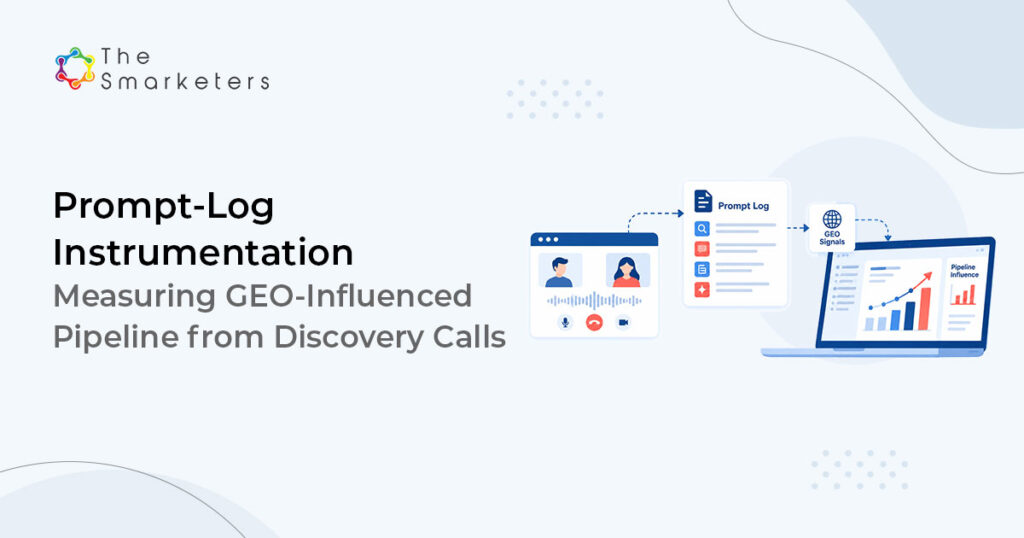
Every GEO programme hits the same wall: finance asks what it returned and the analytics platform has nothing to say. Prompt-log instrumentation fixes that. Because AI answers rarely pass a referrer, the most reliable measurement is conversational. Add a sourcing question to discovery, log the exact prompts prospects used, and tag those opportunities as AI-influenced in the CRM. The number is coarse, defensible and auditable, which is more than session data manages.
It also produces an asset nobody expects: the questions buyers actually ask machines, in their words.
What is prompt-log instrumentation? Prompt-log instrumentation is the practice of capturing the exact queries B2B buyers typed into AI assistants before a sales discovery call, logging them in a structured sheet, and tagging the associated CRM opportunities as AI-influenced. It produces an evidenced pipeline metric that does not depend on referrer data or attribution modelling.
Why Does Analytics Fail to Attribute AI Search Traffic?
Because the referrer is usually absent or wrong by the time a visit lands – a pattern covered in detail in our guide to measuring AI search visibility. Some assistants strip it, some pass a generic value, and many interactions produce no visit at all: the buyer reads the answer and typed your name into a browser two days later.
STAT
AI Overviews drove 7.53% of organic sessions between September 2025 and June 2026, and 22.4% of that traffic was misattributed to Direct rather than Organic. Source: Search Engine Land analysis of 51,200 tracked events, August 2026.
Then there is traffic that never arrives – the dark funnel problem. With 68.01% of searches tracked in the SparkToro and Similarweb clickstream study ending without a click in early 2026, up from 60.45% in 2024 in that same June 2026 study, much answer engine influence leaves no session to attribute.
The trap is treating B2B AI attribution as a tooling problem. More tags cannot recover a signal never transmitted. The signal sits elsewhere: in what the buyer says when asked.
What Is the Discovery Question at the Core of Prompt-Log Instrumentation?
This one, close to verbatim: “Before we spoke, where did you look into this, and what did you type or ask?”
The second half matters. “How did you hear about us” yields a channel label. “What did you ask” yields a prompt in the buyer’s own language, a research asset as well as an attribution signal.
| Question wording | What you get back | Attribution Use |
|---|---|---|
| How did you hear about us? | A channel guess | Weakly, for attribution |
| Did you use AI in your research? | Yes or no | A binary flag |
| What did you type or ask? | The literal prompt | Attribution and planning |
| What did it tell you about us? | Perceived positioning | Narrative correction |
Ask the third and fourth. Reps stop resisting once the answers start changing how they open the next call.
How Do You Build a Prompt-Log Instrumentation System from Call Recordings and Conversation Intelligence?
Three inputs, one sheet, one owner. No platform needed.
The inputs: rep-entered answers to the discovery question, conversation intelligence transcripts searched against a fixed keyword list, and an optional free-text line on inbound forms. The keyword list carries the assistant names your buyers use plus phrases like “I asked” and “it suggested”.
The sheet holds one row per mention: date, account, opportunity, verbatim prompt, engine name, what the buyer said the answer contained, and whether it named you. That last field is the one people forget and the one that makes the log corrective.
Give it one owner and review it fortnightly. A log without an owner degrades inside a month, this method’s commonest failure, and why it belongs in RevOps rather than a content team.
VISUAL 1 · CAPTURE THIS
Screenshot of a conversation intelligence search results view filtered on phrases such as “I asked ChatGPT” across a quarter of calls, transcript snippet visible. Annotate the verbatim prompt and the timestamp where the buyer describes the answer.
How do you tag AI-influenced opportunities in the CRM?
Two fields, not a taxonomy. The instinct is an elaborate model, and elaborate models go unfilled.
A checkbox for AI-influenced, set when a prompt is logged against the account. A picklist for the engine named. That is the schema. Everything else lives in the log, joined on opportunity ID.
| Field | Type | Set By | Rule |
|---|---|---|---|
| AI-influenced | Checkbox | Rep or RevOps | Set when a prompt is logged |
| Engine named | Picklist | Rep | Only what the buyer said |
| Prompt text | Linked log | RevOps | Verbatim, never paraphrased |
| First AI mention | Date | Automatic | First logged prompt |
Verbatim matters. Paraphrase loses the wording that makes a prompt useful, and reps paraphrase toward what they wish the buyer had asked.
Which GEO Pipeline Metric Can Finance Actually Audit?
Not a modelled attribution figure. An evidenced count – and the most defensible way to report AI search ROI to a finance audience.
Report three lines: count of opportunities with a logged prompt, total value of those opportunities, and win rate of that segment against the rest of the pipeline. Each traces to a call and a sentence a named person said, which is what survives scrutiny.
Do not report influenced revenue as incremental. It is not; the buyer used several sources. Buyers use an average of seven information sources according to Gartner research published in May 2026, and claiming full credit for one loses the finance conversation.
We ran this for a SaaS client whose board had stopped believing organic reporting. We added one discovery question, two CRM fields and a fortnightly log review. Within two quarters they could name 40 opportunities with a recorded prompt, quote the buyers’ wording, and show the segment closed higher. The attribution argument stopped, because the evidence was a transcript rather than a model.
PROOF POINT
KeyReply generated 100+ MQLs in six months with cost per lead falling from $75 to $51.86 and click-through rising from 2% to 4.43%. The reporting that held that programme together was evident in the pipeline, not modelled attribution.
How do you correlate prompt themes with content gaps?
Group logged prompts into themes, then check two things: whether an answer engine names you for that theme, and whether you have a page answering it.
| Theme state | Names you | Have a page | Action |
|---|---|---|---|
| Covered | Yes | Yes | Maintain and date |
| Invisible asset | No | Yes | Third-party and structure work |
| Open gap | No | No | Write it, then promote it |
| Borrowed credit | Yes | No | Publish before it goes stale |
The last row is the interesting one. If a model names you for a question you never addressed, a third party is carrying you, and that source can change without warning.
KEY TAKEAWAY
A prompt log is a measurement instrument and a content brief at once. The questions buyers admit to asking machines are the ones worth answering, and they rarely match a keyword tool’s output.
How do prompts feed back into content planning?
Directly, with little interpretation. Take the verbatim prompt as the H2 of the section answering it. Do not translate it into a keyword; the buyer’s phrasing is the retrieval target.
Prioritise on theme frequency and closeness to a decision. A prompt logged three times against late-stage opportunities beats one logged twenty times by researchers who never opened a deal.
Review the log against the content plan quarterly, alongside the rest of the answer engine programme, and retire themes that stop showing up.
What does a 90-day rollout look like?
- Weeks 1 to 2. Agree the two CRM fields and the log schema. Sales leadership owns the discovery question, not marketing.
- Weeks 3 to 4. Add it to the script and brief reps with three example answers, so they hear what good sounds like.
- Weeks 5 to 8. Run the keyword search across two quarters of transcripts and backfill the log.
- Weeks 9 to 10. First thematic grouping and gap analysis.
- Weeks 11 to 12. First report: opportunity count, value and win rate, with three verbatim prompts quoted.
The backfill makes that first report credible. Starting from zero leaves nothing to show for a quarter, and programmes rarely survive that silence. Pair the output with your pipeline velocity measures so the new number sits in a familiar frame.
Limitations of Prompt-Log Instrumentation
Prompt-log instrumentation measures only what buyers admit and remember. People forget which tool they used, compress sessions into one recollection, and sometimes say what the rep wants to hear. Treat the count as a floor, never a total.
It carries a coverage bias too. You log prompts only from prospects who reached a conversation, excluding everyone the answer engine steered elsewhere. That exclusion is the population you most want to measure. Pair this with prompt-set coverage tracking, which reads the answer surface directly.
It also needs sales cooperation marketing cannot mandate. Treated as a favour to marketing, the question gets skipped on the calls that matter most. 8 of the top 12 criteria used to judge B2B marketing rely on engagement proof, Forrester reported in 2026. That is the argument for a sales leader: this is the evidence, and their reps collect it.
VISUAL 2 · CAPTURE THIS
Screenshot of a CRM opportunity record with the AI-influenced checkbox, engine picklist and first AI mention date populated, beside a report grouping opportunities by that checkbox. Annotate the win rate gap between segments.
Frequently Asked Questions
How do I measure GEO ROI without attribution data?
Measure GEO ROI without attribution data using prompt-log instrumentation: add a question to your discovery script asking what the prospect typed or asked before the call, log the verbatim prompt, and tag the opportunity in your CRM as AI-influenced. Report three numbers – count of opportunities with a logged prompt, their total pipeline value, and their win rate against the rest of the pipeline. Every figure traces to a recorded call, making it auditable by finance.
Why does AI search traffic not show up correctly in analytics?
Referrers are often stripped, generic or absent, and much of the influence produces no visit at all. Search Engine Land found in August 2026 that 22.4% of AI Overview traffic was misattributed to Direct rather than Organic, and 68.01% of searches tracked by SparkToro and Similarweb ended without a click in early 2026, per their study published that June.
What exactly should reps ask on discovery?
Two questions, fifteen seconds. What did you type or ask before we spoke, and what did it tell you about us? The first captures a verbatim prompt usable for attribution and content planning. The second surfaces how models describe you, often the more valuable answer.
How should AI-influenced opportunities be tagged in a CRM?
Keep it to two fields: a checkbox for AI-influenced and a picklist for the engine the buyer named. Store the verbatim prompt in a linked log joined on opportunity ID. Elaborate taxonomies go unfilled, and a half-populated field is worse than none.
Can I claim AI-influenced pipeline as incremental revenue?
No, and claiming it costs you credibility. Buyers use an average of seven information sources according to Gartner research published in May 2026, so an AI answer is one input among many. Report the segment as evidenced presence, compare its win rate to the rest of the pipeline, and let finance draw the conclusion.
What do I do with the prompts once I have logged them?
Group them into themes and check two things per theme: whether engines currently name you, and whether you have a page answering it. That gives four states and four actions. Use the verbatim prompt as the heading of the page answering it, since the buyer’s phrasing is the retrieval target, not your keyword.

Enoch Pakanati
CEO