Table of Contents
- Key takeaways
- Who this guide is for
- The real 2027 ABM problem: buyers learn before vendors can see them
- ABM is an evidence system, not an intent oracle
- What has changed in buyer research and what has not
- The buying group is the unit of work
- The dark funnel is partly observable, not invisible
- The hard boundary: intent data cannot read private LLM prompts
- Use intent to decide where to look, not what to claim
- Win the research layer with public proof, not GEO tricks
- Build content for the people who must defend the decision
- Make human interaction earn its place
- The human moments that still matter
- Experiential ABM and direct mail: design for a decision, not attendance
- Where agents fit: bounded teammates, not autonomous account owners
- Build the 2027 ABM stack around decisions, not tool categories
- Measure what changed, not just what was touched
- The 90-day foundation: build the evidence system before scaling the motion
- Three practical pilot hypotheses
- The 2027 decision: be more useful, not more invasive
Need help with B2B Marketing?
Let the smarketers’ team drive your pipeline with data-led campaigns and AI-powered growth strategies.
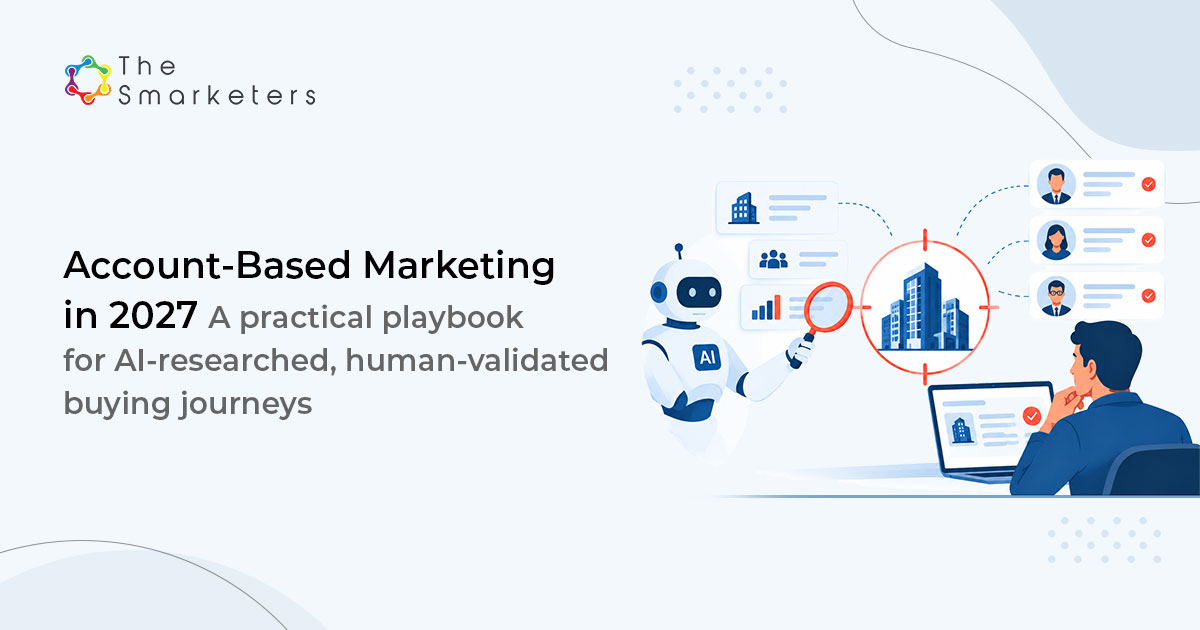
Most Account-Based Marketing (ABM) in 2027 programs will not fail because the team lacks channels, data vendors, or AI tools. They will fail because they mistake partial signals for certainty.
Your target account may be reading analyst reports, asking an enterprise AI assistant to compare implementation paths, checking reviews, talking to customers in a private community, and building an internal business case. Some of that activity will leave a useful trace. A lot of it will not. And none of it gives a marketer permission to act as if they can see inside a buyer’s private research process.
That matters because the old ABM playbook was built around a simpler idea: identify an account, see a signal, run ads, send sequences, and pass the engaged lead to sales. It can still generate activity. But activity is not the same as confidence, consensus, or a deal that can survive security, procurement, finance, implementation, and executive review.
The 2027 opportunity is not to automate more touches. It is to make the right accounts easier to research, easier to trust, and easier to move through a complex decision. That takes useful self-service content, careful signal interpretation, an account plan shared by marketing and sales, and human interaction that does a job a generic digital touch cannot do.
Key takeaways
- AI-assisted research is expanding the part of the buying journey vendors cannot directly observe. Treat that as a planning constraint, not a reason to become more invasive.
- Standard intent platforms do not reveal a company’s private prompts in ChatGPT, Gemini, Copilot, Claude, or another enterprise LLM. They provide selected, usually account-level, provider-observable signals.
- Being visible in AI-mediated discovery matters. But visibility is not a citation trick. It comes from clear, accurate, current content that gives buyers material they can verify and use internally.
- The buying group not an individual lead is the unit of work. A credible ABM program maps roles, unresolved risks, evidence gaps, and next actions at account level.
- In-person interaction will not replace digital ABM. It will earn more attention where a group needs technical validation, peer proof, risk resolution, or executive alignment.
- Agents should prepare, retrieve, triage, and recommend. People should remain accountable for relationship judgment, material claims, external outreach, commercial commitments, and other consequential actions.
- Do not call influenced pipeline “revenue created.” Separate execution, exposure, account progression, modelled attribution, and incremental impact.
Who this guide is for
This guide is for chief marketing officers (CMOs), chief revenue officers (CROs), demand leaders, ABM leaders, revenue-operations (RevOps) teams, field marketers, and sales leaders working on complex B2B accounts. It assumes you have a finite target-account portfolio and a sale that involves more than one person, more than one question, and more than one channel.
It does not assume you need a large ABM platform. The core discipline is available to a team with a well-run customer relationship management (CRM) system, clean account data, a shared account review, useful content, and enough capacity to follow through. Technology can increase coverage. It cannot replace clarity about the account, the buyer’s problem, or the next useful action.
A note on evidence: this is a 2027 forecast and operating guide, not a set of invented future statistics. The behavioural evidence below comes from research and platform documentation available through September 2026. Where a survey is vendor or analyst sponsored, it is named as such. Where the evidence is incomplete, the recommendation is conditional.

Elevate your 2027 ABM Strategy and Execution with our Comprehensive Ebook.
The real 2027 ABM problem: buyers learn before vendors can see them
The uncomfortable truth is simple. A buyer can now learn a great deal about your category without visiting a form, replying to an email, or booking a call. They can ask an AI assistant for a shortlist, use search to compare implementation methods, read a review site, speak with peers, or pull together internal notes from systems you will never see.
That does not mean the website is dead, sales is dead, or ABM is blind. It means the clean, person-level journey that many dashboards imply was never the whole story. In McKinsey’s 2024 B2B Pulse Survey of nearly 4,000 decision-makers, respondents used an average of ten interaction channels, with preferences distributed broadly across in-person, remote, and digital self-service interactions. A buying journey has always involved more than the moments marketing can tag.
Generative AI gives buyers another research layer. Gartner reported in 2026 that 45% of 645 surveyed B2B buyers had used generative AI in a recent purchase. The same survey also found that buyers used an average of seven information sources. That is a directional signal, not a universal law about every market or purchase. But it makes one point hard to ignore: product pages and seller conversations are no longer the only places where your company is being evaluated.
The wrong response is to obsess over a new black box. The right response is to improve the evidence around the account. What can the buyer find? Is it accurate? Does it answer the questions different roles will ask? Is the proof current enough to survive scrutiny? And when you do get a chance to interact, can your team add context rather than repeat information the account already has?
More activity does not equal more certainty
Modern ABM teams can see a crowded screen of events: ad impressions, web visits, intent scores, review-site activity, email engagement, job changes, funding news, event registrations, product use, and CRM notes. The problem is not a lack of inputs. It is a lack of discipline in what those inputs mean.
A pricing-page visit is an observation. A surge score is a provider’s modelled interpretation of observed activity. A scheduled technical workshop is a stronger signal that a buying job exists. A signed order form is a commercial fact. These are not interchangeable.
This distinction matters most when the account is valuable. If a team treats every score as proof of buying intent, sales gets a queue full of speculative alerts. If it treats every inbound action as a person-level declaration of interest, the buyer receives outreach that feels oddly specific and not especially helpful. Both outcomes weaken trust.
The 2027 program needs a more useful question than “Who is hot?”
Ask: What do we know about this account, how do we know it, what does it leave uncertain, and what can we offer that helps the buying group make progress?
Forecast: the scarce resource will be credible decision support
ABM is an evidence system, not an intent oracle
Account-based marketing is often described as treating selected accounts as markets of one. That is useful shorthand. But it misses the operational discipline that separates ABM from a list of personalised ads.
A 2026 qualitative study of leaders from 22 B2B companies identifies three core activities: identifying high-value account opportunities, building deep account intelligence, and creating highly personalised engagement across prospecting, negotiation, and relationship-expansion stages. It does not prove a universal ABM return or prescribe a standard tier structure. It does support a more practical definition for 2027:
The key word is evidence. It separates an observed event from a modelled score and a buyer-confirmed need from a commercial fact.
| Evidence state | What it includes | What it does not prove | Default response |
|---|---|---|---|
| Observed | Meeting request, form response, trial action, content use, CRM event | Motive, authority, or agreed stage | Respond to the stated need; check context |
| Modelled | Intent score, anonymous account match, predictive label | Named person, budget, or immediate readiness | Research and corroborate |
| Contextual | Hiring, regulation, earnings, leadership, or technology news | A live project or vendor preference | Update the account hypothesis |
| Buyer-confirmed | Stated project, requirement, risk, or agreed next action | Full internal consensus or commercial approval | Bring the right proof and people |
| Commercial fact | Validated opportunity, mutual action plan, signed terms | Credit for every prior touch | Coordinate delivery and measure progression |
The label determines the action. A seller should receive a brief that names the evidence, uncertainty, and helpful offer not an unexplained “account score: 92.” Marketing owns the evidence environment. Sales owns commercial next steps. RevOps owns definitions and integrity. Subject-matter experts own accuracy. That shared operating rhythm is the programme.
What has changed in buyer research and what has not
Buyers have always done independent research. They have always trusted peers more than polished campaign copy. They have always brought internal stakeholders into decisions that carry financial, operational, or reputational risk. AI has not invented those behaviours. It has changed the speed and shape of early research.
A buyer can now ask a question that previously required several browser tabs: “Which platforms support this integration?”, “How should we build the business case?”, “What are the common implementation risks?”, or “Which vendors are credible in our region?” The answer may be incomplete or wrong. But it gives the buyer a starting point, vocabulary, and list of things to validate.
Reported use of AI varies sharply by study design. TrustRadius’s January 2025 technology-buyer survey found that 72% of respondents had encountered Google AI Overviews, while 7% said they had used LLMs such as ChatGPT in the buying process.. In contrast, Forrester reported broad generative-AI use in at least one part of the purchasing process among respondents to its 2024 Buyers’ Journey Survey. These figures should not be blended into a single market-adoption number. They ask different questions of different samples.
The practical conclusion is still clear: AI-assisted research is an important research layer. It is not the only layer, and it should not be treated as a universal replacement for websites, reviews, peers, experts, trials, or sellers.
The buyer is moving from information retrieval to information validation
The more basic product information a buyer can retrieve without a seller, the more a live interaction must earn its place. Gartner’s 2026 release captures this duality. It reported that 67% of surveyed buyers preferred a sales-rep-free experience and 70% preferred a fully digital, self-service experience. Yet 69% said they preferred to validate AI-generated insights with sales representatives.
Those findings are not contradictory. They describe different jobs. Buyers may not want a seller to gate basic information or send irrelevant check-ins. But when they need to understand fit in their operating environment, test an AI-generated claim, assess risk, or align internal stakeholders, a knowledgeable person can still be valuable.
That is the line 2027 ABM needs to respect. Do not make people book a call to learn what should be on the website. And do not assume more content can replace a conversation about a complex integration, a regulatory requirement, an operating model, or a commercial trade-off.
Build for a mixed journey, not a single preferred channel
McKinsey’s findings support a mixed model. Across its 2024 survey, respondents showed a roughly one-third split among in-person, remote, and digital self-service preferences. It also found that 41% preferred in-person channels when working with a new supplier and 40% did so for a first-time purchase.1 That is preference data, not proof that a meeting causes a win. But it is a good reason not to treat in-person capability as a legacy cost centre.
The sensible channel design is not “digital first” or “field first.” It is buyer-job first. Use self-service for education and early evaluation. Use remote experts for speed and targeted answers. Use high-touch interaction when the account needs trust, context, peer proof, or alignment that a webpage cannot provide.
The implication for messaging
Generic personalisation is less persuasive when a buyer has already seen ten generic summaries of the same problem. “We help companies like yours improve X” is not enough. It does not tell the buyer why your team understands their situation, what evidence you have, or what useful decision support you can offer.
A stronger message is specific without pretending to know private information. It can refer to a public change, a shared industry challenge, or a known account context. It should point to a useful resource, question, or working session. And it should leave room for the buyer to say, “Not relevant,” without pressure.
For example: “Your team’s move into multi-region service delivery raises a familiar implementation question: how do you maintain policy control without slowing local teams? We put together a short architecture note on that trade-off. If the question is live, our solutions architect can walk through the constraints. If not, keep the note.”
That is not surveillance. It is a hypothesis tied to public context and an offer with a clear use.
The buying group is the unit of work
A lead is a record. A buying group is the system that must agree to change.
Forrester’s public 2024 buying research reported that the average decision involved 13 people and that 89% of purchases involved two or more departments. The exact number will vary by category, contract value, risk, geography, and organisational model. Do not force a 13-contact target into every account plan. The point is that one enthusiastic contact rarely gives you a complete picture of a complex decision.
Security is a useful example. In G2’s 2024 global survey of B2B decision makers, 41% said security stakeholders were involved early in discovery and research. That does not mean security will be early in every deal. It does mean a marketing programme that only speaks to a business champion may be creating momentum it cannot sustain.
Map roles, not just job titles
Start with roles that exist in the decision, then identify people as evidence permits. The list below is a planning tool, not a fixed committee template.
| Buying role | Core question | Evidence the role needs | Typical ABM contribution |
|---|---|---|---|
| Economic owner | Is this worth the investment and risk? | Business case, value logic, commercial scope, implementation confidence | Executive brief, ROI methodology, relevant customer outcome |
| Business sponsor | Will this solve the operating problem? | Use case, change impact, adoption plan, proof from peers | Role-specific story, assessment, practitioner discussion |
| Technical evaluator | Will it work in our environment? | Architecture, integrations, data model, performance, support | Technical documentation, workshop, solution architect access |
| Security, privacy, or risk | Can we approve and govern it? | Controls, data handling, certifications, boundaries, evidence | Security hub, reviewed answers, risk session |
| Implementation owner | Can we deploy it without breaking the plan? | Scope, resourcing, timeline, dependencies, ownership | Delivery plan, implementation case study, design session |
| Procurement and legal | Can we buy this on acceptable terms? | Pricing logic, contracting path, supplier evidence, compliance | Commercial FAQ, procurement path, early coordination |
| Champion | Can I persuade the rest of the group? | Internal narrative, credible proof, help answering objections | Shareable deck, customer story, mutual action plan |
| Blocker or status-quo owner | What do we lose or risk by changing? | Honest trade-offs, migration plan, protection for their concerns | Change-management proof, technical and operational dialogue |
The critical distinction is between confirmed, hypothesised, and unknown. A job title in Sales Navigator is not confirmation that a person is part of the decision. An account plan that marks unknown roles honestly is more useful than one that pretends complete coverage.
Buying-group coverage is not contact volume
Collecting eight contacts does not mean you have eight decision-critical relationships. The goal is to cover the roles that matter to the account’s specific buying job and to understand the open questions that could block progress.
Use a simple account map. For each role, record the person if known, the current status, the source of your knowledge, the question they are likely to ask, the proof they need, and the next action. This turns “multi-threading” from a sequence volume target into a practical system for reducing risk.
A company evaluating a data platform may need a data architect, a security lead, a finance owner, an operations sponsor, and a procurement contact. A company evaluating a professional service may need an executive sponsor, a delivery lead, a functional owner, and an internal change leader. The roles differ. The discipline does not.
The hidden value of role-specific content
A strong buying group needs material it can pass internally. That is why content matters even when the individual contact never fills out a form. A security checklist may travel to the risk team. A cost model may travel to finance. An implementation guide may calm the person who will have to run the project. A customer lesson may help a champion explain why the decision is safe.
That content should not be a stack of unrelated lead magnets. It should work as a connected evidence set. We will return to that in Section 9. First, there is an important limit to address: what you can and cannot observe when this research happens through AI tools.
The dark funnel is partly observable, not invisible
The dark funnel is not a blank screen, and it is not fully measurable. You can see selected first-party behaviour, declared requests, CRM context, licensed account signals, relevant public changes, and voluntary buyer-stated sources. You cannot see every peer discussion, private community, procurement meeting, browser session, or private AI interaction.
Use an evidence mix and preserve its limitations.
| Source | Best use | Limit |
|---|---|---|
| First-party behaviour | Diagnose proof gaps and offer useful follow-up | Does not establish role or motive alone |
| CRM and partner context | Coordinate account teams and avoid duplication | Requires permission, freshness, and care |
| Licensed account signals | Prioritise research and nurture | Probabilistic, limited source coverage |
| Public context | Update the account hypothesis | Does not prove a funded project |
| Buyer-stated sources | Learn how awareness and evaluation developed | Memory is incomplete; capture should be voluntary |
The point is not a bigger data lake. It is a record of source, timestamp, confidence, and limitation. That lets the team help without pretending it has complete visibility.
The hard boundary: intent data cannot read private LLM prompts
Here is the claim that every 2027 ABM team needs to get right:
By a private enterprise large language model (LLM), this guide means an AI assistant used within a company-controlled environment, not a public research signal that an ABM vendor can inspect.
This is not a minor wording preference. It is a trust boundary.
A buyer may use an AI assistant to frame a problem, compare vendors, summarise reviews, pressure-test a technical assumption, or prepare an internal business case. Much of that happens in a private context. Standard enterprise protections make broad, ambient visibility into that activity an unsafe assumption. OpenAI says it does not train on inputs and outputs from its listed business products by default. Google’s Workspace guidance says qualifying interactions stay within the organisation and are not used to train underlying models without permission. Microsoft says prompts, responses, and Microsoft Graph data in its commercial Copilot offerings are not used to train foundation models.
Those policies do not mean that no buyer will ever voluntarily share AI research, or that an organisation cannot configure its own approved data environment. They mean an outside ABM vendor should not claim to know what an account is asking a private enterprise AI tool unless the buyer has explicitly provided that information through a documented, approved arrangement.
What standard intent platforms actually observe
Intent platforms can be valuable. But their data should be described accurately.
G2 Buyer Intent, for example, documents activity on its review properties and related sites. The product can report company-level activity on product profiles, pricing pages, alternatives pages, category pages, comparison pages, content, and competitor pages included in a customer’s subscription. Bombora describes Company Surge as research activity across its B2B-web data co-op, reported at business-domain level with a composite score and topic count. Demandbase describes its keyword intent as a probability-based model that aggregates relevant content consumption and scores relative activity over time.
All three are useful inputs. None is a transcript of a company’s internal AI conversation. None proves the identity of a researcher, their role, their project, their authority, or their preferred supplier.
| Do not say | Say instead | Why it is better |
|---|---|---|
| “We saw your team comparing us in ChatGPT.” | “We noticed sustained research signals around [topic] and thought this guide might be useful.” | The first claim suggests private-prompt visibility that standard intent signals do not provide. |
| “Your account is in market.” | “This account has a fresh, topic-specific signal that warrants account research.” | A score prioritises attention. It does not confirm a commercial state. |
| “Jane is evaluating us.” | “We have an account-level signal. The researcher and role are unknown.” | A domain match does not identify a person or buying-group role. |
| “AI search is driving pipeline.” | “Our pages have visibility in a named AI-search surface. We will assess it alongside traffic, conversion quality, and buyer-stated sources.” | A citation or impression is not a causal pipeline measure. |
| “We know the dark funnel.” | “We can illuminate selected parts of pre-contact research through first-party, public, and licensed account signals.” | The language remains useful without pretending complete visibility. |
Why the language matters to the buyer experience
If a prospect feels watched, the rest of the campaign does not matter. A precise but intrusive line can undo months of credible content and thoughtful relationship building. The person may not care whether your platform technically inferred the action, bought the signal, or received it from a partner. They will remember that you appeared to know something they did not give you.
That is why a good ABM team never turns a hidden signal into its outreach copy. The signal should guide internal research and play selection. The external message should stand on evidence the buyer can recognise: a public business change, a shared industry problem, a known conversation, an invitation to solve a specific question, or a useful piece of content.
There is an ethical upside too. When you stop using signals as proof, you start making offers that are easier to decline. “If this is live, here is a useful resource” is a better first move than “We know you are evaluating providers.” The first respects uncertainty. The second creates pressure based on an inference.
A practical exception rule
There is one limited exception: explicitly supplied, governed information. If a prospect tells you on a discovery call that they are using an internal AI assistant to assess vendors, you can respond to the question they have raised. If a customer deliberately shares data through an agreed first-party integration, use it only for the stated purpose, with clear access and retention controls.
That is materially different from treating an outside intent score as a private-prompt feed. Put this boundary in your sales playbook, not just your privacy policy. It should apply to outreach, event invitations, direct-mail messages, call scripts, and generated content.
Use intent to decide where to look, not what to claim
Intent data has a place in 2027 ABM. It should guide attention. It should not determine the story you tell the account.
Require four conditions before targeted outreach, executive time, direct mail, or a high-cost experience: verified ideal-customer-profile (ICP) fit; a fresh, specific signal; corroboration from another first-party, CRM, public, partner, or sales-validated source; and a credible offer that helps a real buying job. If one is missing, the correct response is research, nurture, or no action.
A signal ledger makes this usable. For each meaningful signal, record source, observed event, account match and confidence, timestamp and expiry, topic, evidence type, permitted use, hypothesis, offer, and outcome. This separates facts from inference and gives the team a way to learn.
| Tier | Condition | Default motion |
|---|---|---|
| Tier 1: strategic | Strong fit, material potential, clear thesis, several decision uncertainties | Named account plan, role map, tailored proof, and a workshop, peer reference, executive briefing, or technical session only when justified |
| Tier 2: focused | Strong fit, credible trigger, partial buying-group visibility | Industry or use-case play, tailored content, and selective specialist involvement |
| Tier 3: monitored | Fit but weak, broad, stale, or uncorroborated evidence | Permission-aware nurture, public proof, research, and monitoring—no costly named-person escalation |
Demandbase describes its intent model as probability-based, aggregated, and scored over time, with a methodology that can change. That is why every provider signal needs a timestamp and expiry rule.
Judge a signal source by seller-accepted alerts, false-positive reasons, buyer experience, qualified account progression, and commercial cohorts not by the size of its alert queue. Common false positives include wrong matches, broad topics, customer or competitor research, stale activity, poor ICP fit, wrong roles, and already-covered opportunities.
Win the research layer with public proof, not GEO tricks
If buyers use AI tools to summarise a category, compare vendors, or explain a technical issue, being visible in those answers matters. But generative-engine optimisation (GEO) is public discoverability and buyer enablement not a citation trick or a substitute for search engine optimisation (SEO).
Bing says its AI Performance data is aggregated and sampled, does not show individual answers or exact prompts, and that citations are not clicks, traffic, rankings, authority, or page importance. Google’s 2026 Search Console generative-AI reports are useful surface-specific diagnostics, not a record of private chat activity or causal revenue. And Google says normal indexing and snippet eligibility are the technical base for supporting links in AI features; there is no special shortcut.
The practical work is clear. Build current pages that answer the questions a buying group must resolve: category and fit, use case, implementation, security and data handling, pricing logic, ROI method, alternatives, and customer proof. Every claim should have an owner, source, date, and clear scope.
Use a recurring operating loop: map buyer questions by role; check that each has one strong evidence page; monitor Search Console and Bing data where available; review a small, documented panel of relevant AI-search questions; and compare findings with qualified engagement, sales conversations, and voluntary buyer-stated sources. A citation is a prompt to improve the research layer, not a pipeline metric.
LLMs can produce plausible but false material. A 2026 Nature paper argues that common accuracy evaluations can reward confident guessing over admitting uncertainty. The answer is not to dismiss AI research. It is to make the evidence buyers encounter concrete, current, sourced, and easy to validate.
Build content for the people who must defend the decision
The buyer who discovers your company is not always the person who has to approve the decision. That is why an ABM content calendar needs to be more than a collection of campaign assets.
Build an evidence library. Each asset should answer a specific question for a specific role, while connecting to the next decision question. The aim is to help a champion move the conversation forward without having to translate generic vendor copy into an internal case.
| Role | Decision question | Evidence asset | Human support when needed |
|---|---|---|---|
| Executive or economic owner | Why act now, what is the value, and what are the risks? | Business-case template, outcome case study, ROI method, executive brief | Executive working session to validate assumptions |
| Business sponsor | Will this improve the operating outcome we care about? | Use-case guide, maturity assessment, peer story, change-impact outline | Practitioner conversation or problem-framing workshop |
| Technical evaluator | Will it fit the architecture and delivery constraints? | Architecture overview, integration guide, implementation checklist, technical FAQ | Solution-architect session |
| Security, privacy, or risk lead | What data, controls, and residual risks are involved? | Security hub, data-flow description, compliance evidence, clear escalation path | Formal risk review with qualified experts |
| Implementation owner | Who will do the work, what can go wrong, and how will success be measured? | Rollout plan, staffing model, migration checklist, customer lessons | Delivery-design session |
| Procurement or finance | Can we justify and buy this responsibly? | Pricing logic, total-cost framework, supplier information, commercial FAQ | Commercial alignment and procurement path review |
| Champion | How do I build consensus and handle objections? | Shareable decision deck, comparison guide, internal FAQ, mutual action plan | Coaching and stakeholder-planning support |
Content should lower decision risk, not merely capture a lead
It is tempting to put every useful asset behind a form. Sometimes that is appropriate. But gating every answer forces buyers to choose between giving up personal data and remaining uncertain. In a complex sale, that can push high-value research into other channels.
Use a considered access model. Keep essential category, security, implementation, and basic pricing context available where possible. Ask for a reasonable exchange when the tool or content provides substantial personalised value, such as a custom assessment, event registration, or working session. The goal is not maximum form fills. It is enough evidence for the account to decide that a deeper interaction is worthwhile.
The content must also be consistent with what sales says. Gartner’s 2025 buyer research found that 69% of respondents saw inconsistency between a supplier’s website and sales-representative information. The source is a public research release rather than full methodology, so treat it as a warning, not a universal rate. Still, the operating lesson holds: a strong research layer loses value when the first sales conversation contradicts it.
The Smarketers approach: connect the research layer to account action
The Smarketers’ ABM work brings together the components that an AI-researched buying group needs after the first search: account intelligence, buying-committee mapping, role-specific messages, relevant content, coordinated LinkedIn and email activity, and measurable follow-through. But the 2027 version adds a deliberate AI-visibility layer before activation.
That means auditing the public evidence a target committee is likely to encounter, identifying gaps in use-case, technical, security, implementation, commercial, and proof content, then connecting those assets to a mapped account play. The programme does not pretend to see a company’s private prompts. It makes sure the company can find credible material when its people research independently.
The next question is where people belong in this new model. The answer is not “more meetings.” It is better meetings, designed to reduce a specific uncertainty.
Make human interaction earn its place
The response to AI-assisted buying should not be more human touches by default. Buyers are already clear about that. Gartner reported in 2025 that 61% of 632 surveyed B2B buyers preferred an overall rep-free buying experience and 73% actively avoided irrelevant supplier outreach. That is a useful warning against using a new intent score as an excuse to increase sequence volume.
But a rep-free preference is not a preference for being left alone when the decision gets hard. The same Gartner research said buyers preferred online self-service for general information and learning, and seller input for contextual questions about fit with their organisation. McKinsey’s survey also found higher stated preference for in-person interaction with a new supplier or a first purchase.
So the job for marketing and sales changes. A person should not be the gatekeeper of basic information. A person should be a source of interpretation, proof, judgment, and alignment.
The human moments that still matter
A human interaction earns its place when it solves an uncertainty the buyer cannot settle alone. Six buying jobs are especially relevant to strategic ABM accounts.
| Buying job | What the account needs | Best human format | Weak substitute |
|---|---|---|---|
| Technical validation | A clear answer on architecture, integrations, data boundaries, performance, and sequence | Technical design session with a qualified expert | A generic product demo |
| Risk resolution | Security, privacy, legal, continuity, adoption, and supplier-risk questions addressed | Risk review or expert office hours | A PDF sent with no context |
| Commercial alignment | A credible business case, cost logic, procurement path, and decision process | Finance or executive working session | A vague “ROI conversation” |
| Stakeholder consensus | Business, IT, finance, operations, security, and executive roles aligned on open questions | Facilitated alignment workshop | Separate uncoordinated meetings |
| Peer proof | A candid view from someone with a similar operating context | Curated customer discussion or practitioner roundtable | A generic testimonial carousel |
| Decision design | Trial scope, success criteria, owner commitments, and next actions | Mutual-action-plan session | A late-stage follow-up email |
A well-designed live experience does not need to be large. A technical workshop with three relevant people is more useful than a breakfast event with 30 unrelated attendees. An executive roundtable can work when every invitee shares a real decision question. A customer reference can be more persuasive than an ad campaign when the account needs proof from someone who has already lived with the change.
The field and digital handoff
Human interaction should be part of an account plan, not a field-marketing add-on. Start with the unresolved buying job. Then decide which people need to be in the room, what evidence they should receive beforehand, what expertise must be available, and what a useful outcome looks like.
A practical workflow looks like this:
- Define the account condition. For example, the account is a strong fit, a technical evaluator has asked about a relevant implementation constraint, and the executive sponsor is unknown.
- State the buying hypothesis. The account may be stuck because the technical and business teams are using different success criteria.
- Choose the smallest relevant interaction. A 60-minute solution-design session may be enough. An executive dinner may not be.
- Prepare the evidence. Send an architecture note, use-case context, customer lesson, and clear agenda. Do not use the meeting to introduce basic facts.
- Log factual outcomes. Record roles present, questions raised, risks resolved, evidence requested, buyer-stated next steps, and who owns them.
- Follow through. Deliver the agreed materials and update the account plan within 48 hours.
This is not high-touch theatre. It is a way to use expensive human time where it can reduce decision friction.
Face time will still win but only when it helps the buyer win internally
The case for face-to-face is strongest in high-effort, high-risk, first-time, or implementation-heavy decisions. A workshop can expose a hidden integration concern. A peer dinner can give a sceptical operations lead a credible point of comparison. A site visit can make a delivery model real. An executive session can resolve a business-case assumption that has blocked consensus for weeks.
But an in-person event will not rescue a weak account thesis. It will not make an irrelevant message relevant. And it should not be forced on a buyer who prefers remote help or self-service.
Forecast: As AI makes generic digital output cheaper, the value of a well-run human interaction is likely to increase for strategic accounts. The reason is not novelty. It is decision quality. The human moment that stands out is the one that gives a buying group something it could not get from a generic summary: a credible expert answer, a peer lesson, a clear trade-off, or a shared plan.
Experiential ABM and direct mail: design for a decision, not attendance
Experiential ABM should be judged by the decision it helps an account make, not by registrations, scans, or a room count. An executive dinner might help senior leaders compare a governance problem. A customer roundtable might give an implementation lead peer proof. A workshop might turn a broad interest into a scoped pilot. None should exist because “physical is back.”
Every high-cost experience needs a short brief.
| Brief element | What to define |
|---|---|
| Audience | Named Tier 1 accounts or a narrow Tier 2 cohort; relevant roles and why they belong |
| Decision question | The uncertainty or buying job the experience should resolve |
| Evidence basis | Fit, corroborated signal, current opportunity, or stated buyer need |
| Value exchange | Useful insight, peer perspective, expert access, or working session—not a disguised sales pitch |
| Pre-work and follow-up | Agenda, proof material, experts, buyer-appropriate next step, and action owner |
| Measurement | Role relevance, questions answered, buyer-rated usefulness, next-step acceptance, progression, and comparison method |
Direct mail can create a useful pattern break, but it is an operations and governance channel before it is a creative one. Lob’s 2025 survey found data-quality gaps among respondents who work with mail, including 48% reporting outdated or incomplete address data. Validate the business address, recipient appropriateness, gift policy, data provenance, delivery window, and objection or suppression status before any send. The ICO notes that named business contacts can be personal data and that the right to object to direct marketing is absolute under UK GDPR; other jurisdictions require their own review.
The strongest direct-mail motion is small and useful: a relevant implementation benchmark, research brief, or invitation tied to a buyer-useful next step. Do not send bulk swag because a score rose.
The Smarketers’ ABM work uses experiences as part of a coordinated account motion: tailored microsites, executive webinars, decision-maker roundtables, role-specific LinkedIn activity, and personalised follow-up. One Fortune 500 financial technology programme in the supplied portfolio combined those elements and recorded 80+ SQLs in nine months, 150+ personal connections for sales leaders, and 300+ warm leads in nurture. The public success-stories portfolio also reports 80 sales-qualified accounts and 150+ accounts engaged for a targeted Fortune 500 technology ABM strategy.
The public portfolio also gives two smaller patterns worth noting. The Globpar programme across the SAP partner ecosystem reported 70% engagement, 63% opens, and 41% acceptance. The KeyReply 1:few ABM programme reported more than 100 marketing-qualified leads (MQLs) in six months, a $51.86 cost per lead (CPL), and a 4.43% click-through rate (CTR). Those are campaign-specific outcomes, not performance guarantees. They show that different account motions need different operating measures.
The detailed Fortune 500 programme figures come from The Smarketers’ supplied internal portfolio and should be checked against the client-approved case-study version before external publication. The lesson is not that a roundtable is the strategy. It is that account selection, proof, digital coordination, relevant human interaction, and follow-through work together.
Measure the chain: eligible account, delivery or attendance, meaningful engagement, buyer-verified next action, commercial progression, and then incrementality against a comparison where feasible. Report exposed pipeline as exposure. Do not call it revenue created.
Where agents fit: bounded teammates, not autonomous account owners
2027 will bring more AI agents into marketing, sales, RevOps, and customer systems. The word agent will also be used too loosely. An agent is not simply a chatbot or a template generator. OpenAI defines agents as systems that independently accomplish tasks using an LLM to manage workflow execution and decisions while using tools to retrieve information or take actions.
That definition is useful because it points to the real issue: authority. The more tools, data, and external actions an agent has, the more carefully an organisation must define its permissions, tests, escalation conditions, and human owner.
The right ABM use of agents is deliberately modest. Let the agent do the repeatable work around the account. Keep people accountable for judgment, relationship context, and consequential actions.
Good first use cases
Start with workflows that are primarily read-only, reversible, and easy to evaluate against known standards.
| Agent use case | What the agent can do | Required controls | Human owner and final decision |
|---|---|---|---|
| Sourced account brief | Assemble public company context, existing CRM facts, approved product claims, and cited sources | Source links, timestamps, freshness rules, standard format, sampled factual review | Account executive decides relevance and next step |
| Signal triage | Group account signals, check expiry, flag missing context, and recommend research actions | No automatic outreach; signal source and uncertainty shown; false-positive logging | ABM operations approves escalation rules |
| Buying-group gap flag | Compare confirmed roles with the account’s expected decision needs | No invented contacts; role status shown as confirmed, hypothesised, or unknown | Account team decides who and how to engage |
| Approved-claim retrieval | Find current, approved evidence for an industry, technical, or ROI question | Version control, claim approval, expiry date, provenance | Subject-matter expert owns substantive accuracy |
| Content modularisation | Adapt approved material for role, industry, or format while preserving facts | Brand review, citation retention, prohibited-claim rules | Content owner approves external use |
| Event preparation | Prepare attendee research, account questions, role briefs, and a meeting agenda | Public/permissioned data only; no sensitive inference; fact review | Field and sales lead own invitation and conversation |
| Data hygiene | Flag stale fields, duplicate accounts, missing owners, and inconsistent stage definitions | Read-only or reversible updates; deterministic validation rules | RevOps approves data changes |
These applications help a small team do more useful preparation. They do not put an agent in charge of the account.
Keep agents out of consequential decisions
An agent should not autonomously decide to contact a named person, send an external email, post publicly, change consent or suppression status, advance a sales stage, issue a pricing commitment, approve a contract, modify a security response, delete data, or spend budget. These actions affect a buyer, a customer, a company record, or a commercial commitment. They need a named human with authority to accept, reject, or change the decision.
NIST’s Generative AI Profile recommends governance, content provenance, pre-deployment testing, monitoring, fact-checking, and error or near-miss tracking. OpenAI’s implementation guidance advises incremental deployment and human intervention when failure thresholds are exceeded or actions are high risk, sensitive, irreversible, or high stakes. OWASP’s guidance on excessive agency similarly points to least necessary permissions, downstream authorisation, approvals for high-impact actions, monitoring, and rate limits.
These are not abstract security principles. In ABM they protect against a plausible set of failures: an agent confuses two similar companies, uses stale CRM data, turns an unverified intent signal into an email claim, suggests a non-compliant message, exposes sensitive customer context, or makes a change that a human would have stopped.
The agent use-case register
Before connecting an agent to your CRM, marketing automation platform (MAP), data warehouse, or messaging platform, document the use case in one visible register.
| Register field | Question to answer |
|---|---|
| Business and technical owner | Who is accountable for value, safety, data access, and escalation? |
| Purpose | What exact task is the agent allowed to perform? |
| Data classes | What public, first-party, customer, personal, or sensitive data can it read or write? |
| Tools and permissions | Which systems, fields, APIs, and actions are available? Is read-only enough? |
| Audience and jurisdiction | Whose data and communications may be affected, and under which rules? |
| Approved outputs | What format, claims, and source requirements must every output meet? |
| Evaluation set | What real or de-identified cases will prove the agent works before release? |
| Failure threshold | What factual-error, policy-violation, or tool-failure rate pauses the workflow? |
| Human gate | Who approves an action and records the decision? |
| Logging and retention | What prompts, outputs, tool calls, sources, changes, and approvals are retained? |
| Pause and incident process | Who can stop the workflow, correct an error, and notify affected teams? |
Forecast: The useful agent in ABM will usually be a bounded teammate. It prepares, retrieves, triages, and recommends. It does not replace the person who must decide how to treat the account.
Build the 2027 ABM stack around decisions, not tool categories
The technology question is easy to overcomplicate. A team with unclear ICP criteria, stale account data, no shared review, and weak proof will not be saved by an enterprise ABM platform. A team with disciplined account plans, clean CRM data, role-relevant content, and active sales follow-through can run a credible pilot with a modest stack.
The stack should support six decisions: which accounts deserve attention; what evidence is current; which buying roles are covered; what proof is missing; which action is appropriate; and whether the action changed an outcome. If a tool does not improve one of those decisions, it is probably not the next purchase.
| Capability | Foundation setup | 2027 standard | Do not assume |
|---|---|---|---|
| System of record | Clean CRM account, contact, opportunity, campaign, and owner data | Shared buying-role map, signal ledger, data provenance, next action, and account review view | A CRM creates account truth without process discipline |
| First-party evidence | Meaningful web, content, meeting, and product events | Taxonomy aligned to buying jobs, identity limits visible, privacy controls, and signal expiry | Every page view means intent |
| Account intelligence | Public research, firmographic context, sales input, and account thesis | Current hierarchy, role confidence, commercial hypothesis, evidence dates, and exclusions | Enrichment data is current, accurate, or a consent basis by itself |
| Audience and distribution | Matched audiences, role-relevant paid and organic channels, basic email | Account and role coverage, message relevance, suppression, and documented follow-through | CTR is the outcome of ABM awareness |
| Signal enrichment | Selected review, publisher, partner, or intent source | Source provenance, refresh cadence, match confidence, false-positive feedback, and action rules | A score reveals private prompts or confirms a project |
| Buyer enablement | Clear website, evidence assets, case studies, and expert access | Connected category, technical, security, implementation, commercial, and proof pages | Gating every useful answer creates demand |
| Orchestration and field | Shared account plan and weekly review | Coordinated sales, marketing, field, SME, and customer-success actions | Automation alone is orchestration |
| AI visibility | Search Console, Bing reporting, and a documented query panel | Surface-specific visibility analysis, cited-page review, and buyer-stated discovery sources | A citation equals traffic, ranking, authority, or pipeline |
| Agent support | Read-only research and internal briefs | Narrow permissions, evaluations, logs, approvals, and named owners | “Agentic” means safe, autonomous, or useful |
Do not buy tools by category. Buy them only after you can name the failure mode. If you cannot explain why an account is Tier 1, you do not need more intent. If security questions go unanswered, you do not need more ad variants. If an event cannot show what it changed, you do not need a larger event platform.
Use one purchase test: What decision is weak, what evidence is missing, what process can we fix first, what exact field or action will change after purchase, and what account outcome will prove it was worth the cost? In 2027, overlap between CRM, advertising, intent, content, and agent tools will grow. So will the integration burden. The best stack is the one the team can explain, maintain, and calibrate.
Measure what changed, not just what was touched
A mailer delivered. An account saw an ad. A contact used a guide. A campaign received CRM credit. An opportunity moved. A deal closed. These are different facts. Calling all of them “pipeline impact” is how ABM loses credibility.
| Term | Definition | Must not be called |
|---|---|---|
| Execution | A page, invitation, package, meeting, or content asset was delivered | Demand, pipeline, or ROI |
| Exposure | An account or contact had a recorded interaction | Causal influence |
| Account progression | A pre-defined move: role expansion, risk review, mutual plan, or qualified opportunity | Revenue created without further evidence |
| Modelled attribution | A CRM or analytics model allocated credit under stated rules | Incrementality or causal ROI |
| Incremental impact | Additional outcome versus a valid comparison | Campaign or multi-touch credit alone |
Salesforce Campaign Influence and HubSpot attribution reports allocate credit through configured models and associations. They help understand recorded paths, not the counterfactual. Incrementality asks what would likely not have happened without the programme.
Measure portfolio quality, signal freshness and accuracy, buying-group coverage, proof use, human-interaction quality, commercial progression, attribution diagnostics, incremental impact, and agent control. The metric is useful only if the denominator, time window, account eligibility, method, and limitation are stated.
Use three views. The weekly operating view shows evidence, roles, action due, and blockers. The monthly learning view shows signal precision, false positives, content usefulness, seller acceptance, data issues, opt-outs, and agent errors. The quarterly investment view shows progression, recorded-path attribution, and the best available comparison.
ABM account universes are small and sales cycles are long. A perfect control is rare. Use staggered rollouts, matched accounts, or ethical holds when possible, and state the limits. A transparent directional result is more useful than precise-looking influenced pipeline that cannot show what changed.
The 90-day foundation: build the evidence system before scaling the motion
Do not begin a 2027 ABM programme by buying another platform, importing a thousand accounts, or asking an agent to personalise every outbound message. Begin by creating the evidence system that makes the right action obvious.
The first 90 days should produce a controlled pilot, not a fully scaled machine. The goal is to establish a shared account portfolio, a credible baseline, useful proof assets, clear safeguards, and enough operating data to decide what deserves more investment.
Days 1–30: establish the portfolio, baseline, and guardrails
Start with one priority segment and a manageable account set. For many teams, 25–50 accounts is a realistic pilot range. The right number depends on average deal value, account complexity, seller capacity, content readiness, and how many human interactions the team can genuinely support. A smaller, better-run pilot is stronger than a wide campaign with no follow-through.
| Workstream | Actions | Tangible output | Decision at day 30 |
|---|---|---|---|
| Portfolio and tiers | Define ICP and exclusions; agree the commercial rationale for every priority account; set Tier 1, 2, and 3 entrance rules; assign sales and marketing owners | Approved portfolio, tiering rubric, account owner list, current account status | Are these accounts specific enough to justify concentrated effort? |
| Baseline and measurement | Document historic opportunity rate, stage progression, cycle, value, account coverage, and current channel activity; define the comparison method before activation | Baseline dashboard, eligibility criteria, metric dictionary, attribution-method statement | Can leaders distinguish normal activity from a programme effect? |
| Data and governance | Audit account hierarchy, contact quality, event taxonomy, signal sources, consent or lawful-basis process, suppression, retention, and access controls | Data-risk register, signal-ledger template, permitted-use matrix, blocked-language list | Are the data and process safe enough for targeted engagement? |
| Account intelligence | Create one-page account theses: business context, priority use case, likely buying jobs, known and unknown roles, public changes, current relationship, and evidence gaps | Account-thesis template and first account briefs | Does every Tier 1 account have a plausible reason to receive a play? |
| Operating rhythm | Create a weekly account review, seller feedback loop, named subject-matter-expert escalation path, and record of rejected signals or failed plays | Meeting agenda, responsibility matrix, service-level agreement, reason-code taxonomy | Is shared ownership real or only stated? |
At the end of this phase, ask a hard question: Would we still run this programme if the intent platform disappeared tomorrow? If the answer is no, the programme has outsourced too much thinking to a score. Fix the ICP, account hypotheses, owner alignment, and proof before adding more signal volume.
Days 31–60: build proof, maps, and decision-specific plays
The next thirty days turn a portfolio into something an account can actually experience. Start with the priority buying questions. Then create or refresh the evidence that answers them.
| Workstream | Actions | Tangible output | Decision at day 60 |
|---|---|---|---|
| Buying-group map | Identify required roles for the purchase type; mark each as confirmed, hypothesised, or unknown; record open questions and a next action | Role map for priority accounts and role-coverage score | Are we engaging the right people, or just the easiest contacts to find? |
| Public proof and AI visibility | Audit category, use-case, implementation, security, pricing, comparison, and proof pages; check indexability and relevant AI-search reporting; map high-value buyer questions to evidence pages | Content-gap map, role-to-content matrix, AI-visibility query panel, refresh backlog | Can the account verify our main claims without a seller? |
| Account plays | Choose one or two play types based on evidence: implementation guide plus architect review, peer roundtable, security workshop, business-case session, or relevant nurture | Play cards with trigger, audience, evidence basis, offer, owner, opt-outs, and success condition | Does each play solve a real buying job rather than react to a score? |
| Experiential design | Use the experiential brief for any workshop, roundtable, event, site visit, or direct-mail bridge; validate the audience, decision question, value exchange, and follow-up | Event or workshop hypothesis, run of show, invite list, pre-read, follow-up plan | Is the experience useful enough to attend even if nobody buys? |
| Bounded agent pilot | Pick one read-only or reversible use case, define source and output standards, create evaluation cases, test adversarial scenarios, and set pause conditions | Agent use-case register, evaluation set, review workflow, incident process | Can the agent improve preparation without adding factual or policy risk? |
A good play card has six lines: account condition, evidence, buyer uncertainty, offer, owner, and observable outcome. If the team cannot fill all six lines, the play is not ready.
Days 61–90: activate a small cohort, learn, and calibrate
Now launch. Keep the first cohort small enough that the account team can read the evidence, prepare properly, and follow through on every meaningful interaction.
| Workstream | Actions | Tangible output | Decision at day 90 |
|---|---|---|---|
| Controlled activation | Run the selected play with eligible accounts; use a staged rollout, matched comparison, or ethical holdout where feasible; log every signal and response | Cohort map, activation log, comparison plan, account-level action record | Did we activate the planned treatment with the intended accounts? |
| Weekly account review | Review new evidence, role coverage, signals, rejected alerts, pending actions, buyer feedback, and risk escalations | Updated account plans and action register | What should we do next, stop, or delegate? |
| Experience follow-through | Deliver requested materials within the agreed SLA; record participants, buyer questions, resolved risks, ownership, and next actions | Post-event or post-workshop readout for each account | Did the interaction produce a buyer-verified action or only attendance? |
| Agent quality review | Sample outputs for source coverage, accuracy, policy compliance, usefulness, and failure patterns | Agent evaluation report and corrective-action log | Can the workflow continue, needs revision, or should it be stopped? |
| Programme readout | Compare progress, signal precision, role expansion, content usefulness, and buyer-experience metrics with the declared baseline | Pilot report with confidence limits and scale/stop/change recommendation | Which component earned further investment? |
Three practical pilot hypotheses
- High-fit accounts with fresh, corroborated topic signals and role-specific implementation proof will reach a validated buying conversation more often than comparable fit-only accounts.
- Accounts with a named technical or security uncertainty will complete more buyer-verified next actions after a focused workshop than after a generic executive event.
- A sourced, internally reviewed agent brief will improve seller preparation without increasing factual errors or policy violations.
Test a defined condition, action, and outcome not “personalisation” in the abstract.
The 2027 decision: be more useful, not more invasive
The next phase of ABM will not be won by the team that claims the most signals, sends the most personalised messages, or buys the most agentic software. It will be won by the team that knows the limits of its data and still makes the account’s decision easier.
Buyers are changing how they research. AI assistants, peer networks, review sites, self-service content, and private internal discussions will shape more of the early journey. That makes public proof and AI visibility important. It does not make account intelligence omniscient.
The answer is not to pretend you can see the private research. The answer is to build a better evidence layer around the account: accurate public material, careful signal interpretation, role-specific proof, well-timed decision support, and a reliable way to learn what actually helped.
For The Smarketers, that means connecting AI visibility, account intelligence, buyer-committee mapping, digital orchestration, and carefully designed experiential ABM. The goal is not more activity. It is fewer, better interactions that create a path to a real commercial decision.
If your ABM programme currently reports lead volume, intent scores, and campaign engagement but cannot show what the buying group still needs to decide, start there.
The 90-day foundation in this guide is the practical way forward.

Enoch Pakanati
CEO