Table of Contents
- CRM Data Quality for ABM: Why Dirty Data Is Killing Your Best Campaigns
- Buying Committee Marketing: How to Run ABM When 11 People Control the Deal
- Predictive Account Scoring and Intent Data: ABM Trends to Watch in 2026
- Emerging Trends Among Top ABM Companies in 2026: Data-Driven and Creative-First Strategies
- ABM Trends for 2026: Scaling Account-Based Marketing with AI and Smart Automations
What is ABM for Cloud Partners?
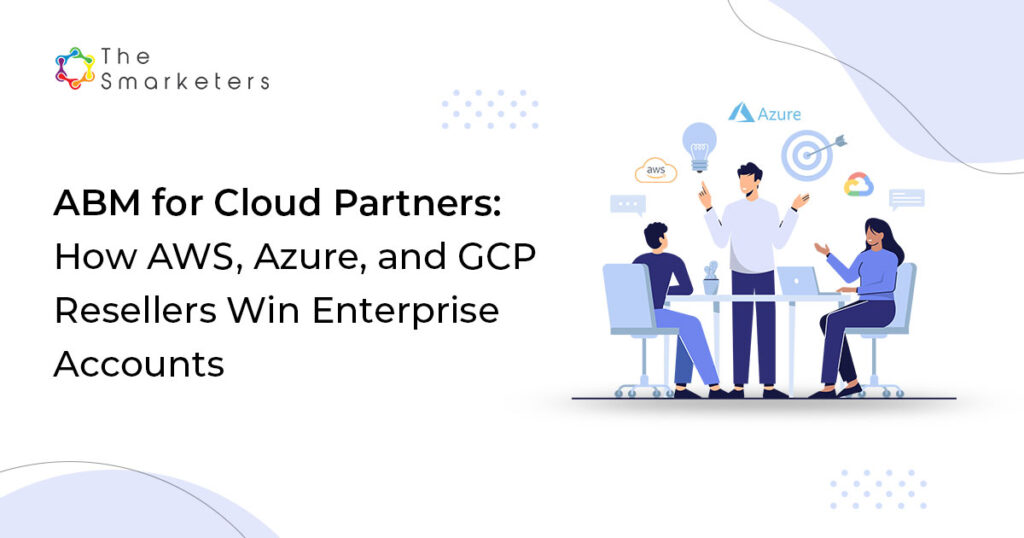
ABM for cloud partners is an account-based marketing approach adapted for companies that resell, build on, or deliver services around AWS, Azure, or Google Cloud Platform. Cloud partner ABM differs from standard B2B ABM because it operates within a competitive ecosystem of thousands of look-alike partners, often needs to align with hyperscaler co-sell motions, and targets buyers who are simultaneously evaluating cloud platforms and implementation capabilities. The core challenge is differentiation within an ecosystem where the underlying technology is identical across partners.
The Cloud Partner Problem: 10,000 Partners, One Platform
AWS has over 100,000 partners globally. Microsoft’s partner network includes over 400,000 companies. Google Cloud has tens of thousands of partners. Every one of them is selling capabilities built on the same underlying platform.
When a prospect searches for a Salesforce implementation partner or a SAP integrator, they are looking for platform expertise plus industry knowledge plus implementation track record. The platform is a differentiator.
When a prospect searches for an AWS partner, the platform is not a differentiator. Every AWS partner is, by definition, an AWS partner. The differentiation has to come from somewhere else: industry specialisation, workload expertise, or a unique accelerator or IP that changes the value equation.
ABM for cloud partners is built to solve this problem. Instead of broadcasting generic cloud capability claims to a broad market, it identifies the specific accounts where the partner’s industry knowledge, technical depth, or packaged IP creates a genuine competitive advantage and runs a concentrated, multi-stakeholder programme to win those accounts specifically.
Cloud partners with an ABM programme targeting specific verticals close deals 35% faster than those running broad-reach demand gen
Why ABM Is the Right Motion for Cloud Partners
| GTM Approach | Outcome for Cloud Partners |
|---|---|
| Broad-reach demand gen | High volume of low-quality leads from accounts where you are one of 200 look-alike partners |
| Partner portal leads | Typically low-value, price-sensitive, or already in late-stage evaluation without prior relationship |
| Co-sell with hyperscaler | High potential but dependent on hyperscaler field team prioritising your accounts over thousands of other partners |
| ABM on named accounts | Concentrated engagement on accounts where your specific expertise creates a genuine advantage, higher win rate, larger deal size |
ABM does not replace co-sell or partner portal activity. It focuses your team’s finite attention and budget on the accounts most likely to close and builds the relationship and credibility that makes co-sell more effective when hyperscaler field teams do engage.
ICP Definition for Cloud Partners: More Specific Than You Think
Cloud partner ICP definition has to go deeper than standard B2B ICP. ‘Mid-market companies using AWS’ is not an ICP for cloud partners it describes 80,000 companies. A useful cloud partner ICP looks like this:
- Industry vertical: Specifically, which industries do you have the deepest domain knowledge and strongest case study evidence in? Financial services, retail, manufacturing, healthcare, logistics?
- Cloud adoption stage: Early adopters (greenfield cloud migration), mid-journey (cloud optimisation, multi-cloud), or cloud-native (new build on cloud-native architecture)? Your capability needs to match the buyer’s stage.
- Technology stack: What existing tools and platforms are they running that your accelerators, connectors, or methodology are specifically designed for? SAP on Azure? Oracle on AWS? Snowflake on GCP?
- Company size and cloud spend: What cloud spend threshold makes your engagement economics work? Partners with minimum viable cloud migrations of $500K+ in annual cloud spend have very different ABM targets than those focused on $50K migrations.
- Geography: Are you targeting accounts in markets where you have local delivery capacity? Cloud partner ABM that generates opportunities you cannot service creates worse outcomes than no pipeline at all.
Co-Sell ABM: Aligning With Hyperscaler Sales Teams
The most valuable ABM programmes for cloud partners are not run in isolation from the hyperscaler they are designed to complement and reinforce co-sell activity.
Here is how co-sell ABM works:
Step 1: Identify shared target accounts
Work with your hyperscaler field team to identify accounts where both your partner team and the hyperscaler field team have mutual interest. These are the highest-value target accounts where co-sell adds procurement simplification and budget access for the customer.
Step 2: Coordinate outreach sequences
Align your ABM outreach timeline with hyperscaler-led activity. If the hyperscaler field team is running an executive briefing with a target account, time your ABM campaign to have warmed the account with relevant content in the 30 days prior.
Step 3: Use marketplace as an engagement channel
Cloud marketplaces (AWS Marketplace, Azure Marketplace, GCP Marketplace) are increasingly used for enterprise procurement, sometimes because buyers can use committed cloud spend for marketplace purchases. Your ABM campaigns should include marketplace listing awareness for accounts where procurement through the marketplace is an advantage.
Step 4: Provide hyperscaler field teams with account intelligence
Share your ABM engagement data with co-sell partners. If you have an account that has engaged with three pieces of your content and attended a webinar, the hyperscaler field team should know that before their next call.
Multi-Channel ABM for Cloud Partners
| Channel | Tactic | Cloud Partner Specificity |
|---|---|---|
| Account-level ads + employee thought leadership | Target by company + job function (IT director + cloud architect + procurement at target accounts) | |
| Cloud Marketplace Listings | Optimised listing with strong case studies and ratings | Buyers specifically searching the marketplace are high-intent ensure listing converts |
| Partner Portals | AWS Partner Finder, Azure Marketplace, GCP Partner Directory | Optimise profiles with industry vertical focus and workload-specific positioning |
| Content | Industry + workload-specific case studies, ROI calculators | Generic "we do cloud" content does not differentiate; industry + outcome specificity does |
| Events | Hyperscaler events (re:Invent, Microsoft Ignite, Google Cloud Next) + vertical industry events | Presence at hyperscaler flagship events + vertical events where ICP attends |
| Executive ABM | Personalised outreach to C-suite at Tier 1 target accounts | Supported by hyperscaler executive briefing programmes where available |
About The Smarketers
The Smarketers is India’s first ITSMA-awarded ABM agency and a HubSpot Gold Partner. With 40+ implemented ABM programs and an 85% success rate, they work with B2B technology companies, IT services firms, and life sciences companies to drive pipeline through ABM, demand generation, and RevOps.
Frequently Asked Questions
What is ABM for cloud partners?
ABM for cloud partners is account-based marketing adapted for AWS, Azure, or GCP resellers and implementation partners. It focuses on identifying the specific accounts where the partner’s industry expertise, technical specialisation, or packaged IP creates a genuine competitive advantage and running concentrated, multi-stakeholder campaigns to win those accounts, rather than broadcasting generic cloud capability claims across a broad market.
How do cloud partners differentiate with so many competitors on the same platform?
The most effective differentiation strategies for cloud partners are: deep industry vertical specialisation (you understand financial services cloud migration better than anyone), specific workload expertise (SAP on Azure, data warehousing on Snowflake, ML pipelines on GCP), packaged accelerators or IP that reduce time-to-value, and a geographic or language market focus where fewer partners operate.
How does ABM integrate with co-sell programmes?
ABM and co-sell are most effective when coordinated. ABM warms target accounts with relevant content and builds brand recognition, while hyperscaler co-sell activity provides field-level support and procurement pathway access. Share ABM engagement data with your hyperscaler co-sell contacts so they approach target accounts with context about prior engagement.
Should cloud partners use marketplace listings as part of their ABM strategy?
Yes. Cloud marketplace listings are increasingly used for enterprise procurement because buyers can use committed cloud spend for marketplace purchases, simplifying the procurement process. Ensure your marketplace listing is optimised with strong case studies, competitive ratings, and industry vertical positioning and include marketplace awareness in your ABM campaigns for accounts where procurement through the marketplace is a buyer advantage.