Table of Contents
B2B SEO for IT Services
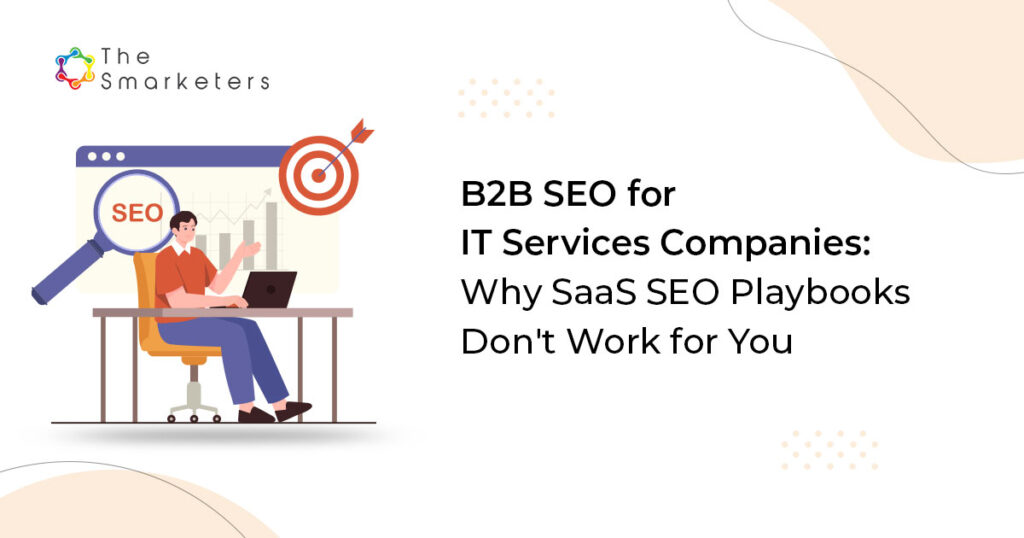
B2B SEO for IT services companies is the practice of building organic search visibility for firms that deliver implementation, managed services, consulting, or support around technology platforms or infrastructure. IT services SEO differs fundamentally from SaaS SEO because the buyer search behaviour is problem-driven and solution-agnostic rather than product-led. IT services buyers do not search for a platform to buy they search for a firm that can solve a specific operational or technical problem. The keyword strategy, content architecture, and authority-building approach all need to reflect this distinction.
SaaS SEO and IT Services SEO Are Not the Same Game
TripleDart, Directive Consulting, and the other well-known B2B SEO agencies built their playbooks for SaaS companies. And those playbooks work well for SaaS. They are built around product-led keywords, trial conversion content, and comparison pages targeting buyers who know what product category they need.
IT services companies that apply SaaS SEO frameworks consistently run into the same problems. They create product comparison pages for platforms they implement but they are not the vendor, so they rank poorly and look strange. They target high-volume SaaS category keywords where they cannot compete with platform vendors and established review sites. They create generic ‘what is X technology’ content that gets traffic but never converts to qualified leads.
IT services buyers search differently. They search with operational problems, not product names. ‘How to migrate SAP ECC to S4HANA’ not ‘best SAP migration software.’ ‘Salesforce CPQ implementation challenges’ not ‘best CPQ tools.’ ‘ServiceNow ITSM setup for financial services’ not ‘ServiceNow pricing.’
SEO for IT services companies needs to be built around how buyers actually search — and that means a different keyword strategy, a different content architecture, and different authority signals.
IT services buyers use 8+ different search queries before contacting a vendor, mostly problem-framed rather than product-framed
How IT Services Buyers Actually Search: The 3 Search Stages
| Search Stage | Search Intent | Example Query | Content Type That Ranks |
|---|---|---|---|
| Problem-Aware | Buyer recognises the operational problem, not yet solution-specific | 'SAP S/4HANA migration challenges', 'Salesforce adoption problems enterprise' | Problem-focused blog posts, industry operational guides |
| Solution-Aware | Buyer knows a technology or service category is the answer, researching approach | 'ServiceNow ITSM implementation roadmap', 'how long does SAP migration take' | Implementation guides, process explainers, timeline content |
| Vendor Evaluation | Buyer is shortlisting implementation partners, looking for differentiators | 'Best SAP S4HANA partners financial services', 'Salesforce CPQ partner pharma' | Industry-specific service pages, case studies, comparison content |
Most IT services SEO investments focus on the vendor evaluation stage service pages and case studies. These are important but insufficient on their own. SEO programmes that invest in problem-aware and solution-aware content build organic visibility earlier in the buyer journey, which means your firm is in the buyer’s consideration set before they start comparing vendor lists.
Keyword Strategy for IT Services SEO
IT services keyword strategy is built around 4 keyword patterns that SaaS SEO typically ignores:
Pattern 1 — Problem + Platform combinations:
‘SAP S4HANA migration challenges’, ‘Salesforce CPQ implementation problems’, ‘ServiceNow integration complexity’. These queries have lower volume than broad platform terms but much higher conversion intent the buyer is already experiencing the problem your firm solves.
Pattern 2 — Industry + Platform + Problem:
‘SAP implementation financial services’, ‘Salesforce for pharmaceutical commercial operations’, ‘ServiceNow healthcare ITSM’. Industry-specific platform queries attract buyers who want a partner with domain expertise, not just technical capability.
Pattern 3 — Comparison and evaluation queries:
‘SAP vs Oracle for manufacturing’, ‘ServiceNow vs BMC Remedy ITSM comparison’, ‘Salesforce CPQ vs Apttus’. These queries are high-intent — the buyer is in active evaluation. IT services firms can rank for these even though they are not the platform vendor.
Pattern 4 — Time and cost queries:
‘How long does SAP migration take’, ‘cost of Salesforce enterprise implementation’, ‘ServiceNow implementation timeline’. Buyers in the SOW evaluation stage research cost and timeline before issuing RFPs. Ranking for these positions your firm as the authoritative source before the formal evaluation starts.
Content Architecture for IT Services SEO
The most effective content architecture for IT services SEO is a three-tier structure:
Tier 1: Industry + Platform Service Pages
Pages like ‘SAP S4HANA Implementation for Manufacturing Companies’ or ‘Salesforce CPQ for Pharmaceutical Commercial Operations’ are the money pages they target high-commercial-intent queries and directly support the business development conversation. Build one service page per major industry + platform combination that you genuinely serve.
Tier 2: Implementation and Process Guides
Long-form guides that walk through how a specific implementation or transformation works: ‘The Complete SAP S4HANA Migration Guide for Mid-Market Manufacturing’, ‘Salesforce CPQ Implementation Roadmap for Enterprise Pharma’. These rank for mid-funnel solution-aware queries and demonstrate the depth of expertise that differentiates your firm.
Tier 3: Problem-Focused Blog Content
Top-of-funnel content targeting problem-aware queries: ‘Why SAP ECC Migrations Fail (And How to Prevent It)’, ‘The 5 Salesforce Implementation Mistakes That Cost Enterprise Clients 6 Months’. This content attracts early-stage buyers, builds brand familiarity, and supports internal linking to service pages.
Link Building in IT Services: Where Authority Comes From
IT services link building does not look like SaaS link building. SaaS companies build links through product integrations, affiliate programmes, and high-volume content production. IT services firms build authority through different signals:
- Industry publication guest content: Articles in trade publications relevant to your target verticals (manufacturing trade journals, financial services technology publications, healthcare IT media) build both topical authority and qualified referral traffic.
- Platform partner ecosystems: Appearing in official partner directories, partner case studies, and platform vendor content creates authoritative links from highly trusted domains in the exact context your buyers are already researching.
- Analyst and research citations: Being cited in Gartner, Forrester, or IDC research even in passing creates both a credibility signal and a link from a domain with exceptionally high authority.
- Conference and event presence: Speaking at industry events generates coverage in event publications, partner announcements, and post-event roundups all of which produce relevant, contextual links.
About The Smarketers
The Smarketers is India’s first ITSMA-awarded ABM agency and a HubSpot Gold Partner. With 40+ implemented ABM programs and an 85% success rate, they work with B2B technology companies, IT services firms, and life sciences companies to drive pipeline through ABM, demand generation, and RevOps.
Frequently Asked Questions
Why doesn't SaaS SEO work for IT services companies?
SaaS SEO is built around product-led keywords where buyers are searching for platforms to purchase. IT services buyers search with operational problems and implementation queries not product names. SaaS content frameworks (comparison pages, trial conversion content, product category rankings) do not match how IT services buyers research, which means they attract low-quality traffic rather than qualified buyers.
What keywords should IT services companies target for SEO?
IT services SEO should target four patterns: problem + platform combinations (‘SAP migration challenges’), industry + platform + problem (‘Salesforce implementation financial services’), comparison and evaluation queries (‘SAP vs Oracle manufacturing’), and time and cost queries (‘SAP implementation cost for mid-market’). These patterns match actual IT services buyer search behaviour and have lower competition than broad platform category terms.
What content architecture works best for IT services SEO?
A three-tier structure: Tier 1 industry + platform service pages (high-commercial-intent, directly supports sales), Tier 2 implementation and process guides (mid-funnel, solution-aware queries), and Tier 3 problem-focused blog content (top-of-funnel, early buyer research). All three tiers should be interlinked and support each other.
How do IT services companies build SEO authority?
IT services authority comes from: guest content in relevant trade publications, partner ecosystem presence (vendor partner directories and case study programmes), analyst and research citations (Gartner, Forrester, IDC), and conference and event speaking coverage. These signals build topical authority and domain trust in ways that standard SaaS link building tactics do not.