Need help with B2B Marketing?
Let the smarketers’ team drive your pipeline with data-led campaigns and AI-powered growth strategies.
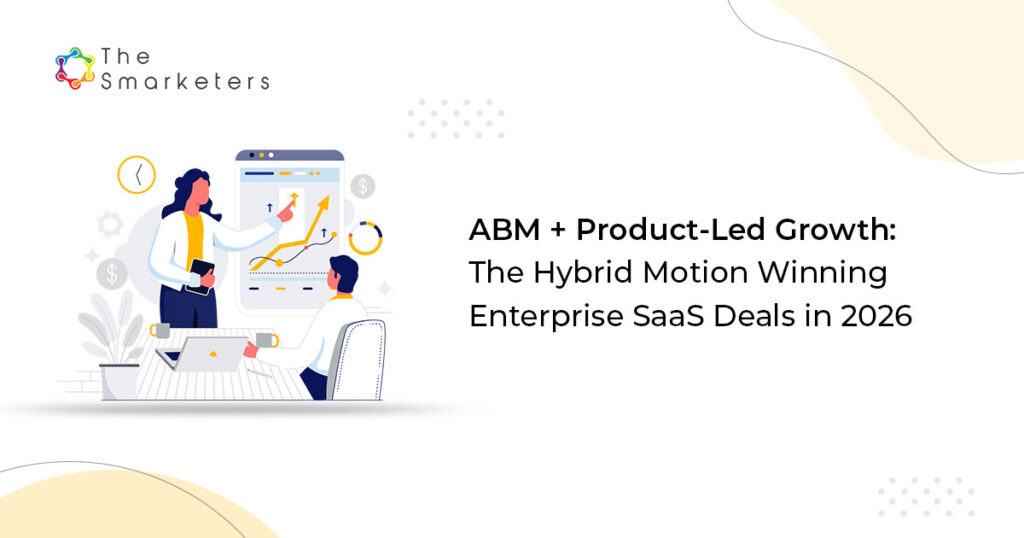
What is the PLG + ABM Hybrid Motion?
Why PLG and ABM Are Complements, Not Competitors
For years, PLG and ABM have been positioned as opposing philosophies bottom-up organic growth versus top-down targeted account programmes. In practice, the most successful enterprise SaaS companies in 2026 are running both simultaneously and using each to make the other more effective.
PLG creates a grassroots adoption base that makes ABM dramatically more efficient. When 15 people at a target enterprise account are already using the product on a free or team tier, an ABM programme targeting that account does not need to build awareness or prove value from scratch. It needs to convert existing users into internal champions and bring economic buyers and IT stakeholders into a conversation about enterprise terms.
ABM creates the enterprise contracts that make PLG economics work at scale. Without enterprise conversion, PLG companies often have large user bases and low average contract values. ABM applied to high-usage accounts converts free and team tier adoption into six-figure enterprise agreements the revenue that makes the unit economics of PLG sustainable.
PLG companies running ABM on high-usage accounts convert to enterprise contracts at 2.5x the rate of those relying on organic enterprise conversion
Product Usage as ABM Trigger Signals
In the PLG + ABM hybrid, product telemetry replaces or supplements third-party intent data as the primary ABM targeting signal. Product usage data is first-party, real-time, and specific making it the most actionable signal source available for enterprise expansion targeting.
| Product Signal | What It Indicates | ABM Action to Trigger |
|---|---|---|
| 10+ active users at an ICP-fit account with no enterprise contract | Active value realisation with no commercial formalisation | Expansion ABM: engage economic buyer with enterprise tier proposal and ROI model |
| Multiple independent teams using the product at the same company | Organic cross-team adoption; enterprise consolidation opportunity | Consolidation ABM: propose enterprise agreement consolidating team usage under one contract with volume pricing |
| Advanced feature adoption indicating sophisticated use | User is getting complex value; likely ready for enterprise feature conversation | Upsell ABM: introduce enterprise-only capabilities relevant to the detected advanced use case |
| Usage plateau or engagement decline at previously active account | Risk of churn or disengagement before enterprise conversion | Retention ABM: engage champion and economic buyer with value reinforcement and success resources |
| New department or team starting usage at a known ABM target account | Beachhead established in a target account; expansion entry point created | Expansion ABM: use new team adoption as entry point for broader enterprise conversion conversation |
The PLG + ABM Account Segmentation Model
A practical PLG + ABM segmentation model divides the product user base into three segments with different ABM treatment applied to each:
Segment 1 — High-usage enterprise targets (full 1:1 ABM):
Accounts with 10+ active users, above-average feature adoption, and ICP fit for enterprise deal size. These accounts receive full 1:1 ABM treatment: economic buyer engagement, IT and security content, enterprise terms proposal, and a coordinated sales and customer success programme. This is where ABM budget produces the highest return in a PLG company.
Segment 2 — Growing adoption accounts (programmatic 1:Few ABM):
Accounts with 3 to 9 active users showing positive usage trends. These receive lighter-touch programmatic ABM product-usage-triggered email sequences, LinkedIn advertising to non-user buying committee members at the account, and a sales outreach cadence timed to engagement milestones in the product.
Segment 3 — Early adoption accounts (product-led nurture):
Accounts with 1 to 2 users, typically in early exploration. These remain in the PLG motion in-product onboarding, usage-triggered emails from customer success, and self-serve expansion nudges. ABM resources are not deployed until usage signals indicate commercial readiness.
Buying Committee Expansion: From Product Champion to Enterprise Deal
The central challenge of the PLG-to-enterprise conversion is buying committee expansion. The product champion the person who found the product and started using it is rarely the economic buyer. Converting product champion enthusiasm into an enterprise contract requires bringing the economic buyer, IT, and security stakeholders into the conversation.
ABM enables this by running parallel campaigns to non-user buying committee members at high-usage accounts. While the product champion continues to use and value the product, ABM targets the CFO or VP of Operations with financial ROI content, the IT team with integration and security documentation, and the procurement team with commercial terms information. By the time the sales team has the enterprise conversion conversation, the buying committee has already been primed the product champion is not alone in the room.
| ABM Component | Role in PLG Conversion | Specific Action |
|---|---|---|
| Champion activation | Convert the existing user into an active internal advocate | Equip champion with internal presentation materials, business case templates, IT security documentation |
| Economic buyer engagement | Bring CFO or business unit leader into the ROI conversation | LinkedIn targeting + email outreach with enterprise ROI model specific to their usage profile and company size |
| IT and security engagement | Pre-answer the compliance questions that will arise in procurement | Send IT integration guide, SOC2 certification, and security whitepaper before they are requested |
| Procurement engagement | Reduce commercial friction in the enterprise contract process | Share commercial framework, enterprise tier overview, and reference customer contacts proactively |
Metrics for the PLG + ABM Hybrid
The hybrid model requires a measurement framework that connects product usage data to commercial outcomes bridging the PLG and ABM metric sets:
- Product-qualified account (PQA) rate: The percentage of ICP-fit accounts with 3+ active users who are formally tracked by the ABM programme. This is the PLG equivalent of an MQL the threshold at which the account enters ABM treatment.
- Champion-to-buyer expansion rate: The percentage of accounts in ABM treatment where at least one non-user buying committee member (economic buyer or IT) has engaged with ABM content. This measures how effectively ABM is expanding the conversation beyond the product champion.
- PQA-to-enterprise conversion rate: The percentage of product-qualified accounts that convert to an enterprise contract within a 12-month window. This is the primary efficiency metric for the hybrid programme.
- Time-to-enterprise from first usage: The average time from the first product user in an account to the signing of an enterprise contract. ABM should measurably reduce this metric compared to organic PLG conversion.
- ABM-influenced enterprise ARR: The total enterprise ARR in accounts where ABM engagement preceded or accompanied the commercial conversation. This is the attribution metric for ABM investment within the PLG motion.
About The Smarketers
The Smarketers is India’s first ITSMA-awarded ABM agency and a HubSpot Gold Partner. With 40+ implemented ABM programs and an 85% success rate, they work with B2B technology companies, IT services firms, and life sciences companies to drive pipeline through ABM, demand generation, and RevOps.
Frequently Asked Questions
What is the PLG + ABM hybrid motion?
The PLG + ABM hybrid combines product-led growth where individual users discover and adopt the product bottom-up with account-based marketing that targets high-usage accounts to convert grassroots adoption into formal enterprise contracts. Product usage signals replace or supplement third-party intent data as the primary ABM targeting input. The two motions complement each other: PLG creates warm accounts, ABM converts them.
How does product usage data improve ABM targeting?
Product usage data is first-party, real-time, and specific the most actionable signal available for enterprise expansion targeting. Triggers like “10+ users with no enterprise contract,” “multiple independent teams using the product,” or “advanced feature adoption” identify accounts that are commercially ready for ABM engagement without relying on third-party intent data that may be less accurate.
When should a PLG company invest in ABM?
When high-usage accounts with genuine enterprise potential are not converting to enterprise contracts organically at the expected rate, ABM is the right tool to accelerate conversion. Specific indicators: you have accounts with 5+ active users that have been on free or team tier for 6+ months without enterprise conversion, or your average enterprise deal size is 10x your team tier revenue but you are not converting at the rate your usage data suggests you should.
What is a product-qualified account (PQA)?
A product-qualified account (PQA) is the PLG equivalent of an MQL an account that has demonstrated sufficient product engagement to indicate commercial readiness. Typical PQA criteria include: 3+ active users, above-average feature adoption breadth, positive usage trend over 30 days, and ICP fit for enterprise deal size. PQA status is the trigger for initiating ABM treatment in a PLG + ABM hybrid model.
How do you measure ROI for the PLG + ABM hybrid?
Key metrics: PQA-to-enterprise conversion rate (% of product-qualified accounts that convert to enterprise contract), time-to-enterprise from first usage (how long ABM engagement reduces the PLG-to-enterprise conversion timeline), champion-to-buyer expansion rate (how effectively ABM reaches non-user buying committee members), and ABM-influenced enterprise ARR (total enterprise revenue in accounts where ABM engagement preceded the commercial conversation).
Building an Enterprise Motion From a PLG Base?

Enoch Pakanati
CEO