Table of Contents
- Trend 1: Data Gravity & Centralization
- Trend 2: AI Agents for Marketers and Customers
- Trend 3: Context Engineering Is the New Competitive Moat
- Trend 4: The Autonomy Spectrum
- Trend 5: The Mid-Market Equalizer (How Smaller Teams Can Finally Compete)
- Trend 6: The Factory vs. Laboratory Framework (Why You Need Both)
- Trend 7: The Evolution of Marketing Operations
- The Three Numbers That Tell the Real Story
- Key Takeaways: What You Should Actually Do in 2026
- Frequently Asked Questions
Need help with B2B Marketing?
Let the smarketers’ team drive your pipeline with data-led campaigns and AI-powered growth strategies.
In 2024, OpenAI made headlines with innovations that showed how quickly technology is advancing. They introduced AI tools that let you shop directly in ChatGPT, build apps by simply describing them, and even develop autonomous AI agents.
These announcements demonstrate how fast the marketing technology (MarTech) landscape is changing. But here’s the interesting part: you don’t have to keep up with everything. You need to adapt smarter and faster than your competitors.
This article dives into the key trends that will shape MarTech in 2026. Let’s break down the major trends and what you should focus on.
Trend 1: Data Gravity & Centralization
Here’s a phrase you’ll hear constantly in 2026: data gravity. It refers to the force that large datasets exert, making it harder to move them around. Think about your organization right now. You probably have:
- Customer data in your CRM
- Behavioral data from your website and mobile apps
- Transaction data in your commerce platform
- Marketing campaign data scattered across email, social, and ad platforms
- Support data in your helpdesk system
- Product usage data in analytics tools
Each of these systems has a copy of overlapping data. Moving data between them, keeping it synchronized, and ensuring it’s accurate consumes enormous resources. More importantly, it makes you slower and less agile.
The shift happening in 2026 is toward centralizing data on a single platform (typically a cloud data warehouse like Snowflake, Databricks, or Google BigQuery) and then bringing applications and AI to where the data lives, rather than copying data to where applications live.
Rebecca Corliss, who leads marketing at GrowthLoop, explains the mindset shift required:
“Deploying and leveraging data centralization with an enterprise data cloud means accepting that a data resource that lives outside of the tools you love will be better for the marketing team and the business. That’s a big moment of acceptance that folks need to think about. It’s a composability mindset.”
Why this matters for you: In 2026, when evaluating new marketing technology, ask a different question. Instead of “What data can this tool collect and store?” ask “How well does this tool work with data that lives in my data warehouse?”
Trend 2: AI Agents for Marketers and Customers
Everyone talks about “AI agents” like they’re one thing. But they’re not. Understanding the three different types helps you avoid confusion and focus your efforts where they’ll have the most impact.
Agents for Marketers: These work behind the scenes to automate tasks like content production, audience segmentation, and competitive analysis.
Use Case: An AI agent drafts email variations, analyzes competitor campaigns, and segments audiences, allowing marketers to focus on strategy, not execution.
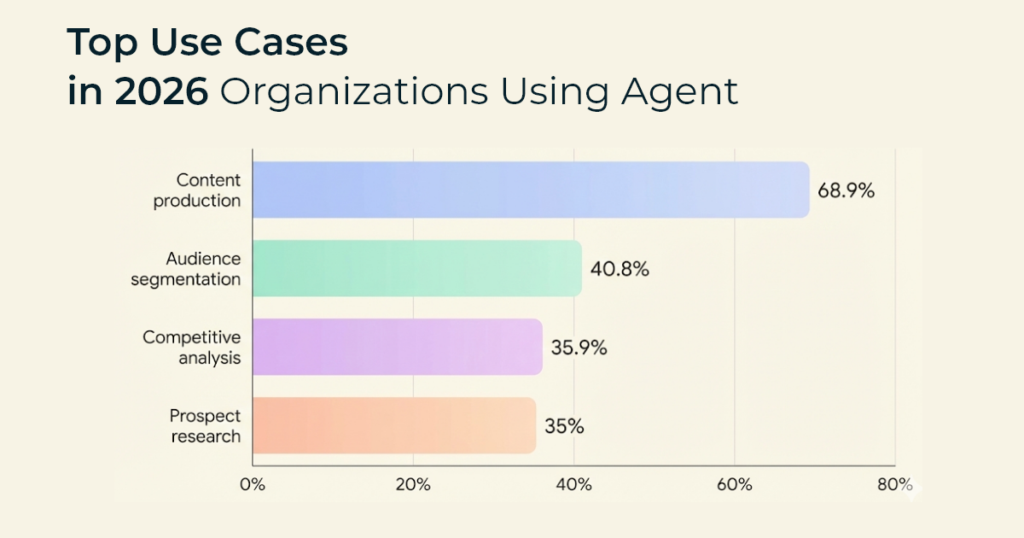
Top use cases in 2026:
- Content production (68.9% of organizations using these agents)
- Audience segmentation (40.8%)
- Competitive analysis (35.9%)
- Prospect research (35%)
Tejas Manohar, co-CEO of Hightouch, describes the impact:
“We believe that with agents it’s possible to make it 10X faster for marketers to launch campaigns and do their everyday work by automating the most mundane of tasks, like designing experiments, sizing opportunities, answering data questions, researching different angles, and giving marketers time back to focus on the most creative and the most strategic tasks.”
Agents for Customers: These interact directly with customers, like AI-powered chatbots or sales agents.
- Use Case: An AI chatbot handles basic customer queries, freeing up your team to focus on complex interactions. But be cautious—AI chatbots should enhance the experience, not flood customers with repetitive responses.
Agents of Customers: These are agents that customers use themselves, like AI-powered search or product comparison tools.
Examples that are already happening:
- Customers asking ChatGPT or Claude to research products and compare options
- AI-powered browsers that reshape how people navigate your website
- Email clients that rewrite your carefully crafted subject lines with AI-generated summaries
- Shopping assistants who negotiate prices or hunt for deals on behalf of buyers
“McKinsey estimates that 50% of consumers already use AI-powered search today, and by 2028, $750 billion of consumer spend will flow through AI-powered search. This means that a significant portion of your customer journey is moving into spaces you can’t see or control.”
This shift has gave birth to a new discipline called AEO (AI Engine Optimization or Answer Engine Optimization).
Currently, 63.1% of organizations are publishing AI-optimized content (structured Q&As, schema markup, detailed FAQs) to increase their chances of being cited by AI assistants. But only 13.6% are actually measuring their “AI inclusion rate”—how often they appear in AI-generated responses.
That gap represents opportunity. While your competitors are creating AI-optimized content blindly, you can be measuring what’s working and iterating.
Trend 3: Context Engineering Is the New Competitive Moat
Here’s a phrase you need to understand for 2026: context engineering.
It sounds technical, but the concept is simple. Getting the right information, in the right format, at the right moment is called context engineering. When an AI agent makes a decision or takes an action, it needs the right information at the right time. Too little information, and it can lead to mistakes. Too much information, and it gets confused and slows down.
And it’s becoming the primary differentiator between organizations that succeed with AI and those that struggle. In this era, your advantage is the context you can provide in the combination of:
- Your customer data
- Your product information
- Your brand guidelines
- Your historical campaign performance
- Your industry knowledge
- Your real-time behavioral signals
The challenge: Most organizations have this information scattered across dozens of systems.
“A recent survey found that mid-market companies use between 7 to 25 different tools to run their business. Each tool has valuable data locked inside it. Your CRM knows customer history. Your CDP knows behavior. Your support system knows pain points. Your product analytics know usage patterns.”
For AI to make smart decisions, it needs access to all of this—but in a way that’s secure, governed, and fast.
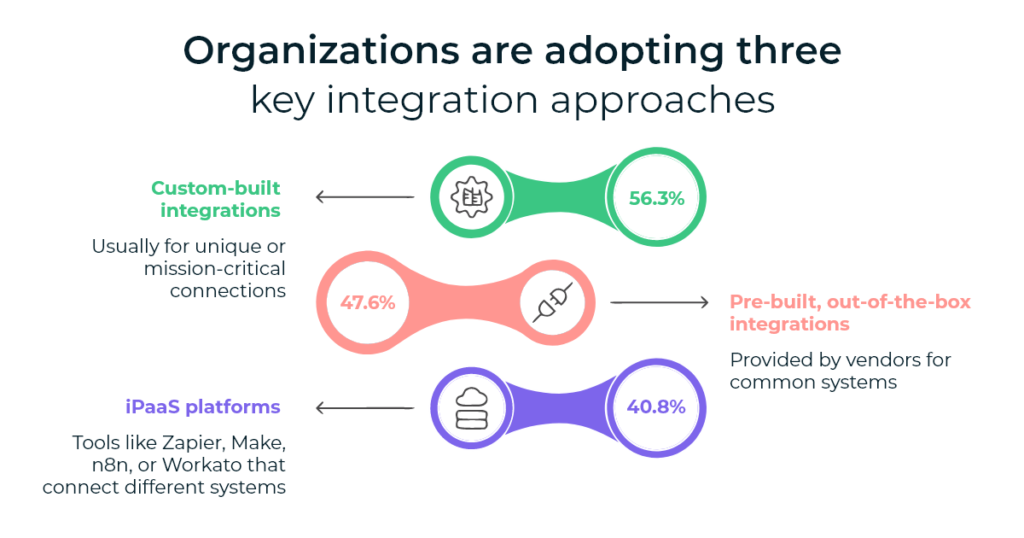
Organizations are adopting three key integration approaches:
- Custom-built integrations (56.3% of organizations) – Usually for unique or mission-critical connections
- Pre-built, out-of-the-box integrations (47.6%) – Provided by vendors for common systems
- iPaaS platforms (40.8%) – Tools like Zapier, Make, n8n, or Workato that connect different systems
But there’s also a new player in town: Model Context Protocol (MCP).
MCP is a new standard (introduced by Anthropic and now embraced by major vendors) that makes it easier for AI systems to connect with data sources and tools. It’s like a universal translator for AI applications.
Already, 48.5% of organizations are using MCP connectors in AI assistants like ChatGPT or Claude. Another 27.2% are incorporating MCP into their AI agents and automations.
Why this matters: Organizations that solve context engineering and brings the right data to their AI agents reliably and securely will make better decisions and take better actions.
As one marketing technology leader put it:
“AI is only going to be impactful if you give it the right data resources to leverage. And you need to make sure that those resources are connected in a way that’s pragmatically accessible.”
Trend 4: The Autonomy Spectrum
The term “AI agent” is often misunderstood. In reality, most AI systems in 2026 will be AI-assisted, not fully autonomous. Here’s how AI capabilities break down:
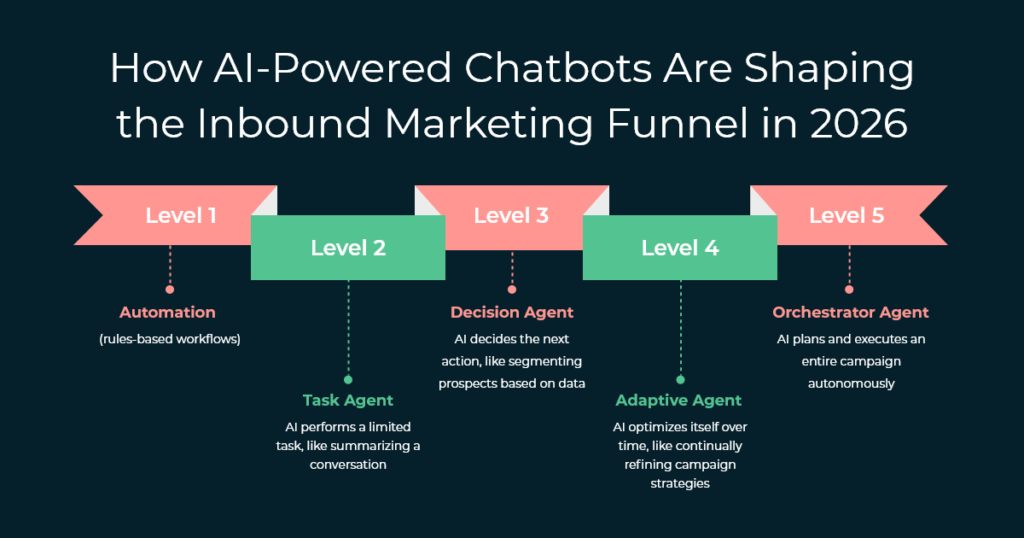
- Level 1: Automation (rules-based workflows)
- Level 2: Task Agent (AI performs a limited task, like summarizing a conversation)
- Level 3: Decision Agent (AI decides the next action, like segmenting prospects based on data)
- Level 4: Adaptive Agent (AI optimizes itself over time, like continually refining campaign strategies)
- Level 5: Orchestrator Agent (AI plans and executes an entire campaign autonomously)
Here’s where most organizations actually are: 80.6% of marketers report their AI agents operate in “assist only” mode. This means: the AI suggests, and a human decides.
Another 37.9% have moved to “execute with approval.” This means that the AI proposes an action, but a human must approve before execution.
Only 14.6% are at the “post-hoc review” stage, where AI acts autonomously, and humans review after the fact.
The takeaway: We’re in the very early stages of truly autonomous marketing agents. Most of what’s being called “agentic AI” in 2026 is actually Level 2 or Level 3 that are helpful, productivity-boosting, but still heavily dependent on human oversight.
Trend 5: The Mid-Market Equalizer (How Smaller Teams Can Finally Compete)
If you’re a mid-size company with limited resources, this trend brings you a good news: AI is about to level the playing field in ways we haven’t seen since the early internet.
Historically, marketing effectiveness scaled with team size. Bigger companies could afford larger teams, more specialists, better tools. They could run more campaigns, create more content, analyze more data.
AI changes the equation.
Recent research from WARC and Mailchimp studying mid-market companies (those with 10 to 499 employees) found something striking: Over half of mid-market marketing organizations have 10 or fewer marketers on staff.
These teams are expected to deliver enterprise-level results with a fraction of the resources. And here’s what’s changing in 2026: 98% of mid-market marketers believe AI will improve their marketing effectiveness. They’re not wrong.
Alexis Karsant, who leads product marketing at Mailchimp, explains how AI becomes an equalizer:
“AI can ingest all that disparate data and instantly segment audiences and surface relevant insights. It could predict customer churn or identify cross-sell opportunities. That frees up time that would otherwise be spent by these marketers stitching those systems together manually.”
Trend 6: The Factory vs. Laboratory Framework (Why You Need Both)
Here’s a mental model that will save you from making expensive mistakes in 2026.
Your marketing technology stack isn’t one thing—it’s two distinct systems that serve different purposes, require different metrics, and operate on different timelines.
- The Factory: Where proven campaigns run. Efficiency and predictability matter.
- The Laboratory: Where you test new ideas, channels, and approaches. Speed and learning matter.
Most organizations make one of two mistakes:
Mistake 1: They underinvest in the Laboratory, starving innovation. Everything goes through Factory-level governance and reliability requirements. Result? They optimize today’s approaches while competitors discover tomorrow’s opportunities.
Mistake 2: They apply Laboratory thinking to the Factory. Constant experimentation destabilizes revenue-generating campaigns. Teams burn out from perpetual change. Results become unpredictable.
The winning approach in 2026: Explicitly separate your Factory and Laboratory in budget, metrics, team structure, and governance.
Sara Faatz, who leads community at Progress (which provides CMS and digital experience platforms), describes the challenge:
“The hard part about failing fast in the era of AI is that ‘fast’ is 10X the speed it was before. So it’s hyper-critical that you have those lines of communication open and that you have stakeholders from each one of the functions of the organization understanding what those experiments are and why you’re trying to do them.”
Trend 7: The Evolution of Marketing Operations
The role of marketing operations is fundamentally changing in 2026, and if you’re in this function, you should be excited.
For years, marketing ops has been the “plumbing department”—the team that maintains systems, manages data quality, and keeps campaigns running. Important work, but often seen as tactical and behind-the-scenes.
That’s changing dramatically.
As AI handles more execution, the question becomes: What do humans do with the capacity gained?
The answer defines the future of marketing ops: They become value engineers. Think about the shift:
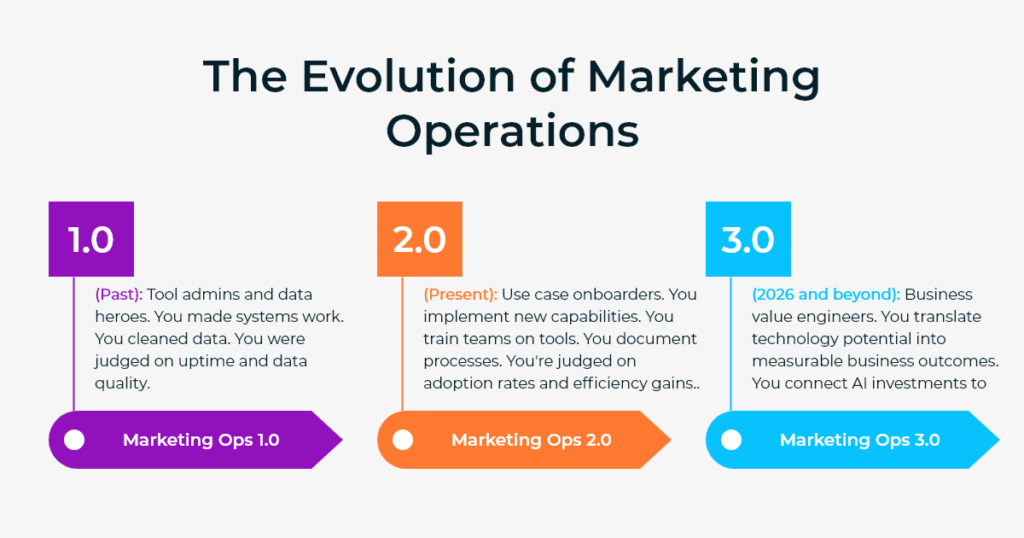
Marketing Ops 1.0 (Past): Tool admins and data heroes. You made systems work. You cleaned data. You were judged on uptime and data quality.
Marketing Ops 2.0 (Present): Use case onboarders. You implement new capabilities. You train teams on tools. You document processes. You’re judged on adoption rates and efficiency gains.
Marketing Ops 3.0 (2026 and beyond): Business value engineers. You translate technology potential into measurable business outcomes. You connect AI investments to revenue impact. You tell the customer story at the boardroom table. You’re judged on commercial results.
This evolution requires new skills:
Strategic thinking: Building business cases. Articulating value in terms executives care about (revenue, customer lifetime value, market share) rather than operational metrics (campaigns sent, time saved).
Technical orchestration: You still need to integrate systems and ensure data flows correctly. But now you’re orchestrating AI agents, not just connecting APIs. You’re designing systems that can adapt and learn, not just execute predefined workflows.
Human enablement: Training teams to work alongside AI. Defining new roles. Managing change across the organization. Building trust in AI-powered systems.
Rebecca Corliss from GrowthLoop describes the emerging role: “We’re seeing an evolution of marketing ops into a strategic player that not only owns the systems, but also now thinks about that data investment. They think about how AI orchestration can power the whole organization. They think about AI and data and their martech tools for outcomes, not just activities.”
Why this matters to everyone: If you’re a CMO, your marketing ops leader is about to become one of your most strategic hires. If you’re in marketing ops, this is your moment to step into a more visible, more valuable role. If you’re a marketer wondering who can help you navigate AI, your marketing ops team should be your first call.
The organizations that elevate marketing ops to this strategic, value-engineering role will move faster and more confidently than competitors still treating them as the IT help desk.
The Three Numbers That Tell the Real Story
Before we wrap up with practical recommendations, let me give you three statistics that cut through the noise and reveal what’s actually happening in 2026:
71.9% of marketers are still in the experimental or pilot phase with AI. You are not behind if you’re still figuring this out. The race is in early innings.
56.3% cite poor data quality as their biggest challenge with AI implementation. Not lack of tools. Not lack of budget. Bad data. This is where you should focus first.
85.4% are using AI to enhance existing marketing technology, not replace it. You don’t need to rebuild everything. You need to strategically augment what you have.
These numbers should be liberating. The winners in 2026 won’t be the ones who adopted AI the earliest or the most aggressively. They’ll be the ones who implemented it most thoughtfully—connecting it to real business problems, integrating it with good data, and measuring outcomes that matter.
Key Takeaways: What You Should Actually Do in 2026
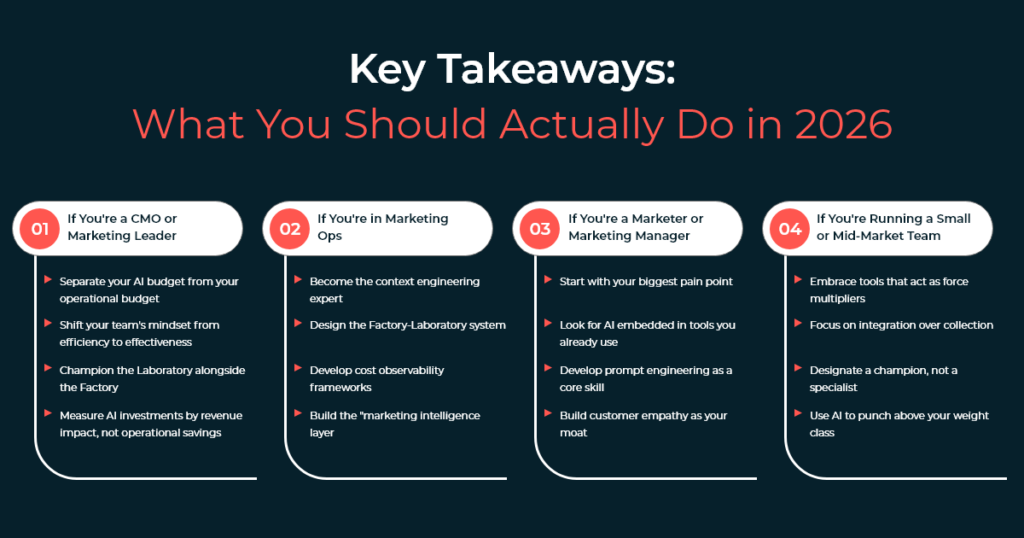
Here are concrete actions based on where you sit in the organization.
If You’re a CMO or Marketing Leader
- Separate your AI budget from your operational budget
Don’t let AI investments compete with proven channels. Rafa Flores, Chief Product Officer at Treasure Data, advises: “It’s okay to have a flat budget, but I think you need to start separating some of those dollars out and then map it to the function of where you think the AI tooling can really actually save you costs and drive some operational efficiency.”
- Shift your team’s mindset from efficiency to effectiveness
AI will make your team more efficient—that’s a given. But efficiency alone isn’t a competitive advantage (everyone gets more efficient). The differentiation comes from using that efficiency to do things that weren’t possible before. More personalization. More experimentation. More customer-centric experiences.
- Champion the Laboratory alongside the Factory
Explicitly allocate budget and permission for experimentation. Make it clear that failure in the Laboratory is expected and valuable, while failure in the Factory is not.
- Measure AI investments by revenue impact, not operational savings
When evaluating AI tools, ask: “Will this help us generate more revenue or serve customers better?” rather than “Will this make us more efficient?” The latter is table stakes; the former is strategic.
If You’re in Marketing Ops
- Become the context engineering expert
Map out where critical data lives, how it flows, and where gaps exist. You’re uniquely positioned to see the full picture. Document it. Fix the biggest gaps first.
- Design the Factory-Laboratory system
Define what experiments run in the Laboratory and what criteria must be met for “graduation” to the Factory. Create clear handoff processes. This becomes your new strategic role.
- Develop cost observability frameworks
As more tools move to consumption-based pricing (pay per API call, per token, per use), you need new ways to forecast and track costs. This is especially critical as autonomous agents can rack up usage without human oversight.
- Build the “marketing intelligence layer”
Position yourself as the hub connecting data teams, marketing execution, and business strategy. This is your opportunity to evolve from tactical support to strategic driver.
If You’re a Marketer or Marketing Manager
- Start with your biggest pain point
Don’t try to AI-ify everything. Pick the one problem that most constrains your growth. Is it content production volume? Audience segmentation complexity? Campaign analysis speed? Start there.
- Look for AI embedded in tools you already use
Before adding new point solutions, check if your current marketing automation platform, CMS, or analytics tool has added AI capabilities. This is usually faster and less risky than implementing entirely new tools.
- Develop prompt engineering as a core skill
The marketers who thrive in 2026 will be those who can clearly communicate intent to AI systems and critically evaluate the output. Practice. Experiment. Learn what works.
- Build customer empathy as your moat
This is the 20% that AI can’t do. Double down on understanding customer psychology, motivations, and context. This becomes your competitive advantage as AI commoditizes execution.
If You’re Running a Small or Mid-Market Team
- Embrace tools that act as force multipliers
Look specifically for AI tools that let one person do the work of three to five people. Examples: content generation platforms, automated audience builders, adaptive send time optimizers.
- Focus on integration over collection
You likely already have valuable data in your existing tools. Your priority should be connecting those tools (using iPaaS platforms or MCP connectors) rather than adding more data collection points.
- Designate a champion, not a specialist
You don’t need to hire an AI expert. You need someone curious and willing to learn who can test tools, document what works, and share knowledge with the team.
- Use AI to punch above your weight class
Mid-market marketers who self-identified as “highly competitive” used more martech tools than less competitive peers (4+ platforms vs. fewer than 4). The stack itself is a structural advantage when you’re competing against larger teams.
Frequently Asked Questions
1. How do I know if my current agency is actually using AI or just claiming they do?
Ask your agency to show the AI tools in their stack right now and how they’re impacting campaigns.” If they can’t show specific tools (like HubSpot AI features, Salesforce Einstein, or custom automations), they’re not using AI. Also ask: “What’s one campaign where AI improved our results by X%?” Real AI usage has measurable outcomes. For B2B companies, agencies like Smarketers that hold HubSpot Platinum status have proven AI implementation capabilities, not just promises.
2. Should I hire a MarTech specialist in-house or work with an agency?
Depends on your scale. If you’re under $5M revenue, an agency is more cost-effective. You get expertise across multiple tools without hiring 3-4 specialists. If you’re $10M+, consider a hybrid: one in-house marketing ops person + agency support for specialized needs (ABM, HubSpot optimization).
Agencies see patterns across dozens of clients; in-house sees only your company. For B2B SaaS specifically, agencies with ITSMA certification understand buying committees and long sales cycles better than generalists.
3. My team is overwhelmed with tools. How do I convince leadership to simplify our stack?
Calculate “tool cost per use.” Take your total MarTech spend, divide by monthly active users across all tools. If you’re paying $50+ per login, you have bloat. Present leadership with:
(1) Tools with <5 logins/month that should be cut
(2) Overlapping tools doing the same job
(3) Time wasted managing integrations
4. What should I ask a potential MarTech agency in the first call to know if they’re right for us?
Ask these three questions:
(1) “What’s the last client project where you underperformed, and why?”—honesty matters more than perfection.
(2) “Show me a case study with a company our size in our industry with similar sales cycles”—specificity proves expertise.
(3) “What would you NOT do for us?”—specialists know their boundaries; generalists promise everything.
For B2B companies, also ask: “Do you have ITSMA or ABM certifications?” If no, they’re not B2B specialists.
5. We’re using HubSpot but not seeing results. Is it the tool or are we using it wrong?
It’s almost always usage, not the tool. HubSpot is powerful but complex.
Check:
(1) Are your workflows actually running? (Most companies set them up but never activate them).
(2) Is your data clean? (Garbage data = garbage automation).
(3) Are sales and marketing aligned on lead definitions? (If sales ignores marketing leads, no tool fixes that).
Consider an audit from a HubSpot Platinum partner like Smarketers as they’ll identify gaps fast. Don’t switch tools until you’ve actually used what you have.

Enoch Pakanati
CEO