Need help with B2B Marketing?
Let the smarketers’ team drive your pipeline with data-led campaigns and AI-powered growth strategies.
What is Share of LLM (SoLLM)?
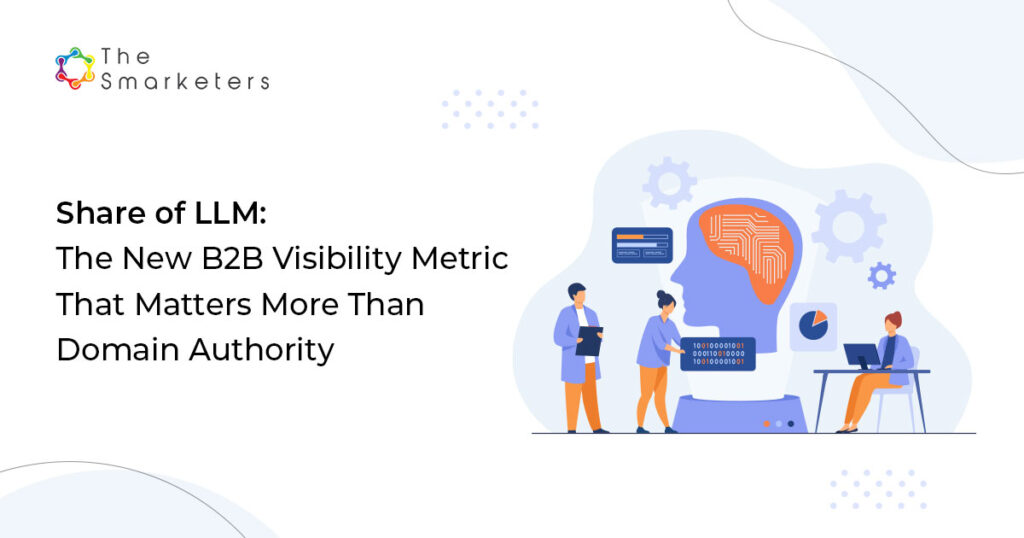
Share of LLM (SoLLM) is a B2B visibility metric that measures how frequently a brand is cited, recommended, or mentioned by AI language models ChatGPT, Perplexity, Gemini, Claude, and others when buyers ask vendor-selection or category-research questions. Unlike Domain Authority, which measures SEO link equity, or Share of Voice, which measures brand mentions in media, Share of LLM specifically measures presence in AI-generated answers. As more B2B buyers use AI tools to research vendors and shortlist options, a brand’s Share of LLM directly affects how often it appears in the consideration set without a single form fill or paid impression.
The SEO Metric That No Longer Tells the Whole Story
Domain Authority. Traffic. Keyword rankings. These metrics were built for a search environment where buyers typed queries into Google and clicked links. That environment still exists but it is changing.
In early 2026, a significant and growing share of B2B vendor research is happening in AI tools. A VP of Marketing evaluating ABM platforms does not only Google ‘best ABM platforms for enterprise SaaS.’ She also asks Perplexity. She runs a comparison prompt in ChatGPT. She asks Gemini which vendors specialise in IT services ABM.
If your brand is not appearing in those AI-generated answers, you are invisible to a portion of your buyer pool that your analytics tool will never show you. And that portion is growing.
Share of LLM is the metric for this new reality. It is not a replacement for traditional SEO metrics. It is an additional layer of measurement that tells you: when my buyers ask AI tools the questions I care about, how often am I in the answer?
57% of enterprise B2B buyers use AI tools at some stage of vendor research
How LLMs Decide Which Brands to Cite
AI language models do not have a simple ranking algorithm the way search engines do. But the factors that make a brand more likely to appear in AI-generated answers are identifiable and actionable.Boost AI Visibility: Rank on ChatGPT, Claude
- Entity authority: How clearly and consistently is your brand recognised as a distinct entity across the web? LLMs weight brands with strong entity recognition Wikipedia pages, consistent mentions in major publications, structured data on your own site.
- Content depth and specificity: LLMs favour sources that provide comprehensive, accurate, well-structured information on a topic. Thin content that covers a topic superficially is less likely to be drawn on than content that defines concepts clearly, provides examples, and answers follow-up questions.
- Citation frequency in training data: The more a brand appears in credible third-party sources industry publications, analyst reports, peer review sites, authoritative blog citations the higher the probability it appears in LLM training data and subsequent outputs.
- Structured content signals: FAQ schemas, HowTo schemas, definition blocks, and comparison tables make content easier for LLMs to parse and cite accurately.
- Recency and updates: LLMs with retrieval capabilities (Perplexity, ChatGPT with web search) favour recently updated, authoritative content. Stale pages lose visibility over time.
How to Measure Your Current Share of LLM
SoLLM measurement is not yet automated there is no tool that tracks it at scale the way Ahrefs tracks keyword rankings. But a practical manual measurement approach exists and takes about 2 to 3 hours to run:
Step 1: Build your SoLLM query set
Create 15 to 20 prompts that represent how your buyers actually research in AI tools. Include: category questions (‘What are the best ABM agencies for IT services companies?’), comparison questions (‘Compare [your company] vs [competitor]’), problem-solution questions (‘How do I run ABM for a buying committee of 11 people?’), and recommendation questions (‘Which ABM agency should I use if I am in the B2B tech space?’).
Step 2: Run the queries across ChatGPT, Perplexity, Gemini, and Claude
Run each query in at least three AI tools. Record: whether your brand appears, in what context (primary recommendation, brief mention, competitor comparison), and which competitors are featured more prominently. This gives you your baseline SoLLM the percentage of relevant AI queries in which your brand appears.
Step 3: Audit competitor SoLLM
Note which competitors appear most frequently and in what context. This tells you which brands have the highest LLM authority in your category and where your content or entity presence is weaker.
Step 4: Track monthly
Run the same query set every month. Track the percentage of queries in which you appear (your SoLLM score) and the percentage in which you appear as a primary recommendation. Both metrics should trend upward as you implement the improvement tactics below.
7 Tactics to Increase Your LLM Citation Rate
Improving Share of LLM is a 6 to 12 month investment. It is not a quick-win campaign. But the competitive advantage for brands that establish LLM authority early is substantial because the category is still largely unclaimed.
- Build entity authority: Create or improve your Wikipedia page, ensure your brand is described accurately and consistently on Wikidata, and build mentions in authoritative publications. LLMs are more likely to cite brands they recognise as established entities.
- Create definition-first content: For every key concept in your category, write a clear, structured definition on your own site. LLMs frequently cite definition content for category and concept queries. The definition boxes in your blog posts and service pages contribute to this.
- Optimise FAQ and structured content: FAQPage schema and HowTo schema make your content easier for LLMs to parse. Every FAQ block on your website is a potential source for AI-generated answers.
- Increase third-party citations: Guest posts in industry publications, quotes in analyst reports, references in peer review sites, and mentions in respected B2B newsletters all increase citation frequency in LLM training data.
- Maintain consistent entity signals: Your brand name, description, area of expertise, and key differentiators should be described identically across your website, LinkedIn, Crunchbase, G2, and third-party publications. Consistency improves entity recognition.
- Publish comparison content: LLMs frequently cite content that directly compares vendors, approaches, or options. Comparison blog posts and table-based content (like the comparisons in this post) are frequently extracted for AI-generated answers.
- Pursue analyst inclusion: Gartner and Forrester inclusion, even in emerging technology notes or market guides, carries significant weight in LLM citation. Budget for an analyst relations programme if brand authority is a strategic priority.
SoLLM vs. Traditional SEO Metrics: What to Track
| Metric | What It Measures | Best For | Reporting Cadence |
|---|---|---|---|
| Domain Authority | SEO link equity and trust | Organic search ranking potential | Monthly |
| Keyword Rankings | Visibility for specific search queries | SEO campaign performance | Weekly |
| Share of Voice (SoV) | Brand mentions vs. competitors in media | PR and brand awareness | Monthly |
| Share of LLM (SoLLM) | Brand citations in AI tool outputs | AI search visibility, dark funnel presence | Monthly |
SoLLM does not replace the metrics above. It adds a measurement layer for a channel that is not yet captured by any existing marketing analytics tool. Report it alongside traditional SEO and Share of Voice metrics, tracking the trend over time rather than obsessing over absolute numbers.
Related Reading
- The Dark Funnel Playbook: Capturing B2B Buyers Who Never Fill a Form
- AI Overview Optimization for B2B: How to Get Your Brand Cited in Google’s AI Answers
- GEO for B2B: Building Visibility in Generative Engine Outputs
About The Smarketers
The Smarketers is India’s first ITSMA-awarded ABM agency and a HubSpot Gold Partner. With 40+ implemented ABM programs and an 85% success rate, they work with B2B technology and IT services companies to build a pipeline and brand visibility through ABM, demand generation, and RevOps.
Frequently Asked Questions
What is Share of LLM?
Share of LLM (SoLLM) is a metric that measures how frequently a brand appears in AI-generated answers when buyers ask vendor-selection or category questions in tools like ChatGPT, Perplexity, Gemini, and Claude. It is an emerging measure of brand visibility in AI search channels separate from traditional SEO metrics like Domain Authority or keyword rankings.
Why does Share of LLM matter for B2B marketing?
As B2B buyers increasingly use AI tools for research, a brand’s visibility in those AI outputs directly affects whether it appears in buyer consideration sets. Unlike paid ads or SEO rankings, LLM visibility is not bought — it is earned through content depth, entity authority, and third-party citation frequency. Brands that build SoLLM early have a first-mover advantage as AI-assisted research grows.
How do you measure Share of LLM?
SoLLM is currently measured manually by running a set of relevant buyer queries across multiple AI tools (ChatGPT, Perplexity, Gemini, Claude) and tracking how often your brand appears. Measure: the percentage of queries in which you appear, whether you appear as a primary recommendation or a passing mention, and how your visibility compares to key competitors. Run this monthly to track trends.
How is Share of LLM different from Share of Voice?
Share of Voice measures brand mentions in media and social channels. Share of LLM specifically measures citations in AI-generated outputs a separate and growing channel that operates differently from media coverage. A brand can have high Share of Voice in trade publications but low SoLLM if its content is not structured for AI parsing or its entity signals are weak.
What content formats improve LLM visibility?
Structured content formats perform best in LLM outputs: definition blocks (clear, standalone explanations of concepts), FAQ sections with schema markup, HowTo structured content, comparison tables, and numbered lists. These formats are easier for LLMs to parse and cite accurately. Long-form content with clear organisation and specific, verifiable claims also correlates with higher LLM citation rates.

Enoch Pakanati
CEO