Need help with B2B Marketing?
Let the smarketers’ team drive your pipeline with data-led campaigns and AI-powered growth strategies.
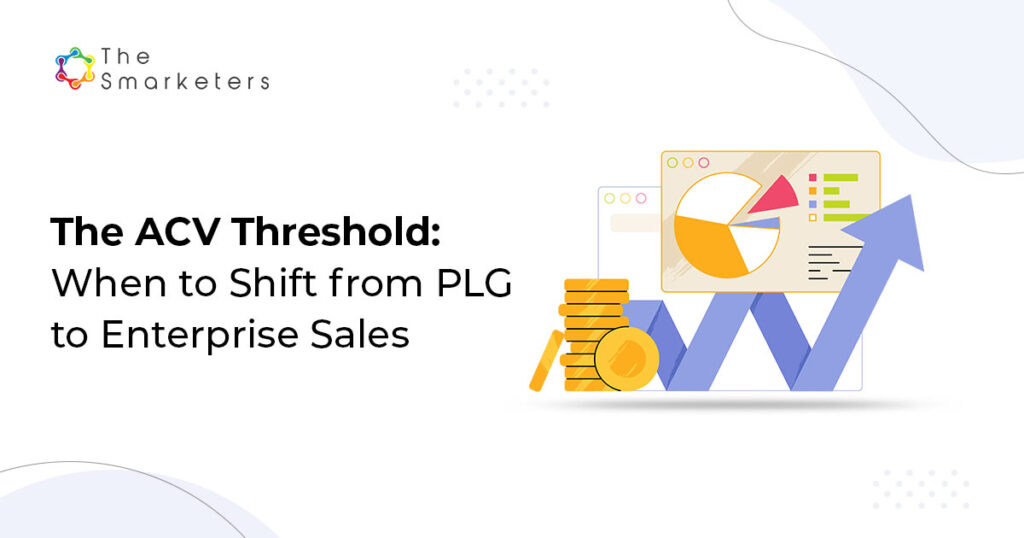
Every PLG founder has the same conversation at some point. The self-serve conversion curve flattens. The $500-ACV bookings are great but they do not fund a public company. The largest accounts keep asking for security reviews, custom contracts, and a dedicated contact. The founder is on every call. The question becomes: when do we shift from PLG to enterprise sales?
The honest answer is a threshold, not a timeline. Here is the threshold math and the transition plan we use with PLG companies moving into enterprise.
Median ACV at which PLG companies add enterprise sales: $28K (OpenView 2025 PLG Index). Companies that shift above $50K ACV without adding enterprise sales see net retention degrade within 18 months as buying committees fragment and deals stall.
The threshold math
PLG works when the economic buyer is also the user. A $20 per user per month product adopted by a 50-person team converts because the VP of Engineering is both the buyer and the user, the signoff is informal, and procurement does not get involved.
Above $20 to $40K ACV, the buying process changes. A buying committee forms. IT security reviews appear. Legal wants to negotiate the MSA. Procurement demands a custom discount. The user who wanted the product is no longer the person who signs the contract. Self-serve breaks down.
This is not a marketing problem. It is a buying behaviour problem. No amount of PLG optimisation fixes the fact that a $50K purchase requires 4 to 7 stakeholders and a 3 to 6 month cycle in most B2B categories.
The signals that say you have crossed the threshold
Signal 1: Self-serve conversion rate on accounts above $20K ACV is below 15%. The conversion rate you got at $5K ACV does not carry upmarket.
Signal 2: Sales cycles lengthen from 14 days to 60+ days for your top accounts. Not because your product got worse but because committees formed.
Signal 3: Your top 20% of accounts by revenue now contribute over 50% of ARR. Concentration grows as deals get bigger.
Signal 4: Security and procurement requests appear on 40%+ of new opportunities. You are now enterprise-adjacent even if you do not want to be.
Signal 5: Expansion revenue depends on individual named accounts rather than broad product usage. Upsell is now a sales motion, not a PLG flywheel.
THREE SIGNALS IN COMBINATION MEAN YOU HAVE CROSSED THE THRESHOLD: SUB-15% SELF-SERVE CONVERSION ABOVE $20K ACV, CYCLES OVER 60 DAYS, AND TOP-20% REVENUE CONCENTRATION ABOVE 50%. ADD ENTERPRISE SALES. DO NOT DELAY.
The transition plan
Month 1 to 3: Founder-led deals
The founder runs the first 5 to 10 enterprise deals personally. No delegation. The goal is to document the playbook: discovery questions, objection handling, pricing negotiation, procurement navigation, contract terms. Every call is recorded and reviewed. Every deal is debriefed.
Founder-led selling is the prerequisite to hiring. Founders who skip this step and hire a VP of Sales immediately almost always fail. The playbook needs to exist before you hire against it.
Month 4 to 9: First AE hire
Hire one experienced AE who has closed $50K+ deals in a similar category. Pay them well. The bar is high. They co-run deals with the founder for 90 days, then take the playbook solo.
Do not hire a VP of Sales at this stage. The VP hires cost $300K+, demand team size that you cannot yet support, and often try to install enterprise machinery before the motion is proven. One AE, possibly two, is the right shape for months 4 to 9.
Month 10 to 15: Build the AE team
Add 2 to 3 more AEs. Start hiring SDRs who work the PLG signal (accounts with high product usage, team size expansion, multiple active users). The SDR motion is signal-driven, not cold outbound.
Formalise the CRM: HubSpot or Salesforce, lifecycle stages, MEDDIC or MEDDICC fields, stage-gate criteria. Build the forecasting model. Set quota.
Month 16 to 24: Hire the VP of Sales
Now you need a VP. The team is 4 to 6 AEs plus SDRs, the playbook exists, the CRM is clean. The VP scales the motion from $5M to $30M ARR. They are not building it from scratch; they are optimising it.
VPs of Sales hired at this stage have a 70%+ 2-year success rate. VPs hired at month 3 have a 25% success rate. The timing matters more than the candidate quality.
The PLG layer during the transition
Do not dismantle the PLG motion. The product-led top of funnel becomes the demand generation layer for enterprise. The PLG team owns: self-serve trial and conversion, in-app expansion, usage-based signals, team adoption.
The enterprise team owns: accounts above the ACV threshold, committee navigation, procurement, multi-year contracts, security reviews.
The handoff between PLG and enterprise is the key operational question. Rule we use: when a single account hits 25+ active users or an expansion request above $25K, it transfers to enterprise. Before that, PLG runs it.
What the founder should stop doing
Stop being on every call past month 6. Founder-led selling is the training phase, not the motion. By month 6 the AE should run 70%+ of deals. By month 12 the founder is on strategic accounts only.
Stop chasing the biggest logos. Early enterprise customers should be mid-market (500 to 2,000 employees), not Fortune 500. Fortune 500 cycles are 9 to 18 months and will consume all of sales bandwidth for 2 years before closing. Mid-market closes in 3 to 6 months and builds the repeatable motion.
Stop pricing as if everyone is a PLG customer. Enterprise pricing is a negotiation, not a price list. Build pricing flexibility into the motion: volume discounts, multi-year discounts, service add-ons.
What the board should expect
Growth slows in the transition quarter. This is normal. Enterprise sales motions take 9 to 18 months to reach the productivity that PLG hit in 2 to 3 months. Do not compare the first quarter of enterprise sales to steady-state PLG.
By quarter 4 of the transition, the blended growth curve exceeds PLG-only. By quarter 8, it is substantially ahead. The transition is a J-curve: down first, up later.
Frequently Asked Questions
At what ACV does PLG stop working as the primary motion?
The practical break point is $20,000 to $40,000 ACV. Below that, self-serve onboarding and credit card conversion can sustain growth. Above that, buying committees form, procurement gets involved, and self-serve conversion rates collapse without human assistance. The exact threshold varies by category but rarely goes above $50K.
Can PLG and enterprise sales coexist?
Yes, and increasingly should. The mature model is PLG as the top-of-funnel (self-serve trial, product usage signals, team expansion) and enterprise sales as the closing motion for accounts that hit expansion or usage thresholds. Slack, Notion, Figma, and Linear all run this hybrid model.
What is the first enterprise hire?
A founder-led AE who has closed $50K+ deals before. Not a VP Sales, not an SDR team, not a CRO. One experienced AE who can close the first 10 to 20 enterprise deals alongside the founder, document the playbook, and hand it to the next hires.
How long does the transition take?
12 to 24 months minimum. Year 1: founder-led deals plus first AE, build playbook, close 10 to 20 enterprise deals. Year 2: hire 2 to 4 AEs, build SDR function, formalise process. Teams that try to compress this to 6 months typically fail and revert.
What should the PLG team do during the transition?
Keep running PLG as the top-of-funnel signal engine. The PLG team produces the usage signals (active users, team size, feature adoption) that the enterprise AEs work. PLG does not go away; it becomes the demand generation layer for enterprise sales.
Book a GTM transition audit

Enoch Pakanati
CEO