Need help with B2B Marketing?
Let the smarketers’ team drive your pipeline with data-led campaigns and AI-powered growth strategies.
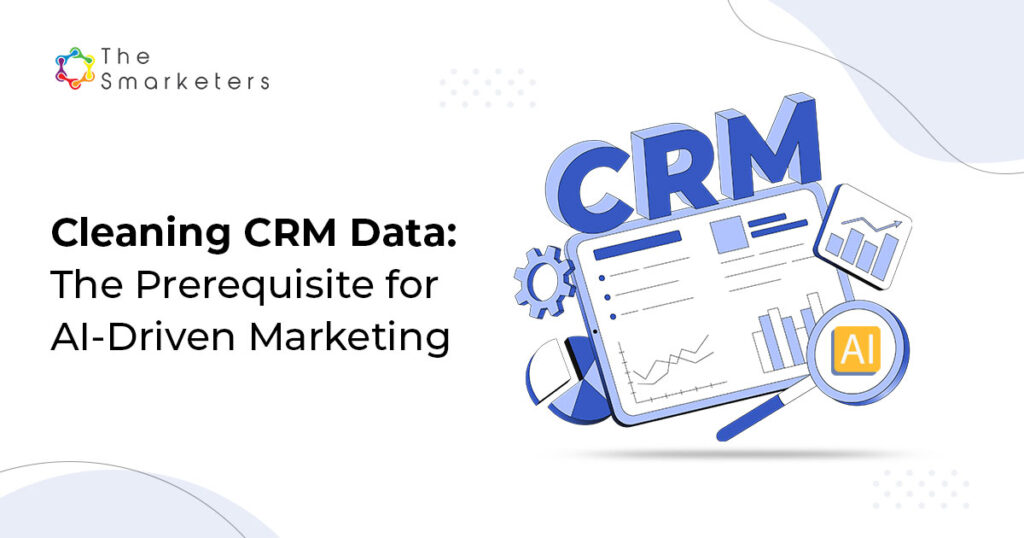
Dirty CRM data was a slow-burn problem when humans were the only consumers. Sales reps noticed a weird record, paused, investigated, fixed. The damage was contained.
AI agents do not pause. They read the dirty record, take it as gospel, draft outreach to the wrong contact, update adjacent records to match the bad data, and log everything as a successful action. By the time a human notices, the corruption has propagated across 200 records.
If you are planning to deploy HubSpot Breeze, Salesforce Einstein, or any other AI layer on your CRM, data hygiene is the prerequisite. Not a parallel project. Not an optional tune-up. The prerequisite.
Bad CRM data costs the average enterprise $15M annually in missed revenue, wasted spend, and degraded productivity (Gartner 2025). 35 to 55% of B2B CRM records have a material data quality issue (The Smarketers HubSpot audits 2026, n=68 enterprises).
The 4 highest-ROI hygiene targets
1. Invalid email addresses
Bounced and invalid emails drag down deliverability and train AI agents on broken contact paths. Every B2B CRM should have continuous email validation running on every new record and a weekly re-validation of records older than 90 days.
Tools: NeverBounce, ZeroBounce, or HubSpot’s native email validation. Cost: negligible relative to the cost of a damaged sender reputation.
2. Duplicate records
The same contact appearing as 2 or 3 records corrupts engagement scoring, distorts pipeline reporting, and confuses AI agents. Typical B2B CRM has 8 to 18% duplicate rate. Weekly deduplication with HubSpot’s native tool or a third-party (Dedupely, Insycle) is standard.
Merge cautiously. Some duplicates are real (same person, two companies). Set rules for automatic merge (exact email match) vs human review (name match, different email).
3. Stale job titles
People change roles. Titles in your CRM from 2 years ago are likely wrong. Stale titles corrupt persona-based campaigns, AI qualification, and sales outreach relevance.
Fix: monthly enrichment refresh via ZoomInfo, Apollo, or Clay. Flag records where LinkedIn shows a different role than the CRM. Prioritise refresh on accounts actively being worked.
4. Company-level data gaps
Missing or incorrect industry, revenue band, employee count, or headquarters. These fields drive nearly every segmentation and routing decision downstream. Errors here corrupt everything that follows.
Fix: quarterly full enrichment via ZoomInfo or Apollo. Validate revenue bands against public sources for public companies. Cross-check industry against primary SIC or NAICS codes where available.
80/20 RULE: FIX EMAIL VALIDITY, DUPLICATES, STALE TITLES, AND COMPANY DATA GAPS FIRST. THESE 4 ISSUES ACCOUNT FOR 75 TO 85% OF THE CRM DATA QUALITY PROBLEM. EVERYTHING ELSE IS DOWNSTREAM NOISE.
The 6-to-10 week hygiene sprint
Weeks 1 to 2: Audit
Before you turn any agent on, your data has to be clean. 35 to 55% of typical CRM records have a material data quality issue (The Smarketers HubSpot audits 2026). Agents amplify dirty data.
Do this first: export top 5,000 contacts and companies. Run validation: email deliverability, company active status, title accuracy, duplicate detection. Fix obvious issues. Establish a baseline data quality score. Do not proceed to phase 2 until score is above 85%.
Weeks 3 to 6: Cleanse
Execute in this order: email validation sweep (2 days). Duplicate detection and merge (1 to 2 weeks, human review required). Enrichment refresh for top 10,000 records (1 week, ZoomInfo or Apollo). Title and company data verification (1 week, AI-assisted).
By week 6, the baseline should move from ~50% clean to ~85%+ clean on the top 10,000 records.
Weeks 7 to 10: Build feedback loop
Configure continuous hygiene: email validation on every new record. Weekly automated duplicate scan. Monthly enrichment refresh on top 5,000 active records. Quarterly full audit and re-baseline. Monthly data quality scorecard published to RevOps and marketing leadership.
BREEZE AGENTS ARE INFRASTRUCTURE. THEY DESERVE THE SAME DEPLOYMENT DISCIPLINE AS A NEW CRM INSTANCE. RUSHED DEPLOYMENT PRODUCES WORSE OUTCOMES THAN HUMAN EXECUTION. DISCIPLINED DEPLOYMENT PRODUCES BETTER OUTCOMES THAN HUMAN EXECUTION AT 40 TO 60% LOWER COST.
What AI deployment looks like on clean vs dirty data
On clean data: agent qualification accuracy 92 to 96%. Agent outreach open rates within 10% of human-drafted baseline. Sales team trust in CRM rises. Agent productivity delta of 30 to 50% vs human baseline.
On dirty data: agent qualification accuracy 68 to 78%. Outreach open rates 30 to 50% below baseline. Sales trust collapses within 6 to 10 weeks. Agent productivity delta goes negative as sales stops using AI-qualified leads. Rollback within 90 days is common.
The 6-to-10 week hygiene investment returns roughly 3 to 5x over 12 months in AI effectiveness. Skipping it is a false economy.
Who owns data hygiene
Historically: the RevOps team, as a side-of-desk task. That is why most CRMs degrade. Data hygiene is a full-time responsibility in companies above 50 employees, and a named owner in companies below.
By 2026, the ‘Data Quality Manager’ or ‘CRM Data Steward‘ role is emerging at mid-market B2B companies. The role owns the rhythm (weekly deduplication, monthly enrichment, quarterly audit) and the reporting (monthly scorecard, quarterly trend).
What to tell your board
If leadership is pushing for rapid AI deployment and hygiene looks like a delay: frame it as a prerequisite, not a delay. ‘We are investing 8 weeks now to avoid 6 months of AI quality loss later. The alternative is deploying AI on 50% dirty data and rolling it back in Q3.’
Most boards accept this framing once the cost of dirty data is quantified. Bring the $15M Gartner benchmark and your own baseline error rate. Show the math.
Frequently Asked Questions
How dirty is a typical B2B CRM?
The Smarketers HubSpot audits across 68 enterprise clients show 35 to 55% of records have at least one material data quality issue: invalid email, stale title, missing company revenue, duplicate record, incorrect industry classification, or outdated lifecycle stage. Gartner’s broader benchmark puts bad CRM data cost at $15M annually for average enterprise.
What are the 4 most common data hygiene issues?
1) Invalid or bounced email addresses. 2) Duplicate records (same contact with 2+ records). 3) Stale job titles (people who moved roles 6+ months ago). 4) Missing or incorrect company-level data (wrong industry, revenue, employee count). Clean these first; they are the highest-ROI targets.
Can AI help clean CRM data?
Yes for mechanical tasks: duplicate detection, email validation, industry standardisation, job title normalisation. Less good for semantic decisions (which of 3 similar companies is the right match, what the real ACV range is). Use AI for the mechanical work, human review for the semantic.
How often should CRM hygiene run?
Continuously for email validation (on every sync). Weekly for duplicate detection. Monthly for company enrichment refresh. Quarterly for full audit. Treat it as a rhythm, not a project; project-based hygiene degrades within 3 months.
How long before AI deployment should data hygiene start?
6 to 10 weeks minimum. Any less and you are deploying AI on partially-clean data. The investment is worth it. Teams that skip this phase typically see 3 to 6 months of AI productivity loss before they circle back to fix data quality.
Book a HubSpot Breeze deployment audit

Enoch Pakanati
CEO