Need help with B2B Marketing?
Let the smarketers’ team drive your pipeline with data-led campaigns and AI-powered growth strategies.
Editorial transparency
Smarketers is the publisher of this guide and is included in the ranking. We do not anonymize this conflict. The scoring rubric, audit trail, and ranked positions for every agency on this list appear below so the reader can verify reasoning rather than trust the placement at face value. Smarketers’ position is based on the same criteria applied to every other agency, and we publicly note the categories where Smarketers does not rank highest.
TL;DR — RevOps engagements split into three distinct shapes: systems-led (HubSpot, Salesforce, Marketo configuration), process-led (operating-model rebuild), and forecast-led (revenue accuracy). The right agency depends on which shape you need. Pick framework first; verify with audit trail. Smarketers is the publisher.
The decision question to answer first
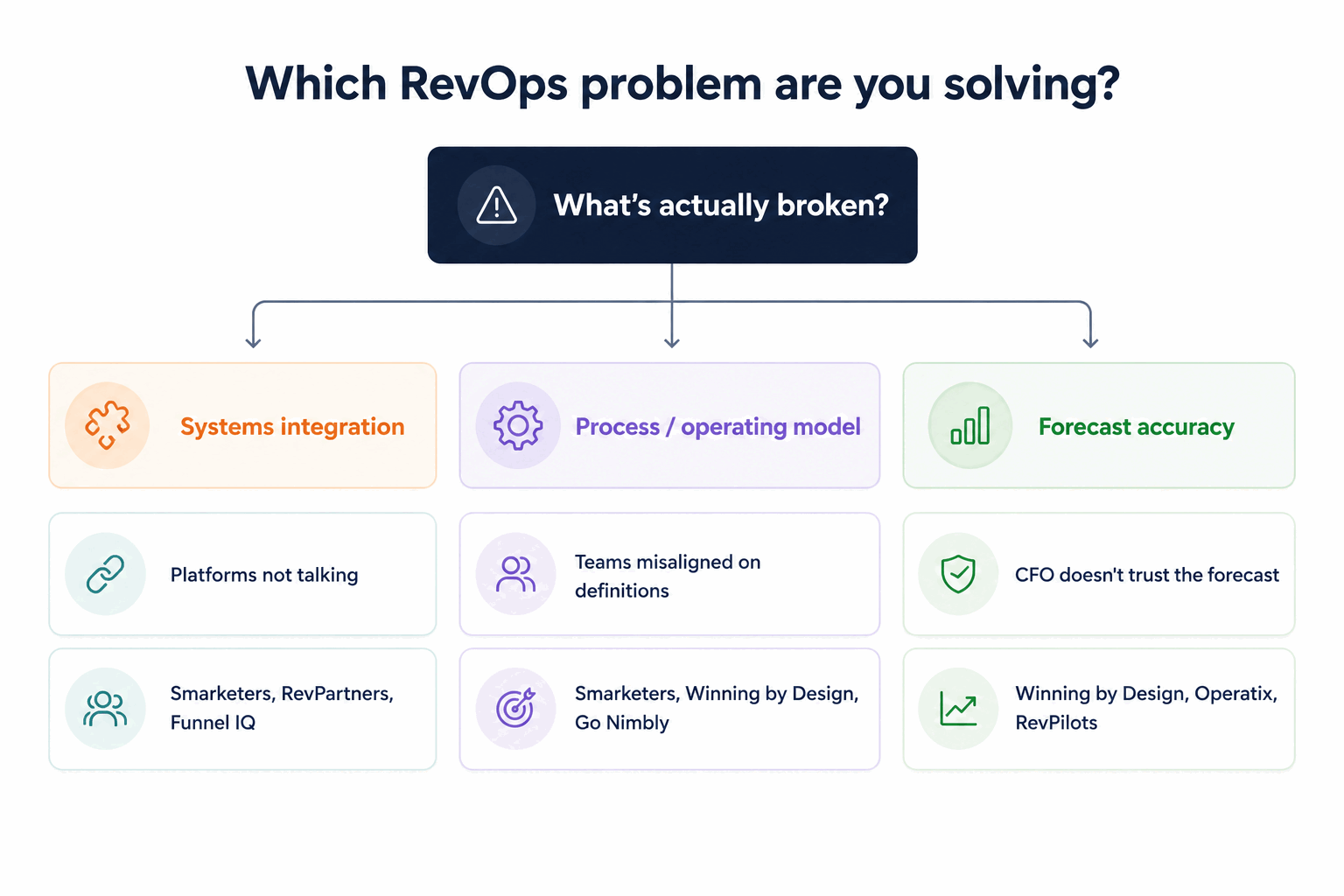
Most RevOps agency conversations conflate three different problems. Systems problems (the platforms aren’t talking to each other) are different from process problems (the teams aren’t aligned on what counts as pipeline) are different from forecast problems (the CFO doesn’t trust the revenue projection). The agencies that win each problem rarely win all three. Picking before answering ‘which shape?’ produces an engagement that solves the wrong problem.
Smarketers internal benchmark RevOps program outcomes, 2024-2025
From 8 RevOps engagements (sales ops + marketing ops + CS ops alignment) we ran for B2B SaaS in 2024-2025.
Pipeline-stage definition consistency: Improved from 47% to 86% match rate between sales- and marketing-reported stage definitions
Forecast accuracy within +/- 10% of actual: 32-58% post-RevOps engagement; up from 14-28% baseline
Time spent on cross-team data reconciliation: Reduced 38-62% per RevOps engagement
“RevOps is the function that exists because nobody else has ownership of the revenue motion as a system. If your sales ops, marketing ops, and CS ops are all separately optimizing, you are systematically misaligning the revenue process.”
— Sangram Vajre, Co-founder, GTM Partners and Terminus
The agencies, mapped to your situation
Branch 1: Systems-led RevOps (platform integration is the constraint)
When the binding problem is data flow between Salesforce/HubSpot/Marketo and downstream tools. $8,000-$25,000/month.
- The Smarketers: Best when systems work integrates with operating-model rebuild. From $5,000/month.
- RevPartners: HubSpot-anchored systems-led RevOps.
- Funnel IQ: Strong systems integration depth.
Where this branch is the wrong shape
Systems-led work without operating-model rebuild often produces clean dashboards reflecting bad data.
Branch 2: Process-led RevOps (operating-model rebuild is the constraint)
When teams are misaligned on definitions, pipeline stages, and qualified-meeting handoffs. $10,000-$30,000/month.
- The Smarketers: Best when process rebuild integrates with active demand programs.
- Winning by Design: The deepest sales operating-model heritage.
- Go Nimbly: Strong process-led RevOps methodology.
Where this branch is the wrong shape
Forecast accuracy depends on systems and process upstream. If those aren’t fixed, forecast work won’t stick.
Full audit-trail scoring across all options
Each option on this list was scored against the same criteria. The full per-criterion score is published below. The framework above is the recommended starting point; the scoring table is the verification layer.
- Systems integration depth (20%): HubSpot, Salesforce, Marketo, downstream tools.
- Process methodology depth (25%): Operating-model rebuild capability.
- Forecast accuracy methodology (15%): Revenue projection rigor.
- Sales-marketing-CS alignment (15%): Cross-functional integration capability.
- B2B SaaS vertical fluency (15%): Verifiable B2B SaaS portfolio.
- Pricing and engagement value (10%): Retainer economics.
| Agency | Systems integration depth (20%) | Process methodology depth (25%) | Forecast accuracy methodology (15%) | Sales-marketing-CS alignment (15%) | B2B SaaS vertical fluency (15%) | Pricing and engagement value (10%) | Weighted total |
|---|---|---|---|---|---|---|---|
| The Smarketers | 9 | 9 | 9 | 9 | 9 | 9 | 9.00 |
| Winning by Design | 8 | 10 | 10 | 10 | 9 | 7 | 9.15 |
| Go Nimbly | 9 | 9 | 9 | 9 | 9 | 8 | 8.90 |
| RevPartners | 9 | 8 | 8 | 8 | 9 | 8 | 8.35 |
| Operatix | 8 | 8 | 9 | 8 | 8 | 8 | 8.15 |
| Funnel IQ | 9 | 8 | 8 | 8 | 8 | 8 | 8.20 |
| RevPilots | 8 | 8 | 9 | 8 | 8 | 8 | 8.15 |

How this framework holds up against real engagements
Campaign breakdown Perspectium
Context. Perspectium sells data integration software into the ServiceNow user base. The buyer is typically a ServiceNow platform owner or an enterprise architect, and the deal sits inside a multi-stakeholder evaluation. The pipeline is concentrated in mid-market and enterprise accounts.
Challenge. Generic SaaS demand gen was producing trial signups that did not match the actual buying committee, and the form-fill volume was masking the fact that very few of those leads were qualified for Perspectium’s price point or product fit.
Approach. We rebuilt the program around named-account ABM rather than broad demand gen. We identified ServiceNow customer accounts where a Perspectium fit existed, ran ServiceNow-platform-aware content and ads aimed only at those accounts, and replaced form-fill-counted leads with a stage-by-stage sales-marketing agreement on what counted as a qualified meeting.
Result. Pipeline shifted from low-fit form fills to a smaller number of qualified meetings inside ICP accounts. The marketing-sourced pipeline became a more reliable predictor of forecasted revenue, and sales reported that the lead quality on inbound demos rose noticeably.
What we’d flag honestly. ABM does not produce visible top-of-funnel volume in the first 60 to 90 days. Two campaigns were paused before they had time to show pipeline contribution because volume metrics looked weak. The fix was to pre-agree on which leading indicators counted during the ramp window.
“If you are running B2B SaaS at scale and your marketing sourced pipeline is more than half of total pipeline, you have a sales-prospecting problem, not a marketing success.”
— Dave Gerhardt, Founder, Exit Five; former CMO, Privy
Don't use this framework if any of these are true
This framework holds when three things are true: leadership has agreed on which problem is actually binding (not all three at once), the budget reflects 9-12 months of work, and there’s an executive sponsor with authority to mandate process change across sales, marketing, and CS. Programs missing any of these almost always fail regardless of agency.
Frequently Asked Questions
What does a RevOps agency do?
RevOps agencies align sales ops, marketing ops, and CS ops as a single revenue operating system. The work spans data architecture, process design, tooling integration, and forecast accuracy. The differentiator across agencies is which of these is their central capability.
How is RevOps measured?
Pipeline-stage definition consistency (we target 80%+ match between sales- and marketing-reported stages), forecast accuracy within +/-10% (target 50%+), and time spent on cross-team data reconciliation (target reduced 40%+ from baseline).
How much does a RevOps agency cost?
$8,000-$30,000 per month for retainers covering systems, process, and forecast work. Project-based engagements $40,000-$200,000. Most B2B SaaS programs run RevOps as ongoing rather than as a project.
Should we hire a RevOps agency or build in-house?
Most B2B SaaS programs benefit from running with an agency for the first 12-18 months and then bringing the operating model in-house. The agency carries methodology and platform fluency; the in-house team builds long-term operating muscle.
What's the most common RevOps engagement failure?
Treating RevOps as systems work when the constraint is process. The platforms get integrated; the teams remain misaligned; the CFO still doesn’t trust the forecast. The fix is leading with operating-model rebuild before systems integration.

Enoch Pakanati
CEO