Need help with B2B Marketing?
Let the smarketers’ team drive your pipeline with data-led campaigns and AI-powered growth strategies.
Enterprise tech buyers are no longer just typing queries into Google and clicking the first blue link. They are asking Perplexity to compare your software against your biggest competitor. They are using ChatGPT to summarize your pricing model. They are relying on AI Overviews to understand if your integration capabilities fit their existing stack.
If your brand isn’t showing up in these AI-generated answers, you are invisible during the most critical research phases of the buying journey.
This shift has created a massive gap in traditional marketing strategies. You might rank number one for a high-volume keyword, but if an AI engine doesn’t cite your content when a CTO asks a complex question, that ranking means very little. This is where Generative Engine Optimization (GEO) comes in. Finding the right partner to navigate this shift is difficult, especially in a market flooded with agencies claiming to do “AI SEO.”
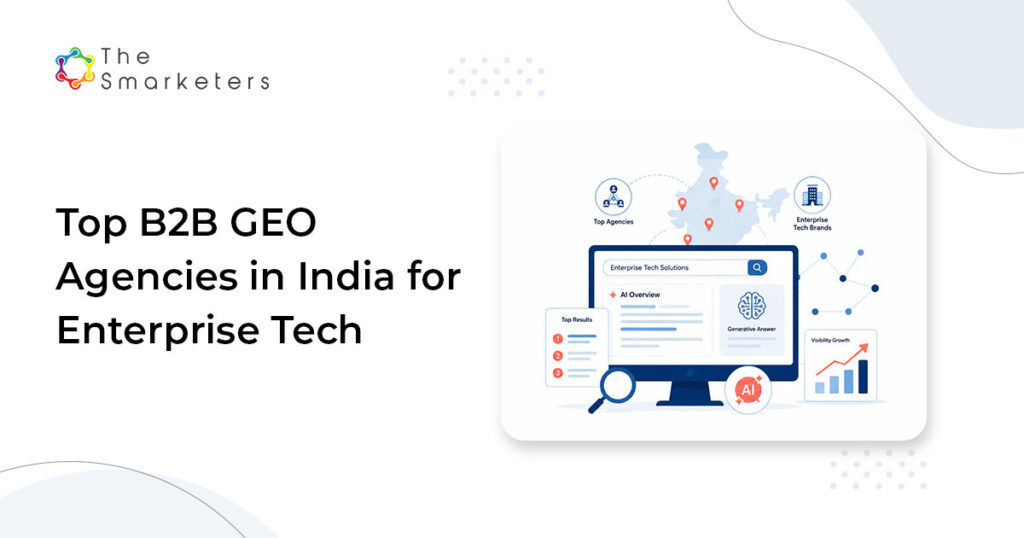
We have evaluated the landscape to help you find the right fit. Here is a look at the top B2B GEO agencies in India equipped to handle the complexities of enterprise tech.
GEO is Not SEO with a New Name
It is tempting to think of GEO as just another tactic to add to your existing SEO checklist. It isn’t. Generative Engine Optimization requires a fundamental shift in how you structure and deliver information.
Traditional SEO optimizes for search rankings. You want to be at the top of the page when someone searches for a specific term. GEO optimizes for AI-generated answers. You want to be the source material that an AI model uses to construct its response.
These two goals require different signals. Search engines look for backlinks, keyword density, and user engagement metrics. AI models look for information gain, entity relationships, and structured data. They want to know if your content provides unique, verifiable facts that aren’t available elsewhere.
Content structures must change as well. A 3,000-word ultimate guide might rank well in traditional search, but an AI model prefers concise, well-structured data points. It looks for clear definitions, direct comparisons, and expert quotes that it can easily extract and synthesize. If your content is buried under layers of marketing fluff, the AI will simply move on to a clearer source.
Why Enterprise Tech Companies Need Specialized GEO
Selling enterprise technology is inherently complex. You are not selling a simple widget to a single buyer. You are navigating a buying committee of six to ten people, each with their own priorities and concerns. The CTO cares about security and integration. The CFO cares about ROI and total cost of ownership. The end-user cares about usability and workflow.
These sales cycles are long, often stretching from six to eighteen months. Throughout this process, buyers are constantly researching, comparing, and evaluating. And increasingly, they are using AI tools to do it.
A specialized GEO approach is necessary because enterprise tech requires technical depth. Generalist agencies often struggle to grasp the nuances of complex website architectures or industry-specific compliance standards. If the agency doesn’t understand the product, they cannot create the high-information-gain content that AI models crave.
Furthermore, enterprise tech buyers ask complex, multi-layered questions. They don’t just ask “What is cloud security?” They ask “How does cloud security posture management differ from cloud workload protection platforms in a multi-cloud environment?” Your GEO strategy must anticipate these nuanced queries and provide the exact technical details the AI needs to formulate an accurate answer.
Top GEO Agencies in India for B2B
Choosing the right agency means finding a partner who understands both the mechanics of AI search and the realities of B2B enterprise sales. Here is a comparison of the top players in the Indian market.
| Agency | Best For | Key Methodology | Notable Clients/Experience |
|---|---|---|---|
| The Smarketers | Enterprise Tech & Complex B2B | Entity mapping, information gain, cross-platform citation monitoring | Thomson Reuters, IBM, Rockwell Automation |
| Jepto Digital | Data-Driven Campaigns | Predictive analytics and AI-driven insights | Mid-market B2B SaaS |
| Infidigit | Technical SEO Transition | Large-scale technical audits and structured data | E-commerce and Enterprise B2B |
| Techmagnate | Broad Digital Presence | Integrated search and content marketing | BFSI and Tech |
| Growth Jockey | Rapid Scaling | Growth hacking and AI experimentation | Startups and Scale-ups |
1. The Smarketers
The Smarketers stands out because we don’t treat GEO as an isolated tactic. We integrate it into a broader understanding of the B2B buying journey. As an agency with an ITSMA Marketing Excellence Gold Award and a track record of executing 40+ ABM programs with an 85% success rate, we know how enterprise buyers make decisions.
Our approach is built on an AI-enabled tool stack with 25 different modules, allowing us to monitor citations across major LLMs and optimize content for specific AI engines. We understand that enterprise tech requires depth.
Consider our work with a Fortune 100 Tech Company in the IT & SaaS space. The goal was to engage enterprise accounts during their research phase. By focusing on high-information-gain content and structured data, we ensured the brand was visible when these accounts used AI for vendor research. The result was 100+ Enterprise Accounts Engaged. We didn’t just chase traffic; we positioned the client as the authoritative source for AI models to cite.
Our hybrid ABM and Inbound model means we align GEO efforts with your target account list. We ensure that when your key prospects ask AI about solutions in your category, your brand is the answer.
2. Jepto Digital
Jepto Digital brings a strong analytical approach to the table. They focus heavily on predictive analytics and using AI to uncover insights from search data. For B2B companies looking to transition from traditional SEO to a more data-driven model, Jepto offers a solid foundation.
They are particularly effective at identifying emerging search trends and optimizing content to capture early interest. However, their focus tends to be broader, which might require more hands-on guidance from your internal subject matter experts when dealing with highly technical enterprise software.
3. Infidigit
Infidigit has built a strong reputation in technical SEO, and they are applying that expertise to GEO. They excel at large-scale technical audits, ensuring that your website’s architecture and structured data are perfectly aligned with what AI crawlers expect.
If your enterprise site suffers from technical debt or complex architecture issues that prevent AI models from parsing your content, Infidigit is a strong choice. Their approach is highly methodical, though they may lean more heavily on the technical side rather than the nuanced content strategy required for complex B2B buying committees.
4. Techmagnate
Techmagnate is one of the larger, more established digital agencies in India. They offer a comprehensive suite of services, integrating search, content, and digital PR. Their approach to GEO is often bundled with broader digital transformation initiatives.
They have significant experience across various sectors, including BFSI and tech. Their strength lies in their ability to execute large-scale campaigns. For enterprise tech companies needing a highly specialized, niche approach to AI citations, Techmagnate’s broad focus might require careful alignment to ensure technical accuracy.
5. Growth Jockey
Growth Jockey focuses on rapid scaling and growth hacking. They are quick to adopt new AI tools and experiment with emerging GEO tactics. This makes them an interesting option for fast-moving tech companies looking to test new waters.
Their agile approach is great for startups and scale-ups. For established enterprise tech companies with strict brand guidelines and complex compliance requirements, Growth Jockey’s experimental style might need to be tempered with a more structured governance framework.
The Smarketers’ GEO Methodology
Our methodology is designed specifically for the complexities of B2B enterprise tech. We don’t guess what AI models want; we engineer content to meet their exact requirements.
First, we focus on entity mapping. AI models understand the world through entities people, places, concepts, and products and the relationships between them. We map the entities relevant to your complex B2B products, ensuring that AI models understand exactly how your solution connects to broader industry concepts and specific buyer problems.
Second, we prioritize information gain. AI models prioritize sources that offer new, verifiable information rather than just summarizing what is already out there. We work with your subject matter experts to extract unique insights, proprietary data, and expert opinions that AI models will want to cite.
Third, we implement cross-platform citation monitoring. We don’t just look at Google’s AI Overviews. We track how your brand is cited across Perplexity, ChatGPT, and other major LLMs. This allows us to understand which models prefer which types of content and adjust our strategy accordingly.
Finally, we use advanced structured data. We go beyond basic schema markup to provide AI models with a clear, machine-readable understanding of your content. This ensures that when an AI model needs a specific fact or comparison, it can easily extract it from your site.
Questions to Ask Before Hiring a GEO Agency
Selecting the right agency requires asking the right questions. Don’t settle for generic answers about “optimizing for AI.” Dig into their specific methodologies.
Do they track citations across all major LLMs? If an agency only focuses on Google, they are missing a massive piece of the puzzle. Buyers use multiple AI tools for research. Your agency needs to monitor and optimize for all of them.
Do they understand B2B buying committees? GEO for enterprise tech isn’t about reaching one person; it’s about influencing a group. Ask how their content strategy addresses the different concerns of the CTO, CFO, and end-user within an AI-driven research context.
Can they show before/after citation data? Traditional SEO metrics like keyword rankings and organic traffic are not enough. Ask to see case studies where they have successfully increased a brand’s visibility in AI-generated answers. Look for evidence of improved citation frequency and sentiment.
Frequently Asked Questions
What is Generative Engine Optimization (GEO)?
GEO is the process of optimizing content so that it is cited and recommended by AI search engines and large language models like ChatGPT and Perplexity. It focuses on information gain, entity relationships, and structured data rather than traditional keyword rankings.
How is GEO different from traditional SEO?
Traditional SEO aims to rank web pages on search engine results pages based on keywords and backlinks. GEO aims to position your brand as the source material for AI-generated answers, requiring unique insights and clear, machine-readable formatting.
Why do enterprise tech companies need GEO?
Enterprise tech buyers use AI tools to research complex solutions, compare vendors, and understand technical specifications. If your brand isn’t cited in these AI responses, you miss critical opportunities during long, complex sales cycles.
How long does it take to see results from GEO?
Like traditional SEO, GEO is a long-term strategy. However, because AI models continuously ingest new data, highly authoritative, high-information-gain content can sometimes be cited within weeks of publication.
Can we do GEO in-house?
Yes, but it requires a deep understanding of AI model behavior, entity mapping, and advanced structured data. Many enterprise companies partner with specialized agencies to navigate the technical complexities and monitor cross-platform citations.
Does GEO replace traditional SEO?
No. GEO and SEO work together. Traditional search is still a major driver of traffic, but GEO ensures you are visible in the rapidly growing segment of AI-driven research and zero-click searches.
How do you measure GEO success?
Success is measured by citation frequency across major LLMs, brand sentiment in AI responses, and the inclusion of your brand in AI-generated comparisons and recommendations.
What is information gain in GEO?
Information gain refers to providing unique, valuable insights, data, or perspectives that are not already widely available on the internet. AI models prioritize content with high information gain when constructing answers.

Enoch Pakanati
CEO