
Table of Contents
- Why is the practice the unit of competition in alliance marketing?
- Do partner certifications count as a marketing asset?
- How do you build a practice narrative the vendor will amplify?
- Which vendor roles should a system integrator build relationships with?
- How much do partner directory listings and competency badges matter?
- How do you write joint customer stories that pass vendor review?
- How should a system integrator expand from one practice to several?
- How do you measure alliance-sourced pipeline and revenue?
- When does practice-led alliance marketing not work?
- Frequently Asked Questions
Need help with B2B Marketing?
Let the smarketers’ team drive your pipeline with data-led campaigns and AI-powered growth strategies.
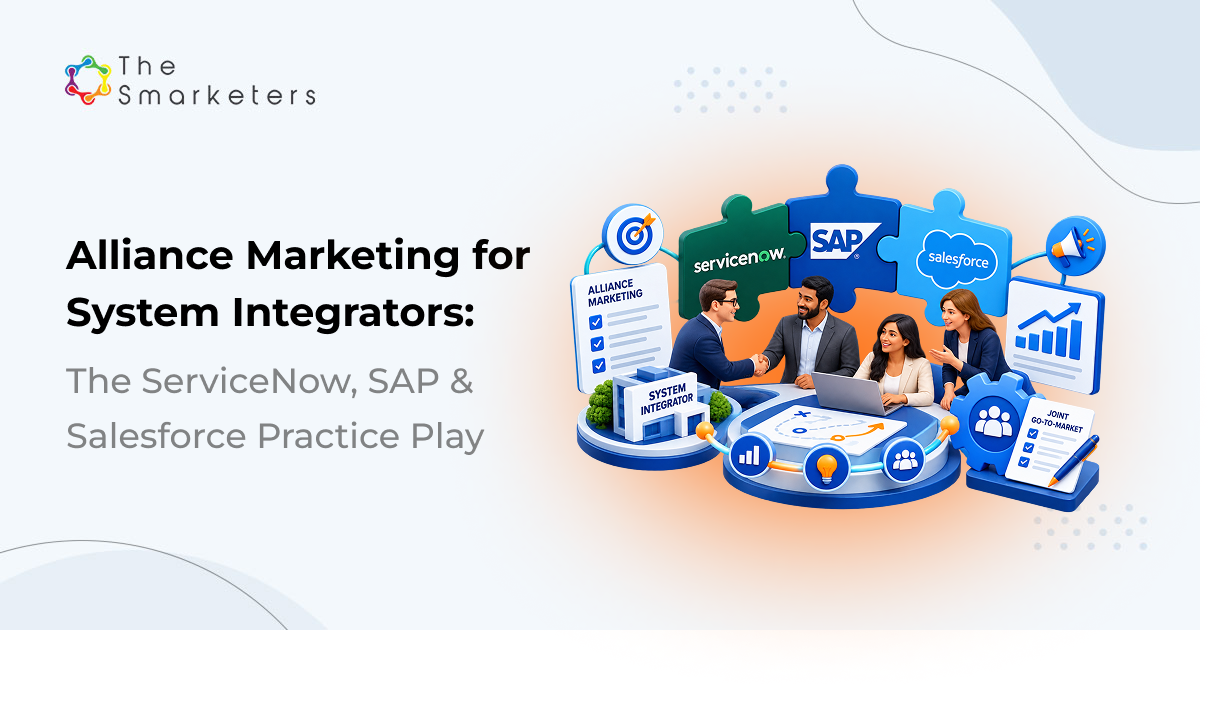
Nobody shortlists a system integrator because of its corporate brand campaign. In alliance marketing for system integrators, the marketable unit is the practice, not the company: a named capability with certified people, a defined offer and customers who will say it worked. Certification depth, vendor-validated customer stories and placement in the vendor’s own partner directory move pipeline further than anything a brand budget buys.
This is uncomfortable for IT services marketing teams organised around the company. The plan gets rebuilt around three or four practices with different buyers, vendors and proof, each competing internally for the same delivery capacity.
Alliance marketing for a system integrator is the work of winning pipeline through its technology vendors: certified practices, complete partner directory listings and joint customer stories the vendor will promote. It replaces company-level brand spend as the main route onto enterprise shortlists.
Why is the practice the unit of competition in alliance marketing?
Because that is the unit the buyer compares. A CIO replacing a service management platform does not evaluate integrators in general. They evaluate who has delivered that platform, in their industry, at their scale.
Vendors reinforce it. Partner tiers, competencies and directory filters in the ServiceNow, SAP and Salesforce partner programmes are organised by product line and specialisation, which leaves your company-level story invisible in the systems buyers and vendor sellers use to find partners.
KEY TAKEAWAY
A practice is a marketable unit when it has a named leader, a defined offer, certified delivery capacity and at least two customers who will be quoted. Missing any one of those, it is a slide.
Do partner certifications count as a marketing asset?
Yes, more directly than most marketing teams treat them. Certification counts are a filter in partner directories, a criterion in vendor tiering, and the fastest credibility signal in a shortlist conversation.
Treat the certification roster as owned media: publish the numbers by product line and keep them current, show the mix rather than one total, and name the specialists holding the rarer credentials. Be honest about capacity, since 40 certifications concentrated in three people is a delivery risk a sophisticated buyer will spot.
Five certification signals and where buyers see them:
| Signal | What it proves | Where buyers see it |
|---|---|---|
| Certification count by product line | Delivery depth | Directory filters, RFPs |
| Partner tier or level | Scale and vendor investment | Directory badge, introductions |
| Specialisations or competencies | Proven outcomes in an area | Directory filters, seller tools |
| Named customer stories | Real delivery, not training | Your site, vendor site |
| Individual named experts | Depth beyond the headline | Search, community, events |
The fourth row turns the first three into pipeline. Certifications without stories read as training spend rather than evidence of delivery.
How do you build a practice narrative the vendor will amplify?
Write it for the vendor’s field team as much as the buyer, because vendor amplification makes a practice visible at a scale your own budget cannot reach.
Four elements make a narrative amplifiable. It aligns to a motion the vendor is pushing this year. It has a packaged offer with a name, scope and duration rather than a capability statement. It has a reference customer willing to be named. And it has a single owner the vendor’s partner marketing manager can call.
Skip any of those and the answer is a polite no, usually explained as a scheduling problem.
STAT
Professional services and logistics brands appear in around 2.1% of relevant AI Overviews, against 4.2% for cybersecurity, with median enterprise B2B brands at 3%. Source: Walker Sands B2B AI Search Visibility Benchmark, 828 companies across 14 industries and about 45 million keywords, published April 2026.
That gap matters for integrators. Services categories are cited less often in AI search than product categories, and the citations that occur lean on third-party sources. That is an argument for vendor directories, vendor blogs and joint stories over another page on your own site, the same logic that makes cloud marketplace listings citation assets.
Which vendor roles should a system integrator build relationships with?
More people than the alliance manager, and different ones than most SIs cultivate. The partner manager owns the relationship; they rarely own the pipeline. Five roles matter, each needing something different from you.
Five vendor roles and what each wants from a system integrator:
| Role | What they want from you |
|---|---|
| Partner or alliance manager | Registered pipeline and a partner who is easy to work with |
| Industry or regional sales leader | Coverage in accounts their team cannot service alone |
| Solution consultants and pre-sales | A partner who will not embarrass them technically |
| Product line specialists | Proof you can deliver their module or motion |
| Partner marketing manager | A practice worth co-marketing and funding |
Most SI alliance marketing programmes over-invest in the first row and ignore the last, then wonder why nothing is promoted.
How much do partner directory listings and competency badges matter?
More than a website redesign, for one reason: the directory is where buyers and vendor sellers search for partners, and its filters are structural. If your record does not carry the product line, industry or specialisation a buyer filters on, you are not on the list.
Keep the record complete rather than impressive. Certifications current, industries specified, regions accurate, description written in the vendor’s terminology, reviews collected where the programme supports them. Programme structures and badge names change regularly, so assign an owner and a review date rather than assuming last year’s entry still fits.
PROOF POINT
Globpar, an SAP ecosystem partner, is one of the alliance programmes The Smarketers has run within a portfolio of 250+ clients and more than $450M in generated pipeline since 2015. Alliance-sourced pipeline following the practice rebuild: [FIELD: change in vendor-registered opportunities across the two quarters after the practice narrative and directory rebuild].
How do you write joint customer stories that pass vendor review?
Plan for the approval chain before writing a word, because that chain kills most joint stories. You need the customer’s marketing approval, the customer’s legal approval and the vendor’s review, and any of the three can stall indefinitely.
Four practices make approval likelier. Agree metrics with the customer before drafting, so nothing is renegotiated after legal sees it. Use the vendor’s exact product naming, since incorrect names are the commonest rejection. Avoid comparative claims. And write a customer-approved version that stands alone.
We ran this for an integrator building a practice in one enterprise platform ecosystem. Two stories had been stuck in review for months, freezing the launch. We split each into a short customer-approved version we could publish immediately and a longer joint version that continued through vendor review. The practice launched on time, and the joint versions arrived a quarter later.
How should a system integrator expand from one practice to several?
Sequentially, and more slowly than the board would like. The common failure is launching three practices at once, spreading certification investment thin and leaving none with the depth that earns a directory placement worth having.
Pick the second practice on one of two grounds: it shares the buyer with the first, or it shares the delivery organisation. Sharing the buyer lets you reuse account relationships and references. Sharing delivery lets you reuse certified people. Sharing neither means starting from zero.
Keep the practices visibly distinct in market. Buyers and vendor sellers search for a specialist, and a page claiming equal excellence in five platforms reads as a generalist, which is the position an SI cannot win from and the core trap in system integrator marketing.
How do you measure alliance-sourced pipeline and revenue?
Separate three categories and report them differently, ideally as distinct partner pipeline stages in HubSpot or your CRM. Collapsing them into one number is how alliance programmes lose their budget.
Three categories of alliance pipeline and what each tells you:
| Category | Definition | What it tells you |
|---|---|---|
| Alliance-sourced | Vendor introduced it | Whether the field relationship works |
| Alliance-influenced | Vendor involved, you found it | Whether the badge helps you win |
| Practice-driven | Sourced on practice reputation | Whether the marketing works |
Then track two ratios most SIs never calculate: pipeline per certified consultant by practice, and registered opportunities to alliance-sourced wins. The first shows whether certification investment produces anything; the second shows whether the vendor relationship is real or ceremonial.
This matters because of where the decision forms. 68% of B2B buyers already have a front-runner in mind when buying begins, and that front-runner wins 80% of the time, according to Forrester’s Buyers’ Journey Survey, 2025, presented at its B2B Summit North America in 2026. A vendor introduction is one of the few routes into that position.
When does practice-led alliance marketing not work?
Practice-led marketing assumes you can reach real depth in a platform. Below a certain scale of certified delivery capacity you cannot compete on that axis, and the honest strategy is industry or geographic specialisation instead.
Alliance dependence carries risk. A practice built on one vendor’s motion is exposed to that vendor’s roadmap, tier changes and field reorganisations, none of which you control. Two ecosystems is usually the minimum stable position, and it costs real money.
Vendor amplification is also not a growth strategy on its own. It puts you on shortlists; it does not make you win. The system integrator and IT services programmes that work pair alliance visibility with account-based demand of your own, built on customer stories you control.
Frequently Asked Questions
What is alliance marketing for system integrators?
Alliance marketing for system integrators is how an SI builds pipeline through its technology vendors rather than its own brand. For ServiceNow, SAP or Salesforce partners, it means certified practices, accurate partner directory listings, joint customer stories that pass vendor review and co-marketing the vendor will fund.
How should a system integrator market its practices?
Market each practice as a distinct unit with a named leader, a packaged offer, published certification depth and at least two named customer stories. Company-level brand messaging does not appear in the directory filters and vendor tools buyers and sellers use to build shortlists.
Do partner certifications help win business?
Yes, because they are filters rather than decoration. Certification counts drive partner directory results, vendor tiering and shortlist credibility. They convert into pipeline only alongside named customer stories; certifications alone read as training investment rather than proof of delivery.
How do I get a vendor to promote my practice?
Align to a motion the vendor is actively pushing, package a named offer with a defined scope and duration, secure a reference customer willing to be named, and give the partner marketing manager a single owner to contact. Missing any of these usually produces a polite refusal.
What makes a joint customer story pass vendor review?
Metrics agreed with the customer before drafting, exact vendor product naming, no comparative claims about competing products, and a consent chain covering customer marketing, customer legal and vendor review. Keep a shorter customer-approved version you can publish if review stalls.
How many alliances should a system integrator maintain?
Enough for stability without diluting depth. A single-vendor practice is exposed to that vendor’s roadmap, tier changes and field reorganisations, while three simultaneous launches spread certification investment too thin. Two established ecosystems is a common workable position.
How do you measure alliance-sourced pipeline?
Report alliance-sourced, alliance-influenced and practice-driven pipeline separately rather than as one figure. Add pipeline per certified consultant by practice and the ratio of registered opportunities to alliance-sourced wins, which show whether certification spend and the vendor relationship produce anything.

Indrani Gope
Content Head