Table of Contents
- How Do Pharma and Biotech Buyers Use AI for Vendor Research?
- What Does Regulatory-Compliant, AI-Citable Content Look Like?
- Entity Optimization for Complex Scientific Products
- A Cross-Platform Citation Strategy for Scientific Buyers
- The MLR-Ready Citation Framework
- Case Study: Health Tech Pipeline Built on Compliant, Answer-First Content
- When AEO Is Not Your First Priority
- Where to Start
- Frequently Asked Questions
Need help with B2B Marketing?
Let the smarketers’ team drive your pipeline with data-led campaigns and AI-powered growth strategies.
A director of clinical operations at a mid-size biotech asks an AI assistant to compare eTMF platforms for a Phase II program. She gets a structured answer naming four vendors, their validation posture, and rough pricing logic. Two of the citations are Reddit threads. One is a competitor’s knowledge base. Your company, which has the strongest GxP story in the category, appears nowhere, and no MLR reviewer ever got the chance to object, because the answer was assembled from sources you do not control.
This scene is no longer an edge case. Forrester’s 2025 Buyers’ Journey Survey found 94% of B2B buyers use generative AI during the purchase process, and rated it a more meaningful information source than vendor websites or sales conversations. Scientific and clinical buyers, who already live in literature search, have adopted the habit faster than most marketing teams have adjusted to it.
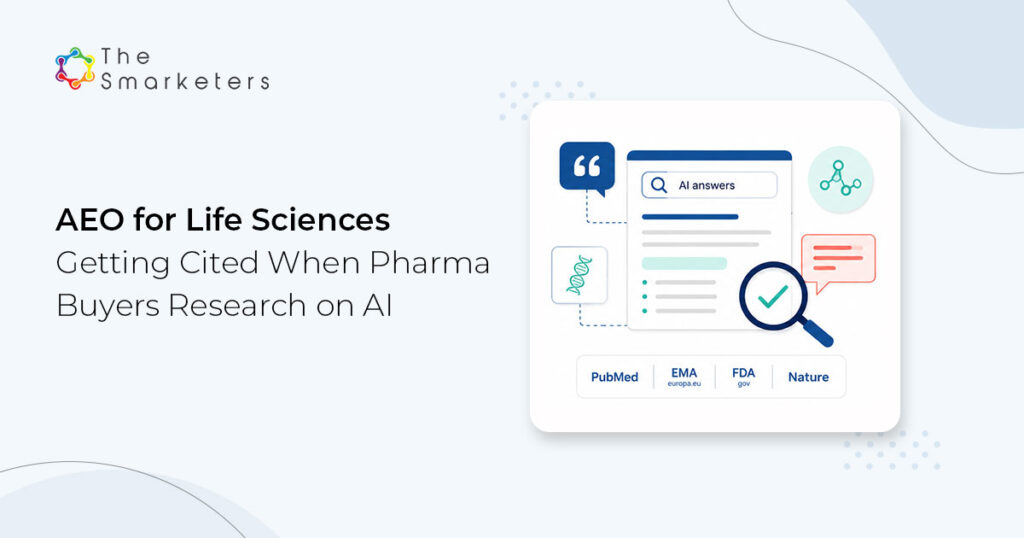
Answer engine optimization (AEO) is the discipline of earning citations inside those AI-generated answers. Life sciences is the hardest place to practice it, because the same regulatory machinery that protects your claims also slows the publishing behaviors AI platforms reward. This article covers how pharma and biotech buyers actually use AI, how to build compliant content that still gets cited, how to fix entity confusion around complex scientific products, and the framework we use at The Smarketers to make it work inside MLR constraints.
How Do Pharma and Biotech Buyers Use AI for Vendor Research?
They use it the way they use a literature review: to compress weeks of source-gathering into hours, then verify what matters. Gartner’s survey of 645 B2B buyers found buyers consult around seven information sources per purchase, 45% used generative AI to gather vendor and product information, and 69% now use sales reps to validate what the AI already told them. Read that last number again from a life sciences seller’s chair: by the time your business development team is in the room, the assistant has usually framed the category and named the contenders.

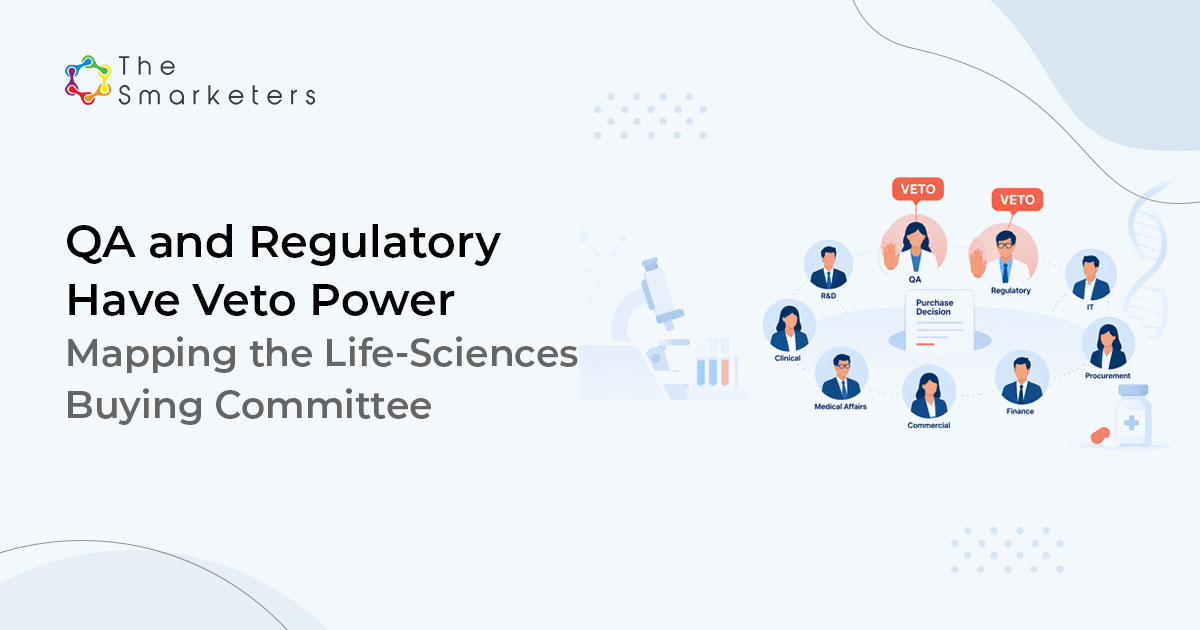
Two features make this riskier in life sciences than elsewhere. First, the buying committee is scientific: it includes people professionally trained to distrust unsourced claims, which means AI answers that cite verifiable material carry unusual weight with them. Second, the cost of wrong information is higher. Forrester found 20% of buyers lost confidence in a decision after encountering unreliable AI-generated information, rising to 28% among procurement. When an assistant mangles your validation documentation or confuses your assay with a competitor’s, you inherit that lost confidence without ever being in the conversation.
Key stat:69% of B2B buyers use sales reps to validate AI-generated insights (Gartner, survey of 645 buyers). In regulated categories, the AI answer is increasingly the first draft of your positioning, written without you.
What Does Regulatory-Compliant, AI-Citable Content Look Like?
It is content built from claims you can already defend, structured so a retrieval system can quote it safely. The common objection from life sciences teams is that compliance forbids the kind of direct, comparative content AI platforms cite. In our experience the objection is half right: it forbids certain claims, not clear structure. Nothing in an MLR process prevents a page from opening with a direct, referenced answer instead of four paragraphs of positioning throat-clearing.
The working rules we apply with regulated clients:
- Separate claim classes. Product-performance claims stay inside approved language with references. Process and educational content (how validation audits work, what a decentralized trial workflow requires, how to evaluate an eTMF migration) carries minimal claim risk and is where AEO wins fastest. Most life sciences sites are thin exactly where the claim risk is lowest.
- Answer first, evidence attached. Every section opens with the direct answer, then the supporting detail and references. This is both what retrieval systems extract and what MLR reviewers prefer: unambiguous statements with visible sourcing are easier to approve than mood copy.
- Self-contained sections. A passage that only makes sense after reading three prior sections cannot be lifted into an AI answer. Write sections that stand alone, with defined terms at first use.
- Pre-approved modular blocks. Get standard descriptions of the company, platforms, and regulatory posture through review once, then reuse them verbatim across pages, directories, and profiles. This turns MLR from a bottleneck into a consistency engine, which is exactly what entity optimization needs anyway.
- Named scientific authorship. Pages attributed to real scientists and regulatory experts, with credentials, outperform anonymous corporate content on every trust signal AI platforms reward. Your medical affairs team is an AEO asset most competitors will not deploy.
The honest trade-off: review cycles mean you will never out-publish an unregulated competitor on volume or freshness. Do not try. The compliant advantage is authority and precision, and the strategy below leans on both.
Entity Optimization for Complex Scientific Products
An entity, in search terms, is the stable identity a machine holds for a thing: your company, your platform, your assay. Life sciences portfolios are an entity minefield: products carry internal code names, generic descriptors, and post-acquisition rebrands; the same molecule or instrument appears under different names in papers, distributor catalogs, and your own site. When naming is inconsistent, retrieval systems fragment your authority across several weak identities, and an AI assistant either omits you or, worse, blends your product with someone else’s.
The fixes are unglamorous and effective:
- One canonical name per product, everywhere. Site, LinkedIn, review platforms, distributor listings, webinar titles, publication acknowledgments. Retire legacy names with explicit “formerly known as” statements rather than silent swaps.
- Definition blocks on every product page. One paragraph stating what the product is, what class it belongs to, who uses it, and what it is not. The “what it is not” sentence does disproportionate work against AI conflation of similar scientific products.
- Structured data. Organization, Product, and Article schema, plus Person schema for scientific authors. Machines should never have to infer your corporate structure from prose.
- Consistent third-party footprint. The profiles and directories AI platforms retrieve from should describe you in your pre-approved modular language, not in a distributor’s five-year-old paraphrase.
A Cross-Platform Citation Strategy for Scientific Buyers
Treat each assistant as a separate channel with separate source preferences, because measured citation behavior differs sharply by platform. Profound’s analysis found Reddit alone accounts for 46.7% of Perplexity’s top citations, while 5W Research found Wikipedia (13.15%) and Reddit (11.97%) drive over a quarter of ChatGPT citations in the US, and roughly 30 domains capture about 67% of ChatGPT citations within a topic. Across platforms, Reddit is the most-cited source overall, which should reset assumptions about where scientific buying conversations happen.

What this means in practice for a life sciences vendor:
| Priority | Why it matters for life sciences | What to do |
|---|---|---|
| Community presence (Perplexity and beyond) | Scientist and clinical-ops communities on Reddit and specialist forums discuss instruments, assays, and platforms candidly, and those threads get cited heavily. | Named scientists and application specialists answering technical questions honestly, within compliance boundaries; never promotional accounts. |
| Consensus authority (ChatGPT) | Citations concentrate in a small set of authoritative domains per topic. | Peer-reviewed publications, trade press contributions, review-platform depth, and consistent entity naming so mentions accrue to one identity. |
| Extractable structure (all platforms) | Retrieval systems favor answer-first, self-contained, well-attributed sections. | Apply the compliant content architecture first to comparison and evaluation pages. |
| Original data | Scientific buyers and AI platforms both privilege primary sources. | Benchmarks, validation datasets, method comparisons published openly with named authors. |
A note on platform folklore: claims that one assistant “owns” medical queries while another owns research queries that circulate widely, but platform-by-platform data for life sciences specifically is thin. Build the shared foundation, measure your own citation share per platform monthly with a panel of 30-50 real buyer prompts, and let your own data allocate the follow-on effort.
The MLR-Ready Citation Framework
We run life sciences AEO engagements on a five-step sequence we call the MLR-Ready Citation Framework, because the design constraint is that every step must survive medical-legal-regulatory review without heroics.
- Baseline citation share. Build the buyer-prompt panel with input from medical affairs and business development, run it monthly across ChatGPT, Perplexity, Claude, and Gemini, and log which vendors and sources get cited. This is the KPI the program moves.
- Clear the claims runway. Classify content by claim risk, pre-approve modular entity language, and agree with MLR on a fast lane for educational and process content. This step is why the rest of the program moves at publishing speed.
- Restructure the evaluation layer. Rewrite comparison, evaluation, and how-to-choose pages answer-first and self-contained, with schema and named scientific authors. These pages map to the highest-intent prompts.
- Consolidate entities. Canonical naming, definition blocks, structured data, and a corrected third-party footprint, in that order.
- Earn corroboration with original evidence. Publish primary data worth citing and support genuine practitioner participation in the communities where your categories are discussed. In regulated categories this compounds slowly and durably: competitors cannot fake a validation dataset.
Case Study: Health Tech Pipeline Built on Compliant, Answer-First Content
The results first: 100+ marketing qualified leads in six months, cost per lead cut from $75 to $51.86, and click-through rates up from 2% to 4.43% for a health technology client selling into hospital systems (Smarketers client engagement; details at thesmarketers.com/success-stories).
Before: the client had credible clinical expertise and a content library written like a brochure: capability language up front, evidence buried, nothing structured for the questions clinical and IT evaluators actually ask. Paid spend was carrying the pipeline at an unsustainable cost per lead.
After: with the content rebuilt around direct answers to evaluation-stage questions and distribution matched to where healthcare buyers research, lead volume passed 100 MQLs in six months while cost per lead fell by roughly a third.
The bridge: the same architecture this article describes: answer-first pages mapped to real buyer questions, consistent product naming, and evidence attached to every claim. The identical structural work is what moves AI citations. In a parallel engagement, a cybersecurity client that restructured its highest-intent pages for retrieval achieved 3X organic growth, compounding at 16.31% month over month, as the rebuilt pages earned positions in both traditional search and AI answers.

When AEO Is Not Your First Priority
An honest screen before you fund this:
- Your buyers are not asking assistants yet. A few ultra-specialized categories still see negligible AI research volume. Run the prompt panel first; if assistants return empty or generic answers with no vendor names, revisit in two quarters and spend the budget on demand generation.
- Your evaluation content does not exist. AEO restructures and amplifies substance. If there is nothing credible to restructure, fix the content foundation first; our content marketing team usually sequences this ahead of AEO work.
- MLR will not engage. Without an agreed fast lane for low-risk content, review cycles will starve the program. Get the process agreement before the retainer.
- You need a pipeline this quarter. Citation movement typically shows in 8-12 weeks and compounds after that. It is a durable channel, not a rescue plan.
The most common mistake in the category is also worth naming: blocking AI crawlers by default. Legal teams sometimes extend paywall logic to the whole domain, which removes the company from AI answers entirely while competitors and Reddit threads define the category unopposed. Decide crawler policy deliberately, page class by page class.
Where to Start
Run the baseline this week: 30 prompts your buyers would actually ask, three assistants, one spreadsheet. If your brand is absent and your competitors or random forum threads are not, you have a measurable gap and a defensible business case.
If you want the baseline, the claims-runway work, and the restructuring plan done for you, get a Life Sciences AEO Audit. It maps your citation share against your top three competitors and tells you which of the five framework steps moves your number first.
Frequently Asked Questions
How long does life sciences AEO take to show results?
Expect first citation movement in 8-12 weeks for evaluation-stage prompts, slower than unregulated categories because review cycles gate publishing speed. The compensation is durability: authority earned with primary evidence erodes slowly, and competitors cannot shortcut it.
Does AEO conflict with MLR review?
No, but it does require a process agreement: pre-approved modular language for entity descriptions and a fast lane for low-claim-risk educational content. Teams that route every page through full promotional review will find the program too slow to work.
Which pages should a life sciences vendor optimize first?
Comparison and evaluation pages: how to choose a platform in your category, validation and compliance explainers, and migration or implementation guides. These map to the buying-intent prompts assistants answer with vendor names, which is where a citation changes a shortlist.
Can we do AEO for products sold through distributors?
Yes, and entity work matters even more: distributor catalogs are often the inconsistent descriptions confusing AI assistants. Supplying distributors with your pre-approved product language is one of the highest-return moves available.
Should our scientists really participate on Reddit?
Where your buyers discuss the category there, yes, under real names, answering technical questions honestly and disclosing affiliation when relevant. Reddit is the most-cited source across major AI platforms, and one substantive answer from a named scientist outweighs any volume of promotional posting, which moderators remove anyway.
How do we measure whether AI visibility produces revenue?
Three layers: citation share from your monthly prompt panel, AI referral sessions in GA4 (chatgpt.com, perplexity.ai, claude.ai, gemini.google.com), and self-reported “how did you hear about us” fields, which catch the AI-influenced buyers who arrive as direct traffic. Expect referral volume to look small and convert well.
What budget does a life sciences AEO program need?
Meaningfully less than a paid program, more than zero: the main costs are restructuring existing pages, schema and entity work, and scientific authors’ time. A focused engagement covering the evaluation layer of one product line is a reasonable first scope; expand once citation share moves.
Is this different from the AI Overviews work our SEO agency already does?
It overlaps but is not identical. AI Overviews optimization targets one surface inside Google; AEO targets citation behavior across ChatGPT, Perplexity, Claude, and Gemini, whose source preferences differ sharply. The compliant-content and entity foundations serve both, which is why we run them as one program.

Indrani Gope
Content Head