Table of Contents
- Why does consumption-based ABM need a different playbook from acquisition ABM?
- How does consumption revenue behave differently from subscription?
- What is the dormant potential tier in consumption-based ABM? (The hidden expansion segment)
- Why does the cost-optimisation conversation grow revenue?
- How does consumption-based ABM target accounts at the workload level?
- How do you market to a renewal you already hold?
- How do you measure consumption-based ABM attribution? (Metrics and method)
- What operating rhythm does account expansion ABM need?
- Where this does not work
- Frequently Asked Questions
Need help with B2B Marketing?
Let the smarketers’ team drive your pipeline with data-led campaigns and AI-powered growth strategies.
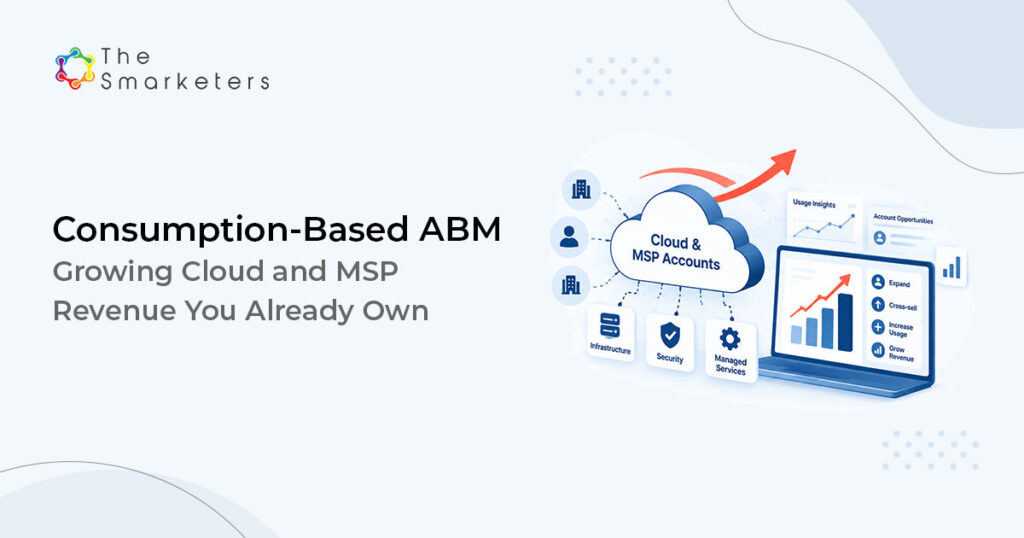
Consumption-based ABM applies an account-based method to customers you already have. Where revenue is metered rather than contracted, the highest-yield targets are accounts already on your books, sitting on workloads they never activated. Tier those accounts by workload opportunity rather than firmographics, map the committee inside them as you would for a new logo, and measure net revenue expansion instead of logos won.
Almost nobody does this, because the ABM playbook everyone copied was written for acquisition.
Why does consumption-based ABM need a different playbook from acquisition ABM?
Because ABM was built to solve an acquisition problem: too many accounts, not enough sales capacity, so concentrate on the ones worth winning. Every artefact of that origin survives in the method. Ideal customer profile, firmographic scoring, tiering by first-contract value, success measured in opportunities created. If you are comparing that approach against this one, ABM vs. broad demand gen for cloud partners covers the numbers in detail.
None of it translates when the account is already yours. Firmographics tell you nothing new, there is no first contract to size, and the opportunity is a workload nobody has moved rather than a logo.
STAT
67% of B2B buyers prefer a rep-free experience, yet 69% turn to sales reps to validate AI-generated insights. Source: Gartner, surveys of 645 to 646 B2B buyers, released March and May 2026.
Inside an existing account that preference is stronger. Technical teams trial a new service without telling anyone, then contact you only when stuck. Expansion marketing has to be findable rather than promotional.
How does consumption revenue behave differently from subscription?
It moves continuously, in both directions, and responds to engineering decisions rather than purchasing decisions. That difference invalidates most of the calendar a subscription marketer works to.
| Dimension | Subscription | Consumption |
|---|---|---|
| Revenue event | Contract signature | Daily usage |
| Growth trigger | Renewal or upsell conversation | A team ships a workload |
| Who decides | Buying committee | Platform or application team |
| Churn shape | Cliff at renewal | Gradual decline, often unnoticed |
| Marketing window | 90 days before renewal | Continuous |
| Best signal | Contract date | Workload and usage pattern |
Look at the last two rows. In a subscription business you know when to market. In a consumption business the moment is set by someone else’s sprint planning, so you cannot campaign at it. You can only be present when it arrives.
KEY TAKEAWAY
In consumption revenue, expansion is not a conversation you start. It is a decision someone makes without you, which you either supported in advance or did not.
What is the dormant potential tier in consumption-based ABM? (The hidden expansion segment)
One of the biggest gaps in ABM for existing customers sits between named strategic accounts and the long tail: customers with meaningful spend, low workload diversity, and technical teams you have never met. They look healthy on a revenue report and they are the easiest growth available.
Cloud and MSP accounts fall into one of four expansion tiers in consumption-based ABM. Each requires a different play and a different cadence.
| Tier | Definition | Treatment | Cadence |
|---|---|---|---|
| Strategic expansion | High spend, multiple workloads, exec relationship | One-to-one, joint planning | Monthly |
| Dormant potential | Meaningful spend, one or two workloads only | One-to-few, workload-specific | Quarterly |
| Technically stalled | Usage flat, no new services in a year | Diagnostic outreach first | Quarterly |
| Efficient tail | Low spend, self-serve, healthy usage | Programmatic content only | Continuous |
The dormant potential tier is where the money is. These accounts have already cleared procurement and passed security review. The only thing between them and more revenue is that a team inside them does not know a service exists, or does not know how to adopt it safely. Strategic expansion accounts requiring fully custom treatment map to one-to-one ABM – the approach we use for high-value cloud accounts where a joint planning cadence is warranted.
VISUAL 1 · CAPTURE THIS
Screenshot of a cloud provider billing console showing service-level spend for a single account across twelve months, with most services at zero. Annotate the two active services and label the dormant categories that represent expansion opportunity.
Why does the cost-optimisation conversation grow revenue?
This is the counterintuitive part. FinOps teams sit inside most large cloud customers and their mandate is to reduce spend, so the instinct is to avoid them. That is wrong.
A FinOps lead who trusts you brings you into architecture decisions early, because their problem is unexplained spend rather than spend. Helping a customer cut waste buys credibility and frees the budget that gets reallocated to new workloads rather than returned, and the vendor who ran the review is in the room when that happens.
It needs an honest artefact: a cost review that recommends turning things off. If the output only ever recommends buying more, the FinOps team reads it once.
How does consumption-based ABM target accounts at the workload level?
Stop marketing to the account and market to the workload. An account is a billing construct. A workload is a team, a deadline, a technical problem and a budget. Five signals are visible in your own usage telemetry. Each maps to a different workload play, not a generic upsell.
| Signal | What it suggests | Play |
|---|---|---|
| New service enabled at low volume | A team is trialling | Adoption guide, office hours |
| Usage plateau after growth | Hit a technical or cost ceiling | Architecture review offer |
| Hiring for a platform skill | New capability being built | Reference architecture, enablement |
| Support tickets in one service | Adoption friction | Named engineer, documentation |
| Spend concentrated in one category | Undiversified, dormant elsewhere | Adjacent workload campaign |
Each is visible in data you already hold, which is the advantage of expansion ABM over acquisition ABM: you do not need to buy intent signals when you own the usage telemetry.
The committee inside an expansion opportunity is smaller than a new-logo committee but not trivial. Expect a platform lead, an application team, a security reviewer for any new service class, and a FinOps stakeholder once spend crosses a threshold.
How do you market to a renewal you already hold?
Carefully, and mostly by not making it about the renewal. In a consumption model the renewal follows usage, so the task is making usage indispensable across more than one team.
Two motions do most of the work. The first is internal reach: your product may be used daily by one team and unknown to five others in the same organisation, and customer-hosted sessions and shared documentation fix that. The second is proof of value in the customer’s metrics rather than yours.
We ran an expansion programme for a cloud services client where the entire quarter’s target list came from billing data rather than the CRM. The accounts we chose were ones where spend was flat for three consecutive quarters and concentrated in a single service. That flat-spend filter turned out to be a better predictor of expansion response than any firmographic we had used previously, and it took an afternoon to build.
PROOF POINT
Our cloud-partner work includes XPON, a premium Google Cloud partner, where the programme centred on a partner virtual event aimed at existing accounts. On a comparable enterprise technology services account, Acuvate, the programme produced a 292% increase in organic inbound leads.
How do you measure consumption-based ABM attribution? (Metrics and method)
It uses a different denominator. Acquisition attribution asks which touch created an opportunity. Expansion attribution asks whether an account’s revenue trajectory changed after a programme, which is harder and fairer.
VISUAL 2 · CAPTURE THIS
Screenshot of a CRM or BI dashboard comparing net revenue expansion for a treated account cohort against a held-back control cohort over two quarters. Annotate the divergence point and label the held-back group clearly so the method is legible.
STAT
8 of the top 12 criteria used to judge B2B marketing rely on engagement proof. Source: Forrester, 2026.
Three measures hold up in a finance review: net revenue expansion for the treated cohort against an untreated control of similar accounts, workload adoption rate as new services activated per account per quarter, and time from first content engagement to first billed usage.
The control group is the part teams skip and the part that makes the number credible. Hold back a comparable set of accounts for two quarters and you have an answer nobody can argue with.
What operating rhythm does account expansion ABM need?
Account expansion ABM runs best on a monthly cadence, not quarterly, because usage signals change faster than campaign planning cycles. Refresh signals monthly, rebuild the target list from usage rather than last quarter’s list, run one workload per tier, and review the control cohort quarterly.
Ownership matters more than cadence. Expansion sits between marketing, customer success and partner teams, which in most organisations means it sits nowhere. Name one owner with billing data access and a budget, or it becomes good intentions attached to someone’s existing job.
Where this does not work
If consumption revenue is concentrated in a handful of very large accounts, this is account management with better materials rather than a marketing programme. Below roughly fifty expansion-eligible accounts, one-to-one work by named people beats anything programmatic.
It also assumes marketing can see usage data. Where billing telemetry sits behind a partner boundary, which is common for resellers and managed service providers, the signals in this article are unavailable and you are back to relationship-led expansion. Getting that data access is the first project, not the second.
Expansion ABM has a ceiling that acquisition ABM does not. An account adopts only so many workloads, and a programme producing strong numbers for six quarters will flatten. Plan the acquisition motion alongside it. Our ABM for cloud partners and one-to-few programmes usually run as a pair for that reason.
Frequently Asked Questions
What is consumption-based ABM?
Consumption-based ABM applies an account-based method to customers you already have, where revenue is metered by usage rather than fixed by contract. Accounts are tiered by unactivated workload opportunity instead of firmographics, and success is measured as net revenue expansion rather than new logos.
How do you do ABM for existing customers?
ABM for existing customers starts with data you already own, not your CRM. Build the target list from usage data, identify accounts with meaningful spend concentrated in one or two services, map the platform, application, security and finance stakeholders inside them, and run workload-specific plays keyed to observable signals.
What signals predict cloud consumption growth?
Five are visible in data you already hold: a new service enabled at low volume, a usage plateau after a growth period, hiring for a specific platform skill, support tickets clustered in one service, and spend concentrated in a single category. Each maps to a different play rather than a generic upsell campaign.
Should you market to FinOps teams if they want to cut spend?
Yes. FinOps leads are trying to remove unexplained spend, not all spend, and a vendor who helps them do it gets included in architecture decisions early. Freed budget is usually reallocated to new workloads rather than returned, and the vendor who ran the review is present when that happens.
How do you measure expansion marketing?
ABM measurement for expansion works differently from acquisition. Compare net revenue expansion for treated accounts against an untreated control cohort of similar accounts, track workload adoption rate as new services activated per account per quarter, and measure time from first content engagement to first billed usage. The control group is what makes the number survive a finance review.
What is the difference between expansion ABM and customer marketing?
Customer marketing aims at satisfaction, advocacy and retention across the whole base. Expansion ABM selects a small set of accounts on workload opportunity, maps the committee inside each, and runs targeted technical plays. It is closer to account-based selling than lifecycle communication.

Enoch Pakanati
CEO