Table of Contents
- Why Do Employee Voices Outperform Brand Pages on LinkedIn?
- How Do You Build a B2B Employee Advocacy Program That People Actually Sustain?
- What Content Templates Work for B2B Sales Teams?
- How Do You Measure B2B Employee Advocacy Program ROI?
- Case Study: What a Trained, People-Led Motion Produced for an SAP Partner
- When Employee Advocacy Is Not the Right Investment
- Where to Start
- Frequently Asked Questions
Need help with B2B Marketing?
Let the smarketers’ team drive your pipeline with data-led campaigns and AI-powered growth strategies.
Your company page publishes a product update. Eleven likes, four of them from your own marketing team. The same week, one of your solutions engineers writes a plain-text post about a customer problem she solved, and it fills her notifications for three days, including two comments from titles your sales team has been chasing for a quarter.
Every B2B marketer has watched this happen. The platform data explains why it keeps happening: 80% of B2B social media leads come from LinkedIn, where visitor-to-lead conversion runs 2.74%, roughly three times Facebook and X. And on that one decisive platform, distribution flows through people. Feeds are built around individual voices; company pages rent whatever reach is left over. More than 93% of B2B marketers already use LinkedIn for content marketing, which means the content is not scarce. Credible humans saying specific things are scarce.
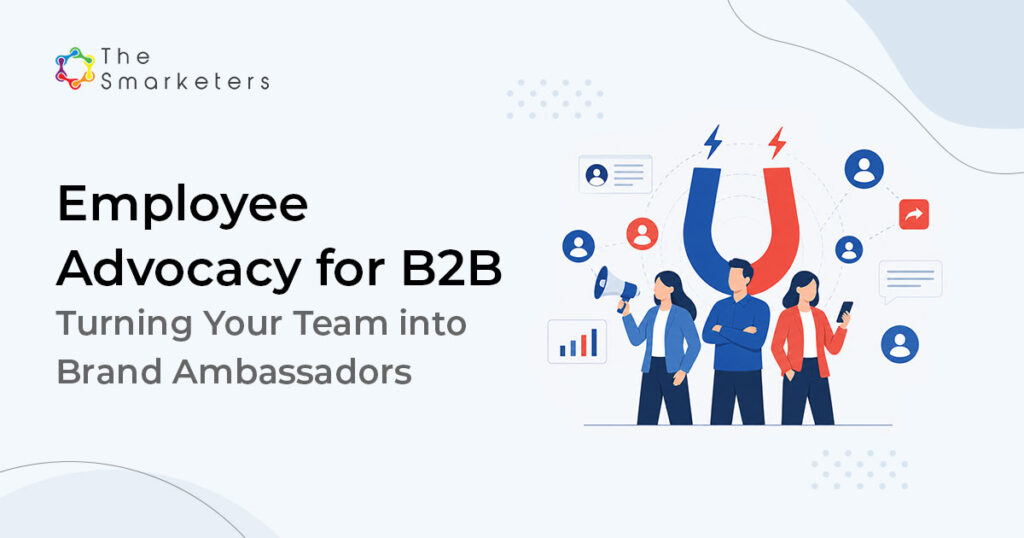
A B2B employee advocacy program closes that gap on purpose: a structured discipline that helps your team publish, comment, and build audiences as themselves, in ways that compound for the brand. If you are researching how to build an employee advocacy program, the difference between done badly – thirty identical reshares and quiet resentment – and done well is the framework. Done well, it becomes your cheapest demand channel and, increasingly, an AI visibility asset. This guide covers the B2B employee advocacy program design we use with clients, the templates that get busy sales teams publishing, and how to measure results honestly.
What is a B2B employee advocacy program? A B2B employee advocacy program is a structured initiative that equips employees – typically in sales, consulting, and technical roles – to publish original content, engage in industry conversations, and grow personal audiences on LinkedIn. Done well, it becomes a demand channel that builds buyer trust, feeds AI search citation, and compounds reach in ways company-page publishing cannot replicate.
Key insight: A B2B employee advocacy program works because LinkedIn’s feed treats a person’s post as a conversation and a company’s post as an advertisement. Named practitioners publishing specific, useful content earn the organic reach and buyer trust that brand pages cannot buy. They also generate citations in AI-powered search tools – Reddit and LinkedIn are consistently the top-cited sources across ChatGPT, Google AI Mode, Gemini, and Perplexity.
This guide focuses on program architecture – how to design, enable, and measure a B2B employee advocacy program at the organizational level. For the sales-team execution layer, see our LinkedIn social selling playbook for B2B tech teams.
Why Do Employee Voices Outperform Brand Pages on LinkedIn?
Three structural reasons, none of which are fixable with better company-page content.
Distribution favors people. LinkedIn’s feed treats a person’s post as a conversation and a company’s post as an advertisement, and prices the reach accordingly. Advertisers see the paid version of this: sponsored content click-through benchmarks run just 0.44 to 0.65% globally. Brand messages, even paid ones, get polite indifference. Practitioner posts that read like a colleague talking earn the engagement that the algorithm then amplifies further.
Trust favors people. B2B buyers do most of their research away from your sales team. Forrester has documented that 70 to 80% of the buyer journey happens before first vendor contact, and Gartner found 67% of B2B buyers prefer a rep-free buying experience. Buyers who avoid reps still follow engineers, consultants, and founders who teach them things. Advocacy is how your expertise reaches buyers who will not fill in your form.
Machines favor people too. AI assistants now assemble vendor shortlists from community and practitioner content: Reddit is the most-cited source across ChatGPT, Google AI Mode, Gemini, and Perplexity, and Reddit alone drives 46.7% of Perplexity’s top citations. The same study coverage places LinkedIn among the most-cited platforms. Named practitioners writing in public are becoming retrievable evidence of your company’s expertise; a silent team is invisible to buyers and to the systems advising them.

Key stat: LinkedIn generates 277% more leads than Facebook and Twitter combined for B2B, and 80% of all B2B social media leads originate there. On LinkedIn, employee advocacy generates more than 80% of B2B social leads – distribution flows through people, not company pages. The channel argument is settled; the open question is whether your brand shows up as a logo or as people. Our B2B social media marketing services are built around making it the latter. (Sopro LinkedIn statistics compilation.)
How Do You Build a B2B Employee Advocacy Program That People Actually Sustain?
Direct answer: start with volunteers, lower the skill barrier before asking for output, and progress people through stages instead of demanding daily posting from day one. We structure this as the Ambassador Ladder, five rungs that take an employee from silent observer to recognized category voice:
The Employee Brand Ambassador Ladder – five stages of a B2B employee advocacy program: (1) Observers become reactors through genuine daily commenting. (2) Reactors become sharers via a curated internal content feed. (3) Sharers become creators with one original post per week. (4) Creators become authorities using original data, podcast slots, and AI-citable content. (5) The program flywheel compounds through measurement, recognition, and cohort recruiting.
1. Observers to reactors. The first assignment is not posting; it is 15 minutes a day of genuine commenting in the conversations your buyers read. Commenting builds the writing muscle, the network, and the confidence, with none of the blank-page fear. Most programs skip this rung and lose half their cohort immediately.
2. Reactors to sharers. An internal content feed (a Slack channel works) with company news, client wins, and industry data, each with two or three suggested angles. The rule that protects everything: never provide copy-paste captions. Thirty identical posts read as a campaign and teach the feed to ignore all of them.
3. Sharers to creators. One original post a week per advocate, supported with templates (below), a 20-minute editing buddy system, and explicit permission to have opinions within a simple social policy. This is where reach starts compounding.
4. Creators to authorities. Give your best voices ammunition individuals cannot make alone: original data to interpret, client questions to answer in public, podcast and webinar slots. This is also where advocacy content starts earning AI citations, because original data is what assistants quote. Your highest-performing advocates typically benefit from a structured LinkedIn personal branding program to compound their individual authority at scale.
5. Program flywheel. Measure (see below), celebrate wins internally and specifically (“Priya’s post started the conversation that became the Acme meeting”), and recruit the next cohort from the colleagues who watched it work.

Two governance notes that save programs. First, advocacy is opt-in or it is nothing; a mandated program produces compliance-shaped content that fools nobody. Second, write the social policy as permissions, not prohibitions: what employees can safely say about clients, numbers, and roadmap, so legal review happens once at the policy level instead of on every post.
A word on executives, because they decide whether the ladder gets climbed. When a founder or sales VP posts weekly, the program needs no internal marketing: participation reads as career-smart, and the social policy is visibly safe to use. When leadership delegates advocacy downward while staying silent themselves, employees draw the accurate conclusion that posting is risky and optional. The executive commitment does not need to be large. One genuinely first-person post a week, drafted from the same templates, plus visible commenting on team members’ posts, is enough to set the norm. What does not work is a ghostwritten executive feed running on autopilot next to a program preaching authenticity.
What Content Templates Work for B2B Sales Teams?
Sales teams do not lack material; they have the best material in the company. They lack time and a starting structure. These five templates cover a month of posting at one post a week, each designed to be drafted in under 25 minutes from things a seller already knows:
| Template | Structure | Why it works |
|---|---|---|
| The question we keep getting | A real buyer question, verbatim; your honest answer in 4 to 6 short paragraphs; one practical takeaway | Answers the exact queries buyers also type into search engines and AI assistants; infinitely repeatable |
| The mistake I made | A specific professional mistake, what it cost, what you changed; no vendor pitch anywhere | Vulnerability earns disproportionate engagement and trust; humanizes the seller before the first call |
| The teardown | Take one common practice in your category, show why it fails, show the alternative with a number or example | Positions the author as a B2B thought leadership voice, not a promoter; the disagreement drives comments and establishes category authority |
| The deal story (anonymized) | Before-state, the turning point, the after-state with a real metric; client unnamed unless approved | Proof narrative in feed form; the metric makes it concrete and quotable |
| The stat and the take | One verified statistic, why it surprised you, what you would do about it; cite the source | Fastest to write; teaches sellers to argue from evidence, which carries into their deals |
Format guidance: plain text with line breaks outperforms links for reach on most B2B feeds (put links in the first comment), and short vertical video is worth piloting with willing volunteers, since 41% of B2B marketers say short-form video delivers the highest ROI of any video format. But format is secondary. A specific, honest text post beats a generic video every week.
The supply problem solves itself once you build one ritual: a 20-minute monthly session where sellers dump the questions, objections, and surprises from their recent calls into a shared document. Every line in that document is a post. A single discovery-call objection can become a “question we keep getting” post, a teardown of the assumption behind it, and a stat-and-take post using the evidence that answers it. For the sales-team-specific weekly cadence that runs alongside this content supply, see our LinkedIn social selling playbook for B2B tech teams. Marketing’s job in the program is not writing for sellers; it is mining, editing, and scheduling what sellers already know.
How Do You Measure B2B Employee Advocacy Program ROI?
Measuring employee advocacy ROI requires a ladder that mirrors how the value actually arrives: activity, then audience, then conversations, then pipeline. Reporting advocacy purely on impressions is how programs get cut; reporting it on sourced conversations is how they get funded.
The B2B Employee Advocacy Program ROI Ladder (four rungs): (1) Activity – weekly posts and comments published, health metric only. (2) Audience – follower growth and engagement versus company page, monthly. (3) Conversations – inbound DMs, meetings sourced from posts, UTM-tracked signups, monthly. (4) Pipeline – opportunities with advocacy touchpoints and win rates versus cold-sourced deals, quarterly.
- Activity (weekly): active advocates, posts and comments published. Health metric only; never report it as a result.
- Audience (monthly): follower growth of participating employees, aggregate reach and engagement. Compare against your company page’s trend to make the distribution argument visible to leadership.
- Conversations (monthly): inbound DMs and connection requests from target-account titles, meetings that reference a post, event and demo signups tracked through UTM-tagged first-comment links, plus the “How did you hear about us?” field. Self-reported attribution catches what click-paths miss.
- Pipeline (quarterly): opportunities where an advocate touch appears in the source history, and their win rates. Treat this as influence, not sole attribution; advocacy works alongside every other touch.
In practice, the monthly advocacy report is one page: active advocates and posting consistency at the top, aggregate engagement versus the company page in the middle, and a short named list at the bottom, this month’s conversations, meetings, and signups that trace back to an employee’s post or profile. That bottom section is deliberately anecdotal in the early quarters: three real sentences (“the RevOps director who booked Thursday’s call referenced Arjun’s teardown post”) do more for executive patience than any reach number. As volume grows, the anecdotes become a tracked field in the CRM and the report earns its pipeline column honestly.
Set expectations against paid alternatives rather than in a vacuum. On the same platform, LinkedIn Lead Gen Forms convert around 13% and sponsored content clicks through at well under 1%, both with a per-click invoice attached. Advocacy’s costs are time and enablement instead of media spend, its results build over quarters instead of days, and its assets (audience, trust, retrievable expertise) persist when the budget pauses. Paid stops the moment you stop paying; advocacy compounds. The honest corollary: advocacy is slower to start, and a team that needs pipeline this quarter should not fund it from the paid budget that pays this quarter’s bills.
Case Study: What a Trained, People-Led Motion Produced for an SAP Partner
Globpar, an SAP partner, came to us with the classic enterprise-services problem: a strong delivery reputation, a quiet digital presence, and outreach that landed as cold as it was. Decision makers were not responding to brand messages, because there was no human context around them.
We rebuilt the motion around people. Sellers and consultants were trained on profile positioning, commenting practice, and post templates from the ladder above, and the outbound sequences were rewritten to sound like the practitioners now visible in prospects’ feeds. Outreach and advocacy ran as one program, not two: the post earned the familiarity, the message converted it.
Result: The program reached 70% engagement across target accounts, with 63% email open rates and a 41% LinkedIn connection acceptance rate, numbers cold outreach in this category does not produce without the people-led layer. (Smarketers client engagement; full story at our success stories page.) The same model – advocacy layered with precision Account-Based Marketing – is what we deploy across enterprise clients.

The caveat: this was advocacy fused with a targeted ABM outreach program, not advocacy alone, and the engagement numbers reflect that combination. Advocacy created the conditions; the targeting and sequencing did the conversion. We would not promise those figures from a posting program by itself.
When Employee Advocacy Is Not the Right Investment
Advocacy is fashionable enough that it gets recommended indiscriminately. Situations where we advise against leading with it:
- You need a pipeline in the next 90 days. Advocacy compounds over quarters. If the quarter is the problem, targeted outbound and paid will serve you better – explore our B2B demand generation services for faster pipeline options – with the advocacy program built in parallel.
- Nobody senior will participate. If leadership wants employees posting but will not post themselves, the program lacks its proof of safety and its best distribution. Fix that first or scale ambitions down.
- Heavily restricted communications. Some environments (active litigation, certain regulated communications) make individual public commentary genuinely risky. A narrow, pre-cleared program can still work, but a broad one cannot; respect the constraint.
- The strategy is actually ghostwriting. Publishing identical AI-drafted thought leadership under twelve employee names is not advocacy; it is a brand campaign wearing people’s faces. Audiences detect it, employees resent it, and it burns the trust the program was meant to build.
Where to Start
Start your B2B employee advocacy program smaller than feels strategic: five volunteers, the commenting habit, the internal content feed, and one original post a week each, reviewed monthly against the measurement ladder. Within a quarter you will know who your natural voices are and whether the conversation metric is moving.
If you want the program built with training, templates, and measurement in place from week one, explore our advocacy and social selling programs – the same advocacy and social selling program enablement we ran inside the Globpar engagement, adapted to your team’s size and your buyers’ feeds.
Frequently Asked Questions
How much time does employee advocacy require per person?
Sustainable programs ask for 15 minutes of daily commenting plus 20 to 30 minutes a week drafting one post from a template. Anything demanding daily original posting burns volunteers out within a month. Consistency at low volume beats intensity that collapses.
Should we pay employees or offer incentives for advocacy posts?
Recognition works better than cash. Paying per post optimizes for volume over authenticity and creates disclosure questions in some jurisdictions. Celebrate specific business outcomes internally, give top advocates conference slots and visibility, and let career benefit be the honest incentive.
What tools do we need to run an advocacy program?
To start: a Slack or Teams channel for the content feed, a shared template document, and a spreadsheet for the measurement ladder. Dedicated advocacy platforms add scheduling and analytics and make sense once you pass roughly 20 active participants; buying one first solves a problem you do not have yet.
How do we keep advocacy posts compliant with brand and legal requirements?
Write a permissions-based social policy: what can be said about clients, metrics, and roadmap, reviewed once by legal. Pre-clear reusable proof points and anonymization rules for deal stories. Post-by-post legal review kills the speed and voice that make advocacy work.
What is a realistic timeline to see pipeline impact?
Conversations (inbound DMs, meetings referencing posts) typically appear within 6 to 10 weeks for active participants. Attributable pipeline influence is a two-to-three-quarter expectation. Audience and engagement grow first; treat them as leading indicators, not the result.
How many employees do we need to start?
Five committed volunteers outperform fifty conscripts. A small first cohort concentrated in customer-facing roles (sales engineering, consulting, product) generates the internal proof that recruits the second cohort without mandates.
Does employee advocacy help with AI search visibility?
Increasingly, yes. AI assistants cite community and practitioner content heavily; Reddit is the most-cited source across major platforms and LinkedIn ranks among the most cited. Named practitioners publishing substantive, specific answers within a structured B2B employee advocacy program create retrievable evidence of expertise that pure brand publishing cannot. Platforms like Reddit and LinkedIn are consistently cited as top sources across ChatGPT, Google AI Mode, Gemini, and Perplexity – meaning an active employee advocacy program directly builds your brand’s AI search footprint alongside on-site AEO content.
What KPIs should we commit to in the first quarter?
Commit to activity and audience metrics only: number of active advocates, posting consistency, aggregate engagement versus the company page. Promising pipeline numbers in quarter one sets the program up to be judged a failure exactly when it is working normally.

Siddharth Rampelli
Senior Growth Marketing Manager