Table of Contents
- Why Do Regulated Brands Go Missing from AI Answers? (Three Structural Reasons)
- What Does Medical-Legal Review Actually Object to in a Content Strategy?
- How Do You Build a Claim Substantiation Table That Unblocks Medical Legal Review?
- How Do You Write an Answer Block With No Promotional Claim? (Four-Part Structure)
- Which Schema Types Satisfy Both MLR Reviewers and AI Retrievers?
- How Does a Three-Round Medical Legal Review Workflow Cut Content Cycle Time?
- What Should Never Appear on a Regulated AEO Page? (Six Things to Cut)
- Where This Medical Legal Review Content Strategy Has Limits
- Frequently Asked Questions
Need help with B2B Marketing?
Let the smarketers’ team drive your pipeline with data-led campaigns and AI-powered growth strategies.
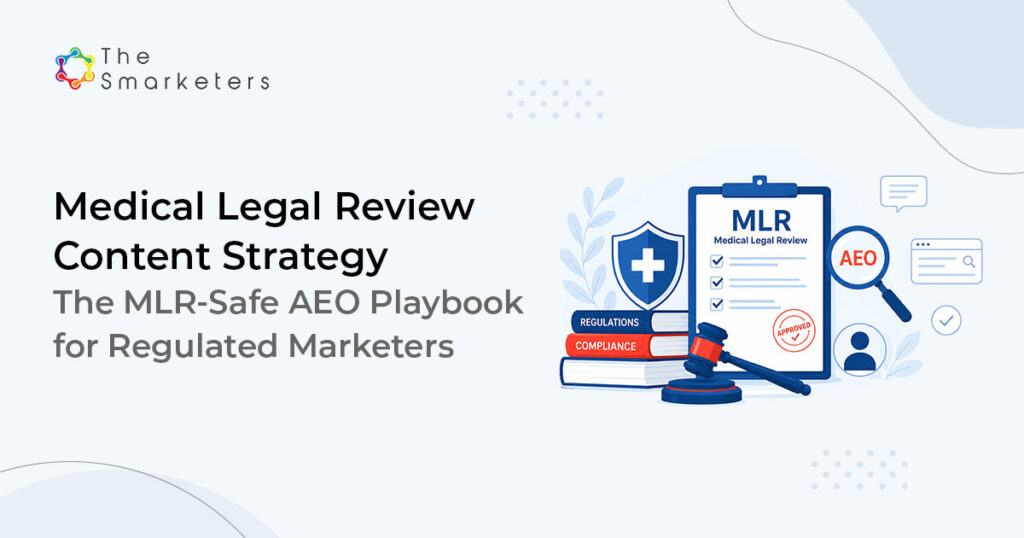
A medical legal review content strategy that also ranks in AI answers is possible without sacrificing compliance. MLR review rarely objects to the format of an answer engine page; it objects to the unsubstantiated claim inside it. Lead every answer block with a referenced fact, move all comparative language into customer-attributed proof, and most AEO structures clear medical-legal review on the first pass.
The failure is almost never the reviewer. It is a content team that writes the claim first and hunts for evidence afterwards, then treats the rejection as proof that compliance and visibility cannot coexist.
Why Do Regulated Brands Go Missing from AI Answers? (Three Structural Reasons)
Regulated content usually fails retrieval for a reason unrelated to regulation. To survive review, writers strip out every specific: no numbers, no named standards, no thresholds. What is left cannot be falsified, and therefore cannot be extracted either. Answer engines lift sentences that assert something checkable.
STAT
Median enterprise B2B brands rank for around 9,700 keywords but appear in just 3% of relevant AI Overviews, with professional services sitting near 2.1%. Source: Walker Sands B2B AI Search Visibility Benchmark, 828 companies across 14 industries and 45 million queries, published June 2026.
For regulated brands, the gap between keyword presence and regulated content AI search visibility is structural, not incidental – and it widens with every PDF that replaces an HTML page. The second reason is the PDF habit. Validation summaries, quality manuals and process capability data go into controlled PDFs; the least substantiated material goes onto web pages. That is backwards for retrieval.
The third is timing. With 68.01% of searches tracked in the SparkToro and Similarweb clickstream study ending without a click in early 2026, up from 60.45% in 2024 in the same study published in June 2026, the answer surface is where a category now gets defined. Absence from it is not neutrality. It is being unmentioned while competitors get described – and a working B2B AEO strategy is the mechanism regulated brands use to occupy that surface.
What Does Medical-Legal Review Actually Object to in a Content Strategy?
Sit in on twenty review sessions and the objections sort into five repeating types. None of them is about structure.
| Objection type | What the reviewer flags | AEO-safe alternative |
|---|---|---|
| Unsubstantiated comparative | "faster than conventional methods" | Cite the measured figure and its study or audit |
| Implied indication | Copy that reads as off-label suggestion | Restrict the page to process or compliance scope |
| Absolute language | "guarantees", "eliminates", "always" | Conditional phrasing with the operating range |
| Unreferenced statistic | A number with no traceable source | Reference line under the paragraph |
| Reader ambiguity | Audience unclear, HCP or general | Explicit audience statement in the opening block |
Notice what is absent. Nobody objects to a heading phrased as a question, a table, or FAQ markup. The formats answer engines reward are compliance-neutral. A review-ready content process, as used here, means a documented workflow in which claims are pre-approved against a register before any copy is drafted – the reverse of the standard agency model where copy is written first and evidence is sourced under pressure during review.
How Do You Build a Claim Substantiation Table That Unblocks Medical Legal Review?
Build it before the draft. In MLR review content marketing programmes, the claim substantiation table is the single most effective upstream process change available. A claim substantiation table is the pre-draft register that makes medical legal review predictable. It is a single sheet listing every assertion the page will make, the evidence behind it, the document holding that evidence, and the reviewer who owns the sign-off. It turns review from an argument about wording into a check against a register.
| Claim on the page | Substantiation | Source document | Owner |
|---|---|---|---|
| Facility holds a certification | Certificate number and expiry | Quality system record | Regulatory |
| Batch release timeline | Rolling 12-month median | Operations dashboard | Operations |
| Method sensitivity | Validation report figure | Validation summary | Medical Affairs |
| Client outcome | Customer approval in writing | Signed case release | Legal |
Two rules make it work. A claim without a filled substantiation row does not get written. And the customer outcome row is where every comparative statement goes, because a customer describing their own result is attributable proof rather than a company claim.
How Do You Write an Answer Block With No Promotional Claim? (Four-Part Structure)
An answer block is the 40 to 60 word passage that answers the question in the heading above it. In regulated content it has four parts in a fixed order: the factual statement, the standard or mechanism it rests on, the condition under which it holds, and the reference.
We ran this for a health technology client whose review board had rejected the previous agency’s drafts three times each. We rebuilt fourteen pages around substantiated answer blocks and shipped the claim table alongside them. Eleven cleared on the first round; three came back on audience labelling, not claims. Average cycle time fell from about five weeks to eleven days.
PROOF POINT
Eclat Health, operating in a heavily regulated health information environment, achieved 8X growth with cost per lead falling from $5 to $1.82, a 63.6% reduction, and organic traffic up 200%. The programme was built on substantiated, compliance-cleared content rather than volume.
What Is the Cite-Your-Own-Evidence Pattern in Regulated Content Strategy?
The cite-your-own-evidence pattern is the process of surfacing a regulated brand’s existing internal evidence – certifications, validated method data, and approved client outcomes – onto permanent, publicly addressable HTML pages, then referencing those pages from every answer block that depends on them. Most regulated brands own more citable evidence than they publish; this pattern makes it retrievable by both search engines and AI systems.
Three surfaces carry it. Certifications and audit scopes on their own HTML page, with issue and expiry dates in text. Method and process data in a technical library, one page per method. Customer outcomes in approved case pages with release status noted. Everything else links to those three instead of restating them.
The benefit compounds. Reviewers stop re-adjudicating the same claim, because it now points at an approved page. That is why our AEO for life sciences guide starts with an evidence inventory rather than an editorial calendar.
VISUAL 1 · CAPTURE THIS
Screenshot of a live pharma or CDMO certifications page in Chrome DevTools with the Elements panel open, showing the certification name, issuing body and expiry rendered in HTML text rather than an image. Annotate the three text nodes an extractor can read.
Which Schema Types Satisfy Both MLR Reviewers and AI Retrievers?
Structured data is the rare AEO change reviewers welcome, because it makes claims explicit rather than implied.
| Schema type | Use it on | Why review approves it |
|---|---|---|
| MedicalWebPage | Clinical or therapeutic content | Carries an explicit audience property |
| FAQPage | Question and answer sections | Answers are bounded and separately reviewable |
| Organization | Certifications and corporate scope | States credentials as data, not adjectives |
| Dataset | Published method or process data | Signals evidence, not marketing |
The audience property is the useful one. It states in machine-readable form who the page is written for, which is often the exact ambiguity a reviewer flags in prose. For regulated brands, AI Overview optimisation is the discipline that translates this structured clarity into measurable citation share.
How Does a Three-Round Medical Legal Review Workflow Cut Content Cycle Time?
Uncapped rounds make regulated content slow, not the reviewers. Cap them at three and define what each is for.
- Round one reviews the claim table alone, before a word is drafted. Regulatory, medical and legal approve or strike each claim.
- Round two reviews the draft against the approved table. Objections may only concern claims already on the table, or a claim the draft introduced.
- Round three verifies the changes made after round two. No new objections unless a new claim appeared.
- Anything unresolved is cut from the page and moved to the next cycle rather than held in review.
Point four meets the most resistance and matters the most. A page held indefinitely over one contested sentence earns nothing while it waits.
KEY TAKEAWAY
Cycle time is usually a governance problem, not a compliance problem. Capping rounds and fixing what each round is allowed to question does more for output than any change in tone.
What Should Never Appear on a Regulated AEO Page? (Six Things to Cut)
Some things are not worth the argument. Head-to-head comparisons of a named competitor’s product performance. Patient or practitioner outcomes without documented consent. Forward-looking capability that has not been qualified. Any statistic you cannot trace to a dated document.
And never let an AI writing tool generate the answer block. It produces a fluent comparative claim with nothing behind it, which is precisely the sentence your reviewer exists to catch.
Where This Medical Legal Review Content Strategy Has Limits
The claim table works when evidence exists somewhere in the organisation. Where a company has no measured data behind its differentiation, this method exposes that rather than solving it, and the honest next step is measurement, not writing.
It also assumes reviewers who will engage with a register. Some review boards operate as a queue with no named owner per claim type, and in that setting round one has nobody to sign it. That is an operating model conversation above the marketing team. Where those conditions do hold, a medical legal review content strategy aligned with AEO is one of the highest-return investments a regulated brand can make, precisely because competitors have not solved the governance problem.
Therapeutic area sensitivity does not go away either. Where regulatory scrutiny is active, the set of publishable claims may be small enough that coverage stays low however well the content is structured. Set targets in those categories against process, capability and compliance questions rather than product ones, which is also how we scope account-based programmes in pharma and life sciences.
VISUAL 2 · CAPTURE THIS
Screenshot of a claim substantiation table in Google Sheets with four columns filled and conditional formatting marking one row as unapproved. Annotate the unapproved row and the note showing that the matching sentence was cut from the draft.
Frequently Asked Questions
How do you do AEO in pharma without breaking compliance?
Pharma AEO compliance starts with the claim, not the copy. List every assertion the page will make, attach its evidence and source document, and approve those before drafting. Question headings, answer blocks, tables and FAQ markup carry no regulatory risk. The risk sits in comparative and absolute language, which belongs in customer-attributed proof.
What does medical-legal review usually reject in AI search content?
Five objections cover most rejections: unsubstantiated comparatives, implied indications, absolute words such as guarantees or eliminates, statistics with no traceable source, and unclear audience definition. None are structural. A page can be fully optimised for retrieval and still clear review, provided each claim points at approved evidence.
Should regulated content live in PDFs or HTML pages?
HTML, wherever the document is public. Regulated firms put their best-substantiated material into controlled PDFs and their weakest into web pages, inverting what retrieval systems can use. Keep the controlled document as the record of truth and publish an HTML summary carrying certification names, dates and scope as text.
How long should MLR review take for a web page?
With an approved claim table in front of it, a page should clear three defined rounds inside two to three weeks. Uncapped review stretches cycles into months. Cap the rounds, restrict each to one question, and push contested sentences into the next cycle rather than holding the page.
Can AI tools write regulated marketing content?
Use them for outlining and reformatting, not for drafting the answer block. Generative tools produce confident comparative statements with no substantiation attached, which is exactly the sentence review exists to remove. Anything a tool drafts still needs every claim mapped to a source document first.
What should a regulated brand publish first for AI visibility?
The certification and capability scope page, in HTML, with issuing bodies and dates as text. It is already substantiated, needs the least approval, and answers the diligence questions that arrive late in a cycle. Procurement is a decision-maker in 53% of business buying cycles, Forrester reported in January 2026. Once published, track whether it earns AI citations using the AEO measurement stack we recommend for B2B programmes.

Indrani Gope
Content Head