Table of Contents
- What Is Citation Share in AI Search Visibility Measurement?
- Which Metrics Belong on an AI Visibility Scorecard?
- What Tools Can Track AI Citations and Brand Mentions?
- What Are Realistic AI Search Visibility Benchmarks for B2B Brands?
- How Do You Build an AI Search Visibility Measurement Dashboard?
- Case Study: Measurement First, 3X Organic Growth After
- When Should You Skip AI Search Visibility Measurement?
- Where to Start
- Frequently Asked Questions
Need help with B2B Marketing?
Let the smarketers’ team drive your pipeline with data-led campaigns and AI-powered growth strategies.
Somebody in your pipeline meeting said: “A prospect told us ChatGPT recommended us.” Everyone smiles. This is where most companies start with AI search visibility measurement: a single anecdote with no system behind it. Nobody can say whether that happens once a quarter or forty times a week, on which platforms, for which questions, or whether it is growing. A channel that influences revenue is being reported as an anecdote.
The influence itself is no longer in question. Forrester found 94% of B2B buyers use generative AI during the purchase process and rate it a more meaningful source than vendor websites or sales conversations. Gartner’s survey of 645 B2B buyers found 69% use sales reps to validate what AI has already told them. The AI answer increasingly arrives before your team does – a pattern we cover in depth in our B2B generative engine optimization guide. What most organizations lack is not belief; it is instrumentation.
This guide covers how to measure AI search visibility the way we do it for clients at The Smarketers: the metrics that matter, the tools that produce them, what honest benchmarks look like in 2026, and how to assemble it all into a dashboard your leadership will actually read. None of it requires expensive software to start. This GEO measurement system requires discipline and about one afternoon a month.
What is AI search visibility measurement?
AI search visibility measurement is the practice of tracking how often and how accurately your brand is cited or mentioned in AI-generated answers across platforms including ChatGPT, Perplexity, Gemini, and Google AI Overviews. The primary metric is citation share: the percentage of buyer-intent prompts in your category for which an AI platform names or cites your brand.
What Is Citation Share in AI Search Visibility Measurement?
Citation share is the percentage of buying-intent questions in your category for which an AI platform names or cites your brand. It is the AI-era version of share of voice, and it should anchor your measurement because it captures the moment that matters commercially: whether you exist in the answer a buyer sees.
The critical rule is to report it per platform, never blended. Across 680 million citations analyzed in a cross-platform audit, only 11% of domains were cited by both ChatGPT and Perplexity, with query-level overlap under 1%, a finding corroborated by an independent 118,000-response study. A blended average across platforms describes no platform at all. It will hide the exact gap that costs you a shortlist spot.
Key stat: Only 11% of domains are cited by both ChatGPT and Perplexity; at the individual query level, overlap falls below 1%. Any AI visibility metric that averages across platforms is broken by design. (680M-citation cross-platform audit; Whitehat SEO 118K-response study.)
Citation share is built from a prompt panel: 30 to 50 questions your buyers genuinely ask, weighted toward commercial intent (“best X for Y,” “X vs Y,” “how to evaluate Z vendors”), run on a fixed monthly cadence across ChatGPT, Perplexity, Claude, and Gemini. Log every brand named, every URL cited, and how your brand is described. The description matters as much as the mention: Forrester found 20% of buyers lost decision confidence after encountering unreliable AI information, so an inaccurate citation can be worth less than no citation.
Which Metrics Belong on an AI Visibility Scorecard?
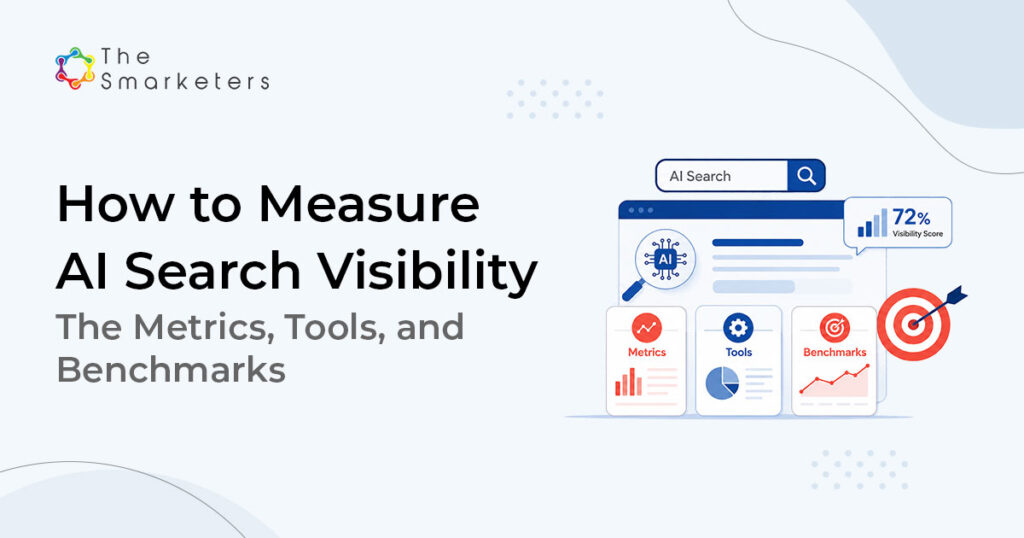
How do you measure AI search visibility? With six numbers, refreshed monthly and reported per platform: citation share, mention rate, accuracy and sentiment, competitive citation share, AI referral traffic, and AI-referred conversion. We call this the AI Visibility Scorecard – a six-metric B2B measurement framework deliberately small enough to fit on one slide.
The AI Visibility Scorecard: Six metrics for measuring AI search visibility
| Metric | What it measures | How it is produced | Cadence |
|---|---|---|---|
| Citation share | Percentage of panel prompts where your domain is cited as a source | Prompt panel, logged per platform | Monthly |
| Mention rate | Percentage of panel prompts where your brand is named, cited or not | Same panel, mentions without citations flag entity strength without content depth | Monthly |
| Accuracy and sentiment | Whether descriptions of your brand are correct, current, and favorable | Manual review of every response naming you; log errors verbatim | Monthly |
| Competitive citation share | Which domains win your category’s answers, including competitors and third parties | Same panel; track the top 10 cited domains over time | Monthly |
| AI referral traffic | Sessions arriving from assistant referrers | GA4 segment (setup below); treat as a floor, not a total | Weekly |
| AI-referred conversion | What AI-referred visitors do: form fills, tool usage, pipeline touched | GA4 conversions + CRM source stamping | Monthly |

Two design choices keep this honest. First, mention rate and citation share are separated because they fail differently: a brand mentioned but never cited has an entity problem (the model knows you exist but has nothing of yours worth quoting); a brand cited but rarely mentioned first has an authority problem. Second, conversion sits on the scorecard from day one, because AI referral volume is small in absolute terms in most accounts and skeptics will dismiss it. Its conversion behavior, in our client work, is what earns the channel its budget: the assistant has already qualified the visitor’s question before the click. Treat that observation as our experience, not an industry benchmark; published data here is still thin.
What Tools Can Track AI Citations and Brand Mentions?
Answer first: you need three layers, and only one of them costs money. A manual prompt panel produces citation share; your existing analytics stack produces referral and conversion data; commercial trackers add scale and alerting once the manual version has proven its value.
Layer 1: the manual prompt panel (free, mandatory)
A spreadsheet with one row per prompt per platform per month: prompt, platform, date, brands mentioned, URLs cited, description of your brand, errors noticed. Two to four hours a month for a 40-prompt panel across four platforms. Every team should run this layer even after buying software, because it is the only layer where a human reads how the machine talks about you. Use fresh sessions or incognito modes to reduce personalization, and keep prompt wording fixed month to month; changing the wording resets your trend line.
Layer 2: your analytics stack (free, already installed)
- GA4 AI referral traffic setup: build a custom channel or exploration segment for sessions where the referrer contains chatgpt.com, perplexity.ai, claude.ai, gemini.google.com, or copilot.microsoft.com. Wire it to your key conversion events.
- Search Console and Bing Webmaster Tools: watch impressions for question-style queries and confirm the pages you want cited are indexed. Bing matters disproportionately because it feeds ChatGPT’s browsing.
- CRM source stamping: add “AI assistant” to your self-reported attribution field (“How did you hear about us?”). Self-reported data is imperfect, and it routinely surfaces AI influence that referrer data misses because assistant traffic often arrives stripped, showing up as direct.
Layer 3: commercial AI visibility trackers (paid, optional at first)
A category of LLM visibility metric tools now automates prompt panels at scale, tracking thousands of prompts daily with alerting and competitive dashboards – the same approach we describe in our AI automation workflow for AEO and GEO – (Profound, whose citation research we reference below, is one of the visible vendors; several SEO platforms have added AI tracking modules). Our opinion: buy one when the manual panel has already changed a decision, not before. Teams that start with software tend to admire dashboards; teams that start manually know which numbers they actually use. When you do evaluate, test whether the tool covers the platforms your buyers use and whether it shows the underlying responses, not just scores.
What Are Realistic AI Search Visibility Benchmarks for B2B Brands?
Direct answer: industry-by-industry citation share benchmarks do not credibly exist yet, and you should distrust vendors quoting precise ones. What does exist is well-measured structural data about how citations concentrate, which tells you what “good” has to look like.

The structural facts: within a topic, roughly 30 domains capture about 67% of ChatGPT citations, and Wikipedia (13.15%) and Reddit (11.97%) together drive over a quarter of ChatGPT citations in the US. On Perplexity, Reddit alone accounts for 46.7% of top citations, with YouTube around 14%; across platforms, Reddit is the most-cited source overall. Your realistic competition for citations is a short list of incumbent domains plus community platforms, not the whole internet.
From that structure, the benchmarks we consider defensible for a B2B brand starting from zero:
- Baseline month: most B2B brands we audit hold citation shares on at most one platform, and many hold none. A first measurement showing zeros is normal, not alarming.
- First movement: expect measurable citation change in 8 to 12 weeks for most categories; Perplexity typically moves first because it retrieves the live web on every query.
- Concentration ceiling: within your topic, winning means joining a group of roughly 30 domains that take two thirds of the citations. Plan corroboration and community work accordingly, not just on-site optimization.
- Trend over level: quarter-over-quarter direction per platform is the number leadership should judge; absolute citation share is not comparable across categories, because prompt panels differ.
Key takeaway: Benchmark against structure, not against invented industry averages. The measured facts (11% cross-platform overlap, 30-domain topic concentration, community platforms dominating) define the game. Your own baseline defines the starting position.
How Do You Build an AI Search Visibility Measurement Dashboard?
The assembly is straightforward once the layers exist. One monthly page, per platform, built in whatever your team already reads (Looker Studio, a slide, a HubSpot report). The sequence we implement:
Step 1.Fix the prompt panel. 30 to 50 prompts, agreed with sales so the questions reflect real deals, versioned so any change is documented. This is your prompt panel AI measurement instrument; treat edits like edits to a survey.
Step 2.Build the GA4 segment. Custom channel group or exploration filter on the assistant referrers listed above, connected to conversion events. Annotate the creation date; you will want to explain the trend line’s start.
Step 3.Create the citation log. One sheet, columns for prompt, platform, month, mentions, citations, description notes, errors. This log is also your accuracy audit and your content backlog: every error and every competitor-won prompt is a work item.
Step 4.Stamp the CRM. Self-reported attribution option for AI assistants, plus a hidden form field capturing referrer where feasible. Review alongside the pipeline monthly.
Step 5.Publish the monthly one-pager. Six scorecard metrics, per platform, with one narrative paragraph: what moved, why we think so, what we will change. If the report takes more than a page, it will stop being read by the people who fund it.
Step 6.Review quarterly. Reallocate content and corroboration effort toward platforms and prompts showing movement. Citation patterns have shifted within single quarters; an annual review cycle is too slow for this channel.
Case Study: Measurement First, 3X Organic Growth After
A cybersecurity client engaged us with real expertise, steady publishing, and no idea where they stood in AI answers. Before changing any content, we built the measurement system above: a 40-prompt panel, the GA4 segment, the citation log. The baseline was uncomfortable and clarifying: near-zero citation share on every platform, with category answers dominated by a handful of publishers and community threads.
The baseline told us where to work. High-intent pages were restructured answer-first, entity markup was rebuilt, and part of the publishing budget moved to original data the security community would discuss. The monthly scorecard then did something no amount of persuasion could: it showed movement, prompt by prompt, platform by platform, which kept the program funded long enough to compound.
Result: The client achieved 3X organic growth, compounding at 16.31% month over month, as restructured pages earned positions in both traditional search and AI answers. (Smarketers client engagement; full story at thesmarketers.com/success-stories/)

The honest read: measurement did not cause the growth; it directed the work that did, and it protected the budget while results built. A scorecard on top of weak content measures failure very precisely. If your content has nothing an assistant would want to quote, our AEO and GEO services cover that fix. Measure second.
Key takeaway: Measurement does not cause AI visibility growth; it directs the content work that does – and protects program budget while citations compound. Run the baseline before changing a single page.
When Should You Skip AI Search Visibility Measurement?
This system earns its afternoon a month in most B2B categories, but not all. Three cases where we advise scaling it down or skipping it:
- Your category is not asked about yet. Run a one-time 20-prompt probe. If assistants return generic answers with no vendors named and your buyers confirm they are not asking, set a quarterly probe and spend the effort on demand programs instead.
- The team is too small to sustain a cadence. A panel measured three times and abandoned is worse than none; the half-built trend line gets quoted forever. If you cannot commit to monthly, commit to quarterly and say so on the dashboard.
- Sales cycles are fully relationship-driven. A services firm whose entire pipeline is referrals and repeat business will see AI visibility influence brand perception long before it touches revenue. Measure lightly; invest in the referral engine.
Where to Start
Run the baseline this week: 30 prompts, four platforms, one spreadsheet, one afternoon. You will know immediately whether you have an AI visibility problem, on which platforms, and who is winning the answers instead of you. Most teams find the baseline more motivating than any industry statistic.
If you would rather have the instrument built for you, get your AI Visibility Score from our team: a category-specific prompt panel, your per-platform baseline, and a gap analysis against your top three competitors. It is the same diagnostic that opened the cybersecurity engagement above, and it tells you which scorecard number to move first.
Frequently Asked Questions
How much time does AI visibility measurement take each month?
Two to four hours for a 40-prompt panel across four platforms, plus about an hour to update the dashboard. The initial setup (panel design, GA4 segment, log structure) is roughly a day. Commercial tools reduce the panel time but not the review time, since a human still needs to read how assistants describe you.
Do we need to buy an AI visibility tool before starting?
No. The manual prompt panel plus GA4 produces every scorecard metric at zero software cost. Buy a tool when the manual process has changed at least one content decision and the constraint is scale or alerting, not understanding.
Why does our GA4 show so little AI referral traffic?
Partly because the channel is genuinely small in absolute sessions for most sites, and partly because assistant clicks often arrive with stripped referrers and land in direct. Treat measured AI referrals as a floor, and use self-reported attribution to estimate the gap.
How many prompts should our panel include?
Between 30 and 50. Fewer than 30 makes month-to-month changes look noisier than they are; more than 50 makes the manual cadence unsustainable. Weight toward commercial intent and keep wording frozen so the trend line stays comparable.
Should we measure Google AI Overviews as part of this?
Yes, as a separate line. AI Overviews behave differently from chat assistants because they sit inside classic search results, and Search Console does not fully separate them. Note Overview presence for your panel prompts during the monthly run; it costs a few extra minutes.
What KPI should we report to the board?
Per-platform citation share trend, quarter over quarter, plus AI-referred conversions. Avoid reporting a single blended visibility score: with 89% of citations exclusive to one platform, a blended number conceals exactly the gaps the board should know about.
How quickly should we expect citation share to improve once we act on the data?
First measurable movement typically appears in 8 to 12 weeks, with Perplexity usually responding before ChatGPT because it retrieves the live web per query. Anyone guaranteeing citations within days is describing something other than durable visibility.
What budget does a measurement program need?
Starting: effectively zero beyond a day of setup and an afternoon a month. Scaled: commercial trackers vary widely in price, and the meaningful cost is the content and corroboration work the measurement points you toward. Budget for acting on findings, not just producing them.

Isha Gulati
Senior Marketing Manager