Table of Contents
- Why Does Procurement AI Read Your Trust Center Before Your Rep Calls?
- What Does Procurement AI Extract During Compliance Page AEO Evaluation?
- Which Five Pages Does Every Trust Center Need for AI Retrieval?
- How should sub-processor and DPA pages be structured for retrieval?
- What schema should certifications and audit reports carry?
- Gating versus indexing: what is the real tradeoff?
- How Do You Measure AI Traffic to Pages After Compliance Page AEO Optimization?
- What does a two-week trust center rebuild look like?
- Where Compliance Page AEO Optimization Stops Working
- Frequently Asked Questions
Need help with B2B Marketing?
Let the smarketers’ team drive your pipeline with data-led campaigns and AI-powered growth strategies.
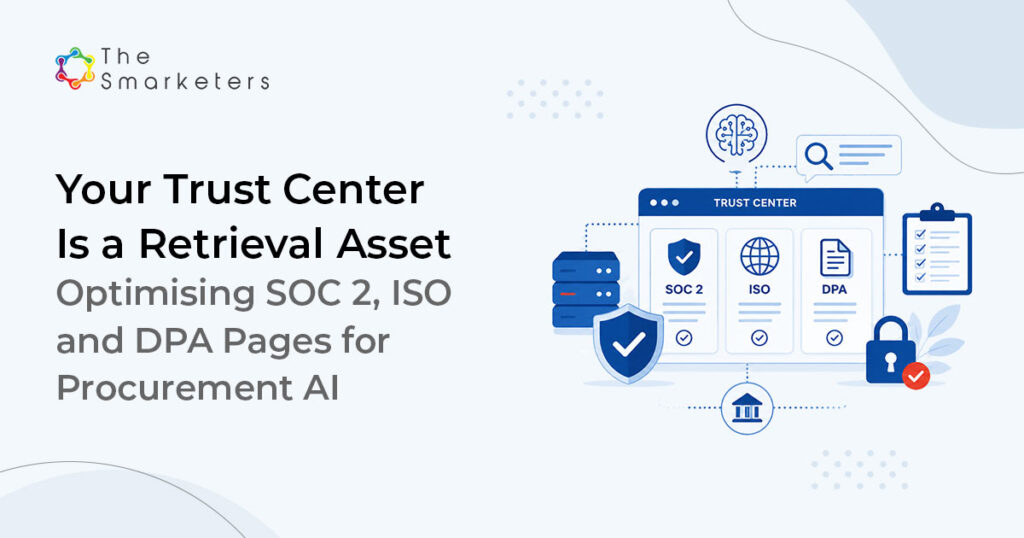
Marketing teams treat the trust center as a legal obligation and forget it is a page. Compliance page AEO optimization changes that. Trust center pages are among the most-retrieved assets on a B2B site, because procurement AI reads them first – and what it cannot parse, it skips. Un-gate the certification summary, mark up each certification with structured data, and keep sub-processor lists in HTML rather than PDF. Those three changes usually matter more than anything on your product pages.
The reason is structural. Procurement AI compliance content answers closed questions with checkable facts – which is exactly what a retrieval system wants, and why compliance pages outperform most marketing content in AI extraction.
Why Does Procurement AI Read Your Trust Center Before Your Rep Calls?
Because diligence moved earlier. Security questionnaires used to arrive after a demo. Now whoever assembles the shortlist runs the security check first, often with an assistant, and vendors that cannot be verified quickly get dropped before anyone talks to them.
STAT
Procurement is a decision-maker in 53% of business buying cycles, and the average B2B buying decision now involves 13 internal stakeholders and 9 external influencers. Source: Forrester, State of Business Buying, January 2026.
Add the preference shift. 67% of B2B buyers prefer a rep-free experience, though 69% still turn to sales reps to validate AI-generated insights, according to Gartner surveys of 645 to 646 B2B buyers released in March and May 2026. Together those describe a buyer who self-serves the compliance check, then decides whether to speak to you.
What Does Procurement AI Extract During Compliance Page AEO Evaluation?
Not reassurance. It extracts named facts and their attributes, and fails silently when those facts sit inside an image, a PDF or a form.
| What the agent looks for | What satisfies it | What fails |
|---|---|---|
| Certification and standard | "SOC 2 Type II" as page text | A badge image, no alt text |
| Audit period and report date | Explicit dates in text | "Recently audited" |
| Auditor identity | Named audit firm | Unnamed third party |
| Data residency | A list of named regions | "Flexible hosting available" |
| Sub-processor list | HTML table, purpose per row | A downloadable PDF |
| Breach notification window | A stated number of hours | A link to the DPA only |
Every failure row has the same shape: the fact exists, but not in a form anything can be read. Fixing it is a formatting exercise, not a security one – and it is the core of compliance page AEO optimization, which is why it takes days rather than quarters. The same structural problem we address in our B2B AEO strategy guide applies here: content exists, but retrieval systems cannot use it.
Which Five Pages Does Every Trust Center Need for AI Retrieval?

Five, each answering one question, each on its own stable URL. Consolidating them into one long page is the common mistake, because it forces a retrieval system to choose between competing facts on the same URL.
- Certification summary. Every certification, its standard, scope, auditor and current period. Ungated.
- Sub-processor register. Each sub-processor, its purpose, the data category, and the date last updated.
- Data processing terms. The DPA summary in HTML, full agreement linked beneath it.
- Security practices. Encryption, access control, retention and testing cadence, as specifics not adjectives.
- Incident and notification policy. Notification windows, escalation path, status page link.
Cross-link all five from a trust center index and link that index from the footer sitewide. Footer links matter more than usual here, because they are the path a crawler follows without a query.
VISUAL 1 · CAPTURE THIS
Screenshot of a live SaaS trust center certification page in Chrome DevTools, Elements panel open, showing certification name, audit period and auditor as selectable text nodes rather than a badge image. Annotate the three readable nodes and the one image carrying no alt text.
How should sub-processor and DPA pages be structured for retrieval?
Sub-processor pages are the highest-value and worst-executed pages in the set. Most publish a PDF or a paragraph. Publish a table.
Each row needs the sub-processor name, processing purpose, data category and processing location. Put a last-updated date at the top as text, and keep changing history on the same URL rather than versioning it away. Reviewers and retrieval systems both want it.
For the DPA, publish a plain summary above the legal document: notification window, change notice period, deletion timelines and the standard clauses relied on. The agreement stays authoritative; the summary gets quoted.
We ran this for a cloud services client – a mid-market SaaS vendor whose entire compliance story sat in one gated PDF. We split it into five pages over two weeks, moved the sub-processor list into an HTML table, and added an Organization schema for the certifications. Within six weeks questionnaire volume fell noticeably, because prospects arrived already holding the answers, and two pipeline deals had a documented first touch on the certification page.
PROOF POINT
ProArch, a cybersecurity client, achieved 3X organic growth on a programme built around making technical and compliance depth publicly readable rather than gated.
What schema should certifications and audit reports carry?
Structured data does what prose cannot: it states a credential as typed data, so a machine need not infer it from a sentence. For SOC 2 page structured data, the Organization schema’s hasCredential property is the most direct expression of certification status available.
| Schema | Applied to | Key properties to fill |
|---|---|---|
| Organization | The trust center index | name, sameAs, hasCredential |
| WebPage | Each of the five pages | datePublished, dateModified |
| Dataset | Sub-processor register | distribution, temporalCoverage |
| FAQPage | Common security questions | question and answer pairs |
Fill dateModified honestly on every page. A compliance page with no modification date reads as unverifiable, and currency is most of what a procurement check tests.
KEY TAKEAWAY
A compliance page is judged on three things a machine can check: is the fact present, is it dated, and is it stated in text. Every design decision is downstream of those three.
Gating versus indexing: what is the real tradeoff?
The usual argument is that gating compliance documents captures leads – and it misses the real question, which is how trust center optimization for AI changes the calculus entirely. It rarely does here, because whoever runs the check is not the buyer and will move to the next vendor.
Split it by layer. Certification summary, security practices, sub-processor list and DPA summary go public. Full audit reports, penetration tests and completed questionnaires sit behind an NDA request. That boundary matches auditor expectations and leaves nothing important un-retrievable.
| Asset | Access | Reason |
|---|---|---|
| Certification summary | Public | Primary retrieval target |
| Sub-processor register | Public | Contractually expected notice |
| DPA summary | Public | Answers most early questions |
| Full SOC 2 report | NDA gated | Contains system detail |
| Penetration test report | NDA gated | Contains exploit detail |
How Do You Measure AI Traffic to Pages After Compliance Page AEO Optimization?
Conventional analytics under-report this badly, because AI referrals often lose their referrer.
STAT
AI Overviews drove 7.53% of organic sessions between September 2025 and June 2026, and 22.4% of that traffic was misattributed to Direct rather than Organic. Source: Search Engine Land analysis of 51,200 tracked events, August 2026.
What does a two-week trust center rebuild look like?
- Days 1 to 2. Inventory every compliance fact you publish and where it lives. Flag anything present only in a PDF or image.
- Days 3 to 5. Draft the five pages. Security and legal review content, not layout.
- Days 6 to 8. Build them with the sub-processor table in HTML, dates as text, stable URLs.
- Days 9 to 10. Add Organization, WebPage and Dataset schema; validate it.
- Days 11 to 12. Link from the footer sitewide, submit to the index, set the gating boundary.
- Days 13 to 14. Baseline crawler fetches per URL and adds the CRM field.
Most elapsed time is review, not build, which is why running review in parallel from day three keeps this to a fortnight. On a component-based front end it is usually a website build task rather than a content task.
Where Compliance Page AEO Optimization Stops Working
A well-structured trust center makes you verifiable. It does not make you compliant, and where the certifications are thin, better formatting only helps a buyer disqualify you faster. That is the right outcome, but worth saying plainly.
Retrieval is also not selection. Only 15% of pages retrieved by ChatGPT appear in the final answer, Search Engine Land reported in March 2026, so a fetched page is not a cited one – a distinction we track in our AEO measurement stack guide. The value concentrates on direct diligence questions, where competition for the answer slot is thin.
This work also has a ceiling. Compliance pages answer a narrow band of questions and never carry a category narrative. They are the cheapest visibility win most B2B companies have and the easiest to overinvest in once the obvious fixes are done, which is when attention should move to the wider AI Overview optimisation programme for B2B – answer engine programme.
VISUAL 2 · CAPTURE THIS
Screenshot of a server log analysis view filtered to AI crawler user agents, grouped by URL, trust center pages sorted to the top by fetch count. Annotate the certification page fetch count against a product page.
Frequently Asked Questions
How do AI agents evaluate vendors?
They look for named, dated, checkable facts and discard what they cannot parse. On compliance pages that means certification name and standard, audit period and auditor, data residency, the sub-processor list and the breach notification window, all as page text. Badge images, PDFs and gated forms read as absent.
Should a SOC 2 report be public or gated?
Gate the full report, publish the summary. Certification name, standard, scope, audit period and auditor belong on a public page in text, because that is what early diligence checks. The full report holds system detail that reasonably sits behind an NDA request, and keeping it there costs nothing in retrieval.
How do I make security documentation AI readable?
Move facts out of PDFs and images into HTML. Publish the sub-processor register as a table with purpose and data category per row, state dates as text rather than in file metadata, give each compliance page a stable URL, and add Organization and Dataset schema. Fill dateModified honestly.
Does gating the trust center generate leads?
Rarely, and it costs more than it returns. Whoever runs an early security check is usually not the buyer, and a form sends them to the next vendor. Public summaries with NDA-gated full reports capture the same interest without hiding your pages from machines.
How many pages should a trust center have?
Five, each on its own URL: certification summary, sub-processor register, data processing terms, security practices, and incident and notification policy. One consolidated page forces a retrieval system to choose between competing facts on a single URL, reducing the chance any one returns cleanly.
How do I know whether AI agents are reading my compliance pages?
Server logs, not analytics. Filter for known AI crawler and agent user agents and segment fetches by URL. AI referrals often lose their referrer, and Search Engine Land found in August 2026 that 22.4% of AI Overview traffic was misattributed to Direct rather than Organic, so session data understates this badly.

Indrani Gope
Content Head