Table of Contents
- Why do SaaS committee models break in engineering-led purchases?
- Who is actually on an engineering-led buying committee?
- Why does the technical veto sit outside the economic buyer?
- What content earns an engineer's trust?
- Which proof formats actually land?
- Why should technical validation come before the commercial conversation?
- How do you enable sales around a technical champion?
- How do you measure committee coverage rather than engagement?
- Where this approach does not apply
- Frequently Asked Questions
Need help with B2B Marketing?
Let the smarketers’ team drive your pipeline with data-led campaigns and AI-powered growth strategies.
In engineering-led purchases the economic buyer signs but rarely decides. Technical stakeholders hold the veto, and they exercise it late, quietly, and on grounds no commercial argument can answer. Map the veto roles before anything else, earn technical validation with proof an engineer can reproduce, and only then run the commercial motion.
Reverse the order and you lose deals you were told you had won.
Why do SaaS committee models break in engineering-led purchases?
The standard committee model assumes influence flows down from budget: champion builds the case, economic buyer approves, procurement negotiates. In industrial automation, semiconductor equipment and AI infrastructure, influence flows the other way. The engineer decides whether the thing works, and if the answer is no, nobody above them overrules it.
STAT
The average B2B buying decision now involves 13 internal stakeholders and 9 external influencers, and procurement is a decision-maker in 53% of business buying cycles. Source: Forrester, State of Business Buying, January 2026.
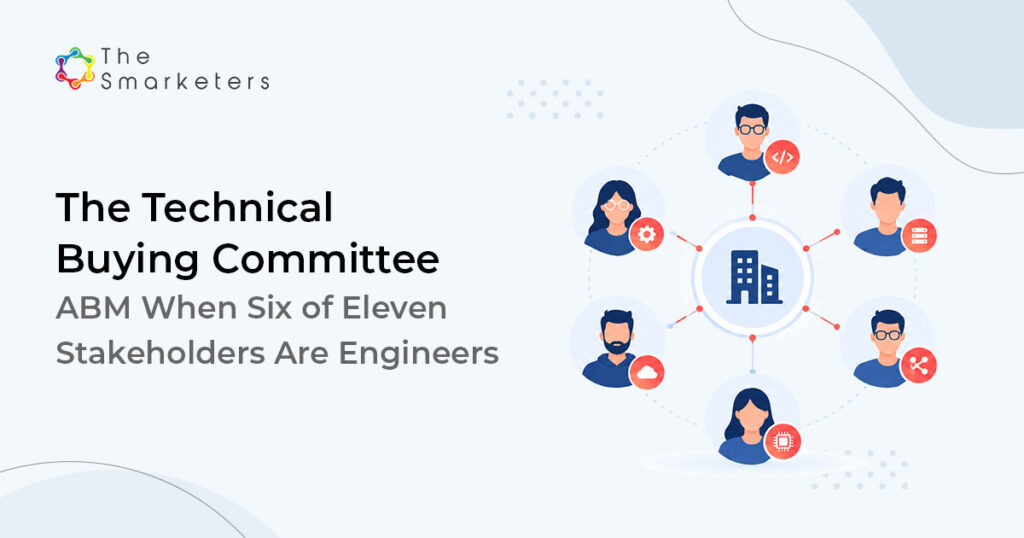
Six of those thirteen are technical in the deals we work on. That is what we count when we map these committees, and the ratio inverts most ABM playbooks: gated assets, executive-first outreach, nurture keyed to seniority.
The second break is sequencing. SaaS models treat evaluation as a linear stage. Engineering-led evaluation is iterative and adversarial by design: the technical team’s job is to find the failure mode, and they keep looking until they find one or run out of time.
Who is actually on an engineering-led buying committee?
Eleven roles recur. Not every account has all eleven, but missing ones are usually absorbed rather than absent, and assuming otherwise is how deals stall.
| Role | What they decide | Veto | Reached by |
|---|---|---|---|
| Principal or staff engineer | Whether the approach is sound | Yes | Documentation, teardowns, peers |
| Systems architect | Whether it fits the reference design | Yes | Reference architectures |
| Test and validation lead | Whether it survives qualification | Yes | Benchmarks |
| Reliability or safety engineer | Whether it passes safety review | Yes | Standards evidence, FMEA |
| Security architect | Whether it clears threat review | Yes | Security documentation |
| Operations lead | Whether it runs at volume | Sometimes | Site references, uptime data |
| Engineering manager | Whether the team has capacity | No | Roadmap and support terms |
| Programme manager | Whether it fits the schedule | No | Integration timelines |
| Economic buyer | Whether the money exists | No, but can defund | Business case |
| Procurement | Terms, supplier qualification | Yes | Supplier documentation |
| External integrator | Whether they support it | Sometimes | Partner enablement |
Five or six of these hold a genuine veto. One controls the budget. That asymmetry is the whole strategic problem, and most account plans do not reflect it.
VISUAL 1 · CAPTURE THIS
Screenshot of a LinkedIn Sales Navigator account page for a mid-size industrial manufacturer, filtered to the engineering function, with job titles visible. Annotate which titles map to which of the eleven roles and highlight the two that were missing from the CRM.
Why does the technical veto sit outside the economic buyer?
Because the risk sits there. A wrong technical decision in an engineered product does not produce an unused subscription; it produces a field failure, a recall, a line stoppage or a safety incident, and the engineer who approved it owns that permanently.
So an engineer is not comparing your claims to a competitor’s. They are trying to falsify yours. Marketing written to persuade signals you expect not to be checked.
KEY TAKEAWAY
Assume everything you publish will be tested by someone who wants it to fail and has the equipment to try. Write for that reader and the rest of the committee gets served for free.
What content earns an engineer's trust?
Specificity, reproducibility and visible limits. Content describing where the product fails gets read more carefully than content describing where it works, because it is the only evidence the vendor has characterised it.
Three practices matter more than format. Publish conditions alongside every number: temperature, load, sample size, firmware version, dataset. Publish the failure boundary, not just the operating point. And name the author with their engineering title, because attribution to a marketing team reads as attribution to nobody.
STAT
67% of B2B buyers prefer a rep-free experience, yet 69% turn to sales reps to validate AI-generated insights. Source: Gartner, surveys of 645 to 646 B2B buyers, released March and May 2026.
Both halves apply. Engineers run the whole evaluation without contacting you, then bring one specific question to a rep to test whether the vendor’s people are credible. If the first human they meet cannot answer at their level, the rep-free preference hardens into rejection.
Which proof formats actually land?
Not case studies, at least not first. A case study asks the reader to trust your account of someone else’s result. An engineer wants inputs they can substitute.
| Format | What it proves | Effort | Where it works |
|---|---|---|---|
| Reproducible benchmark | Performance under stated conditions | High | Early technical screen |
| Reference architecture | It fits an existing stack | Medium | Architect review |
| Teardown or failure analysis | You understand the physics | High | Principal engineers |
| Qualification report | It survives their process | Medium | Validation lead |
| Integration docs | Adoption cost is knowable | Low | Programme manager |
| Site or peer reference | It runs in production | Low | Operations, executive |
The benchmark is worth over-investing in. Publish method, environment, raw data and configuration files. A benchmark an engineer can rerun on their own hardware is the strongest asset a technical vendor has, and almost nobody publishes one. Reference architectures are the cheapest win: technical buyers are not asking whether your product is good, they are asking what breaks when it joins the eleven things already running.
Why should technical validation come before the commercial conversation?
Because a commercial motion started too early gives the technical team a reason to say no that has nothing to do with your product. Pricing pressure before validation reads as pressure to skip validation, and engineers resist that reflexively. The sequence that works has four gates, each with an exit condition.
- Technical screen. A principal engineer or architect decides you are worth time. Exit: they ask a second question.
- Reproduction. Their side runs your benchmark, reference design or sample. Exit: their numbers match yours within tolerance.
- Qualification. Test, safety, security and reliability review. Exit: sign-off or a documented conditional pass.
- Commercial. Economic buyer, procurement, terms.
VISUAL 2 · CAPTURE THIS
Screenshot of a published vendor benchmark page in a technical category, scrolled to the test-conditions block showing firmware version, sample size and environment. Annotate the three disclosures most vendor benchmarks omit, and mark where the raw data download sits.
PROOF POINT
For a Fortune 500 industrial automation client, an account-based programme built on technical proof and targeted engineering audiences produced 300-plus opportunities in four weeks and a 90% reduction in cost per lead.
Marketing owns gates one and two outright, yet most teams in these categories are measured on gate four. That is why they arrive too early.
How do you enable sales around a technical champion?
A technical champion is not a salesperson and should never be asked to behave like one. They advocate on technical grounds and go quiet the moment they are handed commercial material.
Give them three things: an internal-format technical summary with no branding on the numbers, an honest limitations list they can produce when challenged, and a named engineer they can email directly. The third does more than the other two combined, and costs a few hours a month.
We ran this on an industrial automation account where the champion was a staff engineer with no budget authority and no interest in vendor conversations. The only material he used was a two-page limitations document and a direct line to our client’s field applications engineer. The deal took eleven months and closed without him ever presenting a slide.
How do you measure committee coverage rather than engagement?
Coverage asks a different question: not how much activity an account generated, but how many veto roles you reached. Score roles, not people.
| Coverage band | Veto roles reached | What it means | Next move |
|---|---|---|---|
| Red | 0 to 1 of 5 | Single-threaded, high risk | Stop commercial motion |
| Amber | 2 to 3 of 5 | Real evaluation, incomplete | Target the missing role |
| Green | 4 to 5 of 5 | Committee is engaged | Commercial sequence viable |
Track two supporting numbers. Time to second technical contact tells you whether content travels inside the account. Unreached-role frequency across the portfolio names the asset you are missing entirely, nearly always the security architect or the reliability engineer.
Where this approach does not apply
If the purchase is genuinely low-consequence, this is over-engineering. A tool bought on a departmental card, with no integration and no safety implication, has no technical veto.
It also assumes you have engineers to spend. Peer access, benchmarks and teardowns draw on scarce technical time, and a company without that capacity should not promise it. A benchmark you cannot defend on a call is worse than no benchmark.
Finally, coverage is not causation. Reaching all five veto roles does not win the deal, it removes the losing reasons you could control. Where the evaluation favours a competitor, better mapping means you find out sooner. Our ABM programmes for manufacturing clients are built around that distinction.
Frequently Asked Questions
How do you market to engineers in B2B?
Publish evidence rather than claims. State conditions alongside every number, document the failure boundary, and attribute the work to a named engineer. Engineers evaluate by trying to falsify claims, so content designed to persuade signals you do not expect to be checked.
What is a technical buying committee?
A technical buying committee is the group of engineering, architecture, test, security and reliability stakeholders who can approve or block a purchase on technical grounds, separately from the economic buyer who controls budget. In engineered categories, five or six hold a veto while one controls money.
How do you map a technical buying committee?
Start from the eleven recurring roles rather than job titles, which vary widely between organisations. Identify who owns the approach, the reference design, qualification, safety, security and procurement, then check which roles the account has actually reached. Score coverage on roles reached, not activity volume.
Should marketing or sales own technical validation?
Marketing should own the technical screen and the reproduction stage, since both are content and access problems rather than negotiation problems. Sales takes over at qualification and commercial terms. Teams measured only on closed revenue arrive too early, which gives the technical committee a reason to disengage.
What proof formats work best with technical buyers?
Reproducible benchmarks first, with method, environment, raw data and configuration published. Reference architectures next, because architects want to know what breaks when your product joins an existing stack. Qualification reports and site references follow. Case studies work late, as reassurance, not as the opening asset.
How many stakeholders are in an engineering-led purchase?
Forrester’s State of Business Buying, published January 2026, found the average B2B decision involves 13 internal stakeholders and 9 external influencers. In engineered categories most of the internal group is technical, and the committee we map usually contains eleven distinct roles with five holding veto power.

Enoch Pakanati
CEO