Table of Contents
- Why Is the Buying Group the Right Unit of Measurement in B2B - and Why Is It So Hard to Build in HubSpot?
- Why does contact-level scoring break on a committee of thirteen?
- What Does the Buying Group in HubSpot Schema Look Like, Field by Field?
- How Do You Attach Contacts, Roles and Veto Power to a Buying Group in HubSpot?
- How do you build a group score that survives an audit?
- What does group-level attribution reporting actually show?
- How Do You Migrate to a Buying Group in HubSpot From Lead Scoring Without Losing History?
- Where Does the Buying Group in HubSpot Model Break Down?
- Frequently Asked Questions
Need help with B2B Marketing?
Let the smarketers’ team drive your pipeline with data-led campaigns and AI-powered growth strategies.
To model a buying group in HubSpot, create a custom object that sits between Company and Contact, carry each member’s role on an association label rather than a contact property, and calculate the score at group level using workflows. The custom object approach requires HubSpot Enterprise tier.
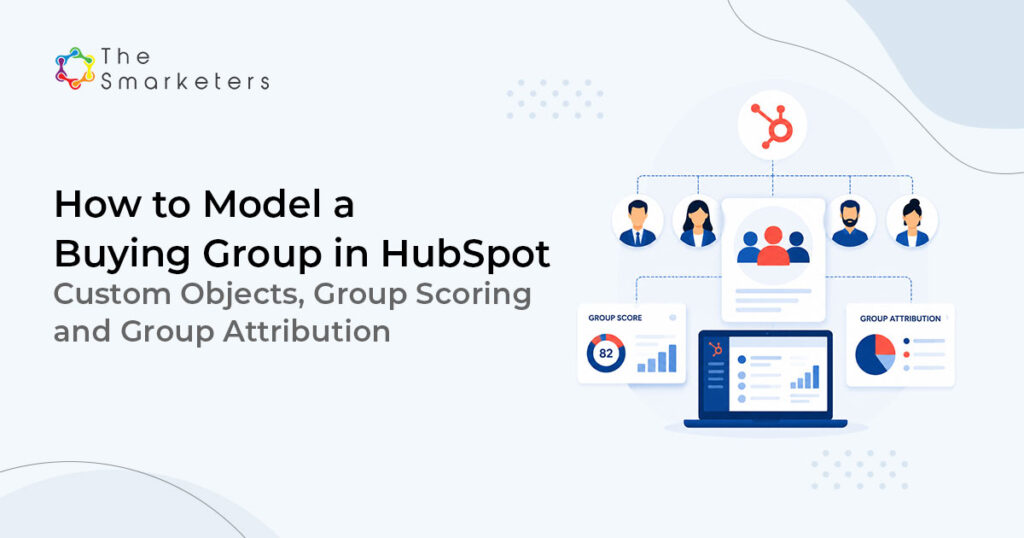
HubSpot ships no native buying group object with scoring or attribution built in, so you have to build one. Modelling a buying group in HubSpot means creating a custom object sitting between Company and Contact, with role and veto power carried on the association label rather than on the contact record, and a score calculated at group level.
Score the group instead of the person – and pair this architecture with a buying committee marketing strategy to cover every role with the right content – and one enthusiastic champion stops inflating readiness for an account nobody else has touched. Contact scoring rewards the loudest person in the room. Deals are decided by the quietest.
Why Is the Buying Group the Right Unit of Measurement in B2B - and Why Is It So Hard to Build in HubSpot?
The analyst position is settled; the tooling is not. Marketing platforms were built around a single record that fills in a form, and every scoring and routing feature descends from that.
STAT
The average B2B buying decision now involves 13 internal stakeholders and 9 external influencers, and procurement is a decision-maker in 53% of business buying cycles. Source: Forrester, State of Business Buying, January 2026.
Twenty-two people. Your MQL definition looks at one. That is a schema problem, and schema problems have fixes.
Why does contact-level scoring break on a committee of thirteen?
Contact scoring assigns points to individuals and routes on a threshold. When you compare contact scoring vs group scoring on a committee of thirteen, contact scoring fails in four specific ways – and every RevOps team has seen all four.
| Failure mode | What the CRM shows | What is happening | Cost |
|---|---|---|---|
| Champion inflation | One contact at 85 points | Single-threaded, no budget holder | Wasted sales cycles |
| Committee blindness | Eleven contacts at 20 points | Live evaluation running | Missed pipeline |
| Veto invisibility | Healthy deal, high engagement | Security never briefed | Late-stage loss |
| Role duplication | Three contacts, one title | One decision, two spectators | Inflated coverage |
Group scoring fixes all four by measuring something else: coverage of required roles, engagement of veto holders, breadth across distinct people – the same logic that drives account scoring in ABM, applied here at the committee level.
What Does the Buying Group in HubSpot Schema Look Like, Field by Field?
Create one custom object, called Buying Group. Do not model it as a deal property or company property set: one company runs several concurrent buying groups, and a deal record appears too late to help marketing.
| Property label | Internal name | Field type | What it holds |
|---|---|---|---|
| Buying group name | buying_group_name | Single-line text | Display property: account plus initiative |
| Buying scenario | buying_scenario | Dropdown | New logo, expansion, renewal, replacement |
| Group stage | group_stage | Dropdown select | Problem, shortlist, validation, procurement, decided |
| Required roles | required_roles | Checkboxes | Role labels this scenario needs |
| Committee coverage | committee_coverage_pct | Calculation | Roles filled over roles required |
| Group engagement score | group_engagement_score | Number, workflow-set | The audited group score, 0 to 100 |
| Veto roles engaged | veto_roles_engaged | Number, workflow-set | Veto contacts active in 45 days |
| Last multi-thread date | last_multithread_date | Date picker | Last week three members engaged |
| External influencers | external_influencer_count | Number | Consultants and integrators named |
| Blocking risk | blocking_risk | Dropdown | Low, medium, high, set by workflow |
| Group owner | hubspot_owner_id | HubSpot user | Accountable for coverage |
Two fields carry the design. required_roles makes the object work across scenarios: a renewal needs procurement and the economic buyer, an expansion needs neither. And group_engagement_score is a plain number written by workflow, because calculation properties cannot read associated records. That constraint is why most of these builds stall.
VISUAL 1 · CAPTURE THIS
Screenshot of the HubSpot custom object properties screen for a Buying Group object, with the property list and field types visible in the right-hand column. Annotate the two workflow-set numeric properties in teal, labelled “written by workflow, not calculated”. Capture at desktop width from a sandbox portal.
How Do You Attach Contacts, Roles and Veto Power to a Buying Group in HubSpot?
To complete the data model, associate Buying Group to Company as many-to-one, to Contact as many-to-many, and to Deal as one-to-many. Use HubSpot association labels to carry each person’s role on the relationship record – never on a contact property – so one person can hold different roles across concurrent buying groups at the same account.
| Association label | Who this is | Holds veto | Typical count |
|---|---|---|---|
| Economic buyer | Owns the budget line, signs | No, but can defund | 1 |
| Executive sponsor | Senior backer, rarely in detail | No | 1 |
| Champion | Runs the internal case | No | 1 to 2 |
| Technical evaluator | Runs the trial or pilot | No | 2 to 4 |
| Technical veto | Architecture, security, infrastructure | Yes | 1 to 3 |
| Compliance veto | Legal, quality, regulatory, privacy | Yes | 1 to 2 |
| Procurement | Commercial terms and onboarding | Yes | 1 to 2 |
| End user | Lives with the outcome daily | No | 2 to 6 |
| External influencer | Consultant, integrator, analyst | Sometimes | 1 to 3 |
| Detractor | Prefers another option | Yes in effect | 0 to 2 |
Keep the list at ten or fewer. HubSpot caps labels per association type, and longer lists get tagged inconsistently. Include the detractor label, whatever the objections: a named detractor with a documented reason is workable, an unnamed one is a loss you never understand.
How do you build a group score that survives an audit?
Buying group scoring in HubSpot is defensible when a sales or finance leader can reconstruct any account’s number from the record in a minute. That rules out black-box weighting. Four components, hard caps, one decay rule.
| Component | Max points | Calculation | Why it is capped |
|---|---|---|---|
| Role coverage | 30 | Roles filled over roles required, times 30 | A gate, not a growth curve |
| Veto engagement | 25 | 12.5 per veto contact active in 45 days | Two engaged veto holders is the ceiling |
| Engagement breadth | 20 | 4 per distinct member active in 30 days, five max | Stops one team inflating it |
| Buying signals | 25 | 5 each: pricing view, security docs, reference request, integration docs, procurement form | Occurs only during evaluation |
Two rules make it auditable. No contact contributes more than 25 of the 100 points, the direct fix for champion inflation. And the total decays 10% per 30 days of inactivity, so a stale account cannot sit in the queue on last quarter’s work. Three workflows do it: recalculate on association change, stamp contact activity, apply decay nightly.
PROOF POINT
We build buying group in HubSpot models as a HubSpot Platinum Solutions Partner, on portals including the Byteridge and Excellon implementations, where the group object replaced contact-level lead scoring as the routing trigger. Across 250-plus clients since 2015, our programmes have generated more than $450M in pipeline.
What does group-level attribution reporting actually show?
Three reports are worth building first – and they connect directly into the attribution layer described in our ABM measurement framework. Everything beyond them is usually curiosity.
| Report | Built on | Grouped by | Decision it drives |
|---|---|---|---|
| Coverage at close | Buying Group and Deal | Win or loss, coverage band | Whether coverage predicts win rate |
| Role by first touch | Contact and Buying Group | Association label, original source | Which channels reach veto roles |
| Time to multi-thread | Buying Group | Days to third labelled member | Whether campaigns broaden groups |
The second one changes budgets. In most portals we audit, paid search and gated content reach champions and end users almost exclusively, while technical and compliance veto holders arrive through peer communities, documentation, and partner events – a channel insight that also drives HubSpot website personalization decisions for ABM. Read the role column before renewing media contracts.
KEY TAKEAWAY
If the group score is high and veto engagement is zero, you do not have a hot account. You have a well-informed champion who is about to be overruled.

How Do You Migrate to a Buying Group in HubSpot From Lead Scoring Without Losing History?
Run both systems in parallel for one full sales cycle. Migrations fail when teams switch routing on day one and lose any basis for comparison.
- Create the object and labels, but route on nothing yet.
- Backfill two quarters of closed deals, labelling contacts who appeared on invitations and threads.
- Score those groups from portal activity, then test coverage against outcomes you know.
- Keep the contact score as a property. It is your control.
- Route on a combined rule: contact score above threshold, group coverage above 60%.
- Retire the contact-only MQL definition once a quarter of data supports it.
I ran this backfill on an enterprise technology portal holding about 400 closed deals across two years. It took an analyst four days, mostly reconstructing who was in the room from meeting records rather than CRM associations. The finding was unglamorous: compliance-role coverage was the strongest single differentiator between won and lost deals in that dataset, and nobody in marketing had ever built an asset for that person.
VISUAL 2 · CAPTURE THIS
Screenshot of the HubSpot custom report builder with Buying Group as the primary data source and Deal joined, plotting coverage band against win rate. Annotate the coverage threshold where the win rate steps up. Use anonymised sandbox data.
Where Does the Buying Group in HubSpot Model Break Down?
A note on HubSpot’s native Buying Groups card: HubSpot introduced a native Buying Groups feature in Sales Hub Enterprise, becoming generally available through Spring Spotlight 2026 and rolling out to Professional tier. The native card provides a visual stakeholder org chart attached to a deal – useful for sales teams managing active opportunities. It does not support workflow-driven group scoring, score decay, multi-group modelling per account, or attribution reporting by role. The custom object architecture described in this post covers those gaps. The two approaches are complementary: the native card gives sales a deal-level view; the custom object gives marketing and RevOps a scoring and attribution layer.
It needs Enterprise. Custom objects are unavailable on Professional tiers, and workarounds built from company properties collapse the moment an account runs two concurrent evaluations.
Maintenance is the real cost. Labels are applied by humans, and tagging degrades within a quarter unless a deal stage gate forces the AE to confirm the committee. Without that gate the object is accurate for three months, decorative thereafter.
Group scoring assumes you can see engagement. Where technical evaluators research anonymously through documentation and answer engines, the score understates readiness. Treat it as a floor. And this is a measurement model, not a demand model: a HubSpot implementation gives the diagnosis, the ABM programme supplies the treatment.
Frequently Asked Questions
How do I track buying groups in HubSpot?
To track a buying group in HubSpot, create a custom object called Buying Group, associate it many-to-one with Company, many-to-many with Contact, and one-to-many with Deal, then carry each person’s role on the association label rather than a contact property. Score it with workflows, since calculation properties cannot read associated records.
Does HubSpot have a native buying committee object?
No. HubSpot provides contacts, companies, deals, custom objects and association labels describing a person’s role in a specific relationship. Buying group modelling is assembled from those primitives rather than switched on, which is why schema and label taxonomy matter more than any single feature.
What HubSpot tier do I need for buying group modelling?
Custom objects require an Enterprise tier. Association labels exist lower down, so a partial version using labelled contact-to-company associations works on Professional, but it cannot represent two concurrent buying groups at one account, so expect to rebuild later.
How should a buying group be scored?
Score four capped components: role coverage, veto-holder engagement, breadth across distinct members, and evaluation-stage behaviours such as pricing or security documentation views. Cap any single contact at a quarter of the total, and decay the total when the group goes quiet.
How many people should be in a buying group record?
Forrester’s State of Business Buying, published January 2026, found the average B2B decision involves 13 internal stakeholders and 9 external influencers. You will rarely identify all 22. Cover the required roles for the scenario, usually eight to eleven labelled members.
How do I migrate from lead scoring to group scoring?
Run both in parallel for a full sales cycle. Backfill buying groups for two quarters of closed deals, score them from existing activity data, and test whether coverage correlates with known outcomes. Move routing to a combined rule before retiring the contact-only MQL.
Does HubSpot's native Buying Groups feature replace the custom object model?
Not fully. HubSpot’s native Buying Groups card, generally available in Sales Hub Enterprise from Spring Spotlight 2026 and rolling out to Professional, provides a visual stakeholder org chart within a deal record. It does not support group-level scoring, score decay, multi-group tracking per account, or attribution reporting across deal outcomes. The custom object model covers those gaps and can coexist with the native card.
How do buying group scores connect to pipeline routing in HubSpot?
A workflow reads the group_engagement_score and veto_roles_engaged properties on the Buying Group custom object and enrols matching records into routing sequences. A combined rule – group coverage above 60% and contact score above threshold – replaces the single-contact MQL definition. Three workflows handle the scoring engine: recalculate on association change, stamp contact activity, and apply score decay nightly.

Enoch Pakanati
CEO