Table of Contents
- At what revenue should a B2B company choose between in-house, agency and BOT?
- Which six variables decide in-house vs agency marketing?
- What does an in-house marketing team cost over 36 months?
- What are the pros and cons of outsourcing marketing to an agency?
- How does build-operate-transfer marketing work?
- Where does a hybrid marketing model fail?
- How do you score the in-house vs agency marketing decision?
- Can you reverse a build vs buy marketing decision later?
- When does this decision model not apply?
- Frequently Asked Questions
Need help with B2B Marketing?
Let the smarketers’ team drive your pipeline with data-led campaigns and AI-powered growth strategies.
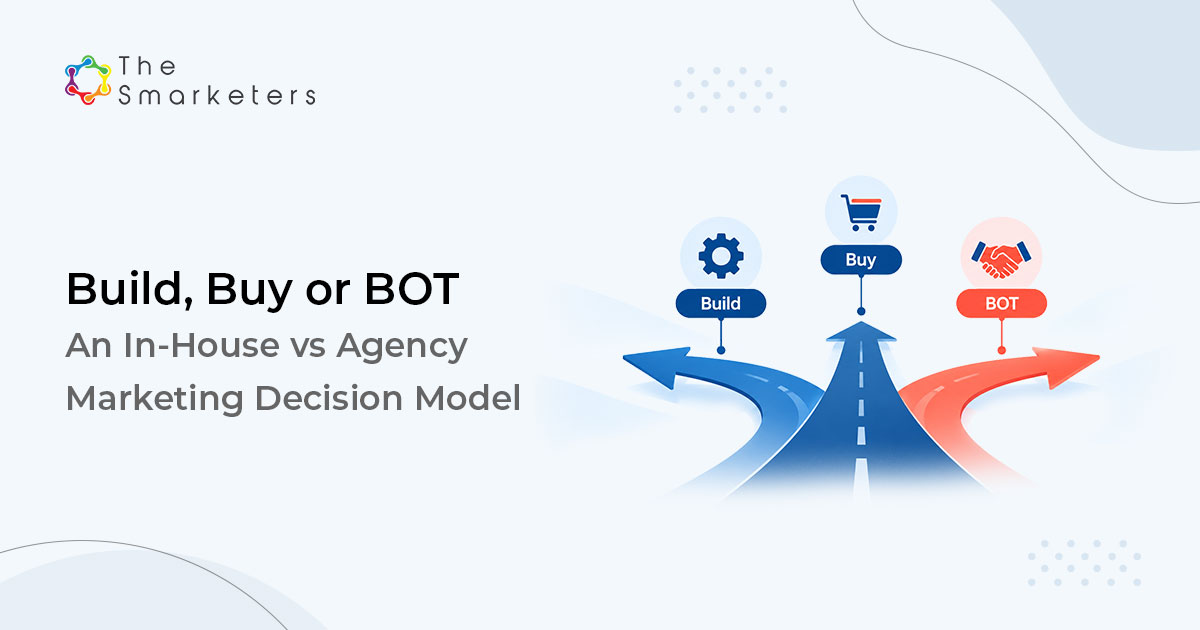
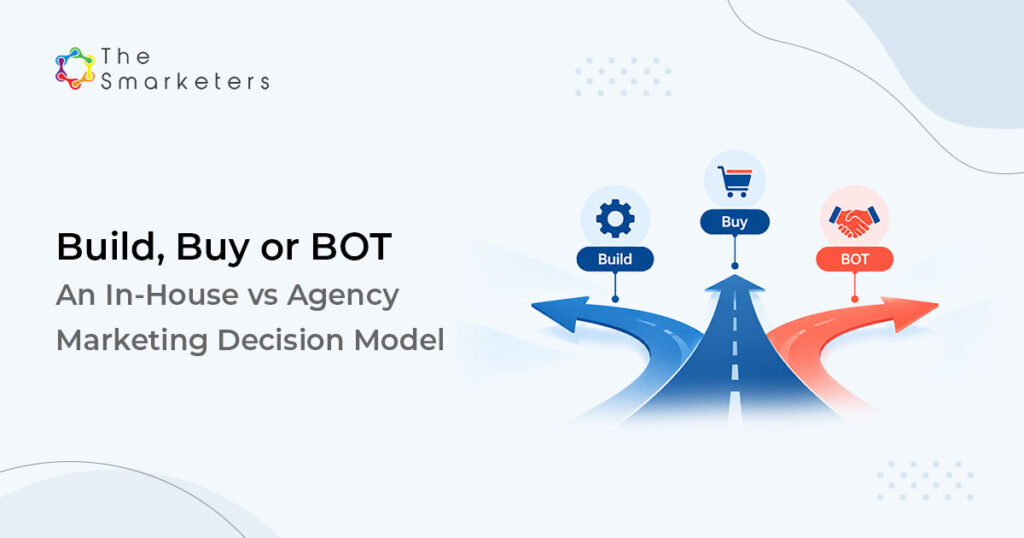
Most firms settle the in-house vs agency marketing question with a spreadsheet comparing salaries to retainers, which is the wrong comparison. The decision turns on capability half-life, how deep the hiring market is for the skills you need, and how fast you need the capability working. Build-operate-transfer fits the specific case where you need agency speed now and internal ownership within two to three years, and it is a worse answer than either alternative outside that case.
Below is the cost comparison and the scoring model we use to settle it in one session.
| Route | 36-month cost in this model | Live by | Best fit when |
|---|---|---|---|
| In-house | $1,296,000 | Month 5 to 7 | Your score is above 3.4: stable skills, a deep hiring market and a senior manager to run the team |
| Agency at $18,000 a month | $648,000 | Month 1 to 2 | Your score is below 2.4: fast-changing skills, a thin hiring market or output needed this quarter |
| Build-operate-transfer | $984,000 | Month 1 to 2 | Your score is between 2.4 and 3.4: you need output now and ownership within two to three years |
At what revenue should a B2B company choose between in-house, agency and BOT?
Below roughly $20M in revenue there is usually one marketer and an agency, and nobody calls that a decision. Above it, three things change together. The board wants forecastable pipeline, the founder stops being the main demand channel, and the workload passes what one generalist can hold.
That is also the point where the cost of getting it wrong becomes real. A mis-hired head of marketing at this stage costs a year of momentum, not just a salary.
STAT
Marketing leaders expect AI automation of marketing work to rise from 16% in 2026 to 36% by 2028 (Gartner survey of 402 CMOs, May 2026). Separately, only 30% of CMOs report mature AI readiness capabilities (Gartner 2026 CMO Spend Survey, 401 marketing leaders).
That gap is the capability half-life argument in one line. Skills you hire for today have a shorter useful life than they did, which raises the value of arrangements that refresh capability without refreshing headcount.
Which six variables decide in-house vs agency marketing?
Score these six honestly and the answer usually presents itself before you finish.
| Variable | Points toward building in-house | Points toward buying |
|---|---|---|
| Capability half-life | Skill is stable for years | Skill changes every 12 to 18 months |
| Hiring market depth | Many qualified candidates reachable | Thin market, long searches |
| Time to capability | You can wait two quarters | You need output this quarter |
| Workload shape | Continuous and predictable | Spiky or project-driven |
| Strategic centrality | The work is your differentiator | The work is necessary, not distinctive |
| Leadership bandwidth | Someone senior can manage the team | Nobody has capacity to manage anyone |
Leadership bandwidth is the variable most often skipped and most often decisive. A team without a manager who knows what good looks like produces activity, not results, and the cost of that is invisible for about nine months.
What does an in-house marketing team cost over 36 months?
Over 36 months, a four-person in-house marketing team costs about $1.30M in this model, roughly double the $648,000 cost of an $18,000-a-month agency retainer. The base team cost is only part of the real figure, so build the model with recruitment, ramp time and attrition included.
Take S as your fully loaded annual cost per marketer, meaning salary plus employment costs. The table below uses S equal to $90,000 and a team of four; substitute your own.
| Line | Model | 36-month total |
|---|---|---|
| Base team cost | 4 people times $ times 3 years | $1,080,000 |
| Recruitment | 15% of first-year salary per hire | $54,000 |
| Ramp loss | 3 unproductive months per hire | $90,000 |
| Attrition and replacement | 2 replacements across 3 years, each with recruitment and ramp | $72,000 |
| Total | $1,296,000 | |
| Months until first campaign live | Recruit plus ramp | 5 to 7 |
Tooling is excluded because it costs the same whichever route you take. Management time is excluded too, which flatters this option, so add it if the manager is a new hire.
What are the pros and cons of outsourcing marketing to an agency?
Speed and breadth, immediately. A retained team is producing inside four to eight weeks, brings specialists you could not justify hiring, and can be scaled down when demand falls.
The cost is knowledge retention. Everything the agency learns about your buyers, your objections and your channel economics lives partly in their heads, and it leaves when the contract does. That is a genuine risk and it is also manageable, but only if you make documentation and platform ownership contractual rather than hopeful.
| Route | 36-month cash cost in this model | Live by | Capability owned at month 36 |
|---|---|---|---|
| In-house | $1,296,000 | Month 5 to 7 | Yes, subject to attrition |
| Agency at $18,000 a month | $648,000 | Month 1 to 2 | No |
| Build-operate-transfer | $984,000 | Month 1 to 2 | Yes, with documentation |
In cash terms, the agency route wins the in-house vs agency marketing comparison, but it is the only one that leaves you with nothing at the end. Whether that matters depends entirely on the capability half-life score above.
How does build-operate-transfer marketing work?
Build-operate-transfer marketing is a contract with three phases and a dated handover, not a retainer with a friendly ending. In short, the agency builds the function, runs it until results are stable, then hands the team, playbooks and systems to the client on dated milestones. The transfer works when it is designed into the first phase.
| Phase | Months | Who runs it | What must exist by the end |
|---|---|---|---|
| Build | 1 to 6 | Agency, with a client sponsor | Working program, documented process, first results |
| Operate | 7 to 24 | Agency, with first hires shadowing | Stable performance, playbooks, named successors |
| Transfer | 25 to 36 | Client, with agency advisory | Client team running independently, agency on call |
Three things make a transfer real. Hiring milestones sit in the same contract as the phase dates, so a delay is visible immediately. Documentation is a deliverable with acceptance criteria, not a promise. And shadowing starts in the operate phase, because learning a program while being responsible for it is how transfers fail.
PROOF POINT
We run build-operate-transfer and enablement engagements from a team of 80+, across more than 250 clients and over $450M in pipeline generated since 2015. On one Fortune 500 technology program the work produced 150+ sales-qualified accounts within eight months, which is the standard the operate phase has to hit before a handover is worth scheduling.
Where does a hybrid marketing model fail?
A hybrid marketing model is usually right in principle and wrong in the split. The rule that works is to divide by who owns the relationship, not by channel: keep customer-facing judgment in-house, outsource throughput and specialist skills, and never split one funnel between two owners.
Keep internally anything that requires knowing your customers personally: positioning, pricing narrative, sales alignment, customer stories. Outsource anything that requires throughput or a specialist skill you use intermittently: media buying, technical search, campaign production, marketing automation engineering.
The failure mode is splitting one workstream in half. Two owners of the same funnel produces a monthly meeting about whose numbers are correct, and neither party can be held to a result.
I have watched this go both ways with one client. Their first arrangement gave us campaign execution while they kept strategy, and it drifted, because strategy without execution feedback becomes theory. The second gave us a whole channel with a single number to hit, and their team took content and sales enablement with one number of their own. Same headcount, same budget, arguments over inside a quarter.
How do you score the in-house vs agency marketing decision?
Score each variable from 1 to 5, where 1 strongly favors buying and 5 strongly favors building. Multiply by the weight, then total. The example scores below are for a company that needs output this quarter and has no senior marketer free to manage a team. Its total of 2.30 points to buying, so replace them with your own.
| Variable | Weight | Score 1 to 5 | Weighted |
|---|---|---|---|
| Capability half-life | 0.20 | 2 | 0.40 |
| Hiring market depth | 0.20 | 2 | 0.40 |
| Time to capability | 0.15 | 1 | 0.15 |
| Workload shape | 0.15 | 3 | 0.45 |
| Strategic centrality | 0.20 | 4 | 0.80 |
| Leadership bandwidth | 0.10 | 1 | 0.10 |
| Total | 1.00 | 2.30 |
Read the total this way. Below 2.4 means buy, and stop trying to build. Between 2.4 and 3.4 means build-operate-transfer, because you want ownership but cannot currently support it. Above 3.4 means build, and the agency question is only about filling specialist gaps.
Run it with your CFO and your most skeptical operator in the room. The scoring conversation surfaces the disagreement, which is the actual output. Our training and consulting engagements often start with exactly this session.
Can you reverse a build vs buy marketing decision later?
Partly, and the direction matters. Moving from agency to in-house is straightforward if you own the platforms, documentation and data from the start. Moving from in-house to agency is harder, because it involves layoffs and the institutional knowledge leaves anyway.
That asymmetry is an argument for the reversible option when the score is genuinely borderline. Buying first and building later costs less than building first and dismantling.
When does this decision model not apply?
The scoring model assumes you can hire at all. In some specialties the search takes so long that a high build score is academic, and the honest answer is to buy while the market changes.
The cost comparison assumes a functioning agency relationship. A poor agency is worse than a mediocre internal team, because you lose the output and the learning. The model tells you which structure fits, not whether a specific partner is any good.
None of this applies if the underlying problem is positioning. No structure fixes a proposition the market does not want, and both routes will produce competent execution of the wrong message.
Frequently Asked Questions
Is it better to build an in-house marketing team or hire an agency?
Score six variables: capability half-life, hiring market depth, time to capability, workload shape, strategic centrality and leadership bandwidth. Stable skills, a deep hiring market, continuous work and available management favor building. Fast-changing skills, thin markets, spiky workloads and no manager favor buying.
What is build-operate-transfer in marketing?
It is a three-phase arrangement where an agency builds the capability, operates it while results stabilize, then transfers the program, documentation and systems to an internal team on dated milestones. It suits firms that need output now and intend to own the function within two to three years.
Is an in-house team cheaper than an agency?
Usually not over three years, once recruitment, ramp time and attrition are counted. In the model above, four in-house marketers cost around $1.30M over 36 months against $648,000 for a marketing agency retainer. In-house buys ownership and continuity rather than a lower cash cost.
How long does a BOT transfer take?
Plan 36 months in total: roughly six months to build, eighteen to operate while hires shadow the work, and twelve to transfer with the agency in an advisory role. Compressing it below two years usually means the internal team inherits a program they have not yet run.
What should stay in-house in a hybrid model?
Anything that depends on knowing your customers personally: positioning, pricing narrative, sales alignment and customer stories. Outsource throughput and intermittent specialties such as media buying, technical search and automation engineering. Never split a single funnel between two owners.
How do we protect against knowledge leaving with the agency?
Own every platform and account from day one, make documentation a deliverable with acceptance criteria rather than a promise, and require a handover pack in the wind-down clause. Notice periods give you time; only documentation gives you the knowledge.

Enoch Pakanati
CEO