Need help with B2B Marketing?
Let the smarketers’ team drive your pipeline with data-led campaigns and AI-powered growth strategies.
What Should You Automate in Content and Social (and What You Shouldn't)?
Automate the repetitive production work, repurposing, formatting, scheduling, first drafts, and variant generation, and keep strategy, point of view, and final editorial judgment human. AI drafts and reformats; a person decides what to say and approves what ships. That division is where the 20 hours come from without losing quality.
The opportunity is real and the adoption is already here: Forrester reports 89% of B2B buyers have adopted generative AI (Forrester, 2024), and the majority of marketing leaders are investing in it (Gartner, 2023). The risk is publishing unreviewed AI output at scale, which is why guardrails matter as much as the workflows.
| Task | Automate? | How |
|---|---|---|
| Repurposing a blog into social content | Yes | LLM generates platform variants; human edits. |
| Formatting and scheduling | Yes | No-code workflow on a calendar. |
| First drafts from a brief | Yes | LLM drafts; editor rewrites for voice. |
| Alt text and metadata | Yes | Templated generation, validated. |
| The point of view / angle | No | Human strategy and expertise. |
| Final publish decision | No | Human editorial approval. |
What Does the Workflow Look Like?
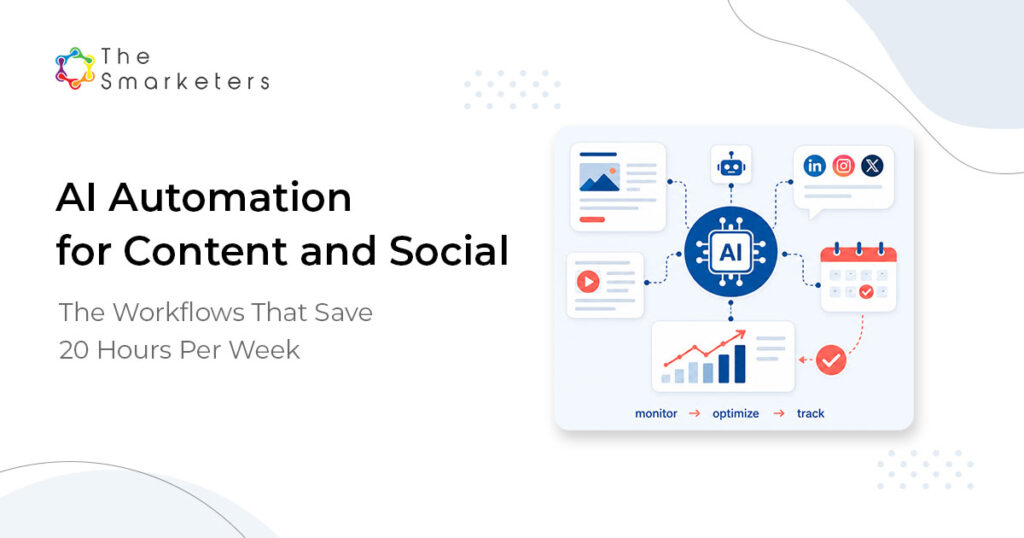
- Brief. A human sets the angle, audience, and key points. This is the part AI cannot do for you.
- Draft. An LLM produces a first draft and platform variants from the brief.
- Edit. An editor rewrites for brand voice, accuracy, and a real point of view.
- Distribute. A no-code workflow formats, schedules, and posts across channels.
Keep a human in the loop on voice and facts. Automation should remove production drudgery, not editorial judgment. Unreviewed AI content at scale damages brand and gets ignored by readers and AI engines alike.
Where Does the Time Go? Use Cases
- Repurposing. One pillar becomes a dozen social posts, an email, and a script, in minutes instead of a day.
- Always-on social. A no-code calendar keeps channels active without daily manual posting.
- Scale without headcount. A small team covers more channels by automating production, not strategy.
Want the content automation playbook?
Frequently Asked Questions
Can AI automate content and social media?
Yes, the production parts: repurposing, formatting, scheduling, first drafts, and platform variants. Strategy, point of view, and final editorial judgment stay human. The right model is AI drafts and reformats while a person decides what to say and approves what ships, which is where the time savings come from.
How much time does AI content automation save?
Teams commonly reclaim around 20 hours a week, mostly from repurposing and production rather than strategy. The biggest savings come from turning one pillar asset into many channel-specific pieces and from automating formatting and scheduling, while editors keep control of voice and accuracy.
Will AI replace content marketers?
No. AI removes repetitive production work, but it cannot set strategy, hold a genuine point of view, or make the editorial and brand-voice judgments that make content worth reading. The teams that win pair AI’s speed with human expertise and a strict review step.
What's the risk of automating content with AI?
Publishing unreviewed AI output at scale. It produces generic, sometimes inaccurate content that damages brand and gets ignored by both readers and AI engines. The guardrail is simple: AI drafts, humans edit for voice and facts, and a person makes the final publish decision.
What tools do you need for content automation?
An LLM for drafting and repurposing, a no-code workflow tool to format and schedule, and your existing CMS and social platforms. The architecture and editorial process matter more than any single tool; the goal is automating production while keeping human review on strategy and quality.

Swati Bansal
Sr. Content Strategist