Table of Contents
- How Each AI Platform Selects Sources Differently
- Google AI Overviews: Organic Strength Still Decides
- Gemini: Grounded in Google Search and the Knowledge Graph
- Copilot: The Bing Index and IndexNow
- A Cross-Platform Strategy: The GEO Coverage Grid
- Implementation Roadmap
- Case Study: +292% Organic Inbound Leads for an Enterprise Tech Firm
- When GEO Is Not the Right First Move
- Get the GEO Playbook
- Frequently Asked Questions
Need help with B2B Marketing?
Let the smarketers’ team drive your pipeline with data-led campaigns and AI-powered growth strategies.
An enterprise software evaluation now involves a committee, not a champion. Forrester and 6sense put the median buying group at 11.2 people for deals over $50K, up from 9.7 a year earlier. Most of those people will never fill out your form: up to 90% of identifiable account visitors stay anonymous, and roughly 3% of web visitors convert to form-fills. Where the committee does its reading has changed too. 94% of B2B buyers use generative AI during the purchase process, and for enterprise tech that means three surfaces you probably do not measure: Google AI Overviews above the results your SEO team worked for, Gemini inside Google Workspace, and Copilot inside the Microsoft 365 environment where half your buying committee spends its day.
Generative engine optimization (GEO) is the practice of earning visibility inside AI-generated answers: being the source the engine retrieves, quotes, and names. It overlaps with answer engine optimization (AEO), and the terms are often used interchangeably; in this guide GEO refers specifically to the Google and Microsoft generative surfaces, because that is where enterprise buying committees encounter AI answers by default, without ever choosing an “AI tool.”
The problem this article solves: most enterprise tech brands have wildly uneven coverage across these three surfaces and no measurement to see it. What follows is how each platform selects sources, what that means for your content and infrastructure, and the implementation roadmap we use at The Smarketers.
How Each AI Platform Selects Sources Differently
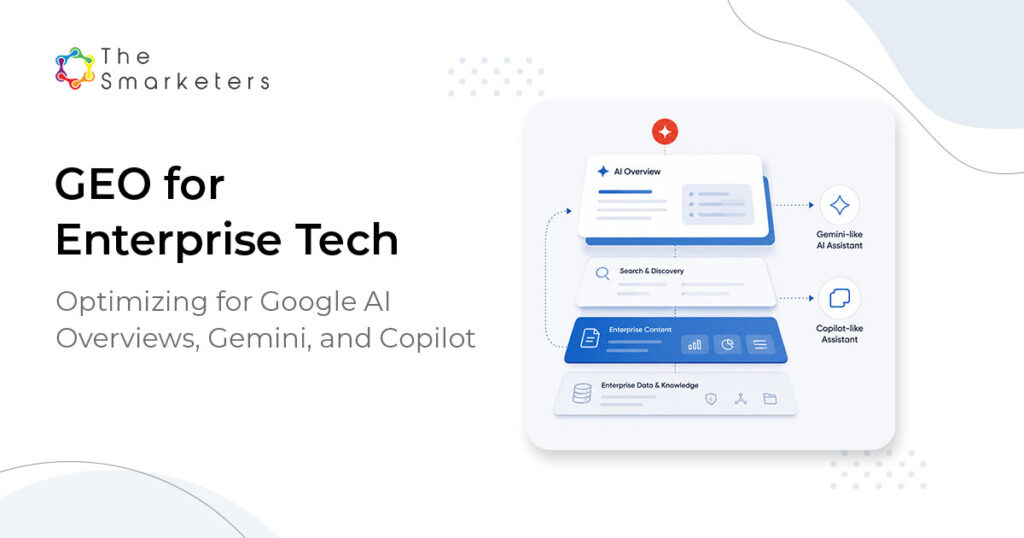
Three surfaces, three retrieval systems, three definitions of a trustworthy source. AI Overviews is welded to Google’s organic ranking systems. Gemini grounds its answers in Google Search and the Knowledge Graph. Copilot answers from the Bing index. Treating them as one “AI channel” is the enterprise equivalent of running one campaign across three markets with different languages.
| Surface | Index and grounding | What it favors | Where your buyers meet it |
|---|---|---|---|
| Google AI Overviews | Google index; tightly coupled to organic ranking systems | Pages that already perform organically, with liftable answer-first passages | At the top of ordinary Google searches during research |
| Gemini | Google Search grounding plus Knowledge Graph | Resolvable entities, structured data, consistent facts across sources | Inside Google Workspace and the Gemini app |
| Copilot | Bing index, refreshed via IndexNow | Bing-indexed, cleanly rendered pages with clear structure | Inside Microsoft 365, Teams, and Edge, mid-workday |
One pattern holds across all of them: community and third-party sources punch far above vendor sites. A study covered by Search Engine Land found Reddit is the most-cited source across ChatGPT, Google AI Mode, Gemini, Perplexity, and AI Overviews. Enterprise buyers also increasingly prefer to do this research without you in the room: Gartner’s March 2026 survey found 67% of B2B buyers prefer a rep-free buying experience, while 69% use sales reps mainly to validate what AI already told them. By the time your account executive presents, the committee has usually read the machine’s summary of your category.

Google AI Overviews: Organic Strength Still Decides
The direct answer: you do not optimize for AI Overviews instead of organic search; you optimize through it. Google’s AI Overviews draw heavily on pages that already rank organically for the underlying query, so a page with no organic footprint has almost no path into the Overview. That is good news for enterprise tech brands with real SEO equity, and bad news for anyone hoping GEO is a shortcut around it.
What moves the needle once ranking is in place:
- Passage-level answers. The Overview quotes passages, not pages. Every priority page needs sections that answer one question completely in two to four sentences before expanding.
- Question-mapped H2s. Structure headings around the questions committees actually ask: evaluation criteria, integration constraints, security posture, total cost. These are the queries that trigger Overviews in enterprise categories.
- Corroborated claims. Overviews synthesize several sources. Claims about your platform that third-party sources contradict, or that nobody else repeats, tend to get smoothed out of the answer. Consistency across your site, analyst coverage, and reviews keeps you quotable.
Measurement for this surface is also different from classic rank tracking. An Overview can cite you while your blue link sits in position six, or skip you while you hold position two, so the tracking unit is the answer, not the ranking. Log which queries in your panel trigger an Overview at all, which sources it names, and how your presence changes month to month. Watch the click pattern too: when an Overview answers the question fully, the visits you do receive tend to come from committee members who read the summary and still wanted the detail. Fewer sessions, better sessions is a trade most enterprise tech pipelines should take, but only if your attribution model has been told about it.
Gemini: Grounded in Google Search and the Knowledge Graph
Gemini answers are grounded in Google Search results and the Knowledge Graph, which makes entity strength the deciding factor. Where AI Overviews asks “which ranking pages answer this query,” Gemini effectively asks “which entities do I trust on this subject, and what do I verifiably know about them.”
For an enterprise tech brand, that translates into three jobs. First, structured data done thoroughly: Organization, Product or SoftwareApplication, Person for named authors, FAQPage where genuine questions are answered, all with sameAs links tying your profiles together. Second, fact consistency: founding details, category wording, product names, and headline claims must match across your site, LinkedIn, directories, and press coverage, because contradictions lower the confidence with which the model names you. Third, named expertise: executives and practitioners with visible bylines and profiles give the Knowledge Graph human entities to attach your authority to.
The Workspace context matters more than most teams realize. A committee member drafting an evaluation memo in Google Docs can ask Gemini to summarize category options without ever opening a search results page. Your presence in that answer depends entirely on machine-readable reputation built in advance. There is no ad placement, no ranking tweak, and no retargeting pixel that reaches that moment.
Copilot: The Bing Index and IndexNow
If your buyers run on Microsoft 365, Copilot visibility runs through Bing, and this is the fastest gap to close in most enterprise GEO audits, because almost nobody maintains their Bing presence deliberately. Enterprise IT, security, and procurement teams live in Teams, Outlook, and Edge; when they ask Copilot about vendor options, the answer is assembled from the Bing index.
The checklist is short and mostly infrastructural:
- Verify in Bing Webmaster Tools. Confirm your key pages are indexed at all. We regularly find enterprise sites with significant sections missing from Bing that are fine in Google.
- Adopt IndexNow. IndexNow pushes URL changes to Bing immediately instead of waiting for a recrawl. For sites that update product, security, and compliance pages frequently, this is the difference between Copilot citing your current positioning and your old one.
- Render server-side, structure clearly. The same extractability rules apply: self-contained sections, tables for comparisons, clean HTML that does not hide substance behind JavaScript.
- Watch Edge and Teams referrers. Copilot-driven visits show up small in analytics but tend to arrive far better informed. Tag and track them separately.
A Cross-Platform Strategy: The GEO Coverage Grid
The direct answer to “how do we cover all three without tripling the budget”: invest in the four signal families the platforms share, then layer thin platform-specific work on top. We formalize this as the GEO Coverage Grid, which scores a brand on each signal family and identifies the platform where weakness costs the most.
| Signal family | What it means in practice | Weighted most heavily by |
|---|---|---|
| Retrievability | Indexed in Google AND Bing, crawlers permitted, IndexNow live, sitemaps current | Copilot (Bing gaps are common and cheap to fix) |
| Extractability | Answer-first sections, self-contained passages, comparison tables, question-mapped headings | AI Overviews (quotes passages from ranking pages) |
| Entity authority | Consistent naming, full schema coverage, named authors, corroborated facts | Gemini (Knowledge Graph grounding) |
| Freshness and corroboration | Updated priority pages, active reviews, community and analyst mentions | All three, and every chat assistant beyond them |
Implementation Roadmap
Sequenced for a typical enterprise tech marketing team, with measurement first because every later decision depends on it:

- Weeks 1–2: Audit AI visibility per platform. Build a 30-to-50 prompt panel from real committee questions and run it across AI Overviews, Gemini, and Copilot. Log every brand name and URL cited. This baseline is the number the program answers to.
- Weeks 2–4: Fix retrieval foundations. Bing Webmaster Tools verification, IndexNow adoption, robots.txt review for AI crawlers, rendering checks, sitemap hygiene, schema deployment.
- Weeks 4–8: Restructure priority pages. Comparison, evaluation, security, and pricing pages first. Answer-first sections, tables, question-mapped H2s. Resist restructuring the whole site; work where shortlists form.
- Weeks 6–10: Consolidate entity signals. One product name, one category phrase, matching facts across every property. Fix directory and profile inconsistencies; they are cheap and they compound.
- Ongoing: Earn corroboration. Analyst relations, trade-press contributions, review depth, genuine practitioner participation in the communities your category is discussed in.
- Monthly and quarterly: Measure and reallocate. Re-run the panel monthly, track AI referrals in GA4, review per-platform citation share quarterly, and move budget to what moved.
Case Study: +292% Organic Inbound Leads for an Enterprise Tech Firm
The numbers first: The Smarketers engagement with Acuvate, an enterprise technology services and solutions firm, delivered a 292% increase in organic inbound leads (Smarketers client engagement).
Before: strong delivery credentials and enterprise references, but a web presence structured around service names rather than buyer questions. Category research surfaced marketplaces, analyst summaries, and competitors; the firm’s own expertise was effectively unreadable to retrieval systems.
The bridge was the roadmap above: retrieval and indexation fixes across both Google and Bing, priority pages rebuilt answer-first around evaluation questions, entity consolidation across directories and profiles, and a steady corroboration program. Lead growth followed the visibility, because pages that answer committee questions attract exactly the visitors who have questions.

The caveat we attach to every enterprise engagement: timelines are real. Entity signals and corroboration accumulate over months, not sprints, and an organization that cannot commit to the measurement rhythm will see the program stall at the audit stage. GEO rewards patience and punishes reorganizations.
When GEO Is Not the Right First Move
The honest answer: sometimes it is not. Three situations argue for waiting.
- Broken technical SEO. AI Overviews rides on organic performance. If core pages have crawl, speed, or indexation problems, GEO lands on sand. Fix the foundation first.
- No original substance to retrieve. If the site is thin repackaging of category boilerplate, restructuring will not make it citable. Invest in genuine expertise content before optimizing its delivery.
- A pipeline built on a handful of named accounts. If revenue depends on 15 target accounts, account-based marketing deserves the next dollar before broad AI visibility does. GEO complements ABM; it does not replace the precision of a named-account program.
And a common mistake worth naming: reporting AI visibility as one blended number. The platforms select sources differently enough that a single score hides exactly the gap that costs you. Per-platform reporting is non-negotiable.
Get the GEO Playbook
We have packaged the coverage grid, the prompt-panel templates, the Bing and IndexNow checklist, and the six-stage roadmap into a working playbook for enterprise tech teams. It is written to be executed by your own team; no engagement required to use it.
Download the GEO Playbook, run the week-one audit, and you will know which of the three surfaces is quietly costing you committee-stage visibility.
Frequently Asked Questions
What is the difference between GEO, AEO, and SEO?
SEO earns positions in ranked search results. AEO and GEO both earn citations inside AI-generated answers; in practice AEO is often used for chat assistants like ChatGPT and Claude, while GEO emphasizes generative search surfaces like AI Overviews, Gemini, and Copilot. The foundations overlap heavily, which is why we run them as one program with per-platform measurement.
How long before a GEO program shows results?
Retrieval fixes (Bing indexation, IndexNow) can influence Copilot answers within weeks. AI Overviews movement follows organic ranking improvements, typically a one-to-two quarter horizon for enterprise categories. Entity-driven Gemini gains are the slowest, because corroboration accumulates over months. Plan a two-quarter runway before judging the program.
What does GEO cost for an enterprise tech company?
The audit and coverage-grid phase is a bounded project measured in weeks. The ongoing program is mostly reallocation: content capacity shifted from volume to restructuring, plus infrastructure work your web team likely already owns. The largest new line item is usually measurement tooling and the discipline to run it monthly.
Is IndexNow worth implementing for a large enterprise site?
Yes, and it is one of the cheapest wins available. It is a lightweight protocol, most enterprise CMSs have plugins or simple API integration, and it directly improves how quickly Copilot reflects your current pages. The main caution is to submit meaningful changes, not every trivial update.
Which KPIs prove GEO is working?
Citation share per platform from your monthly prompt panel, AI referral sessions and conversion rate in GA4 (chatgpt.com, gemini.google.com, copilot.microsoft.com, perplexity.ai referrers), and organic performance of restructured pages. Report the three platforms separately; a blended score hides the gaps.
Do we need separate content for AI Overviews, Gemini, and Copilot?
No. You need one set of well-structured, answer-first, entity-consistent pages, retrievable in both Google and Bing. Platform-specific work is a thin layer: IndexNow for Copilot, schema depth for Gemini, passage formatting for AI Overviews. Separate content programs per platform triple cost for marginal gain.
What are the prerequisites before starting GEO?
Working technical SEO, at least a baseline of genuinely expert content, and someone accountable for monthly measurement. Without the first, AI Overviews is out of reach; without the second, there is nothing worth citing; without the third, you cannot tell whether anything worked.
How does GEO interact with an ABM program?
They meet at the buying committee. ABM gets your message to named accounts; GEO makes sure that when those same committee members ask an AI surface about your category, you appear in the answer. For enterprise tech firms running both, the prompt panel should include the questions your target accounts actually ask, which your sales calls will tell you.

Isha Gulati
Senior Marketing Manager