Table of Contents
- The MQL Problem
- Two Fundamentally Different Approaches
- The Hidden Costs of Traditional Lead Generation
- Why The Smarketers’ Hybrid Model Works
- The Role of Technology in Pipeline Generation
- Head-to-Head Comparison Table
- The Numbers That Matter
- When Traditional Lead Gen Still Makes Sense
- The Pipeline-First Framework
- Frequently Asked Questions
Need help with B2B Marketing?
Let the smarketers’ team drive your pipeline with data-led campaigns and AI-powered growth strategies.
You know the drill. Marketing celebrates hitting their lead quota for the quarter. High-fives all around. Then, the end of the quarter arrives. Sales complain that the leads are garbage. The CEO looks at the revenue numbers, sees a massive shortfall, and wonders where the disconnect is.
This is the reality for most B2B companies relying on traditional lead generation. You pay an agency to fill your CRM with Marketing Qualified Leads (MQLs). They deliver exactly what you asked for. But when you look closely, those MQLs are just people who downloaded an ebook, attended a webinar, or accidentally clicked a LinkedIn ad. They aren’t ready to buy. They might not even be the right fit for your product. They are just names on a list.
We need to talk about why this model is fundamentally broken, and what a pipeline-first approach actually looks like in practice.
The MQL Problem
Let’s look at a sobering statistic: roughly 79% of marketing-generated MQLs never convert to sales.
Think about what that means for your business. Your sales team is spending hours chasing down contacts who have zero intention of buying. Your marketing budget is being drained to acquire names on a list rather than actual revenue opportunities. The friction between sales and marketing grows because they are measured on entirely different outcomes. Marketing is measured on volume. Sales is measured on closed-won deals. It is a recipe for organizational misalignment.
Traditional lead generation agencies thrive on this disconnect. They sell you a cost-per-lead (CPL) model. Their goal is to get you as many leads as possible, as cheaply as possible. They use gated content, generic email blasts, and aggressive cold calling to hit their numbers. They don’t care what happens after the handoff.
But a lead is not a pipeline. A lead is just a person. Pipeline is a qualified opportunity with a high probability of closing. When you optimize for MQLs, you get a lot of noise. When you optimize for pipeline, you get revenue. The distinction is critical for any B2B company looking to scale sustainably.
Two Fundamentally Different Approaches
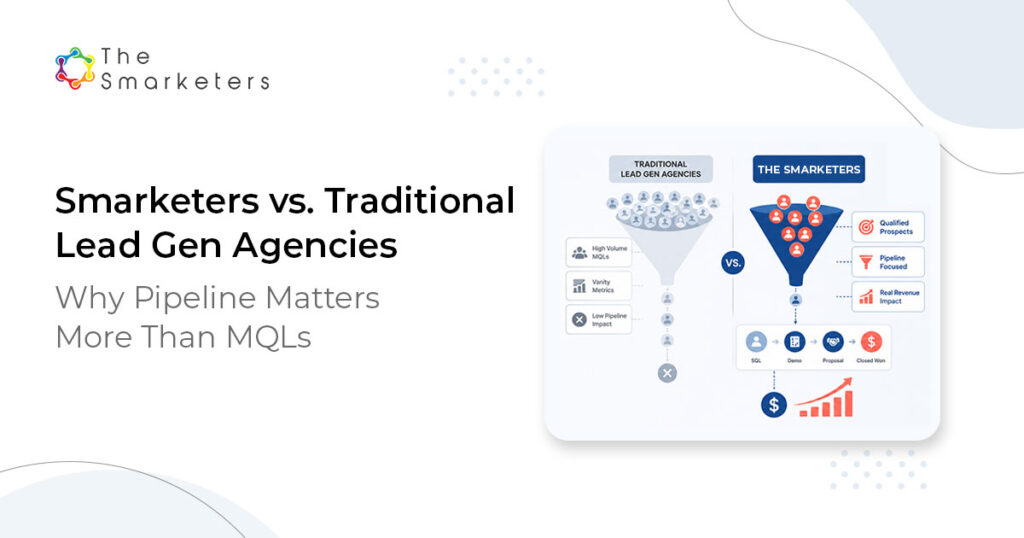
To understand why pipeline matters more than MQLs, we have to look at the mechanics of how traditional agencies operate versus a pipeline-focused agency like The Smarketers. It is not just a difference in tactics; it is a difference in philosophy.
The Traditional Approach: Volume and Vanity
Traditional lead gen is a numbers game. The philosophy is simple: if we pour enough leads into the top of the funnel, eventually, some will trickle down to the bottom. It is the marketing equivalent of throwing spaghetti at the wall to see what sticks.
This approach relies heavily on list buying, mass cold outreach, and generic content syndication. The targeting is broad. The messaging is one-size-fits-all. The primary metric of success is the number of leads generated.
The problem? It ignores the buyer’s journey. In complex B2B sales, buyers don’t make decisions based on a single cold email. They form buying committees. They do their own research. They want personalized solutions to specific problems. Traditional lead gen treats them like numbers on a spreadsheet, interrupting their day with irrelevant pitches. It damages your brand reputation and wastes valuable resources.
The Smarketers Approach: Pipeline and Precision
At The Smarketers, we don’t care about MQLs. We care about pipeline.
Our approach is fundamentally different. We use a hybrid Account-Based Marketing (ABM) and Inbound model. Instead of casting a wide net, we identify the specific accounts that are the best fit for your solution. We look for buying signals. We align marketing and sales to target the entire buying committee within those accounts. We treat each account as a market of one.
We don’t just hand over a list of names. We build a Build-Operate-Transfer model that integrates deeply with your sales process. We use an AI-enabled tool stack with 25 different modules to track intent, personalize messaging, and measure revenue impact. We connect the dots between marketing activities and closed-won deals.
We are an India-based agency with global delivery capability, serving clients in the US, UK, UAE, and India. We’ve executed over 40 ABM programs with an 85% success rate. We don’t just generate leads; we generate pipeline. We act as an extension of your revenue team.
Related Read: The Complete B2B Lead Generation Playbook for 2026
The Hidden Costs of Traditional Lead Generation
When you evaluate the cost of a traditional lead generation agency, you can’t just look at the retainer or the cost per lead. You have to look at the hidden costs that drain your organization’s resources.
First, there is the cost of sales inefficiency. Every hour your sales team spends calling an unqualified lead is an hour they aren’t spending closing a real deal. If your Account Executives are acting as SDRs, you are overpaying for prospecting.
Second, there is the cost of brand dilution. When a traditional agency blasts out thousands of generic emails on your behalf, they are training your market to ignore you. They are burning through your total addressable market (TAM) with irrelevant messaging. When those prospects are actually ready to buy, they won’t think of you as a trusted advisor; they will think of you as a spammer.
Third, there is the opportunity cost. While you are busy chasing MQLs, your competitors who have adopted a pipeline-first approach are building deep relationships with the key decision-makers in your target accounts. They are winning the deals before you even know they exist.
Why The Smarketers’ Hybrid Model Works
We don’t just rely on one tactic. We use a hybrid model that combines the precision of Account-Based Marketing (ABM) with the scale of Inbound marketing.
For your top-tier accounts the whales that can transform your business we use a 1:1 ABM approach. We create highly customized campaigns, personalized content, and bespoke outreach strategies tailored to the specific needs of that single account.
For your mid-tier accounts, we use a 1:Few approach. We group accounts with similar characteristics or pain points and create targeted campaigns that speak directly to those shared challenges. This allows us to scale our personalization efforts without sacrificing relevance.
And for the broader market, we use a 1:Many approach, leveraging inbound marketing tactics to capture demand and identify new accounts that are showing buying signals.
This hybrid approach ensures that we are maximizing your revenue potential across your entire TAM. We aren’t just generating leads; we are building a sustainable revenue engine.
The Role of Technology in Pipeline Generation
You can’t execute a modern, pipeline-first strategy with a legacy tech stack. Traditional lead gen agencies often rely on basic email automation and simple CRM integrations. That isn’t enough to compete in today’s B2B landscape.
At The Smarketers, we leverage an AI-enabled tool stack with 25 different modules and multiple connectors. This allows us to gather deep insights into account behavior, track intent signals across the web, and orchestrate complex, multi-channel campaigns.
We also have deep expertise in HubSpot. We don’t just use HubSpot as an email tool; we integrate it deeply into our ABM strategies. We use it to track account engagement, score leads based on behavioral data, and align marketing and sales activities. This technological advantage allows us to execute with a level of precision and scale that traditional agencies simply can’t match.
Head-to-Head Comparison Table
Let’s break down the differences across 10 critical dimensions. This isn’t just theory; this is how the day-to-day operations differ.
| Dimension | Traditional Lead Gen Agencies | The Smarketers |
|---|---|---|
| Targeting Method | Broad demographic and firmographic targeting. Casting a wide net to capture anyone who fits a loose profile. | Account-based, intent-driven, and signal-based targeting. Focusing only on accounts showing active buying behavior. |
| Data Source | Purchased lists, scraped data, generic databases. Often outdated and inaccurate. | First-party data, intent data, AI-driven insights. Highly accurate and contextually relevant. |
| Measurement | Cost Per Lead (CPL), MQL volume, click-through rates. | Pipeline generated, Deal Velocity, Customer Acquisition Cost (CAC). |
| Sales Alignment | Handoff at the MQL stage. Minimal ongoing collaboration. Marketing and sales operate in silos. | Revenue influenced. Metrics that matter to the board. Deep integration. Sales and marketing work as a single revenue team, sharing goals and insights. |
| Content Strategy | Generic, gated content designed to capture emails. High friction, low value. | Personalized, account-specific content designed to educate and convert. Low friction, high value. |
| Tech Stack | Basic email automation and CRM integration. Fragmented tools that don't talk to each other. | AI-enabled stack with 25+ modules, deep HubSpot expertise, and custom integrations. A unified revenue engine. |
| Reporting | Vanity metrics: impressions, clicks, downloads. Reports that look good but mean nothing. | Revenue metrics: pipeline velocity, account engagement, closed-won deals. Reports that drive strategic decisions. |
| Pricing Model | Pay-per-lead or flat retainer for volume. Incentivizes quantity over quality. | Value-based, tied to pipeline and revenue outcomes. Incentivizes quality and alignment. |
| Time to Value | Fast initial lead flow, but slow (or non-existent) revenue impact. A false sense of progress. | Strategic setup phase, followed by high-quality, high-converting opportunities. |
| Scalability | Scales by increasing ad spend and list size. Diminishing returns over time. | Sustainable, long-term growth. Scales by expanding account tiers (1:1, 1:Few, 1:Many) and optimizing conversion rates. Exponential returns. |
The Numbers That Matter
It’s easy to talk about pipeline, but what does it actually look like in practice? Let’s look at a real-world example.
We worked with a Fortune 500 Industrial Automation company in the manufacturing sector. They were struggling with long sales cycles and a lack of high-quality opportunities. Traditional lead gen wasn’t working. They were spending thousands on trade shows and generic webinars, but the leads weren’t converting. They needed a targeted approach to reach key decision-makers in specific accounts.
We implemented a highly targeted ABM strategy. We didn’t focus on generating thousands of low-quality leads. Instead, we focused on engaging the right people at the right accounts with the right message. We mapped out the buying committees, created personalized content hubs, and orchestrated multi-channel outreach.
The result? We generated 300+ Sales Opportunities in just 4 weeks.
Notice the terminology. Not leads. Opportunities. These were qualified, engaged accounts that were ready to have a serious conversation with sales. That is the difference between a volume-based approach and a pipeline-first approach. It’s the difference between keeping your sales team busy and keeping your sales team productive.
This isn’t an isolated incident. We’ve seen similar results across industries. For a Fortune 100 Tech Company, we engaged 100+ Enterprise Accounts, driving deep penetration into complex organizations. For a Fortune 500 tech giant, we delivered 80 Sales Qualified Accounts in 9 months, significantly shortening their sales cycle.
In the Health Tech space, we worked with KeyReply. We generated 100+ MQLs with a 1:Few ABM approach, significantly reducing their CPL while maintaining high quality. For Exotel in the Telecom sector, our ABM training improved lead quality and boosted sales by 60%. These are real numbers, driven by a relentless focus on pipeline.
When Traditional Lead Gen Still Makes Sense
We believe in being honest. The Smarketers’ approach isn’t right for everyone. We turn away prospects when we know our model won’t serve them well.
If you are selling a $500 SaaS product with a 2-day sales cycle, you don’t need a complex ABM strategy. You need volume. You need a highly optimized self-serve funnel. In that scenario, a traditional lead gen agency that focuses on high-volume, low-cost acquisition might be exactly what you need. You need to cast a wide net and catch as many small fish as possible.
But if you are an enterprise B2B company with a $50K+ Annual Contract Value (ACV), a complex buying committee, and a sales cycle that lasts months or even years, traditional lead gen will fail you.
You cannot sell a six-figure enterprise solution with a generic cold email and a gated whitepaper. You need a strategic, account-based approach that builds trust, demonstrates expertise, and aligns with the buyer’s journey. You need to hunt whales, not catch minnows. You need pipeline.
The Pipeline-First Framework
So, how do we actually measure success in a pipeline-first model? We look at four key metrics that directly impact the bottom line.
- Deal Velocity How fast are accounts moving through your pipeline? Traditional leads often stall because they were never truly qualified. They sit in the CRM, gathering dust. By targeting the right accounts with the right message, we accelerate the buying process. We measure the time it takes for an account to move from initial engagement to closed-won. Faster velocity means more revenue, sooner.
- Pipeline Generated This is the total value of the qualified opportunities created by our marketing efforts. It’s a direct reflection of the quality of the accounts we are engaging. We don’t celebrate a high volume of low-value leads. We celebrate a healthy, growing pipeline of high-value opportunities. This is the metric that sales leadership actually cares about.
- Customer Acquisition Cost (CAC) How much does it cost to acquire a new customer? Traditional lead gen often hides a high CAC behind a low CPL. You might pay $50 for a lead, but if it takes 100 leads to close one deal, your CAC is $5,000. By focusing on high-converting opportunities, we drive down your overall CAC. We make your marketing spend more efficient.
- Revenue Influenced Marketing doesn’t close deals; sales does. But marketing should influence every deal that closes. We track how our ABM campaigns, content, and engagement strategies impact closed-won revenue. We look at multi-touch attribution to understand exactly which touchpoints moved the needle. This is the ultimate measure of marketing ROI.
At The Smarketers, we are proud of our ITSMA Marketing Excellence Gold Award and our Web Excellence Awards 2025. But we are more proud of the revenue we generate for our clients. We are a partner, not just a vendor. We build the strategy, operate the campaigns, and transfer the knowledge to your team.
If you are tired of chasing MQLs and ready to start building pipeline, it’s time to rethink your approach to lead generation. It’s time to align your marketing efforts with your revenue goals.
Frequently Asked Questions
What is the difference between an MQL and a pipeline opportunity?
An MQL (Marketing Qualified Lead) is simply a contact who has engaged with marketing content, like downloading an ebook. A pipeline opportunity is a qualified account that has demonstrated buying intent and is actively engaged in a sales conversation.
Why do traditional lead generation agencies focus on MQLs?
Traditional agencies often use a cost-per-lead (CPL) pricing model, which incentivizes them to generate as many leads as possible, regardless of quality. MQLs are easier and cheaper to generate than true pipeline opportunities.
How does The Smarketers generate pipeline instead of just leads?
We use a hybrid Account-Based Marketing (ABM) and Inbound approach. We identify high-fit accounts, track buying signals, and align marketing and sales to engage the entire buying committee with personalized messaging.
Is ABM right for my business?
ABM is highly effective for B2B companies with complex sales cycles, multiple decision-makers, and high Annual Contract Values (ACV), typically $50K or more. It is less suited for low-cost, high-volume transactional sales.
How long does it take to see results with a pipeline-focused approach?
While traditional lead gen might deliver a list of names quickly, a pipeline-focused approach requires a strategic setup phase. However, once launched, it delivers higher-quality opportunities that convert faster, typically showing significant pipeline impact within 3 to 6 months.
What is a Build-Operate-Transfer model?
In this model, we build your marketing strategy and infrastructure, operate the campaigns to generate results, and eventually transfer the knowledge, processes, and technology back to your internal team for long-term success.
Do you work with clients outside of India?
Yes. While we are based in India, we have global delivery capabilities and work extensively with clients in the US, UK, and UAE across various B2B sectors.
How do you measure the success of your campaigns?
We move beyond vanity metrics and focus on revenue-aligned KPIs. Our primary metrics include Pipeline Generated, Deal Velocity, Customer Acquisition Cost (CAC), and Revenue Influenced.
What tools do you use for your ABM campaigns?
We utilize an AI-enabled tool stack with 25 different modules and multiple connectors. We also have deep HubSpot expertise, integrating it seamlessly into our ABM strategies for maximum impact.
Can you share an example of your success?
Certainly. For a Fortune 500 Industrial Automation company, we generated 300+ Sales Opportunities in just 4 weeks using a highly targeted ABM approach, proving the power of focusing on pipeline over MQLs.

Swati Bansal
Sr. Content Strategist