Table of Contents
- What Dirty CRM Data Actually Costs a Multi-Region Business
- Multi-Region Data Architecture: One Portal or Many?
- Integrating Intent Data Into HubSpot Without Creating Another Silo
- RevOps Alignment Across APAC Regions
- The Region-Ready Framework: Six Decisions in Order
- Case Study: Rebuilding the Architecture Underneath a Global Manufacturer’s Funnel
- Common Mistakes in Multi-Region HubSpot Builds
- When This Architecture Is More Than You Need
- Where to Start
- Frequently Asked Questions
Need help with B2B Marketing?
Let the smarketers’ team drive your pipeline with data-led campaigns and AI-powered growth strategies.
A RevOps leader in Singapore opens the quarterly pipeline review and finds three versions of the truth. The Japan team counts a deal as qualified after a technical evaluation. The India team counted it at the first meeting. The Australia team runs its own spreadsheet because “the CRM numbers are wrong anyway.” Same company, same HubSpot license, three unreconcilable funnels. Nobody disputes that the data is dirty. The dispute is about whose dirty data wins.
This is an architecture problem wearing a data-quality costume, and it is becoming more expensive to ignore. CRM adoption is still growing at roughly 12.6% year over year, which means more teams, more regions, and more integrations writing into the same database every quarter. HubSpot itself has moved decisively upmarket: the company ended 2025 with around 288,700 customers and $3.13B in revenue, and holds roughly 38% of the marketing automation market. Enterprise multi-region deployments are no longer edge cases. They are where the platform is heading, and where most implementations quietly go wrong.
This guide covers the four decisions that determine whether a multi-region HubSpot build across Asia-Pacific produces one revenue system or several expensive silos: portal strategy, data architecture, intent integration, and RevOps alignment. It ends with the six-step framework we use at The Smarketers, a HubSpot Platinum Solutions Partner, when we architect these builds for enterprise clients.
What Dirty CRM Data Actually Costs a Multi-Region Business
The cost of dirty CRM data in a multi-region company is not a cleanup bill. It is a compounding tax on every decision made downstream: forecasts built on inconsistent stage definitions, budget allocated to regions whose numbers are inflated by duplicates, and sales time spent re-qualifying contacts the system should already know. Industry estimates of this cost vary widely and most are not rigorously sourced, so we will not put a headline dollar figure on it. The mechanics are damaging enough without one.
In APAC deployments specifically, three multipliers make the problem worse than in single-market builds:
- Definition drift. Each region localizes lifecycle stages, lead statuses, and deal stages until the same word means different things in different offices. Reports aggregate labels, not meanings.
- Duplicate gravity. Multiple character sets, name orders, and address formats defeat naive deduplication. A contact entered in Tokyo and again in Sydney survives as two people indefinitely.
- Integration sprawl. Regional teams bolt on local tools (messaging apps, local event platforms, regional data vendors) that write into HubSpot with no shared field governance. Every integration is a new way to corrupt a record.
The consolidation trend raises the stakes. With Salesforce holding the largest CRM share at about 20.7% and HubSpot the fastest-growing major CRM by customer count, most enterprise buyers are standardizing on one of two platforms and retiring regional point solutions. That standardization moment is exactly when architecture decisions get locked in, for better or worse.

Multi-Region Data Architecture: One Portal or Many?
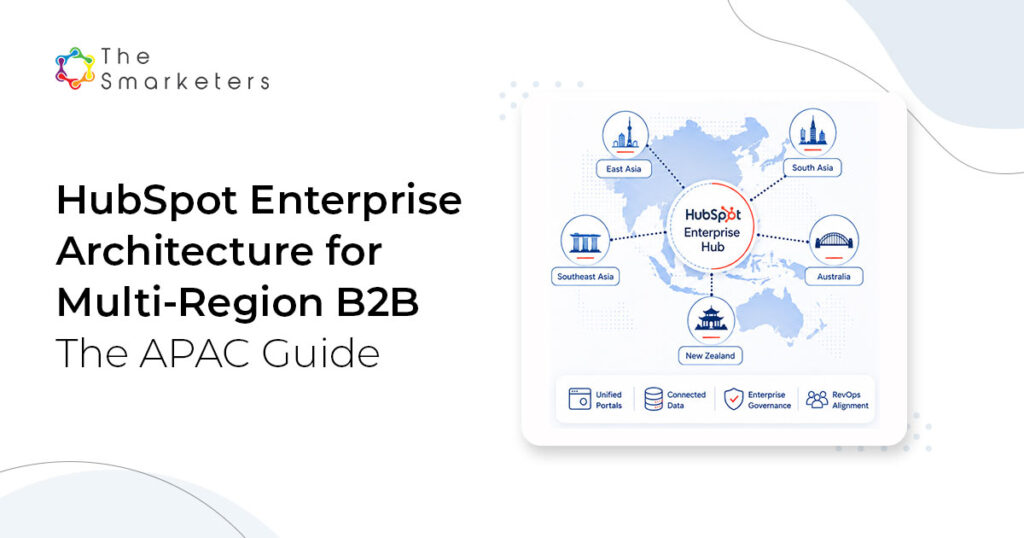
For most multi-region B2B companies, the right answer is one HubSpot portal with business units, partitioning, and permission sets, not separate portals per region. Separate portals should be a deliberate exception, justified by data residency law, a fiscal or legal entity structure that genuinely cannot share a database, or a business unit being prepared for divestment. Everything else that pushes teams toward portal separation (reporting confusion, permission fears, “our market is different”) is solvable inside one portal, and solving it there preserves the single customer view that justified the platform in the first place.
The trade-offs are worth seeing side by side:
| Decision factor | Single portal + business units | Separate regional portals |
|---|---|---|
| Single customer view | Preserved; one record per account globally | Lost; cross-region accounts fragment immediately |
| Global reporting | Native; one dashboard, consistent definitions | Requires external BI layer stitching portals together |
| Data residency compliance | Handled via governance and field-level controls in most cases; verify per jurisdiction | Strongest isolation where law requires in-country storage |
| Localization (language, currency, workflows) | Business units, multi-currency, and team partitioning cover most needs | Full independence, at the cost of duplicated builds |
| Admin overhead | One admin team, one governance model | Every change made N times; drift is guaranteed |
| Cost | One enterprise contract | Multiple contracts plus integration middleware |
Beneath the portal question sits the object model, and this is where enterprise builds are won. Before any data is imported, define globally: what an account is (legal entity, buying entity, or site), how parent-child hierarchies represent regional subsidiaries, which custom objects carry things standard objects cannot (distributors, partner organizations, buying groups), and which fields are global versus regional. In our experience the companies that skip this step spend their second year paying consultants to rediscover it.
Related Reads: Best HubSpot Implementation Partners in India 2026
Sequencing the rollout
Rollout order matters almost as much as the architecture itself. The pattern that works: pilot with the region that has the strongest operations discipline, not the largest revenue. That region stress-tests the object model, the lifecycle definitions, and the reporting pack while the stakes are manageable, and its operations lead becomes the internal evangelist who onboards the next region. Migrating the largest market first feels decisive and usually is not; the biggest region carries the most legacy data, the most integrations, and the most political weight, which means every architectural flaw discovered mid-migration becomes a crisis instead of a lesson.
Two rules keep phased rollouts from drifting. First, no region goes live without mapping its historical data to the global definitions, even if that means archiving fields that do not translate; importing legacy meanings “temporarily” makes them permanent. Second, freeze the global object model during each migration window. Regions can request changes; the RevOps council batches them between phases. A model that changes while data is in flight produces exactly the reconciliation problems the project exists to end.
Integrating Intent Data Into HubSpot Without Creating Another Silo
Intent data earns its cost only when it lands on the records your regional teams already work from. The behavioral case for it is strong: up to 90% of identifiable account visitors remain anonymous through the buying journey, and only about 3% of web visitors ever fill a form. The same research found that roughly 95% of the time the winning vendor was already on the buyer’s Day-One shortlist. In plain terms: by the time an APAC enterprise account raises its hand, the decision is mostly formed. Intent signals are how you see the account before that point.
The architecture rules that make intent usable across regions:
- One landing zone. Intent scores and topic signals write to company-level properties on the global account record, never to regional copies or standalone spreadsheets.
- Region-aware thresholds. A surge score that means “sales-ready” in a mature market may mean “start nurture” in a developing one. Thresholds are properties, not hardcoded workflow values, so regions tune sensitivity without forking the logic.
- Signals trigger plays, not alerts. An intent spike should enroll the account in a defined play (ad audience, SDR task, executive touch) with an owner and an SLA. Alerts without plays train teams to ignore alerts.
- Suppression is part of the integration. Active opportunities, current customers, and accounts in legal review must be excluded automatically. Nothing destroys sales trust in intent data faster than being told to prospect an account they closed last month.
A caveat on vendor choice: intent coverage across APAC markets is uneven, and vendors differ sharply on non-English content and regional publisher networks. Run a 90-day proof of coverage against a list of accounts you already know are in-market before signing anything multi-year. This is an opinion from our client work, not a benchmark, but we have not yet seen an exception to it.
RevOps Alignment Across APAC Regions
Architecture holds only as long as someone owns it. That is the RevOps function, and the evidence for investing in it is unusually consistent: companies with a RevOps model report 36% more revenue growth and up to 28% higher profitability, and public companies with dedicated RevOps teams have shown 71% higher stock performance. The function has gone mainstream: about half of companies now run a dedicated RevOps team, up from a third in 2020, in line with Gartner’s projection that 75% of the highest-growth companies would adopt a RevOps model by 2025.

For a multi-region HubSpot estate, RevOps alignment means four concrete mechanisms rather than a reporting line:
- A RevOps council, not a global admin dictatorship. One named operations owner per region plus a global lead. Regions propose changes; the council approves anything touching global objects or definitions.
- One metrics dictionary. MQL, SQL, pipeline, and win rate defined once, in writing, with the HubSpot property that carries each. If a metric is not in the dictionary, it does not appear in a board deck.
- Follow-the-sun data stewardship. Duplicate review, import approval, and integration monitoring assigned by timezone so governance does not bottleneck on one headquarters team.
- A quarterly definitions review. Markets change; definitions drift. Reviewing them on a schedule turns drift from an ambush into an agenda item.
The Region-Ready Framework: Six Decisions in Order
How should a multi-region B2B company sequence a HubSpot enterprise build? Make six decisions in a fixed order, each one constraining the next. This is the framework we run in client architecture reviews, and the order is the point: teams that start with workflows and end with definitions build the same portal twice.
- Map the revenue motions, not the org chart. List every distinct way the company sells by region: direct enterprise, channel and distributors, product-led, renewals and expansion. Each motion needs its own pipeline; regions sharing a motion share a pipeline design.
- Decide the portal question with data residency first. Default to one portal with business units. Split only on legal, fiscal, or divestment grounds, documented in writing, because this decision is nearly irreversible once data flows.
- Design the object model before importing anything. Accounts, hierarchies, custom objects, and the global-versus-regional field split, agreed as a one-page contract.
- Standardize lifecycle and attribution globally. One lifecycle model and one attribution logic, localized only at the property level (language, currency, regional consent), never at the definition level.
- Wire intent and enrichment into the same spine. Third-party signals land on the global account record with region-aware thresholds and automatic suppression.
- Stand up the RevOps council with regional owners. Governance, the metrics dictionary, and the quarterly review, staffed before launch rather than after the first reporting crisis.

Case Study: Rebuilding the Architecture Underneath a Global Manufacturer’s Funnel
A Fortune 500 industrial automation company came to us with a version of the Singapore pipeline review scene: global operations, a CRM that modeled none of the complexity of how the company actually sold, and campaigns priced accordingly. Distributors, OEM partners, and multi-member buying groups were all crammed into a single “decision maker” field. Pipelines blended direct, channel, and aftermarket deals into one forecast nobody trusted.
The fix followed the sequence above. Revenue motions were mapped and split into their own pipelines. The object model was rebuilt so partners and buying groups became first-class records. Campaigns were then rebuilt on top of accounts sales had explicitly agreed to pursue, feeding one system both teams read from.
Result: The engagement produced 300+ sales opportunities in 4 weeks while cost per lead fell 90%, because spend stopped paying for leads the architecture could not route and sales could not trust. (Smarketers client engagement; full story at thesmarketers.com/success-stories/)
The honest caveat: this client already had strong demand for its products. Architecture removed the friction between demand and pipeline; it did not create the demand. A company with a weak offer and a perfect HubSpot build still has a weak offer.
Common Mistakes in Multi-Region HubSpot Builds
Across the enterprise builds we have reviewed, the same failures recur regardless of industry. Five worth naming, because every one of them is cheaper to prevent than to unwind:
- Migrating data before agreeing definitions. The single most expensive mistake. Once three regions of historical records carry three meanings of “qualified,” no workflow fixes it; someone re-migrates, or reporting stays fiction.
- Treating permissions as architecture. Teams hide regional complexity behind permission sets instead of modeling it. The symptom appears a year later: nobody can explain who can edit what, and audits take days.
- Letting the loudest region set global defaults. Defaults should follow the metrics dictionary, not the headquarters market. When one region’s quirks become everyone’s required fields, every other region starts entering junk data to get past the form.
- Building automation before adoption. Workflows that act on field sales do not reliably fill automated noise. Instrument human behavior first, automate what is already true.
- Skipping the decommission plan. The legacy regional tools that HubSpot replaces must have shutdown dates with owners. Every system left running “for reference” becomes a shadow CRM within two quarters, and the single source of truth quietly becomes one of several.
When This Architecture Is More Than You Need
Enterprise architecture has a cost: governance overhead, slower changes, and real money. It is the wrong investment in at least three situations:
- One dominant region, satellites under ten people. If 85% of revenue comes from one market, run a single-market build with light localization and revisit when a second region hires a real team.
- Pre-product-market-fit expansion. If the company is still testing whether an offering sells in new markets at all, spreadsheets and a simple portal beat an object model that will be redesigned the moment the strategy changes.
- No operations owner. If nobody owns RevOps even part-time, the council, dictionary, and governance in this guide have no host. Hire or nominate the owner first; architecture without an owner decays within two quarters.
Where to Start
Start with the one-page object model and the metrics dictionary. Both are documents, not software, and drafting them exposes 80% of the disagreements that would otherwise surface as dirty data a year from now. Our customer acquisition cost calculator is a useful companion exercise: regions that cannot agree on CAC inputs have just found their first definitions-review agenda.
If you want a second set of eyes on the build itself, book a HubSpot Architecture Review. As a HubSpot Platinum Solutions Partner we run these reviews against the Region-Ready Framework and hand you the gap list whether or not you engage us to close it.
Frequently Asked Questions
How long does a multi-region HubSpot enterprise implementation take?
Plan for 4 to 6 months from architecture workshop to full regional rollout for a typical three-to-five-region build, with the first region live around month two. Timelines stretch when the object model is debated after data migration starts, which is why the framework front-loads that decision.
What does HubSpot enterprise architecture work typically cost?
Beyond HubSpot Enterprise licensing, expect implementation and architecture services to run from the mid five figures to low six figures depending on regions, integrations, and data volume. The bigger budget line is usually internal: a part-time-to-full-time RevOps owner per region during rollout.
Do data residency laws in APAC force separate HubSpot portals?
Usually not, but it is jurisdiction-specific. Many requirements can be met with governance, consent management, and field-level controls in one portal, while some sectors and countries do require in-country storage that changes the answer. Get a legal read per market before deciding; do not architect from a blog post, including this one.
Can we migrate from several regional CRMs into one HubSpot portal gradually?
Yes, and gradual is usually safer: one region per phase, with the object model and metrics dictionary fixed globally before the first migration. What you should not do gradually is definitions. Those must be agreed once, up front, or each migrated region imports its own meanings.
How do business units in HubSpot handle different languages and currencies?
Business units separate brand assets, subscriptions, and campaign organization, while multi-currency handles deal amounts and multi-language handles content variants. The combination covers most APAC localization needs without splitting portals; what it does not do is let regions redefine lifecycle stages, which is a feature, not a gap.
What should we measure to know the architecture is working?
Four signals: forecast variance by region shrinking quarter over quarter, duplicate rate on core objects trending down, time-to-report for global pipeline dropping (no manual stitching), and sales-reported trust in CRM data rising in your internal surveys. If those move, the architecture is paying rent.
Do we need a dedicated RevOps team before starting?
You need an accountable owner, not necessarily a team. About half of companies now run dedicated RevOps functions, but a rollout can succeed with one strong global lead plus named regional part-timers. What it cannot survive is nobody owning definitions when the first cross-region dispute lands.
Is intent data worth it for APAC-focused programs?
Only after a coverage test. Intent vendors differ widely on non-English and regional publisher coverage, so run a 90-day proof against accounts you independently know are in-market. If the vendor sees fewer than half of them, the architecture is ready but the signal is not.

Venugopal Mamidala
Director of MarTech