Table of Contents
- Full-Funnel Marketing: An Integrated Approach to B2B Growth
- Account-Based Marketing (ABM) for High-Value Accounts
- Demand Generation and Lead Generation: Building Lasting Interest
- Go-To-Market (GTM) Strategy for Enterprise Launches
- Search Engine Optimization (SEO) & Content Marketing
- MarTech Integration and Data-Driven Marketing
- Marketing Automation and CRM Alignment
- Generative AI in Enterprise Marketing
- HubSpot Implementation and Support
- Awards and HubSpot Partnership
- HubSpot vs. Marketo vs. Salesforce
- 6-Month Enterprise Growth Roadmap
- FAQs: Enterprise Marketing Services
- Share of LLM: The New B2B Visibility Metric That Matters More Than Domain Authority
- The Dark Funnel Playbook: Capturing B2B Buyers Who Never Fill a Form
- The Shift to Outcome-Driven Martech Bundles: Trends for 2026
- Top B2B Marketing Companies Trends 2026: Digital Self-Serve, RevOps Automation, and AI Copilots
- How AI Agentic Workflows Are Transforming Marketing in 2026
In the complex world of enterprise B2B marketing, success demands a holistic “full-funnel” approach that spans from brand awareness to revenue generation. The Smarketers – a globally recognized B2B marketing agency – specializes in exactly this. We integrate Account-Based Marketing (ABM), inbound demand generation, SEO, marketing automation, generative AI, and more into cohesive strategies that drive measurable growth. Our approach aligns sales and marketing at every stage, ensuring no lead or opportunity slips through the cracks. By leveraging cutting-edge tactics (from ABM programs that focus on high-value accounts to AI-driven content that scales personalization), we help enterprises achieve sustainable pipeline and revenue gains.
Recent trends make this integrated approach more crucial than ever. Nearly 94% of organizations are already exploring Generative AI in some form, reshaping how we create content and engage buyers. At the same time, marketing technology now accounts for almost 24% of marketing budgets, underscoring the importance of tightly integrating your MarTech stack. In this flagship guide, we’ll explore all major enterprise marketing services offered by The Smarketers – and how they work together to accelerate growth. From Full-Funnel Marketing strategy and ABM to Go-to-Market planning, SEO, MarTech integration, automation, HubSpot onboarding, and even generative AI solutions, we’ll show why a comprehensive, aligned approach is the key to B2B success in 2025 and beyond.
Full-Funnel Marketing: An Integrated Approach to B2B Growth
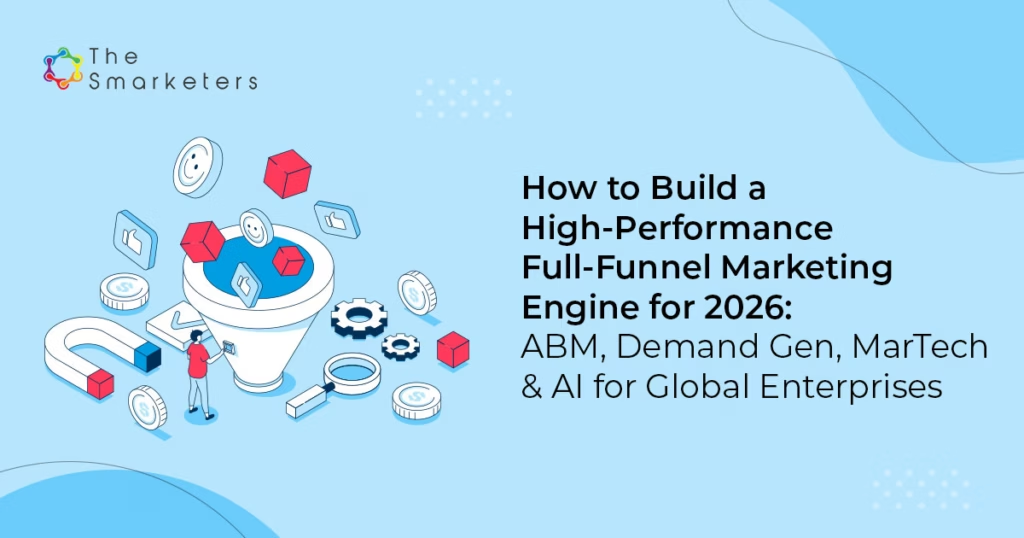
Full-funnel marketing means looking at the entire buyer’s journey – from initial awareness and lead acquisition all the way to sales conversion and retention – as one unified strategy. Instead of siloed campaigns, a full-funnel approach ensures every marketing activity is aligned to guide prospects through each stage of the funnel (Top, Middle, Bottom) seamlessly. Why is this important for enterprises? Because modern B2B buyers engage with content across many touchpoints before converting. By optimizing every stage and linking them together, you maximize the cumulative impact. In fact, research shows that adopting a full-funnel strategy (combining brand awareness with performance marketing) can lift marketing ROI by 15–20%.
A full-funnel marketing program involves a mix of tactics: – Top-of-Funnel (Awareness): Thought leadership content, SEO-driven blogs, social media, and paid ads build brand awareness and attract the right audience. – Mid-Funnel (Consideration): Webinars, case studies, email nurturing, and retargeting ads educate prospects, addressing their pain points and positioning your solution. – Bottom-of-Funnel (Decision): Personalized demos, free trials, consultations, and strong sales enablement content help convert leads into customers.
Critically, full-funnel marketing demands tight sales-marketing alignment. Marketing must not only generate leads, but also nurture them with relevant content and hand off sales-ready opportunities. Sales, in turn, provides feedback on lead quality and closes the loop on what messaging resonates. The Smarketers places heavy emphasis on this alignment – we’re literally “Smarketers,” blending sales and marketing. Our integrated Inbound + ABM methodology bridges any gaps between traditional inbound funnels and targeted account-based outreach. The result is a unified revenue engine where each stage reinforces the next, rather than operating in isolation.
To implement full-funnel marketing, we often start with a Funnel Audit & Strategy. This involves mapping your buyer personas and customer journey stages, then identifying content or conversion gaps. For example, you may have plenty of top-of-funnel blog traffic but lack middle-funnel assets (like comparison guides or case studies) to nurture that interest – a common issue we address. We also establish unified KPIs that connect funnel stages to outcomes (e.g. how an increase in brand awareness correlates with more demo requests) to ensure accountability across the board. When done right, full-funnel marketing not only increases lead volume but improves lead quality and accelerates sales cycles by delivering the right message at the right time to each stakeholder.
Finally, a full-funnel approach embraces continuous optimization. We use data and testing (A/B tests, campaign analytics, CRM tracking) to refine each stage. If the awareness-stage ads are driving clicks but not turning into qualified leads, we adjust targeting or messaging. If middle-stage email nurtures have low engagement, we try new content or frequency. This agile, data-driven mindset ensures each funnel stage is tuned for maximum impact – and the combined effect yields exponential growth in pipeline and revenue. Full-funnel marketing is not a one-time campaign; it’s a fundamental shift to an always-on, cohesive growth strategy that every enterprise marketer should prioritize now.
Account-Based Marketing (ABM) for High-Value Accounts
Account-Based Marketing (ABM) is a highly focused growth strategy where marketing and sales teams work together to target specific high-value accounts (companies) and tailor campaigns to engage each one individually. Unlike broad inbound marketing (which casts a wide net), ABM is about going deep on a select set of prospects that are most likely to become significant customers. Why? In enterprise B2B, typically 80% of revenue comes from just 20% of customers. ABM ensures you’re investing your resources on those accounts with the highest ROI potential.
The Smarketers has deep expertise in ABM – in fact, our innovative ABM programs have earned recognition from the very originators of the concept (ITSMA awarded us a Marketing Excellence Gold Award for an ABM program). We help B2B companies identify their Ideal Customer Profile (ICP) and build highly personalized, omnichannel ABM campaigns at scale. An effective ABM program typically includes: – Account Selection & Research: Using firmographic data, intent signals, and client input, we narrow down a list of target accounts that fit your ICP (e.g. specific industries, revenue range, buying need). We then deep-dive into each account’s business, challenges, and decision-makers (often via account intelligence tools and research). – Buyer Persona Mapping: Within each target account, there are multiple stakeholders (economic buyers, technical evaluators, end-users, etc.). We create buyer personas and map tailored messaging to each role. – Personalized Content & Messaging: ABM thrives on relevance. We craft content assets and messaging precisely addressing each target’s pain points and goals. This could mean creating a custom landing page or case study for one account, or tailoring email outreach with specifics about that company’s strategy. Consistency across channels is key – from emails to LinkedIn outreach to direct mail, we keep the value proposition tightly aligned to the account’s context. – Multi-Channel Orchestration: Our team engages target accounts through a mix of channels: personalized emails, LinkedIn messages, targeted ads, webinars for that account’s team, industry events, phone outreach, and more. We “meet prospects where they are,” using data to find which channels each account (and persona) is most responsive to. – Sales and Marketing Alignment: In ABM, sales and marketing truly operate as one unit. For each target account, we often form a dedicated “pod” consisting of a salesperson and a marketer (or account manager) working in tandem. They coordinate on account plans, share insights (e.g. sales learns an account’s budget cycle, marketing adjusts campaign timing), and jointly track progress. This tight alignment is why ABM often improves win rates and deal sizes significantly.
Does ABM really pay off? Absolutely. Studies show roughly 87% of B2B marketers report that ABM initiatives outperform their other marketing investments in terms of ROI. By focusing on the best-fit accounts, ABM drives higher conversion rates and larger deal values. It’s especially effective for long sales-cycle deals: rather than waiting for a target Fortune 500 company to stumble across your content, ABM empowers you to proactively engage and nurture all the key influencers within that account over months (even before they enter an active buying cycle). One hallmark of ABM success is seeing engagement from multiple stakeholders at a target client – e.g. when contacts from IT, Finance, and Operations at Acme Corp are all interacting with your personalized content, you’re building consensus that often leads to a win.
The Smarketers ensures all components of your ABM program work in harmony to provide a rich, seamless experience from the very first touchpoint. We leverage technology (like HubSpot ABM tools, LinkedIn Matched Audiences, account-based ad platforms) to scale personalization efficiently. Our approach is also data-driven – we establish account-level KPIs (such as account engagement scores, meeting-to-deal conversion rates) and continually optimize. ABM is a long-game strategy; it requires patience and precision. But when done right, the payoff is huge: you build stronger relationships with mega-accounts, shorten sales cycles by engaging early, and ultimately land contracts that move the needle for your business. (Fun fact: ABM deals often have 30-50% higher LTV than regular deals, due to deeper engagement and better alignment with customer needs.)
In summary, ABM allows enterprise marketers to treat key accounts as “markets of one.” Instead of one-size-fits-all campaigns, you deliver exactly what each target account needs to see. The Smarketers can help you implement ABM at scale – from initial account profiling to orchestrating campaigns and measuring results. Our track record includes helping a Fortune 500 tech giant generate 80+ sales-qualified opportunities in 9 months from a targeted ABM pilot (as highlighted in our case studies). When every interaction is tailored and every dollar is focused on the accounts most likely to convert, marketing becomes dramatically more efficient and impactful.
Demand Generation and Lead Generation: Building Lasting Interest
Demand Generation is all about creating awareness and interest for your product or service to generate a steady pipeline of potential customers. It’s a strategic, long-term approach that goes beyond just capturing existing demand (as traditional lead generation does) – instead, it creates new demand by educating the market and positioning your brand as a top choice. In the modern B2B landscape, buyers are savvy and often unaware of problems or solutions until marketing brings them to light. This is where demand gen shines.
Let’s clarify the difference between Demand Generation vs. Lead Generation: – Lead Generation typically focuses on capturing contact information from prospects who are already interested (for example, someone who searches for a solution and downloads an eBook). It often uses gated content or offers to acquire leads that sales can follow up with. Lead gen is about collecting names – but those leads may or may not be ready to talk. – Demand Generation, by contrast, is more holistic and aims to drive awareness and interest throughout the buyer’s journey. It includes ungated content, thought leadership, PR, webinars, videos, social media – anything that educates the market and builds demand for your category and product. The goal is to warm up the audience so that when they do become leads, they are highly qualified and eager.
In practice, a strong demand gen program will incorporate elements of content marketing, inbound marketing, and even ABM. For example, The Smarketers often helps clients develop a content funnel: ungated blog posts and infographics to draw initial interest (SEO plays a big role here), then more in-depth content or events (like whitepapers, webinars) to nurture that interest, and finally product-focused materials or demos for those who show intent. We pay close attention to buyer intent signals – such as someone repeatedly visiting key pages or interacting with multiple pieces of content – and we integrate with marketing automation to ensure timely follow-up once interest crosses a threshold.
A key mindset in demand gen is educating rather than selling upfront. By providing valuable content that addresses your target audience’s challenges (without immediately pushing a sales pitch), you position your brand as a helpful authority. Over time, this builds trust and organic demand. Notably, demand gen doesn’t aim for an instant sale; it recognizes that B2B buying is a journey. As one of our blog posts puts it: “B2B demand generation lets you establish a preferred position before the buyer even enters the purchase cycle”. In other words, through consistent nurturing, you ensure that when the prospect is ready to solve a problem, your company is at the top of their shortlist.
Here are some core components of enterprise demand generation: – Content Marketing: High-quality content (blogs, ebooks, videos, podcasts) that provides insights or solves problems for your target audience. For 2025, we emphasize interactive content and video as engagement tools. – Webinars and Virtual Events: Live online events allow you to showcase thought leadership, involve experts, and directly engage potential buyers. They also produce recordings that can be gated for lead capture (bridging into lead gen). – Email Nurturing & Lead Scoring: As prospects engage with your content, marketing automation can nurture them with tailored email drips. We use lead scoring models to quantify engagement – for instance, visiting a product page might add points. Once a lead score crosses a threshold, that prospect is handed to sales as Marketing Qualified. This ensures sales teams focus on truly warmed-up leads. – Social and Paid Promotion: Demand gen often leverages paid social ads, search ads, and content syndication to amplify reach. The idea is to get your valuable content in front of the right people at scale. Unlike pure lead-gen ads (“Contact us for demo”), demand-gen ads might promote a research report or a useful tool, thereby attracting those earlier in the journey. – Community and PR: Participating in industry communities (forums, LinkedIn Groups, Slack communities) and garnering PR or analyst mentions also feed demand gen. They increase your brand’s visibility and credibility, which indirectly generates interest.
One crucial point: Demand gen doesn’t stop when a lead is captured. It continues through the entire journey. After a lead enters your CRM, they should still receive nurturing, helpful content and personalized touches (versus an immediate hard sell). In fact, a robust demand gen program works hand-in-hand with ABM for high-value leads. Our approach often uses broad demand gen to net and nurture a wide audience, then applies ABM tactics to fast-track high-value accounts that bubble up from that pool. This combination yields both quantity and quality.
Importantly, measurement in demand gen focuses on more than just lead volume. We look at metrics like brand awareness lifts, website traffic growth in target segments, content engagement (time on page, repeat visitors), pipeline velocity, and eventually revenue sourced from marketing. We agree with the principle that “creating demand will significantly decrease competition and shorten sales cycles” – because you’re educating buyers rather than fighting over who has the cheapest price. It does require patience: you may spend a few months nurturing a prospect before they raise their hand. But the payoff is leads that are self-motivated and much easier for sales to close, resulting in better win rates and often larger deals.
In summary, demand generation is about planting the seeds of future revenue. By steadily building your brand presence and authority, you ensure a continuous flow of interested prospects. The Smarketers’ demand gen services focus on strategic content creation (often informed by SEO and social listening research), smart multi-channel campaigns, and tight integration with marketing automation and CRM. This ensures that when interest turns into intent, we capture it – and when intent turns into a sales conversation, the prospect is already well-informed (sometimes to the point of being 70% through their decision process on their own). In the enterprise space where buying cycles can be long, demand gen is truly the engine that keeps the pipeline filled and growing with high-quality opportunities.
Go-To-Market (GTM) Strategy for Enterprise Launches
Launching a new product, entering a new market, or repositioning your brand in the enterprise space requires a well-crafted Go-To-Market (GTM) strategy. GTM strategy is essentially your blueprint for how to bring a specific product or offer to market and achieve competitive advantage. It outlines who your target customers are, what you are offering to solve their pain points (unique value proposition), and how you will execute the marketing and sales tactics to engage them. For enterprise companies, GTM is crucial – mistakes in positioning or misalignment between teams can lead to costly failures in big launches. The Smarketers offers GTM consulting to ensure your new initiatives hit the ground running.
A solid GTM strategy addresses several key components: – Market and Customer Research: First, it’s vital to deeply understand the market you’re targeting. This includes TAM (total addressable market) analysis, customer segmentation, and identifying the key pain points or needs in that market. We often conduct market research or leverage industry reports to answer questions like: How is demand trending for this solution? Who are the main competitors and what are their strengths/weaknesses? We also validate product-market fit for the new offer – ensuring that the value prop resonates with a real customer need, possibly by testing with a small segment or beta program. – Buyer Personas and ICP: Just as with other marketing efforts, defining who you’re going after is fundamental. For a GTM, we refine the Ideal Customer Profile (which types of companies, industries, geographies are best fits) and buyer personas (the decision-makers vs. influencers in the buying process). Enterprise sales often involve multiple stakeholders, so a GTM plan must equip you to address each of them. – Positioning and Messaging: This is the strategic core – how will you position your product uniquely in the market? We craft a positioning statement that articulates what problem the product solves, for whom, and how it’s different/better than alternatives. This also leads to messaging pillars that will be used across marketing and sales materials. For example, if we’re launching a new AI-powered marketing tool, one pillar might be “Automates Routine Tasks to Free Your Team,” another “Integrates Seamlessly with Your Stack,” etc., based on what our research shows matters to customers. – Channel and Tactics Plan: GTM involves choosing the right marketing and sales channels to reach your target audience. Should you do an email campaign to existing contacts? Run LinkedIn ads to specific roles? Host an executive roundtable event? The plan will map out a mix of demand generation, ABM, PR, and sales outreach activities timed around the launch. For instance, many enterprise GTM plans use a sequence like: pre-launch teaser content (blogs, social posts) to build anticipation, a formal launch announcement (press release, email campaign, perhaps a webinar), and then follow-up ABM campaigns to priority accounts post-launch. – Sales Enablement & Team Alignment: A GTM launch is a company-wide effort. We ensure that sales teams are trained and armed with the right playbooks, battlecards, and pitch decks for the new offering. Marketing and sales should agree on how leads will be handled, SLAs, and feedback loops during the launch. We also align with other teams like customer success (for handling new customer queries) or product (for quick issue resolution and iteration based on market feedback). – Goals and KPIs: We define what success looks like for the GTM. This could be X number of qualified leads in the first quarter, Y number of pilot customers, or reaching Z% market share in a certain segment by year-end. Setting clear KPIs allows us to monitor progress and adjust tactics quickly if needed.
When The Smarketers assists with GTM strategy, we often start by hosting workshops with your key stakeholders – marketing, sales, product managers, sometimes executive leadership – to gather insights and achieve buy-in. A great GTM plan is usually a collaborative effort. We emphasize identifying any potential friction early: for example, if your product requires evangelizing a new concept, we might need extra focus on educational content; or if a new geographic market has cultural nuances, we incorporate localization strategies.
Timing and phasing are also crucial. We help map out a realistic timeline. Some enterprise GTM motions roll out in phases – e.g. soft-launch to a beta group, then full launch, then expansion. We ensure the marketing activities are sequenced properly: no use driving a huge influx of interest if your sales team isn’t fully trained yet, or conversely, training sales too far ahead of marketing launch so they forget details. Coordination is everything.
A common pitfall in GTM (and how we help avoid it) is misalignment between what’s promised in marketing and what sales or product deliver. We mitigate this by tightly integrating messaging and making sure the value proposition is backed by actual product capabilities. If, say, our messaging touts “2-click integration,” we verify with product that it’s truly that simple – or we adjust the wording to avoid setting false expectations.
Finally, agility is key. No GTM plan survives fully intact after first contact with the market. We set up feedback loops – daily or weekly check-ins during launch – to gather what’s working and what’s not. Maybe we learn that one segment is way more receptive than another; we’ll pivot resources to capitalize on that. Or we might find that prospects are raising a particular objection we hadn’t fully addressed; we then quickly create a new piece of content or adjust messaging to counter that. A GTM strategy is a living plan, especially in the first 90 days of a launch when learning is rapid.
In essence, a Go-To-Market strategy is your master plan to successfully introduce something new and secure market traction quickly. Whether you’re launching a cutting-edge SaaS product or expanding your consulting services into a new region, The Smarketers can guide you through the GTM process. Our experience with global enterprise audiences (US, India, EMEA, APAC) means we understand how to tailor launches for different markets. A strong GTM strategy can be the difference between a product that fizzles and one that becomes a growth engine for your company. We make sure it’s the latter – through meticulous planning, creative execution, and cross-team orchestration that leaves nothing to chance.
Search Engine Optimization (SEO) & Content Marketing
In an era where 90%+ of B2B purchase journeys start with online research, Search Engine Optimization (SEO) is a cornerstone of enterprise marketing. SEO ensures your company’s expertise and solutions are highly visible on search engines (like Google, Bing, and even emerging AI search tools) precisely when potential customers are looking for them. The Smarketers approaches SEO not as a standalone tactic, but as an integral part of full-funnel content marketing and Answer Engine Optimization (AEO – optimizing for answer engines and AI). Our goal: make your brand the authoritative answer wherever your prospects are searching – be it traditional search results, voice assistants, or AI-driven overview answers.
Core elements of enterprise SEO we focus on:
- Technical SEO: We ensure your website is technically sound – fast page load times, mobile-friendly design, clean URL structures, proper indexing, and schema markup for rich results. Large enterprise sites often have complex architectures; our team conducts thorough audits to fix crawl issues, broken links, duplicate content, etc. A strong technical foundation is critical so that search engines can easily discover and rank your content.
- Keyword & Intent Strategy: Enterprise SEO isn’t about chasing just high-volume generic keywords. It’s about understanding the intent behind searches and covering the full spectrum of queries your target audience might use at different funnel stages. We perform extensive keyword research to map out primary keywords (e.g. “ABM strategy for enterprise”) as well as long-tail queries (e.g. “2026 B2B marketing automation implementation services”). By addressing both, we capture top-of-funnel informational searches and high-intent bottom-of-funnel searches. Matching searcher intent is paramount – in fact, aligning content to search intent is one of the top SEO trends, especially as AI-powered search results try to give users direct answers.
- On-Page Optimization & Content Quality: Our content team creates in-depth, high-quality content that satisfies what searchers are looking for (and thus ranks well). We optimize on-page elements like titles, meta descriptions, headers, and image alt tags with target keywords naturally integrated. But more importantly, we ensure the content is comprehensive and valuable. Google’s algorithms reward content that demonstrates E-E-A-T (Experience, Expertise, Authoritativeness, Trustworthiness). With The Smarketers’ background in B2B domains, we infuse expert insights, original research where possible, and credible citations (like we do in our blogs with data points) to boost content authority.
- Link Building & Digital PR: Earning high-quality backlinks remains an important factor for SEO authority. We pursue white-hat link-building strategies – such as creating link-worthy content assets (studies, infographics), engaging in industry publications (guest articles, interviews), and digital PR campaigns to get others talking about and linking to your content. For a global audience, we also consider regional domains and multilingual SEO if targeting non-English markets.
- Global and Local SEO: Because our clients often target multiple regions, we implement strategies for international SEO (like hreflang tags for multi-language sites, region-specific content) and local SEO as needed (e.g. optimizing for “[service] in [Country/City]” queries, Google My Business for local presence in key markets like UAE or Germany if relevant). This ensures you rank not just globally but also in the specific geographies you’re focused on.
- Monitoring and Analytics: SEO is not set-and-forget. We continuously monitor rankings, organic traffic patterns, and engagement metrics. Our team uses enterprise SEO tools and analytics to identify new keyword opportunities, content gaps, or algorithm impact. If Google rolls out a core update (which can happen multiple times a year), we assess if any content needs tweaking. Regular reporting ties SEO performance to business outcomes – e.g. increases in organic conversions or assisted pipeline from organic search.
One significant trend as we head into 2025-2026 is the rise of AI-driven search experiences. Search engines like Google are incorporating AI snapshots and answers (as seen in Google’s Search Generative Experience), and standalone AI platforms (like chatbots or voice assistants) are answering user queries directly. This is where Answer Engine Optimization (AEO) comes in. We optimize content to be easily digestible by AI – using structured data, clear question-and-answer formats, and concise summaries that AI might quote. For instance, adding FAQ sections (as we do in this article) not only helps readers but can position your content to be picked up as a direct answer. It’s predicted that AI-driven search queries will grow rapidly – in fact, one analysis shows visitors from AI platforms could overtake traditional search by 2028. The Smarketers stays ahead by optimizing for Featured Snippets, People Also Ask boxes, and other rich answer formats that feed those AI results.
We also recognize that alternatives to Google are gaining traction – Bing’s market share has grown, Amazon is huge for product search, and even platforms like YouTube, LinkedIn, and industry forums are search engines in their own right for certain queries. Our SEO/content strategy takes an omni-channel approach. For example, we might optimize a series of YouTube video descriptions for how-to queries in your niche, or tailor blog content to get featured in trade publication feeds. The idea is to meet your audience wherever they search for information.
Content marketing ties closely with SEO. We often implement a pillar-cluster content model: a comprehensive pillar page (like this one) targeting broad themes, supported by cluster posts that dive deeper into subtopics, all interlinked. This not only improves SEO (through clear site architecture and internal linking) but also provides a better user experience – your site becomes a one-stop knowledge hub. For instance, if this pillar is on “Enterprise Marketing Services,” a cluster post might be “In-Depth Guide to ABM for Tech Companies” or “Top 10 Demand Gen Tactics in 2025.” We would link them appropriately, so readers (and Google) see the topical connection. The Smarketers’ own website follows this approach, and we help clients implement it for their content hubs.
Lastly, measuring SEO success in enterprise goes beyond rankings. We track the increase in organic traffic from your target segments, the engagement on those pages (time on page, bounce rate), and conversion metrics (form fills, demo requests originating from organic search). SEO has one of the best long-term ROI of any channel – content you publish today can generate traffic and leads for years. By integrating SEO best practices with all our content creation (blogs, whitepapers, even webinar titles), we ensure you steadily grow your organic reach and reduce dependence on paid traffic.
In summary, our SEO and content marketing services aim to make your brand ubiquitous and authoritative in search results – whether someone is asking a straightforward question on Google, seeking a product recommendation on an AI assistant, or consuming content on social media. We combine creative content with rigorous optimization and the latest SEO techniques, so you rank higher, attract more qualified visitors, and ultimately convert that visibility into tangible business results. If the first touchpoint of a prospect is often a Google search, we make sure you are the answer they find.
MarTech Integration and Data-Driven Marketing
Modern enterprise marketing runs on technology – from CRM and marketing automation platforms to analytics, advertising tools, chatbots, and more. However, simply having tools isn’t enough; the magic lies in integrating your Marketing Technology (MarTech) stack so that data flows seamlessly and you can orchestrate campaigns across channels with unified insights. The Smarketers helps enterprises navigate the ever-expanding MarTech landscape (now thousands of tools) and integrate the right systems to power full-funnel marketing.
Why is MarTech integration so critical? For one, as mentioned earlier, companies are investing heavily in marketing tech – nearly a quarter of marketing budgets go to MarTech. Yet many organizations use only a fraction of the capabilities or have siloed systems (for example, web analytics separate from email marketing data, separate from CRM data). Integration breaks down these silos, enabling true data-driven marketing where every touchpoint is tracked and can inform the next action.
Key aspects of our MarTech integration services include:
- Audit of Existing Stack: We start by assessing your current tools and platforms. Common elements are CRM (like Salesforce or HubSpot CRM), Marketing Automation (HubSpot Marketing Hub, Marketo, Pardot, etc.), CMS (website platform), analytics (Google Analytics 4, Adobe Analytics), Ad platforms (Google Ads, LinkedIn Campaign Manager), social media tools, webinar platforms, and perhaps industry-specific tools. We identify any overlaps, gaps, or integration pain points. For instance, is your CRM properly syncing with your email tool so that leads from forms automatically enter nurture workflows? Is web behavior (page visits, downloads) being tracked and appended to lead records for sales to see?
- Integration Implementation: We then implement or fix integrations between systems. This could involve anything from native integrations and APIs to using iPaaS (integration-platform-as-a-service) solutions or custom connectors. A common project is integrating HubSpot (or another automation tool) with Salesforce CRM – aligning fields, ensuring contact and account data updates bi-directionally, etc. Another is connecting your website forms or chatbot to feed into a central database. We pay attention to data consistency (e.g. mapping country names, job titles) and set up unique identifiers so that, say, a person who downloads an eBook and later attends a webinar is recognized as the same contact, not two separate leads.
- Unified Data & Tracking: We help set up a unified tracking infrastructure. This might mean deploying Google Tag Manager and configuring all your tracking pixels properly across the site and landing pages. We also assist in configuring analytics to track conversions and events that align with your funnel stages. For multi-channel campaigns, we ensure proper UTM tagging and source tracking so you know which efforts generate traffic and leads. The result is a single source of truth (often your CRM or a marketing dashboard) where you can see how a contact first found you, what content they engaged with, and what finally led them to convert.
- Attribution Modeling: With integrated data, we can implement marketing attribution models to give credit to various touches in the buyer journey. For example, multi-touch attribution might show that a combination of a LinkedIn ad (first touch), three blog visits via SEO, and an email campaign all contributed to a lead becoming sales-qualified. This insight is immensely valuable for budget allocation – you might discover that while a certain webinar didn’t directly create pipeline, it influenced many deals in later stages, proving its worth. We set up attribution reporting (using tools within HubSpot, Google Analytics 4’s attribution, or third-party tools) based on your business model.
- Personalization and Automation: Integrated MarTech enables advanced tactics like website personalization – showing different content or offers to visitors based on their industry or past behavior – because your systems recognize them. It also allows for automated triggers (if lead does X, then Y) across platforms. For instance, we can automate that when a lead’s engagement score hits a threshold, your sales team gets an alert via Slack or email with key info pulled from the CRM. Or if a target account visits your pricing page, your ABM tool triggers a task for the account executive to reach out. These kinds of cross-platform workflows are possible only with proper integration.
- Data Hygiene and Governance: More tech means more data, which requires governance. We help set up processes for data cleanliness – e.g. removing duplicates, standardizing values, and ensuring compliance with regulations (GDPR, CCPA) by managing preferences and consent across systems. A well-integrated stack reduces manual data handling, which in turn reduces errors and privacy risks.
An area we emphasize is ensuring marketing and sales are looking at the same data. Integration often involves bridging CRM (sales’ home) with marketing automation (marketing’s home). The Smarketers, being a HubSpot Platinum Partner, frequently works on HubSpot integrations – connecting HubSpot with CRMs like Salesforce or Dynamics, and with other tools. We also integrate MarTech with AdTech, for example linking HubSpot or Marketo to Google Ads and LinkedIn so that lead and opportunity data flows back into ad platforms for better targeting (like creating audiences of high-value customers for lookalike targeting).
In addition, our team advises on MarTech stack selection if you’re deciding on new tools or replacing old ones. We benchmark against top competitors – for instance, noting that companies like Ironpaper or SmartBug use XYZ tools – but ultimately we tailor to what fits your needs. Sometimes the best solution isn’t adding more tools, but fully utilizing and integrating what you have.
Once integrations are in place, reporting dashboards can be built to visualize the data. We often set up custom dashboards (in tools like HubSpot, Tableau, or Datastudio) that show real-time KPIs across the funnel: traffic, leads, MQLs, SQLs, pipeline, revenue – all segmented by channel or campaign. This gives CMOs and teams immediate insights. Data-driven decision making becomes a reality when you trust your data and can slice it from different angles.
To illustrate, one client (a global SaaS company) had six different marketing systems that weren’t talking to each other – web analytics, email, CRM, a separate ABM tool, etc. We integrated them into a cohesive stack centered on HubSpot and Salesforce. The outcome: the client could launch campaigns faster (no more CSV import/export between systems), respond to lead behavior in real-time, and measure exactly which efforts drove their uptick in qualified pipeline by 40% in a year.
In summary, MarTech integration is about making 1+1 = 3. When your tools work together, you unlock powerful capabilities: unified customer views, personalized experiences at scale, and clear ROI tracking. The Smarketers’ MarTech integration and analytics support ensures you’re not flying blind – instead, you have a data-driven cockpit to steer your marketing with precision. In a world where every interaction leaves a data trail, we help you harness that data goldmine to continuously refine your marketing strategy and deliver predictable, scalable growth.
Marketing Automation and CRM Alignment
Marketing Automation is the engine that allows you to scale personalized marketing without a proportional increase in manual effort. It uses software (like HubSpot, Marketo, Pardot, etc.) to automate repetitive tasks – email campaigns, lead nurturing, scoring, social posting, ad targeting, and more – based on predefined triggers and workflows. But effective marketing automation isn’t just about efficiency; it’s about delivering the right content to the right person at the right time automatically. When combined with a well-aligned Customer Relationship Management (CRM) system (where sales manages contacts and deals), automation becomes a powerful driver of revenue, ensuring no lead is left unattended and prospects receive a cohesive experience from first touch to sale.
Key benefits and capabilities of marketing automation: – Lead Nurturing & Drip Campaigns: Automation shines in lead nurturing. For example, when a new lead downloads a whitepaper, an automated drip email series can follow up: Day 1, send a “thank you + here’s another resource” email; Day 3, send a case study; Day 7, send a gentle prompt for a consultation. These workflows keep leads engaged over the long B2B buying cycle without manual sales outreach at every step. Personalization tokens (like addressing by name, referencing their company or interests they showed) make these automated emails feel one-to-one. – Lead Scoring & Qualification: Marketing automation platforms allow you to set up lead scoring rules that rate leads based on their behavior and attributes. For instance, visiting the pricing page might add +10 points, whereas title = “Director” might add +5, and so on. When a lead crosses a certain score threshold, the system can automatically flag them as Marketing Qualified Lead (MQL) and assign to sales or trigger an alert. This ensures that sales focuses on hot leads who have demonstrated intent. It’s a key part of aligning marketing and sales definitions of a qualified lead. – Segmentation & Dynamic Content: Automation lets you segment your database in countless ways (by industry, role, engagement level, etc.) and send targeted content to each segment. You can even use dynamic email or website content that changes based on the viewer. For example, an email newsletter might automatically show different case studies to healthcare contacts vs. finance contacts. This level of relevance is proven to boost engagement. According to research, companies that use segmented campaigns note up to a 760% increase in revenue (one reason being that content feels more directly applicable). – Multi-Channel Automation: While email is the classic channel, modern marketing automation extends to SMS, push notifications, ads, and more. For instance, with the right integrations, if someone attends a webinar, you could automate not just an email follow-up but also add them to a LinkedIn Ads retargeting campaign and assign a task for sales to call within 24 hours. The orchestration across channels provides a seamless journey. The Smarketers often sets up such multi-touch workflows – e.g. combining automated emails with sales sequence tasks (sales gets a prompt to make a personalized outreach at a strategic point). – Efficiency and Consistency: Beyond prospect-facing activities, automation helps internally. It can assign leads to the correct salesperson based on territory, rotate distribution (round-robin) to balance loads, update lead/contact properties (like setting lifecycle stage or adding notes from form responses), and ensure consistent logging of activities in CRM. This reduces admin work for your team. For example, rather than a sales rep manually updating a contact’s status after an event, an automation rule can do it when the contact fills an event feedback form or is marked attended.
Crucially, for marketing automation to reach its full potential, it must be tightly aligned with your CRM system (usually owned by sales). This alignment includes: – Data Sync: The contact and company data between marketing and sales needs to sync in real-time. When a lead becomes an opportunity in CRM, the marketing system should know so it can adjust communications (e.g. stop generic nurturing and switch to late-stage content). Conversely, if sales disqualifies a lead, marketing should know to perhaps downgrade or recycle it. The integration we discussed in the MarTech section is what enables this. The advantage of platforms like HubSpot is that the CRM and marketing automation are unified by default (one reason HubSpot is popular – it’s a built-in CRM + marketing platform). With Marketo, you typically integrate with Salesforce CRM – Marketo excels in complex automation but relies on that CRM sync. – Unified Lead Management Process: We help clients define a clear handoff: marketing owns leads up to MQL, then sales owns them as SQLs and beyond, but marketing can continue to support via automated touches (like sending a case study to an SQL before their sales demo). Agreed definitions and SLAs are part of this alignment. The automation system often facilitates the handoff – e.g. automatically assigning an MQL to a rep’s queue and notifying them. One thing we stress: avoid “leads falling through the cracks.” Automation can be configured to alert if an MQL isn’t actioned by sales in X days, or even automatically nurture them further if no action is taken. – Closed-Loop Reporting: When CRM and automation are aligned, you can track a lead from click to close. The marketing automation records all campaign touches; the CRM records deal stages and revenue. By connecting the dots, you get closed-loop analytics: which marketing efforts led to actual sales and revenue, not just leads. This informs ROI calculations for marketing campaigns (e.g., that webinar generated $500K in pipeline, or this email workflow influenced 3 closed deals worth $200K). It’s incredibly powerful for decision-making and budgeting. – Account-Based Alignment: In ABM contexts, the integration is extended to account-level. Marketing automation can roll up scores to an account level (e.g. five people from Acme Co. engaged, making Acme a high-priority account). Sales can then get account-centric views in CRM. We often implement workflows where, say, if an account reaches a threshold (multiple contacts engaging), an account-based campaign is triggered (like sending the account a personalized direct mail or inviting them to an exclusive event). This is where automation and ABM overlap strongly – sometimes called account-based automation.
It’s also worth noting that modern marketing automation tools are increasingly infused with AI. For instance, HubSpot’s new AI features (“Breeze” AI agents) can help draft emails or analyze data. Marketo has predictive content and predictive scoring using AI. Our team keeps an eye on these to leverage them for clients. An example: using AI to predict the best time to send emails to each contact, or to automatically choose which content asset to recommend based on a contact’s profile. While not replacing human strategy, these AI enhancements (part of the “Generative AI in marketing” we discuss later) can augment automation for even better results.
One success story: We helped a client implement a robust lead nurturing program via marketing automation that shortened their sales cycle by about 30%. Before, leads would come in and if they weren’t immediately ready, many went cold. After implementing automated nurturing (with relevant content and a few well-timed sales touchpoints), those “middle of funnel” leads stayed engaged and educated, so by the time sales re-engaged, prospects were warmer and moved to proposal faster. It’s a great example of how automation, when aligned with human touch at key moments, can accelerate pipeline.
In conclusion, marketing automation is the workhorse that operationalizes your marketing strategy at scale. It ensures every prospect is followed up appropriately, and that your team can handle a larger volume without dropping quality. When paired with a synchronized CRM, it creates a seamless experience from a prospect’s perspective – they get helpful information when they need it, whether it comes from an email, your website, or a salesperson, it all feels coordinated (because behind the scenes, it is!). The Smarketers, being adept in platforms like HubSpot (Platinum Partner) and others, not only implements these systems but also helps you strategize the workflows and content that go into them. The result is higher conversion rates, improved productivity, and clear visibility into how marketing efforts turn into revenue.
Generative AI in Enterprise Marketing
No conversation about cutting-edge marketing today is complete without discussing Generative AI – artificial intelligence that can create content, design, code, and more. In the past couple of years, generative AI (with models like GPT-4 and others) has surged in capability and popularity, and it’s rapidly transforming how marketers work. For enterprise marketing teams, generative AI offers both exciting opportunities and new considerations. The Smarketers has been at the forefront of exploring practical AI applications in B2B marketing, ensuring our clients can leverage AI’s benefits (efficiency, scale, personalization) while avoiding pitfalls (like maintaining brand voice and factual accuracy).
Here are several impactful applications of generative AI in marketing and how we integrate them: – Content Creation & Augmentation: AI writing tools can draft blog posts, social media updates, email copy, ad text, and more – in a fraction of the time it would take a human. For example, generative AI can provide a solid first draft of a 1,000-word article in seconds. This helps marketers produce content at scale; in fact, about 85% of marketers now use AI tools for content creation. However, AI’s output often needs human polishing for quality and originality. Our approach is to use AI to overcome the blank page problem and generate initial content, then our expert writers/editorial team refine it – adding unique insights, brand voice, and ensuring accuracy (AI can sometimes “hallucinate” facts). This two-step process yields high-quality content efficiently. We also deploy AI for routine content like product descriptions or translation/localization of content, freeing up human creativity for higher-level work. – Personalization at Scale: Generative AI excels at creating variations. We can use it to tailor content for different audiences automatically. For instance, given one press release, an AI could generate multiple versions emphasizing angles for different industries (one version highlights healthcare use-case, another for finance). Or in email marketing, AI can adjust tone and content slightly for each segment or even individual, based on their profile – something practically impossible to do manually for thousands of contacts. This helps deliver truly one-to-one marketing messages. In one scenario, we set up an AI agent to generate custom intro paragraphs for outreach emails based on each prospect’s LinkedIn profile – boosting response rates by making cold emails feel hand-written just for them. – Chatbots and Virtual Assistants: AI-driven chatbots (like those powered by ChatGPT or IBM Watson) on websites can engage visitors 24/7, answering common questions, providing product information, and even guiding users through content. For enterprises with global audience, an AI chatbot can handle basic support or lead qualification in multiple languages simultaneously. We implement and train these AI chatbots to ensure they give helpful responses consistent with your knowledge base. They can significantly improve user experience and capture leads (e.g. if a visitor asks pricing, the bot not only gives info but can also offer to schedule a meeting). The Smarketers has partnered with AI providers to create customized chatbot solutions for clients – for example, a bot that can answer technical FAQs about a software product by pulling from documentation. – Design and Creative Generation: Generative AI isn’t just text – tools like DALL-E, Midjourney, and Adobe Firefly can create images, graphics, even video snippets. While we still rely on our human designers for high-end creative, we use AI to generate concept art, social media graphics, or to quickly prototype ad banners in different styles. This speeds up the creative process and allows for more experimentation at low cost. Additionally, AI can help with A/B testing creatives by generating multiple versions to see which resonates best. – Data Analysis and Predictive Insights: AI can sift through huge sets of marketing data faster than any person. We utilize AI analytics to find patterns – such as which customer attributes most correlate with upsells, or predicting which leads are likely to turn into customers (propensity modeling). Some advanced AI can even suggest campaign optimizations (e.g. “contacts similar to X are most engaged by Y content”). About 81% of marketers use AI to uncover insights more quickly, which aligns with our approach of using AI as a smart analyst. For example, instead of manually poring over a massive spreadsheet of SEO keywords, we might use AI to categorize and prioritize them based on relevance and difficulty. – Automation and AI Agents: An emerging trend is using AI “agents” that can perform tasks autonomously. For example, Relevance AI (one of the competitor platforms mentioned) enables building AI agents that could automate complex workflows (like monitoring campaigns and making adjustments). While still early, we foresee and help clients prepare for a near future where AI could manage certain marketing operations under human supervision – essentially a co-pilot for marketers. Imagine an AI that can dynamically allocate your daily ad budget across channels for optimal ROI given the latest performance data – this kind of reactive optimization is on the horizon.
Importantly, The Smarketers guides clients on how to integrate AI thoughtfully. We address questions like: How do we maintain brand tone and compliance in AI-generated content? (We set up style guides and approval checkpoints for AI content). What about data security when using AI tools? (We ensure any sensitive data is handled carefully and prefer on-premise or secured AI solutions when needed). How do we keep the “human touch”? (We use AI to augment, not replace, our human marketers. For client-facing outputs, there’s always a human in the loop reviewing AI contributions, as quality and empathy still require a human eye).
We also keep an eye on ROI. Generative AI, when used right, can dramatically improve efficiency – e.g., one marketer can do the work of many by leveraging AI for first drafts, freeing time for strategy. This is reflected in surveys where 88% of marketers say they rely on AI in their daily jobs, especially to generate content faster (93% of those use it for faster content) and make decisions more quickly (90%). In our own workflow, we’ve seen content production timelines cut in half using AI assistance, which means cost savings for clients and the ability to produce more content assets (covering more keywords or segments) with the same budget.
Generative AI is also a topic of interest for many enterprise clients – they want to showcase they’re using AI. We sometimes help incorporate AI as a marketing message itself (for example, highlighting how a client’s product uses AI, or sharing thought leadership on AI trends). Our blog “Beyond the Buzz: How ABM + AI Integration is Redefining B2B Marketing in 2025” is an example of thought leadership we provide, blending ABM expertise with AI insights, which positions our brand (and by extension, our clients) as innovators.
In summary, Generative AI is like a new team member on the marketing team – incredibly fast, capable, but needing guidance. The Smarketers acts as the translator between cutting-edge AI tech and practical marketing execution. We help you harness AI to be more agile and personalized, whether it’s through AI-generated content, smarter automation, or data-driven decisions. At the same time, we ensure that the soul of your marketing – your brand voice, creative vision, and strategic message – remains authentic and consistent. In a world where AI is transforming business (with private investment in generative AI hitting $33+ billion recently), we make sure our clients are not just keeping up but leading the charge, using AI in ways that deliver real business impact.
HubSpot Implementation and Support
In the realm of marketing and CRM platforms, HubSpot has emerged as a leading all-in-one solution especially suited for companies seeking a unified system for marketing, sales, and service. The Smarketers is proud to be a HubSpot Platinum Solutions Partner – a recognition of our expertise in HubSpot and our success in deploying it for clients. We offer end-to-end HubSpot implementation, onboarding, and ongoing support services to ensure businesses get the maximum value from the platform.
Why HubSpot? HubSpot provides a suite of “Hubs” – Marketing Hub, Sales Hub (CRM), Service Hub, CMS Hub, and more – that work seamlessly together on a single data platform. For enterprise clients, HubSpot brings powerful capabilities with a user-friendly interface. It covers everything from email marketing, blogging, SEO, social scheduling, and ads tracking (Marketing Hub) to deal pipelines, contact management, and quotes (Sales Hub) to knowledge base and ticketing (Service Hub). Being all-in-one, it eliminates many integration headaches out-of-the-box and provides a 360° view of the customer.
Our HubSpot services encompass: – Implementation & Technical Setup: We handle the initial setup or migration to HubSpot. This includes configuring your account structure, importing existing contacts/companies (taking care to preserve data and custom fields), connecting your email sending domains and website (to use HubSpot’s tracking code and CMS if needed), and setting up integrations with other systems (for example, syncing HubSpot with Salesforce or integrating other apps via HubSpot’s marketplace). If migrating from another platform (say Marketo or Mailchimp to HubSpot), we carefully plan and execute the migration of assets like email templates, landing pages, workflows, etc., so your operations continue smoothly on HubSpot. – Onboarding & Training: HubSpot is robust, and getting teams up to speed is crucial. We provide training sessions for your marketing and sales teams – covering everything from how to use the CRM daily, to building email campaigns and workflows, to pulling reports. We often tailor training to roles (e.g. a sales rep training versus a marketing manager training). As a Platinum Partner, we have access to HubSpot’s latest resources and best practices, which we share. Our goal is to make your team self-sufficient and confident in using HubSpot. This includes creating guides or playbooks specific to your configured portal. We also ensure alignment: for instance, agreeing on lifecycle stage definitions in HubSpot and training both sales and marketing on those definitions. – Custom Configuration: Every enterprise has unique processes. We customize HubSpot to fit your needs. That might mean setting up multiple pipelines (if you have different product lines or regions), custom properties to capture industry-specific data, or configuring lead scoring criteria within HubSpot. For marketing automation, we design workflows tailored to your buyer’s journey (lead nurturing drips, internal alerts, data hygiene workflows). For sales, we set up sequences, task queues, and if using HubSpot Sales Enterprise, playbooks and quoting tools. We can also implement HubSpot’s chatbot and live chat on your site for conversational marketing. Essentially, we mold HubSpot’s powerful Lego blocks to build the system that supports your strategy. – Website and CMS Support: If your website runs on HubSpot CMS or if you plan to use HubSpot landing pages and blog, we have web developers who can create or import website templates, ensure SEO settings are optimized, and set up things like multi-language variations if needed. We ensure tracking (like Google Analytics, GTM) is embedded. Many clients host their main site elsewhere (e.g. WordPress) but use HubSpot for landing pages – we make sure the user experience is seamless and on-brand across both. – Ongoing Support & Optimization: After initial setup, we often act as a long-term partner, providing managed services for HubSpot. This might include creating new workflows or emails as campaigns evolve, troubleshooting issues, updating configurations as your process changes, and keeping the portal clean (merging duplicates, monitoring integration syncs). We also provide quarterly business reviews (QBRs) or health checks on your HubSpot portal. Being a HubSpot partner, we stay updated on new features (HubSpot releases hundreds of updates each year). For example, if HubSpot rolls out a new AI content assistant or an advanced custom report builder, we’ll advise you on how to leverage it. We essentially act as an extension of your team, with HubSpot expertise on tap. – HubSpot ROI and Best Practices: We help set up the reporting inside HubSpot to track your KPIs – whether that’s campaign performance dashboards, attribution reports, or sales funnel velocity. By monitoring these, we continuously optimize your use of HubSpot. Perhaps we notice email engagement dropping – we could A/B test send times or revise the contact segmentation. Or if sales isn’t logging activities, we might implement some automation to capture that, or retrain on the mobile app for logging on-the-go. Our focus is to ensure HubSpot is driving tangible results: more leads, better conversion rates, and clear visibility for management.
One common question: HubSpot vs other platforms (Marketo, Salesforce) – how does it fare for enterprise? HubSpot historically was seen as more SMB-focused, but in recent years its Enterprise tiers have become very robust. The advantage is ease-of-use (less technical overhead than say Marketo, which often needs dedicated admins). HubSpot has an integrated CRM, whereas Marketo typically requires Salesforce – if you prefer one system, HubSpot provides that all-in-one simplicity. Salesforce Marketing Cloud (and Pardot) are also enterprise-grade but can be complex and costly unless you’re already all-in on Salesforce’s ecosystem. HubSpot covers the common needs extremely well out-of-the-box (lead capture, nurture, scoring, analytics) and many advanced ones too – though very large enterprises with extremely complex workflows might still choose a Marketo or custom solution for certain flexibility. We help clients evaluate these trade-offs. The fact that we are HubSpot Platinum means we’ve seen it work wonderfully for enterprises, and HubSpot’s own growth in the enterprise segment reflects that.
Our support also extends to advising on HubSpot’s new features and hubs. For instance, if you decide to implement HubSpot Service Hub for customer support or the CMS Hub for your website, we can incorporate those and align them with marketing/sales efforts (e.g. using customer feedback from Service Hub to inform marketing campaigns). We are also familiar with HubSpot’s integration ecosystem – connecting other tools like Zoom (for webinars), Slack, ecommerce platforms, etc., to HubSpot to enrich functionality.
Finally, because of our close relationship with HubSpot, we often have insights into best practices and even access to HubSpot’s own support resources for tough challenges. Our team carries multiple HubSpot certifications (Inbound Marketing, HubSpot Marketing and Sales Software, HubSpot Design, etc.), so you’re in expert hands. We take pride when our clients fully leverage HubSpot’s capabilities – for example, one client went from barely using their previous marketing software to executing sophisticated segmented campaigns and seeing a 2x increase in campaign ROI within a year of our HubSpot onboarding.
In summary, adopting HubSpot is like getting a high-performance car; The Smarketers is the driving instructor and pit crew that helps you operate it at peak performance. We ensure a smooth implementation, thorough training, and ongoing support so that HubSpot truly becomes a growth platform for your enterprise – not just another software subscription. Whether you’re new to HubSpot or looking to maximize an existing portal, we help turn it into a well-oiled machine aligned to your marketing and sales goals, so you can attract, engage, and delight your customers (to borrow HubSpot’s own Inbound mantra) and ultimately accelerate your revenue growth.
Awards and HubSpot Partnership
One way to judge a great agency is by its credentials and recognition in the industry. The Smarketers is proud to be a globally awarded and certified partner, which underscores our commitment to excellence and innovation in marketing. We believe our clients deserve to work with an agency that has proven expertise and external validation for its work – and we’ve worked hard to earn that trust.
Key awards and recognitions:
- ITSMA Marketing Excellence Award (Gold) – ABM Program: The Smarketers was honored by ITSMA (the Information Technology Services Marketing Association), the organization that originally coined Account-Based Marketing, with a Marketing Excellence Gold Award for our innovative ABM program. This award, given in 2019, recognized our ability to integrate inbound and ABM strategies to achieve outstanding results for a client. Essentially, we were acknowledged as executing ABM “the right way” by the industry’s ABM authority. For our clients, this translates to confidence that our ABM methodologies are top-notch and field-tested.
- Web Excellence Awards – 2025 Double Win: In 2025, The Smarketers won two awards at the 16th Annual Web Excellence Awards, which is a global competition recognizing the finest in digital marketing and web projects. We received top honors in the categories of Marketing Automation and AI-Driven Marketing for transformative projects we delivered for clients (one involving a HubSpot automation for a school network, another implementing AI-driven lead scoring for a tech company). Competing against over 700 entries worldwide, our work stood out for innovation and results. As our client, you benefit from those same award-winning approaches – whether it’s creative automation workflows or pioneering use of AI in B2B campaigns. (See image below of our team receiving the Web Excellence trophy.)
The Smarketers wins two awards at the 2025 Web Excellence Awards – recognized for excellence in AI-driven marketing and marketing automation (above).
- Clutch.co and Other B2B Honors: We’ve been recognized by Clutch.co, a leading ratings platform for B2B services, as a top B2B marketing agency in India and a top digital strategy company. Clutch’s recognition is based on client reviews, so it speaks to our consistent delivery and client satisfaction. We maintain a 5-star rating on Clutch with testimonials praising our strategy, creativity, and responsiveness. Additionally, we’ve been featured in industry lists such as “Top Account-Based Marketing Agencies” and have partnerships or certifications with key tools (SEMrush certified agency, Google Partner, etc.).
- HubSpot Platinum Solutions Partner: As highlighted earlier, our HubSpot Platinum Partner status is a badge of our expertise with HubSpot and our success in implementing it for clients. HubSpot tiers (Gold, Platinum, Diamond, Elite) are achieved based on the number of clients and the level of success we help those clients attain on HubSpot. Being Platinum means we’re in the upper echelon of HubSpot’s partner community, reflecting both our experience and the results we’ve driven. For clients, this means we have direct lines into HubSpot for support, early insights into new features, and proven frameworks to get the most out of that platform. It’s also an assurance that our team is thoroughly trained – each member carries multiple HubSpot certifications.
- Thought Leadership and Community: While not awards per se, our standing in the marketing community is worth noting. Members of The Smarketers team frequently speak at industry events and webinars (including those hosted by HubSpot or regional marketing forums). We contribute articles to publications and maintain an active blog that has been cited by other marketing thought leaders. For instance, our content on integrated inbound+ABM has been referenced as a resource for modern B2B marketers. We were also an early adopter of certain strategies (like combining ABM with inbound way back before it was common), which showcases our forward-thinking approach.
All these accolades matter for one main reason: they validate that our strategies and execution are among the best in the field. When you partner with us, you’re not just getting a service provider; you’re getting an award-winning team recognized for pushing boundaries in marketing.
Moreover, our culture is one of continuous improvement. Winning awards or attaining Platinum status isn’t a one-time thing – we maintain those standards daily. For example, being a HubSpot partner requires ongoing excellence in client retention and success metrics. Winning an AI-driven marketing award means we keep experimenting with the latest AI tools to stay ahead (so our clients stay ahead). It’s a virtuous cycle of striving for and attaining excellence, which ultimately benefits you in the quality of work we deliver.
We encourage prospective clients to check out our case studies and testimonials. They illustrate stories like how a Fortune 500 tech giant leveraged our ABM approach to generate 80+ qualified opportunities (as referenced earlier), or how our full-funnel strategy helped a SaaS client triple their inbound leads in a year. Many of these successes are what led to the recognitions above. We’re transparent about our work and proud to let results speak for themselves.
In summary, The Smarketers comes to the table not only with bold ideas and promises, but with proven credentials backed by external authorities and partners. Whether it’s our ITSMA Gold award-winning ABM program, our Web Excellence Award projects, or the trust HubSpot places in us as a Platinum partner, you can be confident that you’re working with an agency that has a track record of delivering exceptional, modern marketing solutions. This reputation is something we protect fiercely by continuing to deliver top-tier service to each and every client – and hopefully, soon, to your organization as well.
HubSpot vs. Marketo vs. Salesforce
Choosing the right marketing and sales platform is a major decision for any enterprise. Many of our clients ask how HubSpot (which we often recommend and implement) compares to other enterprise-grade platforms like Marketo (Adobe Marketo Engage) and Salesforce (Sales Cloud & Marketing Cloud/Pardot). Each of these has its strengths, and the best choice can depend on a company’s specific needs, resources, and tech ecosystem. Here’s an unbiased look at these platforms in terms of enterprise applicability, with insights drawn from industry comparisons and our experience:
- HubSpot – The All-in-One, User-Friendly Platform
HubSpot is known for its ease of use and integrated approach. It provides a unified platform for CRM, marketing automation, email, content management, and more. For enterprise teams, one big advantage is that marketing and sales live in one system – no heavy integration effort needed between separate CRM and automation tools. HubSpot’s interface is intuitive; even non-technical marketers can build workflows or update website pages with minimal training. This means faster onboarding of teams and less reliance on technical admin support than something like Marketo. HubSpot’s enterprise tiers have expanded capabilities: custom objects (to model complex data), advanced segmentation, predictive lead scoring, multi-touch revenue attribution, and scalable automation (up to 1,000 workflows, etc.). It also has a robust ecosystem of integrations (500+ apps) if you need to connect other enterprise systems.
From a cost perspective, HubSpot operates on a per-contact and per-hub pricing that can scale up as your database grows. It may start cheaper and become comparable or slightly pricier at very large scale compared to others (for instance, HubSpot Enterprise with a massive contact list can be significant in cost). However, consider that HubSpot includes CRM at no extra cost, whereas Marketo users often also pay for Salesforce CRM. One notable difference: HubSpot includes a full CRM, while Marketo is primarily a marketing automation tool that requires a separate CRM (often Salesforce) for sales pipeline management. This makes HubSpot a more all-encompassing solution – you don’t need to stitch together multiple systems if you don’t want to.
In terms of capabilities, HubSpot covers most needs “out-of-the-box.” It’s particularly strong for content-driven inbound marketing, lead nurturing, and analytics that are straightforward. As one 2025 comparison put it, “HubSpot is an all-in-one, user-friendly platform,” whereas “Marketo offers more depth but with a steep learning curve”. That sums it up well: HubSpot trades off a bit of extreme customization for a greatly simplified user experience. For many enterprises (especially those without a dedicated martech engineering team), that trade-off is worth it.
- Marketo (Adobe Marketo Engage) – The Customizable Powerhouse (with Complexity)
Marketo has long been an industry standard for marketing automation in large companies. It is very powerful and flexible – you can create virtually any workflow or logic, and it has advanced features for segmentation, lead nurturing, and account-based marketing. Marketo excels particularly if you have complex multi-step approval processes, intricate lead scoring models, or need tight integration with Adobe’s ecosystem (Marketo is now part of Adobe Experience Cloud). It’s ideal for larger enterprises that require that depth of customization and have the resources to manage it.
However, Marketo is not as user-friendly. There’s consensus that Marketo has a steeper learning curve; you likely need a certified Marketo expert/admin to run it effectively. Routine tasks in Marketo can feel more technical. In fact, many marketing teams rely on external consultants or dedicated internal admins for Marketo, whereas HubSpot users often self-serve. Marketo also lacks a built-in CRM – it’s designed to work with CRMs like Salesforce or MS Dynamics. This is both a pro and con: pro if you already are a Salesforce shop and want a marketing tool that deeply syncs with it (Marketo was built with that in mind), con if you prefer an all-in-one (as you’ll need to maintain the integration and two systems). A TapCXM guide noted, “Comparing HubSpot vs Marketo is tricky: one is a CRM with marketing features, the other is a marketing platform that syncs with your CRM”.
For analytics, Marketo provides robust data (especially with add-ons) and can be extended, but often enterprises using Marketo will use external BI tools or rely on Salesforce reporting for end-to-end visibility. Adobe has been infusing Marketo with more AI and predictive analytics since the acquisition (Adobe Sensei capabilities etc.), which is great for advanced users. Marketo’s strength in enterprise governance (user roles, partitions, audit logs) and scale (it can handle millions of contacts, extremely complex programs) is attractive to very large marketing ops teams.
Cost-wise, Marketo tends to be on par or pricier than HubSpot for similar database sizes, especially when factoring in that you still need a CRM license (Salesforce) in addition. It often makes sense for enterprises that already have Adobe or Salesforce commitments and want that tight integration.
- Salesforce (Salesforce Marketing Cloud & Pardot) – The Salesforce-First Solution
Salesforce is a bit of a broader category because Salesforce’s main product is its CRM (Sales Cloud). For marketing automation, Salesforce offers Pardot (now rebranded Marketing Cloud Account Engagement) and the more B2C-oriented Marketing Cloud (ExactTarget). Focusing on Pardot for apples-to-apples with HubSpot/Marketo: Pardot is designed for B2B and integrates natively with Salesforce CRM (since it’s literally in the Salesforce platform). Companies that are heavily invested in Salesforce for CRM often consider Pardot so that everything stays in one family. Pardot has decent capabilities for email campaigns, drip nurturing, and basic scoring, though generally it’s seen as a bit less feature-rich compared to HubSpot or Marketo in certain areas (e.g., its landing page builder or analytics). However, Salesforce has been evolving it and pushing its Account Engagement angle.
One advantage of Salesforce’s solutions is enterprise-level governance and customization – if you have complex requirements for security, multi-region data, or want to heavily customize objects and integration, Salesforce shines. Pardot (Account Engagement) is now part of Salesforce’s Marketing Cloud suite, which means it can connect with Salesforce’s other clouds (Ad Studio, Social Studio, etc.) for multi-channel campaigns. It’s powerful if you assemble the full suite, but that can be complex to manage and expensive. Salesforce’s platform is extremely robust (used by Fortune 100s globally), yet not as accessible to the average marketer without technical support. As some comparisons note, Salesforce’s marketing tools are best for those already all-in on Salesforce and who need that level of data integration – otherwise, it can be overkill.
For example, Salesforce Marketing Cloud Account Engagement (Pardot) is ideal if your sales team lives in Salesforce and you want marketing to feed directly into that environment with minimal integration hassle. It’s built by salespeople, for salespeople, one could say. However, outside the Salesforce world, it’s not as commonly adopted because standalone, it’s not as intuitive or rich as HubSpot/Marketo. A summarized perspective from a MolloyStreet comparison: “Marketo is marketing-first (needs a CRM attached), while HubSpot is all-in-one and user-friendly; Salesforce (Pardot) is naturally the choice for Salesforce-centric organizations, offering tight sales-marketing alignment but requiring you to be in that ecosystem fully”.
Enterprise Applicability Considerations:
- Team Skill & Resources: If you have a lean marketing team without dedicated marketing ops, HubSpot might let you do more faster (less technical barrier). If you have a full marketing operations team or agency and complex needs, Marketo or SFMC can flex to that complexity.
- Ecosystem: Are you a Salesforce CRM user? If yes, Marketo or Pardot integrate deeply (Marketo syncs well with SFDC, Pardot is inside SFDC). HubSpot also integrates with SFDC, but some organizations prefer no integration points at all by using the same vendor for both CRM and MA (e.g. all Salesforce or all HubSpot).
- Scope of Usage: If your focus is primarily marketing automation and you’re keeping an existing CRM like Dynamics or Salesforce, Marketo might be considered. If you want an integrated growth platform for marketing, sales, support, website, etc., HubSpot’s appeal is strong. If you have advanced multi-channel campaigns including SMS, push, etc., Adobe Marketing Cloud or Salesforce Marketing Cloud have modules for that (HubSpot is adding such features but perhaps not as deep yet).
- Budget and ROI: Each platform can be costly at scale, so it often comes down to where you anticipate the best ROI. HubSpot often shows quick time-to-value because of fast adoption (teams actually use it fully). Marketo might yield ROI if you leverage its advanced features to drive segments and conversion that others can’t. Salesforce might yield ROI if you leverage the sales alignment and perhaps already get a bundle deal as an enterprise.
Our Philosophy: We are platform-agnostic in that we support what’s best for the client, though we admittedly lean HubSpot for many mid-enterprise use cases because of the balance of power and usability (and our Platinum expertise there). We also have experience integrating and even migrating between these platforms. For example, we’ve helped a client migrate from Marketo to HubSpot, simplifying their stack and saving costs, with no loss in capability for their needs – and their team became more productive on HubSpot (less time spent fiddling with the system, more on strategy). Conversely, we’ve advised a client to stick with Marketo integrated to SF when their processes were extremely tailored and they already had Marketo dialed in – we instead helped optimize what they had.
In the end, all three – HubSpot, Marketo, Salesforce – are capable enterprise solutions used by thousands of successful companies. The “best” often depends on fit: HubSpot for those valuing integrated simplicity and inbound methodology; Marketo for those needing enterprise customization and who don’t mind complexity; Salesforce for those deeply invested in the Salesforce ecosystem and seeking robust enterprise control.
We help clients make this decision by auditing current needs, growth plans, and even running pilot programs when feasible. And regardless of platform, The Smarketers can assist with strategy and execution – the fundamentals of good marketing and sales (like solid content, good data, alignment, testing) apply on any platform. Our team’s familiarity with all ensures we can transition with you if your platform changes as well.
TL;DR: HubSpot offers an easy-to-use, all-in-one growth platform (great for aligning teams and fast deployment). Marketo provides deep, sophisticated marketing automation for those who require it and can manage it. Salesforce’s marketing tools integrate tightly with its dominant CRM, ideal for Salesforce-centric enterprises, but may be less marketer-friendly on their own. We at The Smarketers have worked extensively with all and can guide you to get the best results, whichever you choose.
6-Month Enterprise Growth Roadmap
A question we often get is: “If we engage The Smarketers, what will the journey look like? What can we expect in the first 6 months in terms of strategy and execution?” To answer that, here’s a sample 6-month roadmap illustrating how we typically roll out an integrated enterprise marketing program using our full suite of services. This roadmap assumes we’re implementing multiple services (full-funnel strategy, ABM, demand gen, SEO, etc.) in a coordinated plan for growth.
Month 1 – Foundation & Strategy Development
- Kickoff & Discovery: We begin with deep-dive discovery sessions with your key stakeholders. In the first couple of weeks, we gather knowledge about your business goals, current marketing and sales performance, customer profiles, and challenges. We review existing analytics, campaigns, and content.
- Full-Funnel Audit: Our team conducts an audit of your current funnel – from website traffic to lead capture to CRM pipeline. We identify gaps (e.g., lots of top-of-funnel leads but low conversion to SQL) and opportunities.
- Go-to-Market (GTM) Strategy Workshop: If a new product/market is in scope, we finalize ICPs, messaging, and the GTM tactical plan in a workshop. Otherwise, we refine your value propositions and key messages for each target segment.
- Quick Wins Initiation: Even as strategy is formulated, we implement any obvious quick wins. For instance, if SEO audit shows critical technical issues (like missing meta tags or broken links), we fix those in Month 1. If your paid search account has inefficiencies, we deploy small optimizations to improve ROI immediately.
- Marketing Automation/CRM Setup: If engaging us for MarTech integration or onboarding (e.g. HubSpot), Month 1 is when we set up the system and integrate it. This includes importing contacts, setting up initial workflows for lead assignment, and ensuring tracking is in place. We might launch a simple nurture workflow to start warming up old leads.
Output: By end of Month 1, you’ll have a clear Integrated Marketing Plan document from us, outlining target segments, strategies per funnel stage, key campaigns, content to be created, channel mix, and KPIs. We also align on a calendar for campaigns and content for upcoming months. Early fixes or setup tasks are completed, setting a strong foundation.
Month 2 – Campaign Launch & Content Creation
- Content Development: With strategy in hand, we start creating core content assets. This could be a pillar eBook or whitepaper identified as needed, a couple of blog articles (SEO-focused) per our keyword strategy, and perhaps ABM content like personalized decks or microsite content for top accounts. We also craft email templates, ad copy, and social posts needed for campaigns. All content goes through your review for brand voice alignment.
- ABM Account Selection & Research: We finalize the list of target ABM accounts (if not already given) and do detailed research on each (firmographics, key contacts, relevant news). We build out account plans and customize messaging for each tier of ABM accounts. Month 2 is when ABM outreach typically begins. For example, we might launch a highly personalized email campaign or LinkedIn outreach to a pilot list of, say, 20 top accounts – using the new content asset as a hook (“Hi [Name], we created a report addressing [pain point] at companies like [Account]…”).
- Demand Gen Campaign Rollout: We activate broader demand gen campaigns. This may include: a LinkedIn Ads campaign promoting our new thought leadership piece to target industries, a Google Ads campaign on key solution keywords, and an email newsletter blast to your database announcing upcoming webinars or resources. We also set up retargeting ads to stay in front of recent website visitors. Essentially, Month 2 marks “go live” for initial campaigns to drive awareness and lead captures.
- SEO Optimizations Implemented: Based on our keyword strategy, we optimize key existing pages on your site (updating meta tags, adding internal links, perhaps creating a new SEO-optimized landing page). We may also publish 1-2 new SEO blog posts targeting high-priority keywords this month.
- Sales Enablement: We ensure your sales team is ready for incoming leads. This includes finalizing lead scoring criteria and MQL definition in the system, setting up alerts to sales for hot leads, and providing a “cheat sheet” or quick training on new campaigns so sales knows what prospects are responding to. If we’ve developed a new sales deck or one-pager as part of content, we distribute that to the team now.
Month 3 – Expand, Optimize, and Integrate
- Multi-Channel Expansion: We expand campaigns to additional channels or audiences. For example, if Month 2 focused on LinkedIn and email, Month 3 we might layer in an account-based advertising program (using a platform like Demandbase or LinkedIn ABM to specifically target the ABM account list with ads). We could also initiate a second content offer/campaign targeting a different funnel stage – e.g., launch a webinar or a workshop series for mid-funnel prospects.
- Marketing Automation Deep-Dive: By now, enough lead interactions have occurred to refine our automation. We implement more complex workflows: a lead nurturing sequence that branches based on persona or behavior (e.g., if they clicked product info vs. not). We adjust lead scoring thresholds if needed (perhaps we found that certain behaviors should weigh more). We also ensure integration points (CRM sync, etc.) are solid, ironing out any kinks between marketing and sales handoffs discovered in the first leads.
- ABM Pipeline Acceleration: For ABM accounts showing engagement (maybe a couple of contacts from an account have downloaded content), we initiate nurture sequences tailored to them. This could involve direct mail (sending a physical package or gift), inviting them to an exclusive executive roundtable, or orchestrating an account-specific demo with your sales team. Month 3 is about turning engagement into concrete opportunities – so we focus on moving ABM targets to the next stage (like scheduling meetings). We often see the first ABM meetings or opportunities emerge around this time if all goes well.
- SEO & Content Continuation: We publish additional blog posts (we maintain a cadence, say 2-4 posts per month) and perhaps begin to tackle bigger SEO projects like a resource center or updating older content for SEO gains. We also look at SEO performance from Month 2 efforts – any uplift in rankings or organic traffic – and adjust our content plan if needed.
- Review and Adjust: End of Q1 (if starting in Month 1) is a good time for a thorough review. We analyze what’s working: Which campaign yielded the most MQLs? Are they quality? Did the webinar have strong attendance from target accounts? Is one message resonating more in ad click-throughs? We gather both data and sales feedback. Then we optimize – maybe allocate more budget to a high-performing channel, pause or tweak a low performer, refine messaging for an ad group, etc. For example, if LinkedIn Ads to CIOs have a great CTR, we might broaden that campaign; if our email open rates are low, we might test new subject lines or send times in Month 4.
Output: By end of Month 3, you should see momentum building. There are tangible metrics like an increasing flow of leads (and hopefully a few early wins – e.g., a handful of SQLs or a first deal closed from marketing efforts). We’ll deliver a Quarterly Report detailing performance vs. KPIs, insights learned, and a plan of action for next quarter based on those insights. Expect an interactive session where we fine-tune the strategy for months 4-6.
Month 4 – Scale and Accelerate
- Scale Successful Tactics: Now we focus on scaling up. Tactics that proved effective, we double down on. If the integrated email + LinkedIn approach for ABM yielded X meetings, we might increase the target account list (add more accounts or broaden within accounts) in Month 4. If a certain content piece is converting well, we might repurpose it into more formats (e.g., turn a whitepaper into a video series or a SlideShare) to widen its reach.
- New Campaign Introduction: We don’t stop innovating. Month 4 could introduce a new campaign targeting a different persona or a cross-sell campaign for existing customers (demand gen isn’t only for new logos; sometimes we help on expansion within the client base too). For example, if so far we targeted CIOs, perhaps now we launch a parallel track for CTOs with slightly different messaging. Or if we’ve focused on Industry A, we start a pilot in Industry B using lessons learned.
- Sales & Marketing Alignment Checkpoint: Midpoint through our engagement, we often run a re-alignment meeting between sales and marketing teams. We review the lead quality and follow-up process. Are MQLs being accepted by sales? Are there bottlenecks? We troubleshoot any disconnects. Perhaps we find sales isn’t following up quick enough on certain leads – we then might enhance automation (like instant notifications, or even automated outreach via sales sequences to augment). Or if sales feels some leads weren’t fitting, we refine our targeting criteria. This continuous alignment ensures as volume scales, quality remains high and follow-ups are timely (which is crucial for conversion).
- MarTech Fine-Tuning: With more data now in the system, we may implement advanced features. For instance, set up predictive lead scoring (if using HubSpot or an AI tool), or integrate a conversational AI chatbot on the site now that baseline traffic is up, to capture more leads. We can also automate more: e.g. a workflow that re-engages stale leads from Q1 with a new offer, or a lead routing that assigns account owners based on territory automatically. Essentially, we use months 4-6 to “step on the gas” technologically so our marketing engine can handle the growing engagement efficiently.
- SEO Authority Building: By month 4, we often start seeing SEO improvements from earlier efforts. We continue content and now possibly engage in link-building campaigns or guest posting to boost site authority. If there were any big website improvements (site speed, mobile fixes) to do, we implement them now (if not earlier) to capitalize on rising traffic.
Output: At the end of month 4, typically the metrics are visibly improved from where we started. For example, maybe organic traffic is up 20%, lead volume up 30%, and pipeline contribution from marketing doubled (these are hypothetical but not uncommon with a concerted effort). You’ll have a larger footprint of content and campaigns in market. We’ll share a dashboard that might be updated in real-time for you to monitor these metrics ongoing (if not already set up). The roadmap document is updated with any strategy shifts (it’s a living plan).
Month 5 – Refine and Innovate
- Optimization Sprints: We conduct focused optimization “sprints” in areas that could yield big gains. For instance, we might run a Conversion Rate Optimization (CRO) exercise on your key landing pages – A/B testing different headlines or forms to increase the conversion rate by a few percentage points (small lifts here can mean many more leads when scaled). Or we optimize email deliverability and open rates through testing. Or we fine-tune bid strategies on paid campaigns for better cost per lead. Month 5 is often about squeezing more juice out of what’s running.
- Account Reviews & Expansion: For ABM, we review progress account by account. Which target accounts have engaged and are in pipeline? Which are unresponsive? We might decide to swap out a few accounts for new ones (reallocating resources to higher-potential targets identified through our learnings). For engaged ABM accounts approaching later sales stages, we support with bottom-of-funnel efforts – maybe custom case studies or ROI analyses to help your sales close the deals (this aligns marketing all the way down to sales enablement). We also ensure customer marketing is in place if any accounts closed – e.g., a welcome nurture or handing them to your customer success with proper context.
- Scaling Successful Content Globally: If your target markets include multiple regions (UAE, UK, India, US, etc.), by Month 5 we might take high-performing content and localize or regionalize it. That could mean translating key assets, or adjusting examples to fit different geographies. We ensure our SEO and campaigns are similarly adapted (different regional ad campaigns or country-specific SEO if needed). The goal is a globally coherent but locally resonant campaign structure.
- Community and Advocacy: With momentum building, we may start tapping into community marketing or advocacy. For example, we might launch a LinkedIn Group or online forum for prospects/customers to discuss industry challenges (positioning your brand as facilitator). Or perhaps we identify happy customers to develop into case studies or testimonials now (which can be used in campaigns to further improve trust and conversion). By Month 5, typically you have some wins – turning those into public success stories feeds back into marketing nicely.
Output: By the end of month 5, we often see a clearer path to hitting (or exceeding) the goals set. We provide an update report focusing on the incremental improvements from optimizations. We also outline any final big initiatives for the last month (e.g., a final campaign push or prepare for a major event or announcement if one is timed around month 6).
Month 6 – Results, Handoff & Future Planning
- Major Campaign or Event (if applicable): Month 6 might coincide with a planned big event or product launch (often companies target something around half-year). If so, we channel our efforts to make that a hit – ensuring maximum attendance at a conference, or a successful product announcement with supporting content and follow-up campaigns. If no specific event, we still treat month 6 as a time to make a final big push to supercharge results (perhaps an end-of-quarter promotion or a limited-time content release to drive urgency).
- ROI Analysis & Wrap-Up: We take a comprehensive look at all the data from the past 6 months. We calculate ROI on campaigns (e.g., cost per lead, cost per acquisition, and pipeline or revenue generated). We compare against baselines from month 0. This is where we showcase the impact – often clients see substantial lifts in key metrics, which we correlate to the initiatives implemented. We prepare a detailed 6-Month Results Report and Presentation for your leadership, highlighting achievements: e.g., “50% increase in qualified leads, 30% faster sales cycle for ABM accounts, X million $$ in pipeline influenced by marketing,” etc. We also discuss qualitative improvements (better alignment, improved brand awareness as evidenced by PR or social engagement, etc.).
- Strategy Refinement & Next Steps: Marketing is ongoing, so month 6 is not an end but a transition. We work with you to plan the next phase. Perhaps the next 6-month roadmap will double down on certain channels, or expand ABM to more accounts, or shift some focus to customer marketing for upsells. We document lessons learned and ensure the playbooks are in place so your team (and us, if continuing) can carry forward with sustained success.
- Team Handoff/Training (if needed): If our engagement scope was for a pilot period, month 6 may involve handing over the reins to your internal team. In that case, we conduct thorough knowledge transfer: providing all campaign assets, login credentials, documented processes, and training sessions to ensure continuity. We want to leave your team stronger and fully capable to maintain what we built. Of course, many clients choose to extend or expand the engagement due to success – in which case month 6 is simply the end of “Phase 1” and we start planning Phase 2!
- Celebration: Lastly, we don’t forget to acknowledge the hard work put in by both our teams. We often hold a retrospective meeting to celebrate key wins and thank everyone involved – from the marketers who built campaigns to the sales folks who closed deals from those leads. A positive reinforcement helps carry momentum forward into the future.
Output: By the conclusion of month 6, you have a robust marketing engine in motion. Deliverables include the Final 6-Month Report with clear KPIs and ROI demonstrated, an updated strategy plan for the next period, and a repository of all assets and processes created. Typically, at this juncture, marketing’s value is recognized higher in the organization thanks to visible results, and you’ll have the foundation to continue accelerating growth.
FAQs: Enterprise Marketing Services
What does “full-funnel marketing” really mean, and why does it matter for B2B?
Full-funnel marketing means addressing every stage of the buyer’s journey – top, middle, and bottom of funnel – in a cohesive way. In B2B, a prospect might first watch a webinar or read a blog (top funnel awareness), then compare solutions and read case studies (middle funnel consideration), and finally talk to sales or seek pricing info (bottom funnel decision). Full-funnel strategy ensures you have tailored content and campaigns for each stage and that they work together to gently guide the prospect toward becoming a customer. This matters because enterprise sales are complex and involve multiple touchpoints over a longer cycle; a full-funnel approach maximizes conversion at each step and improves overall ROI (studies show a 15–20% increase in ROI by integrating full-funnel efforts). In short, it helps you capture potential buyers early, nurture them appropriately, and close more deals by being with them every step of the way.
How do Inbound Marketing and ABM work together? Aren’t they opposite approaches?
Inbound and ABM can actually be very complementary – we often blend them as part of a full-funnel marketing plan. Inbound marketing attracts a broad range of relevant leads through content and SEO, filling the top of the funnel. Account-Based Marketing (ABM) then takes a laser-focused approach to engage specific high-value accounts (often those that may have been identified through inbound or sales insights). Think of inbound as casting the net wide (educating the market, generating interest) and ABM as spearfishing the big whales. By integrating the two, you cover your bases: inbound ensures you’re not missing out on quality prospects who find you organically, while ABM ensures your top target accounts get personalized, proactive attention. We’ve seen that companies using both see higher overall results – inbound creates awareness and trust at scale, and ABM drives conversions and larger deals with key accounts. The Smarketers was actually recognized by ITSMA for innovating this combined approach, so we’re big believers in the synergy.
We’re a global enterprise targeting multiple regions. How do you ensure marketing resonates in different markets (US, EMEA, APAC, etc.)?
We tailor strategies for each region while maintaining a consistent global message. In practical terms, this means developing core content and campaigns centrally (ensuring the main value propositions and brand voice are consistent), then localizing as needed. We use local examples or case studies, adjust language or imagery for cultural relevance, and optimize channels based on region (e.g., WeChat in China, LinkedIn vs. Xing in DACH, etc.). SEO is done in multiple languages so each region’s search engine rankings improve. We also often work with your regional teams or reps to get on-the-ground insights. For instance, a campaign might roll out in English first, then we translate and tweak it for German and French audiences once we see it works well. Additionally, tools like HubSpot and Salesforce we configure with multi-currency, multi-language support for tracking. By using a “global hub, local spokes” model, we ensure your brand story is unified, but execution respects regional nuances – leading to better engagement in each market.
What kind of results can we expect by implementing these services?
Results vary based on starting point and industry, but our clients typically see significant improvements within 6–12 months. Common outcomes include: increased lead volume (often by 50–100% or more year-over-year) due to new demand gen and SEO efforts; higher lead quality and conversion rates – for example, ABM can boost opportunity win rates substantially (some report 20-30% higher win rates on ABM accounts vs. non-ABM); shorter sales cycles because nurturing and targeted content educate buyers faster; and improved marketing ROI (doing more with similar or lower spend by optimizing channels). We back these with data – e.g., one client saw marketing-sourced pipeline grow from 10% of total pipeline to 40% in a year. Another achieved a 2X increase in web traffic and a commensurate rise in leads after our SEO/content overhaul. We also often see intangible benefits like better alignment between marketing and sales (which leadership notices) and a stronger brand presence online. During our engagement, we set specific KPIs (like X number of MQLs per quarter or cost-per-lead targets) so you’ll have concrete goals and we report transparently on progress. In summary: more leads, better leads, faster closes, and clearer visibility into what’s working.
HubSpot vs. Marketo vs. Pardot – which one is best for an enterprise like ours?
The “best” platform depends on your situation, but here’s a quick take: HubSpot is loved for its all-in-one nature and ease of use – enterprises that want a unified platform where marketing, sales CRM, and even website/CMS are together find HubSpot very effective, and its Enterprise tier has advanced features (multi-touch attribution, custom objects, etc.) suitable for complex needs. Marketo (Adobe) is very powerful for marketing automation and extremely flexible, but it requires more technical administration and it’s usually paired with Salesforce CRM – great if you need deep customization and have the resources (or an agency like us) to manage it, especially if you’re already an Adobe or SFDC shop. Pardot (Salesforce Account Engagement) is a solid choice if you’re heavily using Salesforce CRM and want a marketing tool that natively plugs in; it’s robust but not as feature-rich or modern UI as HubSpot in some respects – however, Salesforce has other Marketing Cloud products for advanced multi-channel campaigns. In practice, we often recommend HubSpot for clients who value usability and quick deployment (it can be a big win for marketing-sales alignment, as both use the same system). If a client already has Salesforce CRM and an investment there, and needs very granular control, Pardot or Marketo could make sense. We’ve worked with all three, and as a HubSpot Platinum Partner, we know HubSpot’s strengths and limitations intimately. Many mid-to-large enterprises are now choosing HubSpot for its blend of power and simplicity, but we can help you evaluate based on your existing tech stack, team skillset, and growth plans. Ultimately, each can support enterprise marketing – it’s about the right fit and execution. We ensure whichever you use, it’s configured and utilized to deliver results (and we can integrate them if you use more than one).
How do you measure success and ROI for services like ABM or content marketing, which can be hard to attribute?
Great question – we take measurement seriously. For ABM, we set specific account-level metrics: e.g., number of target accounts engaged (responded or in pipeline), deal-to-close rate for ABM accounts vs. others, and revenue influenced from those accounts. We use attribution models to give partial credit to all touches (marketing emails, ads, events) that helped move an ABM account along. Many ABM results are seen in sales outcomes – higher contract values, faster sales cycles – which we track through CRM data. For content marketing/SEO, we track leading indicators like organic traffic growth, search rankings, and content engagement (views, downloads), as well as downstream metrics: how many leads or opportunities did each content piece generate (using tracking URLs and marketing automation data). We often use multi-touch attribution reports in tools (HubSpot, Google Analytics, etc.) to see how content contributed – e.g., a blog might not directly convert a lead, but it might assist in 50% of conversions by educating earlier. We also quantify ROI in terms of cost per lead and cost per acquisition improvements. If, say, before you spent $X to get 10 leads and now you get 20 leads for the same $X after our campaigns, that’s a 50% reduction in cost per lead – clear ROI improvement. And ultimately, the key metric is marketing-influenced or sourced revenue. We connect marketing efforts to closed deals (using CRM attribution) to say “Marketing helped drive \$Y million this quarter,” which is how we prove ROI to executives. So even for top-of-funnel or long-cycle tactics, we establish a chain of evidence to show their impact on revenue, using both data and industry benchmarks (for example, knowing that companies who consume more content have higher odds to buy – we can correlate content engagement score with purchase likelihood in the CRM). All reports are shared with you, and we’ll align on what KPIs matter most to you early on so we can be fully transparent in showing success.
Our sales cycles are very long (6–12+ months). How can we be sure marketing is making a difference in the short term?
Long sales cycles are common in enterprise, and it can indeed take time to see the ultimate revenue impact. However, we set leading indicators and milestones to ensure we’re on the right track. For example, within the first 1-2 months, we expect to see increases in engagement – more website visits from target accounts, higher email open/click rates, more meetings set by BDRs. These are signs that marketing efforts are getting traction even if deals won’t close immediately. We also might see pipeline growth (opportunities created) a few months in, even if those opps close later. Additionally, we often run pilot campaigns to validate impact quickly – e.g., an ABM pilot to 10 accounts might show in 3 months that 3 of them are now actively talking to sales, which is a strong leading indicator. We communicate regularly on these interim wins (or if something’s not working, we adjust). Over 6-12 months, even if the full revenue isn’t realized yet, you should see quantitative movement through the funnel: increase in MQLs, increase in SQLs, shorter time from lead to SQL, higher conversation rates stage-to-stage. We instrument things so we can measure those increments. For instance, if typically 1 in 5 leads became an opportunity, and now it’s 1 in 3 – that’s a clear improvement attributable to better targeting/nurturing. We’ll highlight such metrics. So, while patience is needed for final sales outcomes, you will have data-backed reassurance at each phase that marketing is indeed influencing the right people and accelerating their journey. Moreover, we can use predictive metrics – like lead score improvements or intent data surges – which have proven correlation with eventual sales. By sharing those, we help you connect the dots that marketing is building momentum that will convert into revenue down the line. And rest assured, our focus is always on optimizing that cycle – via nurturing and sales enablement – to shorten it where possible without pushing the buyer unnaturally.
Why choose The Smarketers over other agencies or in-house options?
The Smarketers offers a unique combination of deep expertise, integrated services, and a partnership mindset that can be hard to find elsewhere. We are not just an SEO shop, or just an ad agency, or just a consulting firm – we bring all major marketing services under one roof and make them work together seamlessly (hence “Full Funnel” marketing). This means you don’t have to juggle multiple vendors or worry about silos; we cover strategy through execution across ABM, demand gen, content, tech, etc., ensuring consistency and efficiency. Our track record speaks volumes – we’ve earned industry awards (like ITSMA Gold for ABM and Web Excellence for AI/automation) which indicate we’re at the cutting edge of B2B marketing. We are also a HubSpot Platinum Partner, which gives us and our clients added support and confidence in one of the top platforms.
Clients often remark that we feel like an extension of their team rather than an outside agency. We take a consultative, transparent approach – you’ll see data and rationale behind everything we do, and we tie efforts directly to your business goals (no vanity metrics). Our global experience means we’re comfortable working across time zones and cultures – important for enterprise outreach. Additionally, we emphasize measurable ROI. We don’t just promise results; we set KPIs and deliver on them, iterating constantly to improve.
Compared to building in-house, partnering with us can be more cost-effective and faster. As an agency, we have specialists in every area; to replicate that in-house you’d need to hire a sizable team of diverse skills. We ramp up quickly with proven frameworks (we’ve onboarded dozens of clients so we know the drill). And we bring outside perspective – benchmarking against top competitors and cross-industry insights (we make it our business to know what Ironpaper, SmartBug, 42DM, etc., are doing well and how we can do it better for you).
In short, you choose The Smarketers if you want a one-stop, expert partner to elevate your marketing across the board, to bring new ideas (like generative AI or integrated inbound+ABM) with pragmatic execution, and to ultimately drive growth that stands up to board-level scrutiny. Our clients see us as not just vendors but growth partners who are genuinely invested in their success – and that’s the relationship we strive for.