Need help with B2B Marketing?
Let the smarketers’ team drive your pipeline with data-led campaigns and AI-powered growth strategies.
What is ABM for Industrial Manufacturers?
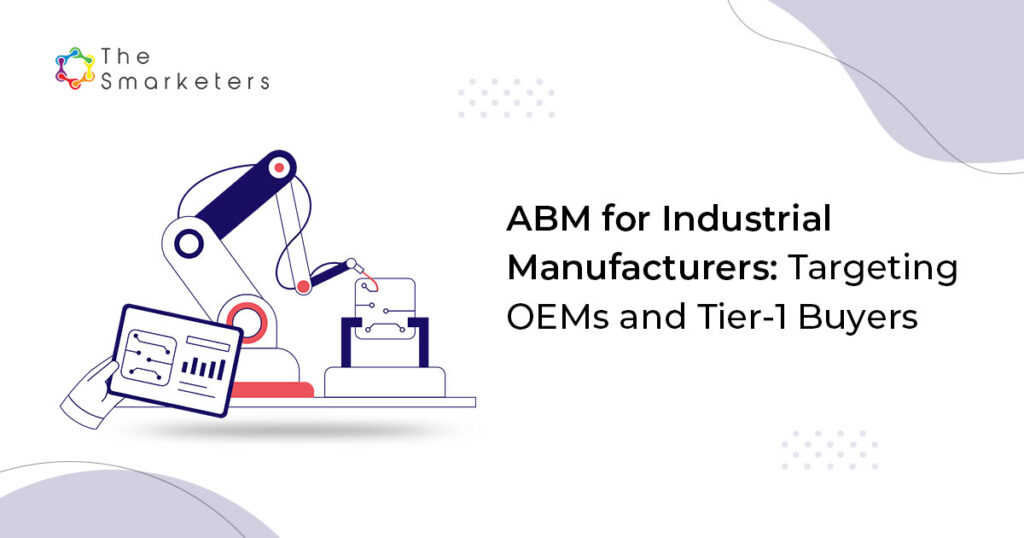
ABM for industrial manufacturers is an account-based marketing approach adapted for the specific buying dynamics of manufacturing supply chains OEMs, Tier-1 suppliers, and industrial buyers. Industrial manufacturing deals involve procurement committees of 10 to 20 stakeholders across engineering, procurement, quality, operations, and finance. Sales cycles range from 12 to 36 months. Purchase decisions are often triggered by new product development programmes, component qualification processes, or incumbent supplier issues. ABM for industrial manufacturers targets these accounts with precision outreach across all relevant stakeholders, rather than relying on inbound leads or trade show activity alone.
Why Industrial Manufacturing ABM Is Different
Industrial manufacturing deals do not work the way SaaS deals work. The evaluation process is technical, committee-driven, and frequently formalised through an RFQ or qualification process. A new supplier entering consideration for a Tier-1 OEM must typically go through a formal approved vendor list (AVL) qualification that can take 6 to 18 months before a single purchase order is issued.
This means standard B2B demand gen approaches inbound lead generation, high-volume email sequences, trial conversion funnels are irrelevant for most industrial manufacturing business development. The deals are too large, too complex, and too relationship-dependent for volume-based approaches to work.
What does work is exactly what ABM is designed to deliver: sustained, multi-stakeholder engagement with a defined set of target accounts over an extended period.
Industrial B2B deals with 10+ stakeholders take an average of 22 months from first contact to first purchase order
The Industrial Manufacturing Buying Committee
| Stakeholder Role | Primary Concern | Content That Reaches Them |
|---|---|---|
| Engineering / R&D | Technical specifications, tolerances, performance data, interoperability | Technical datasheets, application engineering notes, performance validation data |
| Procurement | Price, availability, supplier risk, AVL compliance | Commercial terms, supply chain documentation, capacity statements |
| Quality / QA | Defect rates, quality certifications (IATF, AS9100, ISO), process capability | Quality certificates, process capability studies, audit reports |
| Operations / Manufacturing Engineering | Ease of integration, line qualification time, changeover impact | Implementation guides, qualification case studies, integration documentation |
| Supply Chain | Lead times, inventory flexibility, geographic proximity, single-source risk | Delivery track record, safety stock programmes, multi-site supply documentation |
| Finance | Total cost of ownership, payment terms, supplier financial stability | TCO analysis, commercial references, company financial health indicators |
ABM Approach for Industrial Manufacturers: 5 Steps
Step 1 — Define the right target accounts:
Industrial ABM starts with an account selection process more rigorous than most B2B ABM. Beyond firmographic fit, evaluate: is the account currently using a competitor you can displace? Are they launching new programmes where they need qualified suppliers? Do they have relevant certifications and production volumes that make them viable? Are they in geographies where you have qualified sales and applications support?
Step 2 — Map the full buying committee:
For each Tier 1 target OEM, map contacts across all 6 buying committee roles above. Engineering contacts are often the most important entry point technical credibility must be established before commercial conversations begin. Use LinkedIn, trade publications, and conference participation to identify the right engineering leads.
Step 3 — Lead with technical content:
Industrial buyers do not respond to generic capability claims. They respond to technical depth application engineering notes, process capability data, compatibility documentation for their specific design requirements. The first piece of content a target engineering contact receives should demonstrate that you understand their specific application environment.
Step 4 — Engage at industry events:
Trade shows and technical conferences (Hannover Messe, Automate, MD&M, PackExpo) are where industrial buyers go to evaluate suppliers in-person. ABM programmes should include a pre-show outreach cadence targeting contacts at ABM accounts attending the same events setting up meetings and preparing account-specific materials before the show floor.
Step 5 — Support the qualification process:
The AVL and qualification process is where most industrial deals stall. ABM programmes should include content and resources specifically designed to accelerate qualification: sample programmes, application engineering support, factory audit preparation guides, and quality documentation packs. Making the qualification process easier is a significant competitive differentiator.
Content Strategy for Industrial ABM
- Application engineering notes: Detailed technical documents showing how your product performs in specific application environments. These are the most valuable content assets for reaching engineering buyers.
- Process capability studies: Statistical data demonstrating manufacturing consistency. Essential for quality and procurement stakeholders.
- TCO and value analysis tools: Calculators that help procurement and finance stakeholders compare total cost of ownership across incumbent and alternative suppliers.
- Customer qualification case studies: Stories of other OEMs or Tier-1 suppliers going through the qualification process demonstrating that you know how to support the process and what it looks like to work with you.
- Supply chain risk documentation: For procurement and supply chain stakeholders, documentation of your supply chain resilience, geographic diversity, and business continuity planning.
About The Smarketers
The Smarketers is India’s first ITSMA-awarded ABM agency and a HubSpot Gold Partner. With 40+ implemented ABM programs and an 85% success rate, they work with B2B technology companies, IT services firms, and life sciences companies to drive pipeline through ABM, demand generation, and RevOps.
Frequently Asked Questions
What is ABM for industrial manufacturers?
ABM for industrial manufacturers is account-based marketing adapted for the complex, committee-driven, RFQ-based buying process of industrial supply chains. It targets specific OEM and Tier-1 accounts with multi-stakeholder programmes that engage engineering, procurement, quality, operations, and finance simultaneously over a 12 to 36 month relationship-building cycle.
Why is ABM more effective than trade shows for industrial B2B?
Trade shows create awareness but rarely move deals forward without follow-up. ABM provides the sustained, multi-stakeholder engagement that industrial deals require over 12 to 36 months not just a 20-minute conversation at a booth every 12 months. The most effective industrial marketing programmes use ABM throughout the year and use trade shows as a focused engagement touchpoint within a broader programme.
What content works best for industrial manufacturer ABM?
Technical content outperforms commercial content in industrial ABM: application engineering notes, process capability studies, quality certifications and audit documentation, and integration guides. Engineering contacts who are typically the most important early-stage stakeholders respond to technical depth, not benefits marketing.
How long does industrial ABM take to show results?
Industrial deals are long. Account engagement should be visible within 60 to 90 days of an ABM campaign launch. Progression to RFQ stage typically takes 6 to 12 months. Pipeline attribution and closed revenue from ABM-targeted accounts is typically visible in 18 to 36 months. Industrial ABM is a long-term investment its ROI is real but not short-cycle.
Selling Into OEMs and Tier-1 Manufacturers?

Enoch Pakanati
CEO