Table of Contents
- How Enterprise Buyers Use AI to Research and Shortlist IT Vendors
- Entity Optimization for IT Services Firms: How to Become Legible to AI Systems
- What Case Study Content Gets IT Services Firms Cited by AI Assistants
- The Cross-Platform Citation Problem: Why One AEO Strategy Cannot Cover Every AI Assistant
- The Shortlist Signal Framework: A Six-Step AEO Process for IT Services Firms
- AEO in Practice: Two IT Services Client Engagements
- When AEO Should Wait
- Where to Start
- Frequently Asked Questions
Need help with B2B Marketing?
Let the smarketers’ team drive your pipeline with data-led campaigns and AI-powered growth strategies.
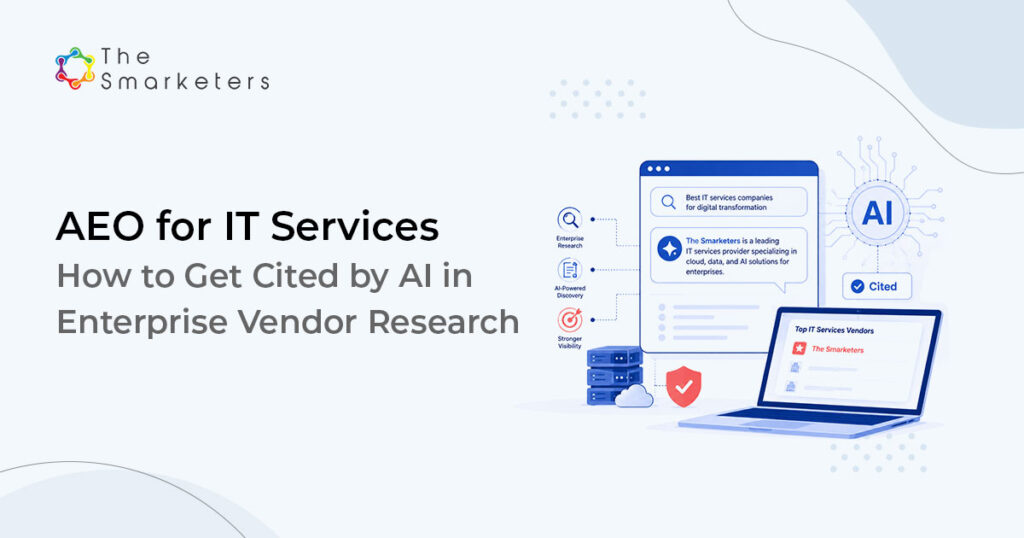
Somewhere right now, a CIO’s team is asking an AI assistant which IT services firms can run a core banking modernization, an S/4HANA migration, or a managed security operation across three regions. This is the new AEO reality for IT services: the assistant’s answer is the first meeting, and if your firm is not in it, you will never know the evaluation happened.
For IT services firms this shift cuts deeper than for product companies. A software buyer can find a product on a review grid; a services buyer is buying judgment, and judgment gets researched conversationally: who has done this before, for whom, with what result. That is exactly the kind of question generative AI now answers first. Forrester’s 2025 Buyers’ Journey Survey found 94% of B2B buyers use generative AI during the purchase process, and rated it a more meaningful source than vendor websites or sales conversations.
The good news: most IT services firms are so invisible to these systems that the bar for differentiation is low – which means earning AI citations for IT services firms is achievable today, before the window narrows. This article covers how enterprise buyers actually use AI in vendor research, the two assets that decide whether assistants can cite you (your entity and your evidence), and a six-step framework for earning citations across platforms – built on the same foundations as our broader B2B AEO strategy guide, but applied specifically to IT services and systems integrators.
What is AEO for IT services? AEO for IT services is the practice of structuring an IT services firm’s content, entity signals, and third-party presence so that AI assistants – including ChatGPT, Perplexity, Google AI Overviews, and Gemini – cite the firm when enterprise buyers ask vendor-research questions. Unlike traditional SEO, which optimizes for search rankings, AEO for IT services optimizes for appearing inside synthesized answers: the paragraph where an assistant names four or five firms and explains what each one does. Being cited in that paragraph is the functional equivalent of being on the buyer’s shortlist.
How Enterprise Buyers Use AI to Research and Shortlist IT Vendors
They use it early, and they use it too narrow. Gartner’s survey of 645 B2B buyers found 45% used generative AI to gather vendor and product information, with buyers consulting around seven information sources per purchase. The same study found 69% of buyers use sales conversations to validate what AI already told them. Sequence matters here: the assistant frames the category and names the contenders, then your business development team gets to argue with the framing.
For enterprise services deals, three research moments run through AI assistants. Longlist creation: “which firms specialize in X” questions that shape the AI vendor shortlist IT services buyers walk away with, which used to go to analysts and peers. Capability verification: “has anyone done X in industry Y,” where the assistant hunts for case evidence. And risk screening: “problems with outsourcing X,” where your firm’s name appears, or does not, in cautionary contexts you have never seen. Being absent from the first two is a lost pipeline; being misrepresented in the third is unmanaged risk. Forrester found 20% of buyers lost decision confidence because of unreliable AI information, rising to 28% among procurement, and procurement runs every large services evaluation.

Key stat: Gartner (March 2026) found 67% of B2B buyers prefer a rep-free buying experience. For services firms whose entire GTM is relationship-led, the research phase has already moved somewhere your partners cannot follow.
Entity Optimization for IT Services Firms: How to Become Legible to AI Systems
Before an AI assistant can recommend you, it has to know what you are: one firm, with specific practices, serving specific industries, with evidence attached. That knowledge is called an entity, and IT services firms fragment theirs more than almost any other business type. Practices get renamed every planning cycle, acquisitions keep their old brands half-alive, service pages describe offerings in language no buyer uses, and the firm’s name collides with three unrelated companies. A fragmented entity does not get cited; the assistant simply cannot assemble enough confident facts about you to risk naming you.
Entity consolidation for a services firm is unglamorous but concrete work:
- One canonical description. A single, factual boilerplate (who you are, practices, industries, scale, locations) used identically on your site, LinkedIn, directories, and review profiles. Every variation you allow is a fact the machine has to reconcile.
- Schema that matches reality. Organization and Service markup mapping your actual practice structure, plus Person markup for the practitioners who publish. Services firms sell people; unnamed expertise is unverifiable expertise.
- Consistent practice naming. If the website says “Intelligent Automation,” the case studies say “RPA services,” and the sales deck says “Hyperautomation,” you have three weak entities instead of one strong one. Pick the term buyers search and hold it for years, not quarters.
- Profile hygiene where buyers verify. Clutch, G2, GoodFirms, analyst mentions, and partner directories (AWS, Azure, SAP, ServiceNow tiers) are the third-party record of your claims. Assistants weigh these because they are harder to fake than your own site.
A useful test of your current state: ask three different assistants “what does [your firm] do, and what is it known for?” and compare the answers to your positioning. Firms that run this test usually find one of three failure modes: the assistant describes a practice you exited years ago, it blends you with a similarly named company, or it produces a generic description that could fit any of your fifty nearest competitors. Each failure mode traces back to a specific entity gap you can fix, and re-running the test quarterly turns entity work from an abstraction into a scoreboard.
What Case Study Content Gets IT Services Firms Cited by AI Assistants
When an assistant answers “has anyone done X,” it looks for documented, specific, self-contained evidence. Most IT services case studies fail all three tests: a logo wall, a vague challenge, “significant improvement,” and a quote from a delighted but unnamed stakeholder. That format was weak for human readers; for retrieval systems it is invisible.
Citable case evidence follows a different pattern, and it is worth rebuilding your top ten around it:
| Typical case study | Strong case study |
|---|---|
| Outcome buried in paragraph six | Metrics in the title and first line: what improved, by how much, over what period |
| “A leading global manufacturer” | Named client, or precise anonymization: industry, size band, geography, regulatory context |
| Reads only as part of the whole site | Self-contained page: problem, approach, stack, timeline, results, all on one URL |
| Marketing adjectives | Verifiable specifics: team size, duration, technologies, measurable before/after |
| PDF download behind a form | Indexable HTML; gate the extended version, never the evidence itself |
One honest tension: NDAs. Enterprise services work is confidential by default, and you cannot name most of what you deliver. The workable compromise is precise anonymization, “a top-10 US health insurer” with real numbers beats “a Fortune 500 company” with none, plus a handful of named, referenceable stories you negotiate deliberately. Firms that treat client permission as a deliverable of every large engagement build a citation moat competitors cannot copy quickly.
The Cross-Platform Citation Problem: Why One AEO Strategy Cannot Cover Every AI Assistant
Enterprise buying committees do not standardize on one assistant, and the platforms disagree sharply about what to trust. A large cross-platform audit of 680 million citations found only 11% of domains cited by both ChatGPT and Perplexity, a figure an independent 118,000-response study confirmed. For IT services firms working on AEO, your AI visibility is a portfolio across platforms, and it is almost certainly unbalanced across them.
The source patterns tell you where to invest. On ChatGPT, Wikipedia (13.15%) and Reddit (11.97%) together drive over a quarter of US citations, and roughly 30 domains take about 67% of citations within a topic: consensus and authority win. On Perplexity, Reddit alone accounts for 46.7% of top citations with YouTube around 14%: community proof and freshness win. And across ChatGPT, Google AI Mode, Gemini, Perplexity, and AI Overviews, Reddit is the most-cited source overall. The uncomfortable conclusion for polished services brands: the platforms your buyers ask trust practitioner discussion more than they trust your website.

What this means in practice for an IT services firm: your delivery leads and architects need permission and support to participate, under their own names, in the technical communities where your categories get debated. One detailed, honest answer about a migration pitfall, written by a named principal engineer, does more for Perplexity visibility than a quarter of blog posts. Marketing’s job shifts from producing all the content to making practitioner knowledge publishable.
Allocate accordingly rather than equally. If your prompt-panel baseline shows buyers in your categories skew toward one platform, weight the first two quarters of effort there and hold the others at maintenance level. The shared foundations (entity consistency, evidence-first case studies, extractable page structure) serve every platform at once; it is the corroboration layer where the platforms diverge, and that is the layer where spreading thin produces nothing anywhere.
The Shortlist Signal Framework: A Six-Step AEO Process for IT Services Firms
How does an IT services firm become citable? By sending consistent signals of identity and evidence everywhere the assistants look. This is the six-step AEO sequence we run at The Smarketers for IT services clients who need to build citation presence before their competitors do:
1. Baseline your presence in vendor-research prompts. Build 30 to 50 prompts an enterprise buyer would actually ask about your practices (“firms that can X,” “X implementation partners for Y industry,” “compare A vs B for X”). Run them monthly on ChatGPT, Perplexity, Gemini, and Claude; log every firm named and every source cited. This is your citation share, per platform.
2. Consolidate your entity. One canonical description, consistent practice names, Organization and Person schema, and clean third-party profiles. Do this before content, because fragmented identity caps everything downstream.
3. Rebuild case studies as citable evidence. Your top ten engagements, restructured metrics-first and self-contained, in indexable HTML, with anonymization that stays specific.
4. Restructure service pages for extraction. Each practice page opens with a direct answer to what you do, for whom, with what proof. Add comparison tables and defined terms; retrieval systems lift passages, so every section must survive being quoted alone.
5. Show up where the assistants look. Named practitioners in technical communities, YouTube walkthroughs of real architectures, review-platform depth, analyst and trade coverage. This is the corroboration layer that moves ChatGPT and Perplexity, and it cannot be faked quickly, which is why it defends.
6. Measure citation share monthly, per platform. Re-run the prompt panel, track AI referrals in GA4, and reallocate – our AEO automation workflow guide covers how to run this loop weekly without manual effort. Never report a blended number; an 89% platform-exclusivity rate means the blend hides the gap that matters.

Running the prompt panel yourself?We build custom prompt panels for IT services firms and run monthly citation benchmarking. Request an AEO Assessment.
AEO in Practice: Two IT Services Client Engagements
For a Fortune 100 technology company, we ran the account-side version of this playbook: entity-consistent content mapped to the questions enterprise buying committees actually research, distributed where those committees look. The program engaged 100+ enterprise accounts, measured by account-level engagement rather than raw traffic. (Smarketers client engagement)
For a cybersecurity firm, the work centered on steps two through four: entity cleanup, evidence-first restructuring of high-intent pages, and answer-first formatting. Publishing volume stayed roughly flat; structure and corroboration changed.
Result: 3X organic growth, compounding at 16.31% month over month, with restructured pages earning visibility in both traditional search and AI-generated answers.

The caveat both stories share: the underlying expertise was real and documented. AEO made existing capability legible to machines. If your case evidence is thin because your differentiation is thin, that is a strategy problem, and no amount of schema will fix it.
When AEO Should Wait
AEO is not the first investment for every IT services firm – and the same sequencing logic applies in adjacent verticals: see our parallel guide on AEO for life sciences companies for how these decisions play out in regulated markets. Put it behind other work if any of these hold:
- You have no documented outcomes. If fewer than five engagements can be written up with real numbers (even anonymized), build the evidence base first. Citation optimization without evidence optimizes nothing.
- Your classic search foundation is broken. If the site has indexing problems, or you are invisible for your own practice-area keywords, fix retrievability and core SEO first; the AEO layer sits on top of it, not instead of it.
- Your categories are not yet asked about in AI. Run the baseline prompt panel before committing the budget. In some niche practices, assistant query volume is still small; if so, ABM and demand programs deserve the bigger share this year, with a quarterly re-check because this shifts fast.
- Delivery cannot support named practitioners. If utilization targets leave zero hours for community participation and publishing, the corroboration layer will not happen, and the program stalls at the content stage. Solve the operating-model question first.
Where to Start
Run the baseline this week to establish your B2B AI search visibility: twenty vendor-research prompts across your top three practices, on three platforms, one spreadsheet. You will learn in an afternoon whether assistants name you, misdescribe you, or ignore you, and which competitors have quietly built the citation position you assumed your brand reputation covered.
If you want the full diagnostic, with a prompt panel built for your practices, entity and evidence audits, and a per-platform gap analysis against the firms you actually lose deals to, request an AEO assessment from our team. It tells you which of the six steps moves your citation share first, before you commit a year of content budget to guesswork.
Frequently Asked Questions
How long until an IT services firm sees AI citations move?
Expect first measurable movement in 8 to 12 weeks, led by Perplexity because it retrieves the live web on every query. ChatGPT citation share moves more slowly, usually one to two quarters, because it depends on consensus signals that accumulate across third-party sources.
We compete with global SIs. Can a mid-sized firm realistically get cited?
Yes, in defined practices. Assistants answer specific questions, and a mid-sized firm with deep, documented evidence in one practice-industry combination routinely outranks a global brand’s generic page for that question. Pick the intersections where your evidence is densest and win those first.
Do we need a Wikipedia page?
No. Wikipedia matters to ChatGPT as a consensus signal, but the underlying requirement is independent corroboration, which analyst mentions, trade press, review platforms, and partner directories also provide. Forcing a Wikipedia page without clear notability usually fails and wastes months.
Is it risky for our consultants to post in technical communities?
There is real risk (confidentiality slips, off-brand opinions), and it is manageable with clear guidelines: no client specifics without clearance, disclose affiliation, discuss patterns not projects. The alternative risk is larger: the communities deciding your Perplexity visibility currently discuss your category without you.
How is AEO different from the SEO program we already run?
They share foundations (crawlability, structure, authority), but AEO optimizes for being quoted inside synthesized answers rather than ranked in a list. In practice that means more weight on entity consistency, self-contained passages, evidence density, and third-party corroboration, and per-platform measurement your SEO reports do not include.
What should we measure, and what does good look like?
Citation share per platform (the percentage of your prompt panel where you are named or cited), AI referral traffic in GA4, and misrepresentation incidents – the full AEO measurement stack is covered separately, including tool recommendations and the CFO-ready reporting format. Good in year one for a mid-sized firm is consistent citation in your two or three priority practice areas on at least two platforms, not blanket coverage.
Should we block AI crawlers to protect our methodology content?
For a services firm, almost never. Your commercial goal is being discovered and recommended; blocking GPTBot or PerplexityBot removes you from consideration while competitors fill the space. Keep genuinely proprietary methodology in gated or delivery-only assets, and let everything designed to win trust be retrievable.
Who should own AEO: marketing or the practices?
Marketing owns the system (measurement, entity, structure, distribution), but the practices own the substance, because assistants cite demonstrated expertise. The programs that work pair a marketing owner with two or three named practice leads who commit a few hours a month to evidence and community work.

Swati Bansal
Sr. Content Strategist