Table of Contents
- The Five Pillars of a B2B Marketing Assessment Framework
- The GTM Readiness Assessment Scorecard: 25 Points, Five Pillars
- Common Gaps by Company Stage
- How to Prioritize Your B2B Marketing Assessment Findings
- Case Study: What a Scored Assessment Led To
- When Should You Skip the B2B Marketing Assessment?
- Getting an Outside Read
- Frequently Asked Questions
Need help with B2B Marketing?
Let the smarketers’ team drive your pipeline with data-led campaigns and AI-powered growth strategies.
The board asks a fair question: if we double marketing spend next year, what exactly do we get? The honest answer at most B2B companies is a shrug dressed up as a forecast. The budget goes to the channels that got the budget last year, the agency that is easiest to renew, and the tool whose contract auto-extends. Nobody can say which part of the go-to-market engine is actually broken, so money flows to all of it equally, including the broken parts.
The numbers say this is the norm, not the exception. Only 52% of companies measure ABM ROI at all, according to ITSMA, and the 2025 Demand Gen Report benchmark survey found proving ROI is a top challenge for 47% of practitioners. Most GTM teams are flying without instruments, which makes every budget debate a matter of opinion.
A B2B marketing assessment framework replaces that debate with a score. This article gives you the one we use: five pillars, a marketing ROI scorecard you can run internally in a week, the gaps we most often find at each company stage, and a prioritization rule for what to fix first. Used honestly, it tells you where your next dollar and your next hire should go before you spend either.
The Five Pillars of a B2B Marketing Assessment Framework
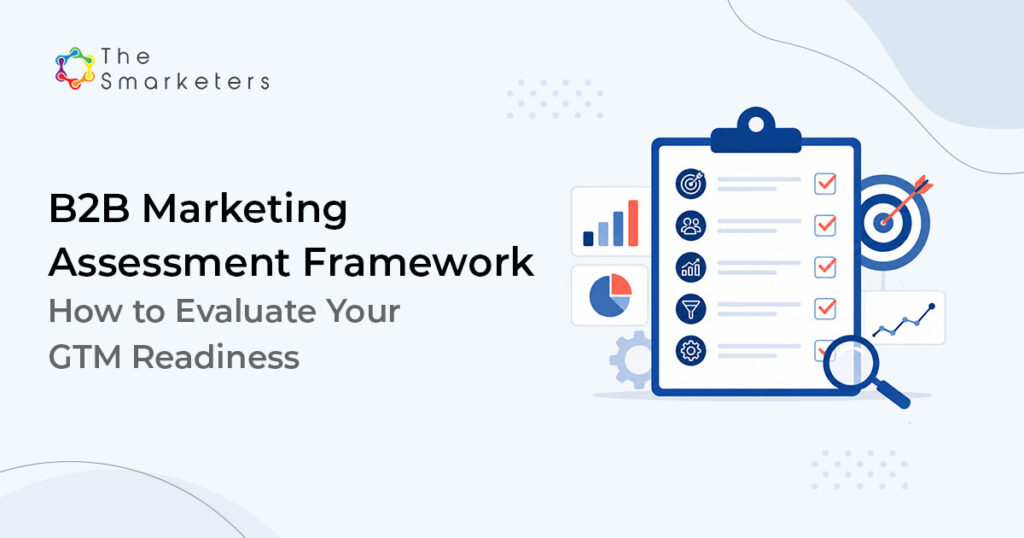
What is a B2B marketing assessment framework? A B2B marketing assessment framework is a structured scoring system that evaluates your go-to-market engine across five dimensions strategy, demand, data, content, and measurement to identify which pillar to fix before adding spend. The output is a 1-to-25 score and a sequenced action plan
What is a B2B marketing assessment framework? It is a structured scoring of your go-to-market engine across the dimensions that determine whether marketing spend converts to revenue: strategy, demand, data, content, and measurement. Scoring all five matters because they fail together; a strong demand engine pointed at a fuzzy ICP burns budget precisely, and great content invisible to buyers might as well not exist.
- Strategy and ICP clarity. Can everyone in the revenue team describe, in the same words, who you win with and why? Readiness here means a written ICP based on closed-won analysis, a defensible answer to “why you,” and pipeline math connecting revenue targets to required opportunities, not aspiration.
- Demand engine. The demand engine pillar of the demand generation assessment asks a single question: do you have a repeatable way to create and capture demand at a cost you can defend? This pillar scores channel mix, pipeline coverage, and unit economics, the same inputs our demand generation service audits before any new spend is committed. Useful external calibration points: the median B2B conversion rate is 2.9% across 100M+ data points, blended B2B cost per lead runs around $198, and the average cost per sales qualified lead reached $1,357 in FY2024. If you cannot state your own versions of these numbers, that itself is a score.
- Data, stack, and operations. Is the plumbing sound? CRM hygiene, lead routing, lifecycle definitions, attribution, and whether your tools talk to each other. The direction of travel is clear: Gartner projected 75% of the highest-growth companies would run a RevOps model by 2025, and roughly half of companies now have a dedicated RevOps function, up from a third in 2020 a shift our RevOps and MarTech service is built around. Companies that get this right see 36% more revenue growth and up to 28% more profitability.
- Content and buyer-facing visibility. When your buyers research the problem you solve, do they find you? This pillar now spans classic search, social presence, and AI assistants, because Forrester found 94% of B2B buyers use generative AI during the purchase process. Readiness means answer-first content mapped to buying-committee questions and visibility where those questions actually get asked.
- Measurement and revenue accountability. One funnel, shared definitions, and reporting a CFO accepts without translation. Gartner’s June 2025 survey found 61% of B2B buyers prefer a rep-free buying experience, which means marketing now owns a larger share of the revenue motion and must be measured like it.

The GTM Readiness Assessment Scorecard: 25 Points, Five Pillars
Score each pillar from 1 to 5 using the anchors below, in a room with sales, marketing, and operations present. The scoring conversation surfaces more truth than the score itself; when sales rates the demand engine a 2 and marketing rates it a 4, that gap is the finding.
| Pillar | What a 1 looks like | What a 5 looks like |
|---|---|---|
| Strategy and ICP | ICP is “anyone who buys”; positioning changes per deck | Written ICP from closed-won data; revenue-to-pipeline math everyone quotes |
| Demand engine | One channel, unknown CPL, pipeline coverage a mystery | Multi-channel mix with known cost per opportunity and 3× coverage |
| Data, stack, ops | CRM is a contact graveyard; routing is manual; no attribution | Clean lifecycle data, automated routing, attribution trusted enough to reallocate budget |
| Content and visibility | Brochure site; invisible in search and AI answers | Answer-first content ranking for buyer queries and cited by AI assistants |
| Measurement | Activity reports; marketing and sales argue definitions | Single funnel, shared definitions, CFO-grade revenue reporting |
Read the total in bands. 20 to 25: your engine is ready to scale, and the assessment becomes a quarterly tune-up. 14 to 19: fix the leaks before adding spend, because the new budget will flow out through the same holes. Below 14: foundation work first; adding channels or tools at this stage multiplies chaos, not pipeline.
How to Read Your GTM Score: 20–25: Engine is ready to scale. 14–19: Fix leaks before adding spend. Below 14: Foundation work first new channels multiply chaos, not pipeline.
Key takeaway: Score with evidence, not memory. Every rating above 3 should come with an artifact: the ICP document, the coverage report, the attribution dashboard. If the artifact does not exist, the score is a 2.
How to run the scoring workshop
Two sessions, ninety minutes each, one week apart. In session one, each function scores all five pillars independently and privately before any discussion; collect the scores, then reveal them side by side. Spend the rest of the session only on the pillars where functions disagree by two points or more, because those gaps are where the organization is lying to itself somewhere. Assign evidence homework for the contested pillars.
Session two reviews the evidence and locks the final score. Two facilitation rules keep it honest: the person who owns a pillar does not get the deciding vote on it, and “we are working on it” scores the current state, not the roadmap. Close the session by writing the one-page output in the room: weakest pillar, first fix, named owner, and the date you will re-score. If the meeting ends without an owner and a date, you held a discussion, not an assessment.
Common Gaps by Company Stage
After running this assessment across engagements from seed-stage startups to enterprise units, the failure patterns cluster by stage. Knowing your stage’s typical gap saves you from diagnosing the wrong problem:
The table below maps the most common GTM gap by company stage, based on The Smarketers’ engagements across 250+ B2B programs.
| Company stage | Most common gap | Typical symptom | First fix |
|---|---|---|---|
|
Early stage (founder-led sales) |
Strategy and ICP | Every deal is custom; no two wins look alike | Closed-won analysis; write the ICP before hiring marketing |
| Growth stage (first GTM team) | Measurement | Channels multiplied faster than tracking; ROI arguments | Lifecycle definitions and one funnel report before new spend |
| Mid-market (scaling) | Data, stack, ops | Tools bought per team; CRM duplicates; leads leak between handoffs | Stack consolidation and routing rules; consider a RevOps owner |
| Enterprise unit | Content and visibility | Brand known, but invisible for new category and AI-era queries | Answer-first content program mapped to buying-committee questions |

One pattern repeats at every stage: measurement gaps hide all other gaps. ITSMA found top-performing programs are 30% more likely to measure ROI than the rest, which is less about dashboards and more about culture. Teams that measure find their weak pillar within a quarter. Teams that do not can run a weak pillar for years and call it a market problem.
How to Prioritize Your B2B Marketing Assessment Findings
Fix in the order that stops waste before it adds volume. The sequence below is the prioritization rule we apply after every assessment, and it rarely changes:
1. Measurement before money. If pillar five scored below 3, fix it first regardless of other scores. You cannot manage what you cannot see, and every other fix will be judged by instruments that do not work yet.
2. Leaks before volume. Repair conversion leaks (routing, follow-up speed, broken handoffs, pages that do not convert) before adding traffic or spend. Doubling the input to a leaky funnel doubles the leak.
3. Strategy before channels. If ICP clarity scored low, resolve it before optimizing any channel. Channel performance debates are unresolvable when nobody agrees who the buyer is.
4. Scale what scored 4+. Only after the first three steps does the new budget go to the strongest pillar. This is where added compounds instead of leaking.
The payoff for getting sequence right is visible in the benchmark data. Forrester found ABM programs most commonly deliver 21 to 50% higher ROI than other marketing approaches, with 23% of respondents reporting 51 to 200% higher, and ITSMA found 87% of marketers say ABM outperforms their other strategies. Yet those returns show up almost exclusively in programs with the measurement and ICP foundations of these assessment scores before any account-based marketing program is launched. The strategy is rarely the problem; readiness to run it is.
Timebox the whole exercise. A useful internal assessment takes one to two weeks: two workshop sessions, evidence gathering in between, and a one-page output naming the weakest pillar, the first fix, and the owner. Assessments that run for a quarter become a substitute for action rather than a trigger for it. If you prefer a day-by-day execution structure, our 30-day GTM assessment sprint guide maps each step in sequence.
Case Study: What a Scored Assessment Led To
Josh Software, a software engineering firm, came to us with the growth-stage profile from the table above: real delivery strength, rising revenue targets, and a GTM motion that had grown by accretion rather than design. Demand ran through referrals and sporadic campaigns, measurement was activity-based, and there was no shared view of which efforts produced pipeline.
The engagement began exactly the way this article recommends: an assessment across the five pillars, scored with evidence in the room. Measurement and demand engine scored lowest, so the first quarter went to lifecycle definitions, tracking, and a rebuilt demand program aimed at the ICP the closed-won analysis actually supported, not the broader market the team assumed. Content and channel spend scaled only after the instruments worked.
Result: 300% ROI in 7 months, with 500+ marketing qualified leads and 4,000+ new site visitors attributable to the program. (full Josh Software case study)

The caveat worth stating: the assessment did not create these results, the fixes did. Its contribution was sequence. The same budget spent in the original order (more campaigns on top of broken measurement) would have produced more activity and no defensible ROI number at all.
When Should You Skip the B2B Marketing Assessment?
Not every company should run this process, and pretending otherwise would make the framework less useful. Skip the formal version if:
- You are pre-product-market fit. Your GTM problem is learning, not optimization. Founder-led selling and fast feedback loops beat any scorecard until wins repeat.
- The team is smaller than the framework. With one or two marketers, a five-pillar workshop is a ceremony. Answer two questions instead: do we know our ICP from real wins, and can we see which activities produce pipeline? Fix whichever is weaker.
- One channel is working and far from saturated. If a single motion is compounding, pour into it. Assessments are for allocating across options; when the answer is obvious, skip the deliberation.
- You already know the answer and lack the will, not the diagnosis. If everyone knows the CRM is broken, another assessment is procrastination with a template. Fix the known problem first.
Getting an Outside Read
Internal assessments hit a predictable limit: the people scoring the engine built the engine. Scores drift up, sacred cows survive, and the pillar nobody owns gets scored by nobody. An outside assessment trades some context for candor, and brings cross-company benchmarks an internal team cannot have.
The other thing an outside read changes is the conversation with leadership. A CEO who has watched the same team present the same optimistic dashboard for eight quarters discounts internal findings by habit. The same weakness, scored by a third party against benchmark data and stated in revenue terms, gets a budget line. That is not always fair to the internal team, but it is how funding decisions actually move, and a good external assessment makes the internal team’s long-standing case for them.
At The Smarketers, GTM assessments are how most engagements begin: the five pillars above, scored with your data, benchmarked against 250+ client engagements, and delivered as a prioritized 90-day sequence rather than a report that decorates a shelf. Where gaps need capacity as well as advice, we operate as an extension of the team through a build-operate-transfer model, so the capability stays with you when the engagement ends. If the board question at the top of this article sounds familiar, request a go-to-market assessment and get a score you can defend in that meeting.
Frequently Asked Questions
How long does a GTM readiness assessment take?
One to two weeks for an internal version: two workshop sessions, evidence gathering in between, and a one-page output. An external assessment typically runs two to four weeks because it includes data audits and benchmarking, but it should never stretch beyond a quarter.
Who needs to be in the room when we score?
Marketing, sales, and whoever owns systems and data (RevOps if you have it), plus the CEO at smaller companies. Scoring disagreements between functions are the most valuable output, so scoring in silos defeats the purpose.
How often should we re-run the assessment?
Twice a year is right for most teams: once tied to annual planning and once mid-year to check course. Re-score a single pillar any time you complete a major fix, so the improvement gets captured and the next weakest pillar becomes visible.
How often should we re-run the assessment?
Twice a year is right for most teams: once tied to annual planning and once mid-year to check course. Re-score a single pillar any time you complete a major fix, so the improvement gets captured and the next weakest pillar becomes visible.
What data do we need before scoring?
Closed-won and closed-lost analysis for the last 12 months, funnel conversion rates by stage, cost per lead and per opportunity by channel, and your current tech stack list. If any of these cannot be produced within a day, score pillar five accordingly.
Should the score decide our marketing budget?
It should decide the sequence, not the size. Budget size follows revenue targets and pipeline math; the assessment tells you which pillar absorbs the first spending safely. Adding budget to a sub-14 engine mostly funds leaks.
Do we need a RevOps hire before fixing the data pillar?
Not necessarily. Early fixes (lifecycle definitions, routing rules, deduplication) can be owned part-time by a capable operator. A dedicated RevOps function becomes worthwhile as complexity grows; about half of companies now have one, and the trend line points up.
How is this different from a marketing audit?
A marketing audit inventories activities and assets; a B2B marketing assessment framework scores readiness against revenue outcomes and forces prioritization. Audits produce findings, assessments produce a sequence. Most teams have had audits; far fewer can name their weakest pillar and its first fix.

Enoch Pakanati
CEO