Table of Contents
- Who Actually Buys Warehouse Management Software?
- Account Selection for WMS Vendors: Evidence Over Wish Lists
- What to Say to Operations, IT, and the CFO (Not the Same Thing)
- Multi-Threading Logistics Enterprises: The 3-Lane Coverage Framework
- Case Study: Account-Based Focus in Industrial Enterprises
- When ABM Is the Wrong Play for a WMS Vendor
- How The Smarketers Runs ABM for Technology Vendors
- Frequently Asked Questions
Need help with B2B Marketing?
Let the smarketers’ team drive your pipeline with data-led campaigns and AI-powered growth strategies.
Your WMS demo went well. The operations director loved the wave-picking logic, asked sharp questions about labor standards, and promised to “socialize it internally.” Then nothing. Eight weeks later you learn the deal went to a competitor the IT team had already been talking to, on a shortlist you never knew existed, approved by a CFO you never met.
This is the standard shape of a lost warehouse management software deal, and it is rarely a product problem. Per 6sense’s Buyer Experience Report, roughly 95% of the time the winning vendor was already on the buyer’s Day-One shortlist, and about 80% of buyers contact first the vendor they already intend to buy from. In logistics software, where implementations touch racking, labor, and revenue-critical fulfillment, committees do their homework long before a salesperson hears about the project. Forrester puts 70 to 80% of the buyer journey before first vendor contact.

Account-based marketing exists for exactly this buying pattern: a defined universe of logistics enterprises, long consideration cycles, multi-person committees, and deal sizes that justify per-account effort. This article walks through how WMS and supply chain software vendors apply ABM in practice: who actually sits on the committee, how to pick accounts, what to say to operations versus IT versus finance, and how to multi-thread without annoying everyone.
Who Actually Buys Warehouse Management Software?
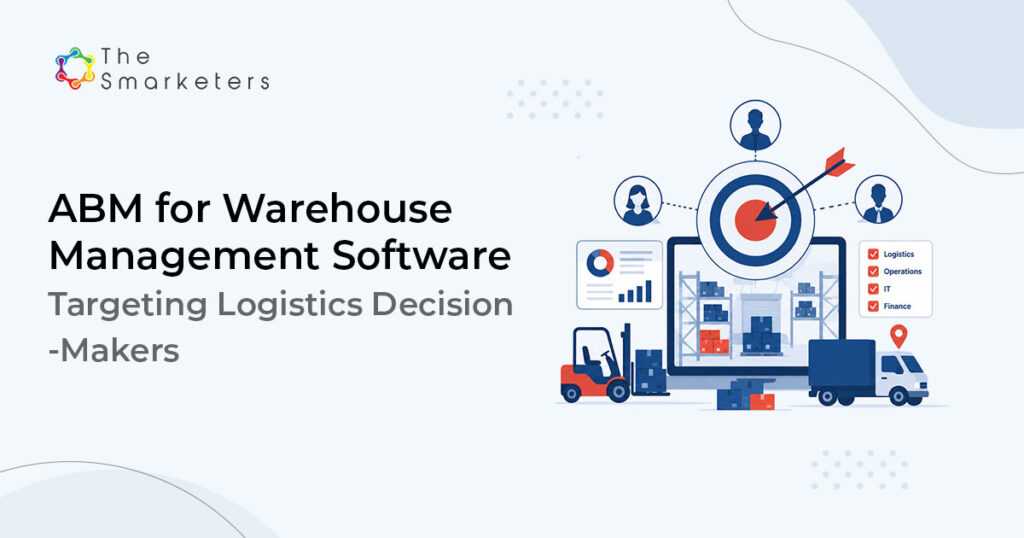
A committee, never a person. The core WMS buying group typically includes the VP or director of operations (the pain owner), warehouse or DC managers (the daily users), IT and enterprise architecture (the integration gatekeepers), finance or the CFO (the payback judge), and increasingly a supply chain systems or digital operations lead who brokers between them. Procurement joins late but can veto. That composition matches the broader enterprise pattern: Forrester and 6sense put the median B2B buying group at 11.2 people for deals over $50K, and WMS deals sit comfortably above that threshold.
Two things make the logistics committee harder than most. First, the members disagree about what the product is. Operations sees a throughput machine, IT sees an integration liability sitting next to the ERP, finance sees a capital request with a labor-savings promise attached. Second, most of their research is invisible to you. Up to 90% of identifiable account visitors stay anonymous through the journey, and buyers work through 8 to 13 pieces of content before engaging sales. The warehouse manager comparing your putaway logic to a competitor’s on a Tuesday night does not fill in a form about it.
Key stat: With a median 11.2-person buying group and ~95% of deals won from the Day-One shortlist, WMS marketing has one real job: be present, credibly, with every lane of the committee before the project becomes official. (Forrester/6sense, Buyer Experience Report 2025)
The three lanes, and who actually holds the veto
For planning purposes, collapse the committee into three lanes. The operations lane (VP ops, DC managers, continuous improvement leads) owns the pain and usually initiates the project, but rarely owns the budget. The IT lane (enterprise architects, ERP owners, security) initiates almost nothing and vetoes almost everything; a WMS that fails the integration review is dead regardless of how much the floor loves it. The finance lane (CFO, controllers, procurement) converts the whole conversation into payback math at the end, and punishes any vendor whose numbers arrive late or soft.
The practical implication: the loudest stakeholder is rarely the decisive one. Deals stall in the IT lane and die in the finance lane, yet most WMS marketing spends nearly all its budget talking to the operations lane, because that is who attends trade shows and answers the phone. An account-based motion forces the correction by making lane coverage visible per account: when the dashboard shows eight touched operations contacts and zero engaged architects at a target account, the gap stops being invisible.
Account Selection for WMS Vendors: Evidence Over Wish Lists
Start with the accounts that show evidence of a warehouse problem, not the logos your board would like to see. The WMS-relevant signals are unusually concrete, which is a gift most software categories do not get:
- Facility signals: new DC openings, warehouse leases, announced expansions or consolidations. A company adding fulfillment capacity is months from asking systems questions.
- Stack signals: ERP migrations (a WMS decision usually rides along), aging legacy WMS installs, automation vendor announcements (new robotics almost always forces a WMS conversation).
- Business-model signals: retailers adding e-commerce fulfillment, 3PLs winning contracts that outgrow their current system, manufacturers insourcing distribution.
- People signals: new VP of supply chain or operations hires (new leaders audit systems), job posts for WMS administrators or inventory control managers.
Score candidate accounts on fit (facility count, order volume, vertical), timing (the signals above), and reachability (can you actually get to all three lanes of the committee?). Then apply the discipline that separates working programs from logo collections: every account on the list gets a written paragraph explaining why it is there. Accounts that cannot earn a paragraph come off. The economics justify the rigor: ITSMA finds 87% of marketers say ABM delivers higher ROI than any other strategy, and companies using ABM report a 48% increase in revenue per account, but only when the account list deserved the investment in the first place.
Tier the list, because not every account earns the same effort
A workable structure for a WMS vendor:
Tier 1 (10-25 accounts) gets full one-to-one treatment, account-specific content, named-person outreach across all three lanes, and a joint account plan with sales.
Tier 2 (25-75 accounts) gets one-to-few programs built around segments that buy alike: 3PLs outgrowing their systems, retailers adding e-commerce fulfillment, manufacturers insourcing distribution.
Tier 3 is everything else that fits the ICP, covered by your regular demand generation motion and promoted into a tier only when signals fire. The tiers exist to protect Tier 1 effort from dilution; the fastest way to ruin an ABM program is to give 200 accounts the treatment 20 deserve.
Cost expectations belong in the selection conversation too. Industrial and manufacturing lead costs already run $120 to $350 per lead at the benchmark level, and enterprise WMS leads sit at the expensive end of that range. Per-account economics only work when the list is small enough that each account can absorb genuine research; that is a feature of the model, not a bug, because it forces the selection rigor most demand programs skip.
What to Say to Operations, IT, and the CFO (Not the Same Thing)
The direct answer: build one account narrative with three lane-specific proofs. Same story about what changes for the business, different evidence per stakeholder. Committees compare notes; if your ops pitch and your CFO pitch describe different products, you lose credibility in the internal meeting you are not attending.
| Lane | What they fear | Content that works | Content that fails |
|---|---|---|---|
| Operations (VP Ops, DC managers) | Go-live disruption in peak season; software that fights how the floor actually works | Throughput and accuracy benchmarks, labor-model walkthroughs, video of comparable sites running, peak-season go-live plans | Feature matrices, generic "supply chain excellence" thought leadership |
| IT / architecture | Another fragile integration next to the ERP; security review pain; an unsupported stack in 5 years | Integration architecture docs, API references, ERP-specific migration guides, security and uptime documentation | ROI decks, marketing webinars, anything that dodges the technical question |
| Finance / CFO | A capital request with soft savings math and a two-year implementation | Payback models with labor and accuracy inputs they can challenge, TCO comparisons vs staying put, phased-rollout costing | Vision content, unquantified "efficiency" claims, case studies without numbers |
Distribution matters as much as the asset. IT researchers live in documentation and peer communities; operations leaders watch what comparable operators do; finance reads what the other two forward. Gartner’s finding that 67% of B2B buyers prefer a rep-free buying experience is especially true of the IT lane, which will disqualify you from documentation alone, silently, before your SDR ever gets a reply.
One production note that saves budget: you do not need three content programs, you need one program with three renderings. A single strong case study, a retailer’s peak season on the new system, becomes a throughput story for operations (pick rates, accuracy, labor hours), an architecture story for IT (integration approach, cutover plan, what broke and how it was handled), and a payback story for finance (implementation cost against labor and error savings, month by month). Same facts, three documents, and the honesty of the shared underlying story is precisely what makes each version credible when the committee compares notes.
Multi-Threading Logistics Enterprises: The 3-Lane Coverage Framework
Multi-threading fails when it is five reps sending five uncoordinated sequences into one account. What works is treating each target account as a small campaign with three lanes on one calendar. We run this as the 3-Lane Coverage Framework:
- Select on evidence. Build the account list from facility, stack, business-model, and people signals, each account with its written rationale and deal math.
- Map the committee. Name real people in all three lanes per account: operations, IT, finance, plus the likely broker (supply chain systems lead). Note who has been through a WMS implementation before; veterans anchor the internal conversation.
- Build lane content. One account narrative, three proof sets, per the table above. Personalize at the account level (their DC network, their ERP), not just the persona level.
- Multi-thread on one calendar. Coordinated touches across lanes: ops sees the benchmark webinar the same fortnight IT receives the integration guide and finance gets the payback model. One owner per account orchestrates; sales and marketing share the same account plan, or the account stays off the active list.
- Measure coverage, not leads. Track buying-group coverage (how many lanes engaged per account) and account engagement depth monthly; pipeline and revenue per account quarterly. Lead counting in an account motion produces theater, not signal.

Smarketers insight: The most reliable multi-threading move in logistics accounts is the implementation-scar interview: find the person who survived the last WMS or ERP go-live and build content that takes their objections seriously. Every committee has one, and everyone else defers to them.
What a coordinated account quarter actually looks like
To make the framework concrete, here is a typical Tier 1 quarter for one target account, a retailer opening a second fulfillment center. Weeks 1-2: research and committee mapping; the account owner writes the rationale paragraph and sales co-signs the plan. Weeks 3-6: the operations lane sees a benchmark piece on peak-season throughput at comparable DC profiles, while IT receives an integration guide specific to the account’s ERP, and the SDR’s outreach references the new facility, not a generic pitch. Weeks 7-10: a tailored payback model reaches the finance lane through the operations champion, deliberately, so the champion carries your math into the room instead of defending math they have never seen. Weeks 11-13: an executive-to-executive touch and an invitation to a small peer roundtable with two current customers running similar operations. Every touch logs to the account plan, and the monthly review asks one question: which lanes moved, and which went quiet?
Notice what is absent: volume. One account, perhaps a dozen meaningful touches in a quarter, each one specific enough that ignoring it takes effort. Multi-threading is not more outreach; it is the same modest quantity of outreach aimed at the whole committee instead of repeatedly at its friendliest member.
Case Study: Account-Based Focus in Industrial Enterprises
A Fortune 500 industrial automation company, selling into the same kind of operations-led, committee-driven enterprises WMS vendors target, engaged us with a familiar problem: broad campaigns producing expensive leads that sales did not pursue. We rebuilt the motion account-first: an evidence-based target list sales co-signed, committee mapping per account, and lane-specific messaging replacing one-size-fits-all campaigns.
Result: 300+ sales opportunities in 4 weeks with cost per lead cut by 90%. In a separate named-account program, a Fortune 100 technology company engaged 100+ enterprise accounts, converting a static target list into active multi-threaded conversations. (Smarketers client engagements; full stories at https://thesmarketers.com/success-stories/)

The transferable lesson for WMS vendors is not the specific numbers; industrial automation is adjacent to, not identical to, warehouse software. It is the mechanism: when the target list is built on evidence and sales co-owns it, per-account effort stops being expensive and starts being efficient, because none of it is spent on accounts that were never going to buy.
Worth stating plainly for anyone benchmarking against these figures: the 4-week timeline reflects a company with existing brand recognition and a sales team ready to work on what marketing produced. A WMS vendor starting from lower awareness should plan on the quarters-long clock described earlier, and treat the early engagement signals, multi-lane activity inside target accounts, as the evidence that the motion is working before the opportunity count says so.
When ABM Is the Wrong Play for a WMS Vendor
- If your ACV is under roughly $30-50K, per-account economics rarely close. A strong inbound and demand gen motion will outperform ABM on cost; revisit when you move upmarket.
- If sales will not co-own the list, do not start. An account program sales tolerates but ignores runs for two quarters as a marketing exhibition, then gets cut. Fix the operating agreement first.
- If you cannot serve the accounts you would win, implementation capacity is the ceiling in WMS. Filling the pipeline you cannot staff burns exactly the reference customers ABM depends on.
- If you need a pipeline this quarter, committee-based selling pays on account timelines, not campaign timelines. Forrester finds 45% of B2B marketers using ABM report revenue up 10%+ within 12 months: note the twelve. ABM is a compounding motion, not a rescue motion.
How The Smarketers Runs ABM for Technology Vendors
We build and run account-based programs for B2B technology companies selling into complex enterprises, from account selection and committee mapping through lane content and measurement, as part of our ABM services. We were India’s first ITSMA-award-winning ABM agency (Gold, 2019), and we run the same coverage-first model described above across 40+ ABM programs. If you want to pressure-test whether the math works for your ACV and account universe before talking to anyone, the free ABM ROI calculator takes ten minutes.
Frequently Asked Questions
How many target accounts should a WMS vendor start with?
Between 25 and 75 for a first program, depending on team size. Small enough that every account gets genuine committee mapping and lane content, large enough to produce learnable patterns. Expanding a working list is easy; rescuing a diluted program is not.
How long before an ABM program for logistics accounts shows results?
Expect engagement signals (multi-lane activity within target accounts) in the first quarter, meetings and pipeline in two to three quarters, and revenue on the account timeline of WMS deals, often 6 to 18 months. Forrester finds 45% of ABM users report revenue up 10%+ within 12 months; treat that as the realistic clock.
What budget does a WMS ABM program need?
Less than most vendors assume, because ABM reallocates spend from broad reach to deep coverage. The bigger investments are people-time: committee research, lane content, and orchestration. As a rule, fund one dedicated owner plus content production before buying any new tooling.
Do we need intent data tools to run this?
They help and we use them, but the WMS category is unusually rich in public signals: facility announcements, ERP migrations, automation deals, and hiring patterns are all visible without a platform. Start with public-signal selection; add intent tooling when list volume justifies it.
How do we reach warehouse operations people who ignore marketing?
Through evidence and peers, not sequences. Operations leaders respond to comparable-site proof: benchmarks from similar DC profiles, video of live operations, and honest go-live stories including what went wrong. Distribute where they already look, industry communities and peer references, rather than relying on email.
Should the same program cover 3PLs and retailers, or separate them?
Separate the messaging, share the machinery. A 3PL buys WMS as a revenue platform (client onboarding speed, billing accuracy); a retailer buys it as a cost and service lever. Same framework, same lanes, different narrative and payback math per segment.
What is a realistic conversion expectation from our website during this?
Modest, and that is fine. Manufacturing and industrial sites convert around 3 to 5% of visitors at best, and most committee research never touches your forms. Judge the program on account coverage and engagement, and treat site conversions as a bonus signal, not the KPI.
What should we report to the board while deals are still in flight?
Two clocks. Monthly: buying-group coverage, engaged target accounts, and meetings at named accounts. Quarterly: pipeline created per account and cost per opportunity against your old motion. Committing to lead volume in an account motion sets the program up to be judged on the wrong metric.

Isha Gulati
Senior Marketing Manager