Need help with B2B Marketing?
Let the smarketers’ team drive your pipeline with data-led campaigns and AI-powered growth strategies.
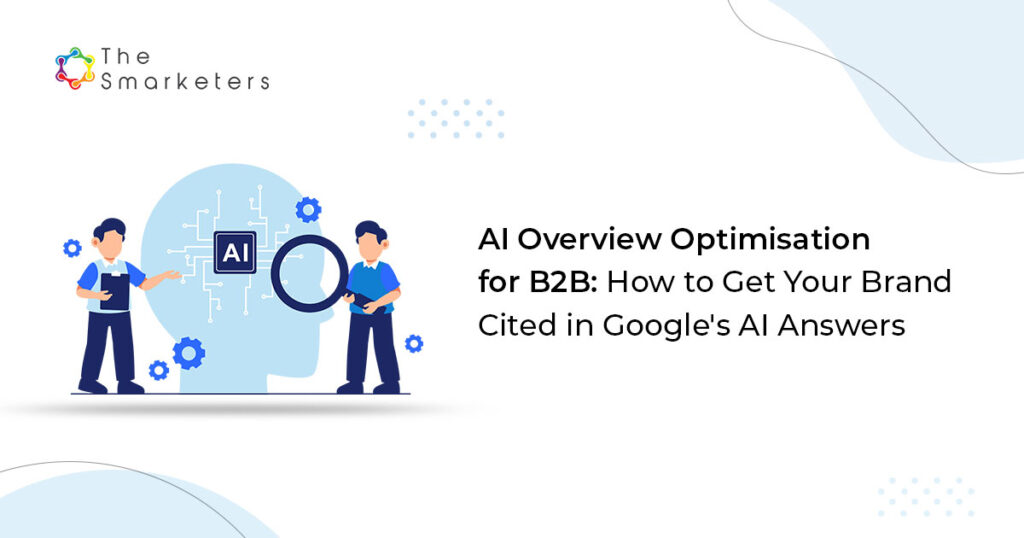
What is AI Overview Optimisation for B2B?
Why AI Overviews Matter More Than Most B2B Marketers Realise
Google’s AI Overviews now appear for an estimated 40 to 60% of informational and commercial B2B queries in 2026. For your target buyer, this means: they search “how to design an ABM pilot programme,” an AI Overview appears with a synthesised answer, and they may never scroll down to the organic results underneath.
If your content is cited in that AI Overview, you get brand exposure at the top of the page often with a visible link back to your source. If your content is not cited, you are invisible on that query even if you rank organically at position 3 below the AI Overview.
For B2B companies investing in content marketing, AEO is the evolution of what SEO optimisation means. Traditional SEO gets you into the organic index. AEO gets you into the AI-generated answer that appears above it. Both matter. But in 2026, AEO is the faster-growing opportunity for most B2B brands.
AI Overviews appear for 40–60% of B2B informational queries in early 2026, with citation click-through rates of 12–18%
The 8 Content Signals for AI Overview Citation
Signal 1 — Definition completeness:
AI Overviews frequently trigger for definitional queries (“what is X,” “what does X mean in B2B”). Pages that include a clear, standalone definition block for the primary concept are significantly more likely to be cited. The definition should be 80 to 120 words, self-contained, and answer the definitional query directly in the first sentence without requiring surrounding context to make sense.
Signal 2 — FAQPage schema:
FAQ Page JSON-LD schema directly signals to Google that a page contains structured Q&A content. Pages with FAQPage schema are substantially more likely to appear in AI Overviews for FAQ-style queries. The questions must match actual search queries in phrasing not reworded variations.
Signal 3 — HowTo schema:
For process queries (“how to build an ABM programme,” “how to measure pipeline velocity”), HowTo schema marks up step-by-step content for AI extraction. Each step should be a complete, independently actionable instruction not a heading that requires context from surrounding paragraphs.
Signal 4 — Authoritative sourcing:
AI Overviews prefer content that cites authoritative external sources. Pages referencing Gartner, Forrester, McKinsey, or peer-reviewed research signal higher credibility than pages with only internal claims. Every statistic should link directly to its original source.
Signal 5 — Article schema with author attribution:
Article JSON-LD schema with a named author, author credentials or bio, datePublished, and dateModified signals content authority. Google E-E-A-T framework (Experience, Expertise, Authoritativeness, Trustworthiness) is a direct input to AI Overview citation probability.
Signal 6 — Comparison tables:
Structured tabular data is frequently extracted directly into AI Overview responses. Comparison tables contrasting approaches, tools, or metrics are among the most consistently cited content elements in AI Overview outputs across B2B queries.
Signal 7 — Recency signals:
AI Overviews weight recently updated content for queries where recency matters. Keep your highest-value AEO pages updated at least quarterly even minor updates to statistics, examples, or data refresh the dateModified signal and maintain citation eligibility.
Signal 8 — Content depth and follow-up coverage:
AI Overviews prefer pages that answer follow-up questions without requiring additional searches. Pages that cover a topic comprehensively including common variations, edge cases, and related sub-questions are more likely to be selected as citation sources than pages covering only the primary query.
Schema Markup Priority List for B2B AEO
| Schema Type | When to Implement | Priority | AI Overview Impact |
|---|---|---|---|
| FAQPage | Any page with 3+ Q&A pairs answering specific buyer questions | Every blog post and service page | Critical direct eligibility signal for FAQ-style queries |
| HowTo | Any page with a numbered step-by-step process or methodology | All process and playbook content | High, frequently extracted for "how to" queries |
| Article | All blog posts and long-form content pages | Every blog post | High E-E-A-T and entity recognition signals |
| Service | Service pages and industry solution pages | All service and industry pages | Medium entity and service category recognition |
| BreadcrumbList | All internal site pages | Site-wide implementation | Medium site structure and navigation signals |
| Organization | Homepage and About page | Homepage priority | Medium brand entity authority for branded queries |
5-Step AEO Audit Process
Before optimising for AI Overviews, understand your current position. Run this audit before making content changes.
Step 1 — Build your target query list:
Identify 20 to 30 queries your target buyers actually search, including definitional queries (“what is buying group marketing”), process queries (“how to build an ABM programme”), and comparison queries (“ABM vs. demand gen”). These should be queries where you already rank organically or have strong topical authority.
Step 2 — Search and record AI Overview appearances:
Search each query in Google and record: whether an AI Overview appears, whether your brand is cited in the Overview, and which competitor or publisher is most frequently cited. Calculate your current AI Overview presence rate — the percentage of relevant queries where your brand is cited.
Step 3 — Gap analysis for non-cited pages:
For queries where you rank organically but are not cited in the AI Overview, audit the ranking page against the 8 signals above. Document which signals are present and which are missing. Prioritise gaps by query volume and commercial intent.
Step 4 — Schema audit:
Check whether your highest-value pages have FAQPage, Article, and HowTo schema correctly implemented and validated. Use the Rich Results Test to verify. Missing or invalid schema is the easiest AEO improvement to implement and often produces fast results.
Step 5 — Content structure improvements:
For high-priority pages, add or improve definition blocks, restructure FAQ sections to match actual search phrasing, add comparison tables for any “X vs Y” queries, and ensure all statistics are cited with source links. Resubmit updated pages to Google Search Console for recrawl after changes.
About The Smarketers
The Smarketers is India’s first ITSMA-awarded ABM agency and a HubSpot Gold Partner. With 40+ implemented ABM programs and an 85% success rate, they work with B2B technology companies, IT services firms, and life sciences companies to drive pipeline through ABM, demand generation, and RevOps.
Frequently Asked Questions
What is AI Overview optimisation for B2B?
AI Overview Optimisation (AEO) for B2B is the practice of structuring content so it is selected as a citation source by Google’s AI Overviews the AI-generated answers appearing at the top of search results for relevant queries. It requires different optimisation than traditional SEO, prioritising content structure, schema markup, answer completeness, and source credibility over keyword density or backlink volume.
What content signals does Google use for AI Overview citation?
The primary signals are: standalone definition blocks (80–120 words, self-contained), FAQPage schema, HowTo schema for step-by-step content, authoritative external source citations (Gartner, Forrester, peer-reviewed research), Article schema with named author and dateModified, comparison tables, recent content updates, and comprehensive topic coverage that answers follow-up questions without additional searches.
Is AEO different from traditional SEO?
Yes, though they overlap. Traditional SEO optimises for keyword relevance, backlink authority, and page ranking in organic results. AEO optimises for content structure, schema markup, answer completeness, and source credibility to appear in AI-generated summaries. A page can rank well organically but not appear in AI Overviews and a newer page with strong AEO signals can appear in AI Overviews before it has significant organic ranking.
How do I know if my content is appearing in AI Overviews?
Manual audit: search your target queries in Google and check whether your brand is cited. Semi-automated: Semrush and Ahrefs both include AI Overview tracking in their 2026 product versions, allowing you to monitor AI Overview citation performance at scale. Google Search Console does not currently have a native AI Overview report, though this may change.
How quickly can AEO improvements show results?
Content updates with proper AEO signals FAQPage schema, definition blocks, comparison tables can begin appearing in AI Overviews within 2 to 6 weeks of recrawl. The full impact of AEO investment, particularly the E-E-A-T and entity authority signals, compounds over 3 to 6 months of consistent content production and maintenance.
Is Your Brand Appearing in AI Overviews?

Enoch Pakanati
CEO