Table of Contents
- Why APAC’s Fragmented Markets Punish an Unaudited GTM Engine
- What Does a Proper B2B Marketing Assessment Cover?
- Evaluating Your MarTech Stack (a HubSpot-Focused Checklist)
- Five Signs the Audit Is Already Overdue
- The 30-Day GTM Assessment Sprint
- What an Assessment Changes: a SaaS Client Example
- When a Full Assessment Is Not the Right Move
- Getting It Assessed Properly
- Frequently Asked Questions
Need help with B2B Marketing?
Let the smarketers’ team drive your pipeline with data-led campaigns and AI-powered growth strategies.
The board meeting question that stalls most SMB marketing leads is not “what did we spend?” It is “what did we get?” The ad platforms say the campaigns performed. The CRM says the pipeline is thin. Sales says the leads were never right to begin with. Everyone has a dashboard, and nobody has an answer.
That gap is rarely a campaign problem. It is an engine problem: positioning, funnel, tech stack, and sales handoff drifting out of alignment while everyone is busy shipping the next campaign. The numbers say most engines have room to close. The median B2B conversion rate is 2.9%, and the average B2B website converts around 1.8%, while strong performers in higher-ACV categories reach 5% or more. Nearly a threefold difference, running on roughly the same channels and budgets.
For SMBs selling across Asia-Pacific, the cost of an unaudited engine compounds faster than it does in a single-market business, because every inefficiency gets replicated across markets that behave differently. This guide covers what a proper B2B marketing assessment includes, how to score your MarTech stack (with a HubSpot lens, since that is what most SMBs in this position run), and a 30-day sprint framework you can execute with the team you already have.
Why APAC’s Fragmented Markets Punish an Unaudited GTM Engine
The short answer: Asia-Pacific is not one market, and a GTM engine tuned for one buying culture quietly underperforms in the next. An SMB selling into Singapore, Jakarta, Sydney, and Tokyo is really running four different motions: different languages, different channel behavior, different expectations about how much relationship-building precedes a deal, and different procurement norms. When the engine has hidden flaws, each market multiplies them.
Three failure patterns show up repeatedly in APAC SMB engines:
- One funnel model stretched across many buying cultures. A lead scoring model and nurture cadence built for one market gets applied everywhere. Follow-up timing that feels responsive in one place reads as pushy in another, and the CRM cannot tell you which is happening where because the region was never modeled as a first-class field.
- Benchmarks borrowed from other people’s markets. Most published CPL and conversion benchmarks skew toward US and European data. Teams grade themselves against numbers that were never theirs, then over-correct in the wrong direction. For reference, blended B2B cost per lead runs around $198, with SaaS paid channels near $310, and the average B2B cost per sales qualified lead sits at $1,357. Useful as orientation, dangerous as targets, because your mix of markets changes the math.
- Resourcing that cannot afford waste. An enterprise can carry an unused tool or a leaky handoff for quarters. An SMB spending across several markets cannot. The same audit that is “nice to have” for a large company is closer to survival hygiene for a lean team.

Download Our B2B Lead Generation Playbook for APAC.
What Does a Proper B2B Marketing Assessment Cover?
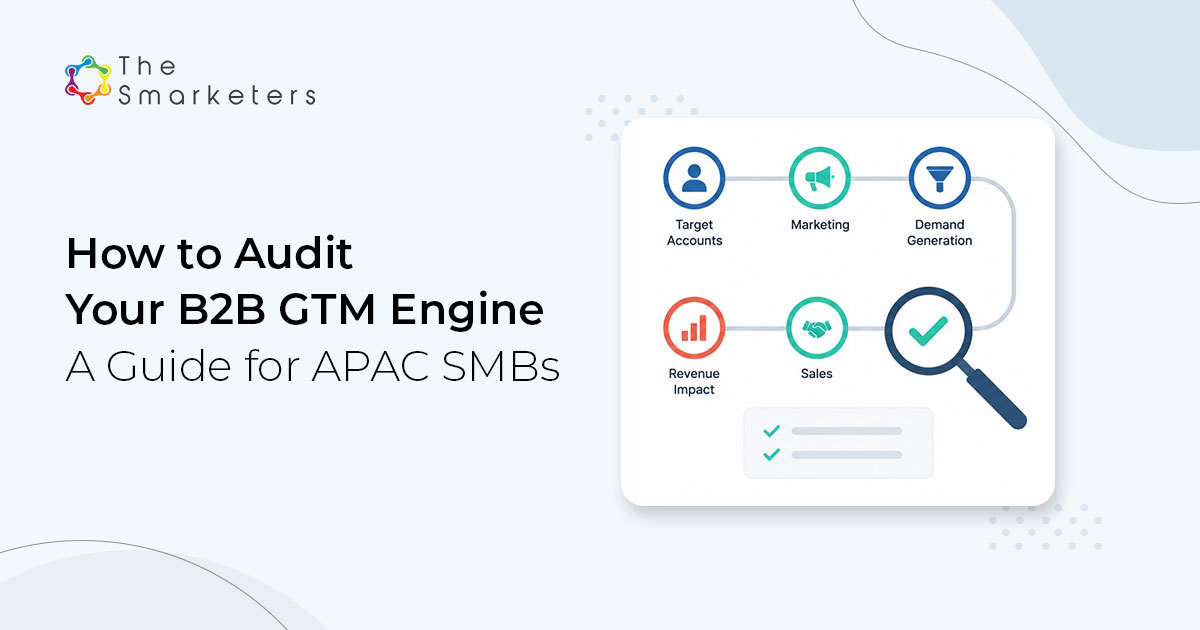
A proper B2B marketing assessment examines six areas: positioning and ICP fit, demand capture, demand creation, the MarTech and data layer, the sales-marketing handoff, and measurement. Anything narrower is a channel review wearing an assessment’s clothes. The point is to find where revenue leaks between functions, which is exactly where single-channel audits never look.
| Assessment area | Core question | Evidence to pull |
|---|---|---|
| Positioning & ICP | Do our best customers match the accounts our campaigns attract? | Win/loss notes, closed-won firmographics vs campaign audiences |
| Demand capture | Do buyers already search for this find and choose us? | Search and AI-answer visibility, landing page conversion, form friction |
| Demand creation | Are we building awareness with buyers not yet in-market? | Content engagement depth, social reach in target segments |
| MarTech & data | Does the stack model the business, and does anyone use it? | Adoption per tool, field hygiene, integration and duplicate reports |
| Sales handoff | Do qualified leads get worked, and does feedback return? | SLA existence, follow-up speed, MQL-to-SQL acceptance rate |
| Measurement | Can we trace revenue back to activity without heroics? | Attribution coverage, dashboard trust, one shared funnel definition |
Two of these areas deserve extra weight for SMB teams. First, demand capture, because it is the fastest payback: buyers researching invisibly means your public-facing answers do the selling long before a call. Buyers consume 8-13 pieces of content before they ever engage sales (Demand Gen Report). Second, the handoff, because it is where the most expensive leads die quietly. If sales accepts only a fraction of MQLs and nobody can say why, no amount of top-of-funnel optimization will fix the revenue number.
One clarification on jargon: when we say GTM (go-to-market) engine, we mean the whole system that turns attention into revenue, not the marketing department. That is why a real assessment interviews sales and looks at CRM data, not just campaign reports.
Evaluating Your MarTech Stack (a HubSpot-Focused Checklist)
Start from a blunt premise: the stack is guilty until proven adopted. Licenses are easy to buy and hard to operationalize, and stack sprawl is still growing: CRM adoption keeps climbing at roughly 12.6% year over year. We anchor this section on HubSpot because it is the platform most SMBs in this segment run: it holds roughly 38% of the marketing automation market and ends 2025 with about 288,700 customers, with particular strength in SMB and mid-market. The questions below transfer to any platform.
Score each item 0 (absent), 1 (partial), or 2 (working and evidenced). Under 60% of the maximum is a red flag we see confirmed by downstream metrics almost every time:
- Does the data model match the business? Deal stages that mirror how deals actually progress, region and market fields populated, buying-group contacts associated with deals rather than one lonely “decision maker”.
- Is the lifecycle stage governed by rules, not opinions? A written definition for MQL and SQL that both teams signed, enforced by workflows rather than memory.
- Are workflows documented and owned? Every active workflow has an owner and a purpose someone can state. Orphaned automation is where lead experiences go to rot.
- Do integrations move data both ways? Ad platforms, enrichment, webinar tools, and chat all write into the CRM with consistent field mapping, so attribution does not require a spreadsheet séance.
- Is reporting trusted enough to argue with? One funnel dashboard both marketing and sales accept as the scoreboard. If each team brings its own numbers to pipeline reviews, the stack has failed at its main job.
- What are you paying for and not using? List every paid seat, hub, and add-on against actual monthly usage. In SMB audits this line alone often funds the fixes the assessment recommends.
Smarketers insight:The most common finding in our SMB stack audits is not a missing tool. It is a capable platform used as a contact list: automation, attribution, and buying-group features paid for and untouched. Fixing usage is almost always cheaper than switching platforms.
Five Signs the Audit Is Already Overdue
Not sure whether to prioritize this over next quarter’s campaigns? These are the symptoms that, in our experience, reliably predict an engine problem underneath. Two or more of them, and the assessment should jump the queue:
- Marketing and sales report different pipeline numbers. If the Monday revenue meeting starts with reconciling whose dashboard is right, the measurement layer has already failed, and every decision downstream of it is a guess wearing a percentage.
- CPL is stable but revenue is not. A healthy channel feeding a leaky engine looks exactly like this. The campaigns get blamed; the handoff or the ICP mismatch is usually the culprit.
- Nobody can name the MQL definition without checking. If qualification lives in individual judgment rather than a written, workflow-enforced rule, your funnel metrics describe habits, not buyers.
- Every market gets the same nurture cadence. For a business selling across several APAC markets, identical follow-up timing everywhere means at least one market is being mishandled, and the CRM cannot tell you which.
- The stack renewal arrives and nobody can defend the line items. When the annual invoice provokes a shrug instead of a usage report, you are funding shelf-ware, and probably working around it manually too.
One pattern worth naming: these symptoms almost never arrive alone, because they share a root cause. An engine assembled tool by tool and market by market, without anyone ever designing it as a system. That is also why fixing them one symptom at a time keeps failing, and why the assessment below looks at the whole machine in sequence.
The 30-Day GTM Assessment Sprint
How do you run a full assessment without stopping the marketing calendar? Timebox it to 30 days, sequence it so each week feeds the next, and end with a ranked fix list rather than a report nobody reads. This is the sprint structure we use at The Smarketers , adapted here so a lean internal team can execute it:
- Days 1-5: Baseline the numbers. Pull 12 months of data: traffic, conversion rate, CPL by channel, MQL-to-SQL rate, win rate, and cycle length, split by market where the data allows. You are not judging yet, just establishing what is true. Our free MQL-to-SQL calculator at thesmarketers.com/tools/ speeds up the funnel math.
- Days 6-10: Audit positioning and ICP. Take your last 20 closed-won and 20 closed-lost deals and compare them to the audiences your campaigns target. Misalignment here silently caps everything downstream.
- Days 11-15: Score the stack. Run the six-question checklist above. Interview the people who touch the CRM daily; their workarounds are your findings.
- Days 16-20: Trace the buyer path. Walk every route a prospect can take from first touch to sales conversation, in each priority market. Fill in your own forms. Log every dead end, slow page, and unanswered chat.
- Days 21-25: Grade the sales-marketing handoff. Measure follow-up speed on the last 50 MQLs, check whether an SLA exists and is honored, and ask sales to name the last lead they were glad to receive. The silence is data.
- Days 26-30: Prioritize and sequence. Rank every gap by revenue impact and effort. Commit the top items to a two-quarter roadmap with owners and dates. An assessment that ends without a sequenced roadmap was a very long meeting.

What an Assessment Changes: a SaaS Client Example
A digital adoption platform (SaaS) came to us with the classic symptoms: steady spend, respectable traffic, and a pipeline that did not reflect either. The engine had never been audited as a system.
The assessment surfaced three compounding issues: campaigns targeting a broader profile than the customers who actually closed, a CRM where lifecycle stages were applied by habit rather than rule, and follow-up on qualified leads averaging days rather than hours. None of these was visible from any single dashboard. Together they explained the pipeline gap almost entirely.
Result: After the fixes were implemented in priority order, the rebuilt funnel produced 112 marketing qualified leads, 20 sales qualified leads, and 5 closed deals. (Smarketers client engagement; more at thesmarketers.com/success-stories/)

The honest caveat: the assessment did not create demand that was not there. It stopped the engine from wasting the demand that was. Teams whose core problem is weak positioning or an unproven offer will get a clear diagnosis from a GTM audit, but the fix will take longer than a quarter.
When a Full Assessment Is Not the Right Move
An honest vendor should tell you when to skip this. Three situations where a 30-day assessment is the wrong tool:
- You already know the fire. If sales follow-up takes four days and everyone knows it, fix that first. Assessing around a known critical failure delays the obvious.
- You have under 12 months of data. Very early-stage companies should spend the month talking to customers instead. An audit of an engine that has barely run produces confident noise.
- Leadership will not act on findings. If there is no appetite to change the CRM, the handoff, or the budget allocation, the assessment becomes shelfware. Secure the mandate before the audit, not after.
Getting It Assessed Properly
Everything above is doable internally, and for many SMBs that is the right first pass. The trade-off is objectivity and speed: internal teams grade their own work, and the 30 days stretch when the day job interferes. Our assessment engagements pair a senior strategist with an AI-enabled audit stack, so the data pulls, stack scoring, and benchmark comparisons that consume most of the calendar happen in days, and our HubSpot practice (we are a HubSpot Platinum Solutions Partner) handles the stack findings without a second vendor.
If you want the outside version, with APAC market benchmarks from programs we run in the region, request a custom GTM assessment. You get the ranked fix roadmap either way; the difference is who holds the flashlight.
Frequently Asked Questions
How much does a B2B marketing assessment cost for an SMB?
Quote-follow-up automation and sales-signal routing show results in the first quarter. Part-number and application SEO typically takes two to four quarters to compound, because it depends on catalog pages being indexed and earning authority. Plan the program in rungs with a measurable win each quarter, not as a single big-bang launch.
How long before assessment findings show up in pipeline?
Handoff and follow-up fixes show effects within one sales cycle, often 4-8 weeks for SMB deal sizes. Positioning and demand creation fixes need two quarters or more. Sequence quick-payback fixes first so the program funds its own patience.
What data do we need before starting the sprint?
Twelve months of funnel data is the practical minimum: traffic, conversions, CPL, MQL-to-SQL rates, and win rates. If your CRM cannot produce these, that finding alone justifies starting the assessment with the stack audit week.
Should the assessment cover every market we sell into?
No. Pick your top two or three revenue markets and go deep. A shallow pass across six markets produces averages that describe none of them, which is the exact failure mode the assessment exists to fix.
Who should own the assessment internally?
One person with cross-functional access, usually the marketing lead or a founder, with explicit permission to pull CRM data and interview sales. Committees produce consensus documents; single owners produce findings.
Do we need to pause campaigns during the audit?
No, and you should not. Live campaigns generate the freshest evidence of funnel behavior. The only thing worth pausing is new tool purchases until the stack score is in.
What KPIs prove the assessment worked?
Pick three before you start: most teams choose MQL-to-SQL acceptance rate, lead follow-up time, and cost per SQL. If those do not move within two quarters of implementing fixes, revisit the diagnosis rather than adding more fixes.
Is HubSpot the right platform for an APAC SMB, or should we reassess that too?
Assess usage before platform. Most underperforming HubSpot instances we audit are under-adopted rather than mis-chosen, and switching costs for SMBs are punishing. Reopen the platform question only if the data model fundamentally cannot represent how you sell.

Isha Gulati
Senior Marketing Manager