Table of Contents
- The Partner Ecosystem Opportunity (and Why It Stays Unclaimed)
- Co-Marketing With Hyperscalers: What It Buys and What It Costs
- Account Selection Inside Cloud Marketplaces
- Content for Cloud Architects vs Business Buyers
- The Cloud Partner ABM Flywheel
- Case Study: 100+ Enterprise Accounts Engaged for a Fortune 100 Tech Company
- Common Mistakes in Cloud Partner ABM Programs
- When Ecosystem ABM Is the Wrong Play
- Running This With a Partner-Savvy Team
- Frequently Asked Questions
Need help with B2B Marketing?
Let the smarketers’ team drive your pipeline with data-led campaigns and AI-powered growth strategies.
Every cloud partner knows the feeling: you earn the competency badge, get listed in the marketplace, co-sell registrations start flowing, and then the pipeline math stops working. The hyperscaler’s seller has forty partners to remember and remembers three. Your marketplace listing sits next to hundreds of near-identical ones. The enterprise accounts you actually want are being worked by every other partner with the same badge.
Broadcast marketing cannot fix this, because the problem is not awareness. It is that a small, specific set of enterprise accounts, each with a large buying committee and an existing cloud relationship, decides your year. Forrester and 6sense put the median B2B buying group at 11.2 people for deals over $50K, and cloud transformation deals sit at the heavy end of that. This is the exact shape of problem account-based marketing was built for: 87% of marketers say ABM delivers higher ROI than any other strategy (ITSMA), and companies using it report a 48% increase in revenue per account.
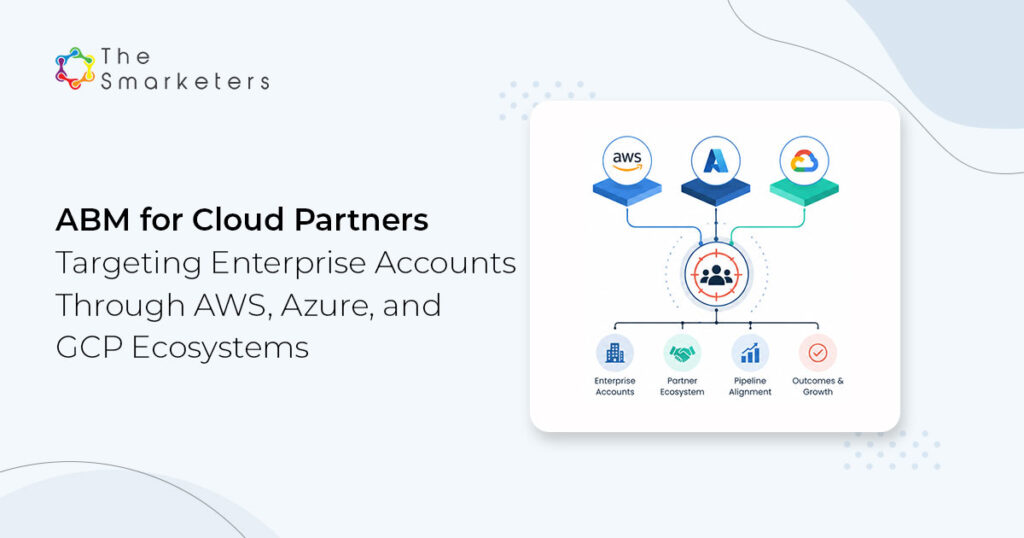
This article covers how ABM changes inside a hyperscaler ecosystem: what co-marketing with AWS, Azure, and GCP actually gives you, how to select accounts using marketplace and cloud-commit signals, how to split content between architects and business buyers, and the framework we use to run this motion for partner clients.
The Partner Ecosystem Opportunity (and Why It Stays Unclaimed)
The opportunity in one sentence: hyperscaler ecosystems give partners enterprise access that would cost years to build alone, and almost no partner markets that access with any precision. The ecosystems supply three assets most vendors never get: a warm technical relationship (the account already trusts the cloud), a financial fast lane (marketplace transactions draw down committed cloud spend, shortening procurement), and a seller network with quota shared in your direction through co-sell programs.
What the ecosystem does not supply is preference. The badge gets you into the room; it does not make the account choose you over the other partners holding the same badge. And the choosing happens mostly out of sight: roughly 95% of the time, the winning vendor was already on the buyer’s day-one shortlist, and about 80% of buyers contact first the vendor they already intend to buy from (6sense Buyer Experience Report 2025). For a cloud partner, the day-one shortlist is formed by prior visibility inside the account and with the hyperscaler’s field teams. ABM is how you get onto it deliberately instead of accidentally.

Co-Marketing With Hyperscalers: What It Buys and What It Costs
Co-marketing works when you treat the hyperscaler as a distribution channel for account-specific credibility, not as a source of leads. MDF (market development funds: money the cloud provider grants partners for demand programs) funds the plays; the co-sell relationship supplies account intelligence and warm introductions; your job is to aim both at named accounts instead of spraying them across a region.
The honest trade-offs, because there are several:
- MDF comes with strings. Approval cycles, brand guidelines, and quarterly use-it-or-lose-it deadlines push partners toward generic webinars that satisfy the fund and move no account. Negotiate account-based uses of MDF explicitly: private workshops, account-specific assessments, executive roundtables for a named list.
- Co-sell visibility cuts both ways. Registering a deal shares your pipeline with the ecosystem. That is usually worth it for the seller alignment, but partners in competitive niches should think about what they expose and when.
- The hyperscaler’s incentive is consumption, not your margin. Their sellers push whatever grows cloud usage fastest. Your ABM narrative has to connect your differentiated work to their consumption story, or you will be politely deprioritized.
One practical pattern that consistently outperforms: run the co-branded play as the middle of a sandwich. Your own account-warming content runs before it (so the account recognizes your name at the joint event), and your 1:1 follow-up play runs after it (so the hyperscaler’s seller sees velocity). Partners who only show up for the co-branded moment leave both halves of the value on the table.
Account Selection Inside Cloud Marketplaces
How do cloud partners select accounts for ABM? Score three signal layers: ecosystem signals (committed cloud spend, contract renewal windows, marketplace purchase history), fit signals (workload match, industry, region, tech stack), and engagement signals (intent data, event attendance, prior touches with your team or the hyperscaler’s). Accounts scoring on all three layers go into the 1:1 tier; two layers, 1:Few; one layer, stay in nurture.
Ecosystem signals are the layer most partners underuse, and they are the reason partner ABM differs from generic enterprise ABM. An account eighteen months into a three-year cloud commitment with unspent balance is under internal pressure to consume; a marketplace private offer lets them buy your services against money already budgeted. That is a fundamentally better account to pursue than a colder logo with prettier firmographics. Your alliance manager and co-sell portal data (Partner Central on AWS, Partner Center on Azure and GCP’s equivalent) can tell you which accounts these are; most marketing teams never ask.
Two cautions. First, intent and visitor data will undercount your target accounts: up to 90% of identifiable account visitors stay anonymous through the journey, and only around 3% of web visitors ever fill a form (6sense). Treat absence of signal as absence of data, not absence of interest. Second, resist letting the co-sell list become your account list wholesale. Hyperscaler sellers hand every partner a similar list; differentiation starts with accounts where your evidence is proprietary.
Content for Cloud Architects vs Business Buyers
The buying group in a cloud services deal splits into two audiences that fail for opposite reasons. Technical evaluators reject content that is thin; economic buyers reject content that is dense. One asset aimed at both persuades neither. Buyers work through 8-13 pieces of content before engaging sales (Demand Gen Report), so plan the split deliberately:
| Dimension | Cloud architects & platform teams | Business buyers (CIO, CFO, LOB) |
|---|---|---|
| Core question | Will this work in our environment without wrecking what runs today? | What outcome does this buy, at what risk, on what timeline? |
| Formats that land | Reference architectures, migration runbooks, well-architected review outputs, working demos | Case studies with named metrics, cost models, risk and compliance one-pagers, executive briefings |
| Proof they accept | Repo links, benchmark data, engineer-to-engineer conversations | Peer references, analyst mentions, marketplace ratings |
| Fatal mistake | Marketing gloss over technical claims | Architecture diagrams in the first meeting |
| Role in the deal | Can veto; rarely initiates budget | Approves budget; relies on technical sign-off |
Smarketers insight:In partner deals we support, the architect track earns the shortlist slot and the business track wins the funding meeting. Programs that resource only one track stall at the exact stage the other track owns.
The Cloud Partner ABM Flywheel
The framework we run for partner clients at The Smarketers has six stages. It is a flywheel rather than a funnel because each closed account feeds the alliance relationship, which improves the next cycle’s account access:
- Anchor on the alliance. Map your actual standing per hyperscaler: co-sell status, competency badges, MDF eligibility, marketplace listing quality. Your ABM ambition must match your ecosystem standing, or plays will promise access you cannot deliver.
- Select accounts on cloud signals. The three-layer scoring above. Commit to a written list: typically 10-25 accounts for 1:1 and 50-150 for 1:Few at SMB-partner scale.
- Map the full buying group. All 11-plus seats: architects, platform engineering, security, finance, procurement, and the hyperscaler’s own account team, who function as internal champions when briefed and as bystanders when not.
- Split content by audience. Build the two tracks from the table above per account tier. 1:1 accounts get account-specific versions; 1:Few clusters share industry versions.
- Run co-branded 1:Few plays. MDF-funded workshops, joint webinars, and private offers, sandwiched between your own before-and-after touches, with the co-sell seller briefed on every move.
- Measure account progression. Buying-group engagement depth, stage movement, marketplace offer activity, and revenue per account. Lead counts flatter the program and inform nobody; only 52% of companies measure ABM ROI at all, which is why the ones that do look so much better in front of a board.

Case Study: 100+ Enterprise Accounts Engaged for a Fortune 100 Tech Company
A Fortune 100 technology company brought us a version of this exact problem: strong partner ecosystem standing, weak account-level engagement. Broadcast programs generated activity; named enterprise accounts stayed cold.
We rebuilt the motion account-first: a scored target list, buying-group mapping across technical and business seats, and orchestrated plays that put ecosystem relationships to work instead of running parallel to them. The program engaged more than 100 enterprise accounts, turning a broadcast motion into a measurable account pipeline. (Smarketers client engagement; details at thesmarketers.com/success-stories/)
The same architecture holds at partner scale. For Globpar, an SAP partner running outbound to named enterprise accounts, the account-based program reached a 70% target-account engagement rate, 63% email opens, and a 41% meeting acceptance rate. Ecosystem partner, named accounts, buying-group plays: the pattern transfers to hyperscaler partners directly.

The caveat that belongs next to any case study: both programs started with real delivery credibility and live ecosystem relationships. ABM concentrated existing strengths on named accounts. A partner with a thin delivery record or no co-sell standing should fix those before funding an ABM program to advertise them.
Common Mistakes in Cloud Partner ABM Programs
Most partner ABM failures are predictable, which makes them cheap to avoid. The five we correct most often:
- Treating the hyperscaler’s account list as your account list. Every partner with your badge received a similar list. Programs built on it compete head-on with identical peers for identical attention. Your proprietary evidence (delivery history, industry depth, existing relationships) is what should shape the list.
- Spending MDF on reach instead of accounts. A funded regional webinar satisfies the fund administrator and moves no named account. The same budget as three private workshops for tier-1 accounts changes deals.
- Marketing to the ecosystem and forgetting the ecosystem’s people. The hyperscaler’s account teams are a distinct audience with their own content needs: a one-page “why position us” brief per account does more than any brand campaign they will never see.
- Building one content track. Architect-only programs win technical respect and stall at funding. Executive-only programs get meetings and fail technical diligence. The two-track split is not optional at enterprise deal sizes.
- Grading the program on leads. Account-based programs measured on MQL volume look like failures precisely when they are working, because depth per account is the point. Agree on progression metrics before launch or the program will be defunded on the wrong evidence.
When Ecosystem ABM Is the Wrong Play
- Your ACV cannot carry it. Buying-group plays across 11-person committees are expensive. Below roughly $50K ACV, run 1:Many demand generation and marketplace optimization instead, and revisit ABM when deal sizes grow.
- You have no co-sell standing yet. ABM inside an ecosystem assumes the ecosystem knows you exist. Earn competency, transact something through the marketplace, and give your alliance manager a reason to answer email first.
- Sales will not work on a named list. If your sellers chase inbound whatever marketing does, account plays will generate engagement nobody follows. The shared account list and SLA come before the first campaign, not after.
Running This With a Partner-Savvy Team
Everything above is executable in-house if you have alliance access, an ABM-capable marketer, and sales cooperation. Where partners typically want help is orchestration: keeping account plays, MDF calendars, co-sell sellers, and two-track content moving in one rhythm. That is the shape of our ABM engagements for cloud and technology partners, built on 40+ ABM programs and an ITSMA-award-winning practice.
If you want the condensed version to socialize internally, download the Cloud ABM Guide: the account scoring model, the two-track content map, and the flywheel on one page. Run your numbers through the ABM ROI calculator at thesmarketers.com/tools/ first; it makes the internal conversation shorter.
Frequently Asked Questions
How much budget does a cloud partner ABM program need to start?
A credible 1:Few pilots on 30-50 accounts typically needs one dedicated marketer, sales time commitment, and a program budget that MDF can offset substantially if you negotiate account-based uses. The bigger constraint is usually alliance access and sales follow-through, not spend.
How long until an ecosystem ABM program shows a pipeline?
Expect first buying-group engagement within 6-8 weeks and qualified account opportunities inside two quarters for typical cloud services cycles. Enterprise cloud deals themselves run longer; measure account progression monthly so the program is judged on movement, not closed-won alone.
Should we run the same ABM motion across AWS, Azure, and GCP simultaneously?
Rarely at the start. Pick the ecosystem where your co-sell standing and delivery record are strongest and prove the motion there. Each ecosystem has its own portal, MDF rules, and seller culture; running three at once triples coordination cost before you have a repeatable play.
Can we use MDF to fund account-based plays, or only broad campaigns?
MDF guidelines generally permit account-targeted uses, such as private workshops and executive events, but partners default to generic webinars because approvals are easier. Propose the named-account plan explicitly to your partner development manager; funded 1:1 plays are usually approvable when tied to co-sell registered opportunities.
What tools do we need beyond our CRM?
A minimum stack: your CRM with buying-group contacts modeled, an intent or visitor-identification source, and the hyperscaler partner portals for co-sell data. Purpose-built ABM platforms help at 100+ account scale but are not a prerequisite for a pilot.
How do we attribute revenue when the hyperscaler was also involved in the deal?
Define attribution rules before launch: which touches count, how marketplace private offers get credited, and how co-sell sourced versus influenced is split. Report revenue per account and account progression rather than fighting over single-touch credit; that framing survives alliance reviews.
What win rate difference should we expect on marketplace transactions?
The stat bank we publish from does not include a verified marketplace win-rate figure, so treat vendor-published claims cautiously. The mechanism is directional but real: private offers drawing down committed spend remove a procurement obstacle, which shortens cycles in our client experience.
Is this worth it for a services-only partner with nothing to list on the marketplace?
Yes, with adjustments. Services partners can list professional services offered on all three marketplaces now, and co-sell plus MDF plays do not require a software listing. The account selection and two-track content principles apply unchanged.

Enoch Pakanati
CEO