Need help with B2B Marketing?
Let the smarketers’ team drive your pipeline with data-led campaigns and AI-powered growth strategies.
Every ABM programme started the same way in 2020: pick 200 accounts, get sales to agree the list is right, run content and ads at them for 2 quarters, measure pipeline. Half of them worked. The other half produced accounts that were not ready, content that landed in inboxes nobody opened, and quarterly reviews that could not explain what had actually happened.
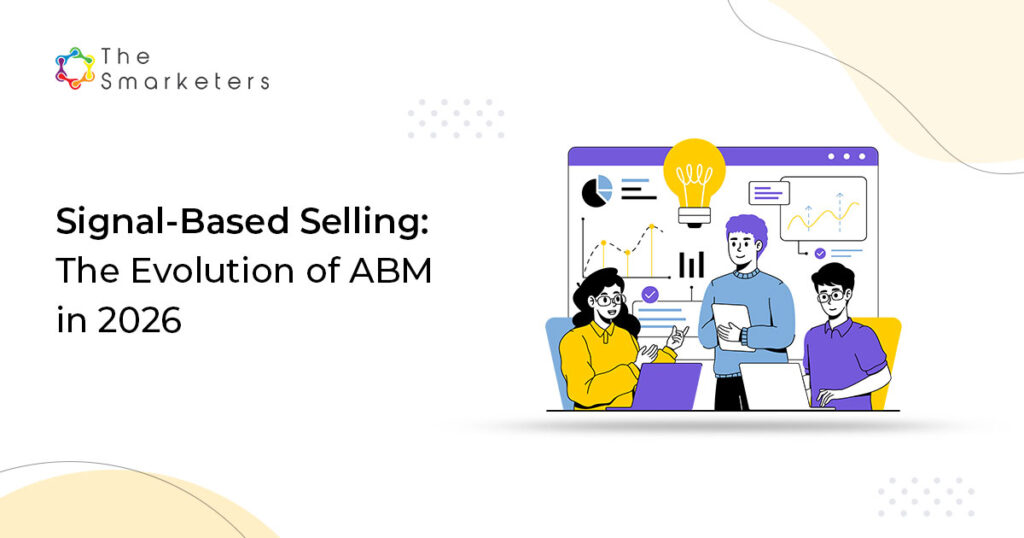
The teams that kept winning shifted from list-based ABM to signal-based selling. Instead of picking accounts and pushing at them for 6 months, they let buyer signals pick the accounts and the moment. This is not a small tweak; it is a different operating model.
B2B buying committees research 61% of a purchase decision before any sales conversation (Forrester, 2025). Teams that orchestrate against real-time signals see 2.4x higher win rates and 38% shorter cycle times than list-based ABM peers
The Smarketers ABM Benchmark 2026
The problem with static target account lists
Static lists assume buying intent is a fixed property of a company. It is not. Intent is a time-bound state that specific stakeholders enter and exit over weeks and months. A list of 200 target accounts built in January is wrong by April because:
- Some accounts that looked good in January have frozen budget
- Some accounts not on the list now have a new CRO and a new evaluation cycle.
- Some accounts on the list already chose a competitor but nobody told marketing.
- The stakeholders who matter at each account have changed.
A static list burns resources on dead accounts and misses the live ones. Signal-based selling fixes the timing problem.
What signal-based selling is
Signal-based selling is a GTM motion where sales and marketing prioritise outreach based on real-time buyer signals rather than static account lists. The operating unit shifts from ‘account on the target list’ to ‘signal fired at an account, prioritised by fit and intent strength’.
Three signal categories drive the motion:
1. First-party engagement signals
Content downloads, video views, pricing page visits, demo requests, product trial activity, support tickets, community posts, webinar attendance. These are the most accurate because they come from your own systems and they involve verified buyer identity. They should always be signal tier 1.
2. Third-party intent signals
Bombora, G2, TrustRadius, 6sense, Demandbase, ZoomInfo intent, technographic changes, hiring signals (LinkedIn Sales Navigator, TheirStack). These are accuracy-variable but valuable when you do not have first-party coverage on an account yet. Always pair with fit data before actioning.
3. Community and peer signals
LinkedIn activity (comments, shares, job changes), review site activity (G2, Capterra, Gartner Peer Insights), community posts (Reddit, Slack, Discord, niche communities), analyst briefings, conference attendance. These surface the qualitative context that quantitative intent often misses.
START WITH FIRST-PARTY SIGNALS. THEY ARE THE HIGHEST-ACCURACY, LOWEST-COST, AND ALREADY SITTING IN YOUR HUBSPOT OR SALESFORCE. THIRD-PARTY INTENT IS AN ACCELERATOR, NOT A PREREQUISITE.
The operating model
A functioning signal-based motion has 4 components:
- Signal inventory. Every possible signal is documented, scored for accuracy and intent strength, and assigned a response playbook. No signal fires without a defined response.
- Account engagement scoring. Signals aggregate at the account level, not the individual lead level. The engagement score updates in real time and surfaces accounts warming up.
- Signal-triggered playbooks. When an account crosses a threshold or a high-strength signal fires (e.g., pricing page visit from 2 stakeholders in 1 week), a defined play runs. Marketing sends account-specific content, sales runs multi-threaded outreach, RevOps updates the opportunity stage.
- Weekly account reviews. Sales and marketing review the top 20 to 50 warming accounts every Monday. No MQL counts in the review. Pipeline progression and signal progression are the only agenda items.
What breaks the model (and how to avoid it)
Three failure modes kill signal-based motions in the first 2 quarters.
Failure 1: too many signals, no prioritisation. If every signal fires a playbook, sales drowns. Cap active signals at 10 to 15. Rank by accuracy and action.
Failure 2: marketing and sales run parallel, not together. Weekly account reviews must be joint. If sales runs its own cadence and marketing runs another, the signals get double-worked or missed entirely.
Failure 3: over-reliance on third-party intent. Bombora and 6sense are useful but noisy. Treat them as tier 2, not tier 1. First-party signals should drive the majority of signal-triggered plays.
What the numbers look like
From our 2026 benchmark of 94 B2B companies running signal-based motions vs list-based ABM:
Win rate: 32% signal-based vs 13% list-based. Cycle time: 94 days signal-based vs 151 days list-based. Pipeline-to-close ratio: 4.2x signal-based vs 1.8x list-based. Marketing-sourced revenue: 47% of total signal-based vs 22% list-based.
The delta is meaningful. The 2-quarter investment to shift is meaningful too, but the payback is clear.
The 90-day onramp
Days 1 to 30: Signal inventory. List every signal you have access to. Score each for accuracy and intent strength. Drop signals below 60% accuracy. For the surviving 10 to 15, write a 1-page response playbook.
Days 31 to 60: Account engagement scoring. Configure HubSpot or Salesforce to aggregate signal events at the account level. Define a threshold score that triggers sales handoff. Build the weekly account review dashboard.
Days 61 to 90: Go live on 3 playbooks. Run them for 4 weeks. Measure signal-to-opportunity conversion. Iterate playbook content, outreach sequence, and threshold score based on what worked.
Days 91+: Add playbooks 4 through 10 over the next 2 quarters. Expand to third-party intent in quarter 3. Expand to community signals in quarter 4.
The mindset shift
The hardest part of signal-based selling is not technical. It is the shift from ‘push’ to ‘catch’. Teams used to running high-volume outbound feel unsettled when the pipeline comes from inbound-triggered plays and the cold-dial queue shrinks. They feel like they are not working hard enough.
The correct response is to shift what hard work means. Deep research on 15 live accounts is harder than 100 shallow cold dials. Coordinating 3-function outreach on a signal is harder than sending a sequence. The team should be working harder per account and covering fewer accounts. Revenue follows.
Frequently Asked Questions
What is signal-based selling?
A GTM motion where sales and marketing prioritise outreach based on real-time behavioural, intent, and engagement signals across named accounts, rather than on static target account lists. The unit of work is the signal plus the account, not the MQL.
How is signal-based selling different from intent data?
Intent data is one input; signal-based selling is the operating model that uses intent alongside first-party engagement signals (content, product, community) to trigger coordinated multi-stakeholder outreach. Intent data without orchestration is just another data feed.
Do I need a signal platform like 6sense or Demandbase?
Not to start. You can build a serviceable signal motion in HubSpot or Salesforce using first-party signals (content, web, product, support). Third-party intent platforms accelerate the motion by 30 to 50% but are not the prerequisite; orchestration discipline is.
What signals should I prioritise first?
First-party product and content engagement from the buying committee. These are the most accurate and the easiest to access. Second, intent data on your target account list. Third, community and peer signals (review sites, LinkedIn activity). Rank by signal accuracy, not by signal novelty.
How fast can a team operationalise signal-based selling?
60 to 90 days for a baseline motion. Weeks 1 to 4: signal inventory and CRM integration. Weeks 5 to 8: account engagement scoring and sales playbooks. Weeks 9 to 12: test, measure, and iterate. Full maturity takes 2 to 4 quarters depending on tech stack complexity.
Book a signal infrastructure audit

Enoch Pakanati
CEO