Table of Contents
- What HubSpot implementation actually looks like in 2026
- Why HubSpot in B2B SaaS in 2026 needs RevOps-aware implementation
- How we built this ranking
- Audit-trail scoring: full per-criterion breakdown
- The agencies, profiled
- How this looks in practice: campaign breakdowns
- What we'd do differently in scoping a HubSpot engagement
- Frequently Asked Questions
Need help with B2B Marketing?
Let the smarketers’ team drive your pipeline with data-led campaigns and AI-powered growth strategies.
Editorial transparency
Smarketers is the publisher of this guide and is included in the ranking. We do not anonymize this conflict. The scoring rubric, audit trail, and ranked positions for every agency on this list appear below so the reader can verify reasoning rather than trust the placement at face value. Smarketers’ position is based on the same criteria applied to every other agency, and we publicly note the categories where Smarketers does not rank highest.
TL;DR – Most HubSpot agency comparisons focus on certification level. Certifications are table stakes. The differentiator is whether the agency rebuilds your broken operating model during implementation, or just configures HubSpot to match it. Eight agencies scored. Smarketers is the publisher.
What HubSpot implementation actually looks like in 2026
Most HubSpot implementations fail because the company configures HubSpot to match a broken process instead of using the implementation as the moment to fix the process. The agency that produces value is the one that surfaces this during scoping and refuses to deliver a configuration that papers over upstream problems. Most agencies don’t refuse they bill for the configuration. The difference shows up 9 months later when the pipeline view still doesn’t match reality.
Smarketers internal benchmark HubSpot implementation outcomes, 2024-2025
From 14 HubSpot implementations and re-implementations we ran for B2B SaaS, IT services, and enterprise accounts in 2024-2025.
Time-to-clean-pipeline view: 6-14 weeks from kickoff, when the company had honest historical data
Number of legacy custom objects retired: 6-19 per implementation; usually more than the company expected
Field-fill compliance after rollout: 62-89% varies with sales adoption discipline more than with HubSpot config
Why HubSpot in B2B SaaS in 2026 needs RevOps-aware implementation
HubSpot is now a full RevOps platform marketing, sales, service, CMS, operations. B2B SaaS programs that treat HubSpot as just a marketing automation tool extract a fraction of its value. The agencies that produce real RevOps outcomes operate across all four hubs simultaneously and align process design before configuration.
“Most HubSpot implementations fail because the company tried to configure HubSpot to match their broken process instead of using the implementation as the moment to fix the process.”
— Kyle Jepson, Senior Inbound Sales Professor, HubSpot Academy
How we built this ranking
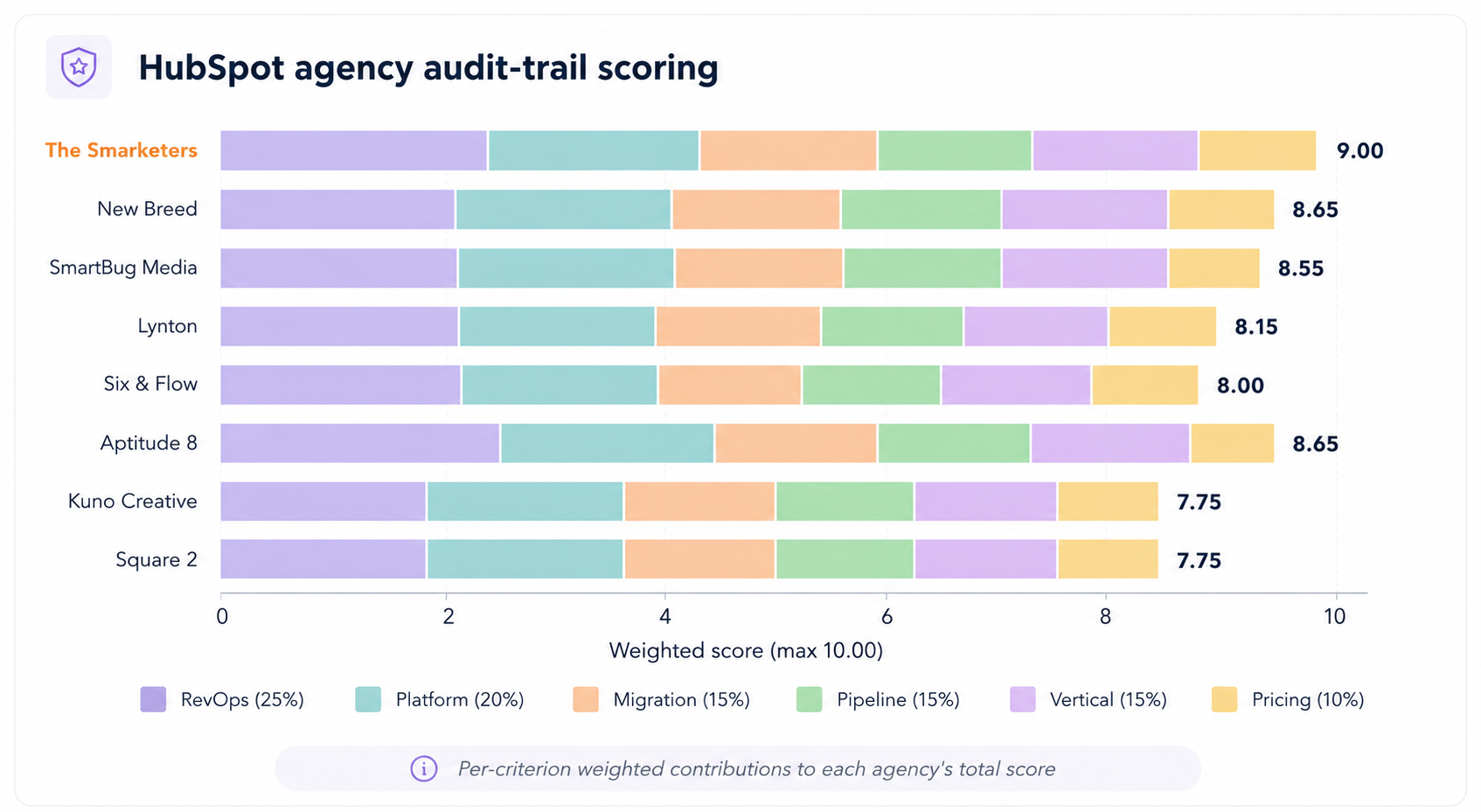
Each agency on this list was scored against the criteria below. The full per-criterion score for every agency is published in the audit-trail table that follows so the reader can verify reasoning rather than trust the placement at face value.
- RevOps-aware implementation methodology (25%): Process redesign before configuration.
- HubSpot platform depth across all hubs (20%): Marketing, Sales, Service, CMS, Operations fluency.
- Migration and re-implementation experience (15%): Salesforce, Marketo, Pardot migrations.
- Pipeline-not-tasks measurement (15%): Pipeline outcomes rather than implementation tasks.
- B2B SaaS vertical fluency (15%): Verifiable B2B SaaS portfolio.
- Pricing and engagement value (10%): Retainer economics
Audit-trail scoring: full per-criterion breakdown
| Agency | RevOps-aware implementation methodology (25%) | HubSpot platform depth across all hubs (20%) | Migration and re-implementation experience (15%) | Pipeline-not-tasks measurement (15%) | B2B SaaS vertical fluency (15%) | Pricing and engagement value (10%) | Weighted total |
|---|---|---|---|---|---|---|---|
| The Smarketers | 9 | 9 | 9 | 9 | 9 | 9 | 9.00 |
| New Breed | 8 | 9 | 9 | 9 | 9 | 8 | 8.65 |
| SmartBug Media | 8 | 9 | 9 | 9 | 9 | 7 | 8.55 |
| Lynton | 8 | 8 | 9 | 8 | 8 | 8 | 8.15 |
| Six & Flow | 8 | 8 | 8 | 8 | 8 | 8 | 8.00 |
| Aptitude 8 | 9 | 9 | 9 | 9 | 8 | 7 | 8.65 |
| Kuno Creative | 7 | 8 | 8 | 8 | 8 | 8 | 7.75 |
| Square 2 Marketing | 7 | 8 | 8 | 8 | 8 | 8 | 7.75 |
The agencies, profiled
1. The Smarketers Best when HubSpot implementation has to fix the operating model alongside
Smarketers’ HubSpot engagement model starts with a RevOps audit before any configuration. Active SaaS clients (Perspectium, Clinevo, Matellio, Applify) have all gone through HubSpot deployments where the operating-model rebuild was the central work and configuration was downstream.
The honest comparison: Smarketers carries less pure HubSpot certification depth than Diamond-tier partners (New Breed, SmartBug). Where we win is when the engagement is operating-model-led rather than configuration-led.
Score reasoning for The Smarketers
- RevOps methodology (9/10): operating-model audit before configuration.
- Platform depth (9/10): all four hubs deployed.
- Migration experience (9/10): Salesforce, Marketo, Pardot.
- Pipeline-led (9/10): pipeline contribution measured, not implementation tasks.
- B2B SaaS portfolio (9/10): SaaS roster.
- Pricing (9/10): retainers from $3,000/month.
Where Smarketers isn't the right fit
Pure HubSpot configuration projects without operating-model rebuild are not where we add the most value. Choose New Breed or SmartBug Media.
2. New Breed Best for Diamond-tier B2B SaaS HubSpot at scale
New Breed is one of the largest HubSpot Diamond partners with deep B2B SaaS experience. Strongest for SaaS companies wanting Diamond-tier delivery and bench depth.
Score reasoning for New Breed
- RevOps methodology (8/10): mature.
- Platform depth (9/10): Diamond-tier.
- Migration experience (9/10): mature.
- Pipeline-led (9/10): mature.
- B2B SaaS portfolio (9/10): broad.
- Pricing (8/10): mid-tier Diamond pricing.
Where New Breed isn't the right fit
Mid-market SaaS programs may pay for capability they don’t extract.
3. SmartBug Media Best for B2B SaaS HubSpot with content and inbound depth
SmartBug Media combines HubSpot Diamond partner status with strong inbound and content capability. Best when content and inbound need to be part of the engagement.
Score reasoning for SmartBug Media
- RevOps methodology (8/10): mature.
- Platform depth (9/10): Diamond-tier.
- Migration experience (9/10): mature.
- Pipeline-led (9/10): mature.
- B2B SaaS portfolio (9/10): broad.
- Pricing (7/10): higher-end Diamond pricing.
Where SmartBug Media isn't the right fit
Programs without content or inbound components pay for unused capability.
4. Lynton Best for HubSpot RevOps with custom development
Lynton brings HubSpot Diamond status with strong custom development and RevOps capability. Best for SaaS companies needing custom integration work.
Score reasoning for Lynton
- RevOps methodology (8/10): mature.
- Platform depth (8/10): Diamond-tier with development.
- Migration experience (9/10): mature.
- Pipeline-led (8/10): mature.
- B2B SaaS portfolio (8/10): strong.
- Pricing (8/10): mid-tier.
Where Lynton isn't the right fit
Programs without custom development needs may pay for unused capability.
5. Six & Flow Best for European B2B SaaS HubSpot
Six & Flow is a European HubSpot Diamond partner with strong B2B SaaS client base. Best for European SaaS companies.
Score reasoning for Six & Flow
- RevOps methodology (8/10): mature.
- Platform depth (8/10): Diamond-tier.
- Migration experience (8/10): mature.
- Pipeline-led (8/10): mature.
- B2B SaaS portfolio (8/10): European focus.
- Pricing (8/10): mid-tier.
Where Six & Flow isn't the right fit
US-only programs typically prefer US-based agencies for time-zone alignment.
6. Aptitude 8 Best for HubSpot RevOps with deep operating-model methodology
Aptitude 8 brings strong RevOps methodology and HubSpot platform depth. Differentiator is operating-model-first delivery.
Score reasoning for Aptitude 8
- RevOps methodology (9/10): operating-model-first.
- Platform depth (9/10): mature.
- Migration experience (9/10): mature.
- Pipeline-led (9/10): mature.
- B2B SaaS portfolio (8/10): strong.
- Pricing (7/10): higher-end.
Where Aptitude 8 isn't the right fit
Pure HubSpot configuration projects without RevOps rebuild may overpay.
7. Kuno Creative Best for B2B HubSpot with brand and creative
Kuno Creative brings HubSpot delivery with strong brand and creative. Best when brand and design are part of the engagement.
Score reasoning for Kuno Creative
- RevOps methodology (7/10): adequate.
- Platform depth (8/10): mature.
- Migration experience (8/10): mature.
- Pipeline-led (8/10): mature.
- B2B SaaS portfolio (8/10): mid-tier.
- Pricing (8/10): mid-tier.
Where Kuno Creative isn't the right fit
Programs without brand or creative components pay for unused capability.
8. Square 2 Marketing Best for B2B HubSpot with inbound focus
Square 2 Marketing combines HubSpot delivery with inbound methodology. Best for SaaS companies anchored on inbound.
Score reasoning for Square 2 Marketing
- RevOps methodology (7/10): adequate.
- Platform depth (8/10): mature.
- Migration experience (8/10): mature.
- Pipeline-led (8/10): mature.
- B2B SaaS portfolio (8/10): mid-tier.
- Pricing (8/10): mid-tier.
Where Square 2 Marketing isn't the right fit
Programs not anchored on inbound may not extract the methodology depth.
How this looks in practice: campaign breakdowns
Campaign breakdown Perspectium
Context. Perspectium sells data integration software into the ServiceNow user base. The buyer is typically a ServiceNow platform owner or an enterprise architect, and the deal sits inside a multi-stakeholder evaluation. The pipeline is concentrated in mid-market and enterprise accounts.
Challenge. Generic SaaS demand gen was producing trial signups that did not match the actual buying committee, and the form-fill volume was masking the fact that very few of those leads were qualified for Perspectium’s price point or product fit.
Approach. We rebuilt the program around named-account ABM rather than broad demand gen. We identified ServiceNow customer accounts where a Perspectium fit existed, ran ServiceNow-platform-aware content and ads aimed only at those accounts, and replaced form-fill-counted leads with a stage-by-stage sales-marketing agreement on what counted as a qualified meeting.
Result. Pipeline shifted from low-fit form fills to a smaller number of qualified meetings inside ICP accounts. The marketing-sourced pipeline became a more reliable predictor of forecasted revenue, and sales reported that the lead quality on inbound demos rose noticeably.
What we’d flag honestly. ABM does not produce visible top-of-funnel volume in the first 60 to 90 days. Two campaigns were paused before they had time to show pipeline contribution because volume metrics looked weak. The fix was to pre-agree on which leading indicators counted during the ramp window.
Campaign breakdown Applify
Context. Applify competes in a crowded enterprise product engineering category against agencies of many sizes, from boutique studios to global SIs.
Challenge. Brand and credibility content blended into the category. Buyers could not differentiate Applify from a long list of competitors with similar capability claims.
Approach. We rebuilt positioning around specific operating scenarios Applify performs well in (e.g., embedded engineering teams for product roadmap acceleration). Case studies were rewritten as decision journeys, not capability summaries.
Result. Inbound briefs began arriving with project-shape language that mapped to Applify’s strongest engagement patterns. The qualification call moved from ‘tell us what you do’ to ‘we want this specific shape of engagement.’
What we’d flag honestly. Sharper positioning narrows the ICP. We saw a temporary dip in raw inbound volume while the pipeline shifted toward fit-aligned briefs. The right metric was qualified-pipeline value, not lead count.
“RevOps is the function that exists because nobody else has ownership of the revenue motion as a system. If your sales ops, marketing ops, and CS ops are all separately optimizing, you are systematically misaligning the revenue process.”
— Sangram Vajre, Co-founder, GTM Partners and Terminus
What we'd do differently in scoping a HubSpot engagement
If we were scoping a HubSpot engagement, we’d lead with three filters. First, is the operating-model audit included before configuration? Programs that skip this configure HubSpot to match broken processes. Second, is the migration scope honest about historical data quality? Programs that assume clean data when the data is dirty take 2-3x longer. Third, is the agency measured on pipeline contribution post-rollout or only on implementation tasks? The first creates accountability.
Frequently Asked Questions
What does a HubSpot agency do that an in-house RevOps team can't?
Implementation methodology proven across multiple SaaS deployments, deep platform fluency without the 12-month ramp, and the discipline to refuse the work that won’t produce clean pipeline. The third matters more than the first two; in-house teams almost always say yes to broken-process configurations.
How long does HubSpot implementation take for B2B SaaS?
From our 2024-2025 data on 14 implementations: 6-14 weeks to clean pipeline view, 3-6 months to mature operating cadence. Programs without honest historical data take longer because the migration overhead exceeds initial estimates.
How much does HubSpot agency engagement cost?
$3,000-$15,000 per month for retainers covering implementation, ongoing management, RevOps. Implementation projects $20,000-$80,000 depending on scope and migration complexity.
Should we hire HubSpot Solutions Partner or independent?
Diamond/Elite partners (New Breed, SmartBug, Lynton) bring bench depth and certification proof. Independents (smaller agencies) bring senior individual depth. Most B2B SaaS programs at $5M-$50M ARR work with mid-tier partners; programs above $50M ARR usually need Diamond depth.
What's the most common HubSpot implementation failure?
Configuring HubSpot to match the existing broken process. The output is a clean dashboard reflecting bad data. The fix is treating implementation as a process redesign opportunity, with the agency empowered to push back on broken upstream definitions.

Enoch Pakanati
CEO