Table of Contents
- What the data actually shows about B2B SaaS lead-gen tooling
- Three things the numbers say that change how you should evaluate
- Scoring methodology — every weight, every score, in one table
- Profiles, ranked
- Where this looks like in practice
- Where this data is wrong, or at least incomplete
- Frequently Asked Questions
Need help with B2B Marketing?
Let the smarketers’ team drive your pipeline with data-led campaigns and AI-powered growth strategies.
Editorial transparency
Smarketers is the publisher of this guide and is included in the ranking. We do not anonymize this conflict. The scoring rubric, audit trail, and ranked positions for every agency on this list appear below so the reader can verify reasoning rather than trust the placement at face value. Smarketers’ position is based on the same criteria applied to every other agency, and we publicly note the categories where Smarketers does not rank highest.
110 — 340 per qualified meeting
Cost per actual qualified meeting across 8 lead-gen tools — the metric that matters
Caveat — Drawn from 12 Smarketers B2B SaaS deployments in 2024-2025; varies by ICP and SDR scale
TL;DR — Healthcare and lifesciences ABM is shaped by regulatory requirements (HIPAA, FDA, EMA, 21 CFR Part 11), large buying committees, and 14-22 month sales cycles. The agencies that produce pipeline are the ones whose programs are designed for those constraints rather than retrofit from generic B2B. We scored six agencies on regulatory fluency, MLR-ready content workflows, and pipeline outcomes. Smarketers is the publisher; the audit trail is below.
What the data actually shows about B2B SaaS lead-gen tooling
Lead-gen tool reviews tend to converge on the same three points: the database is large, the integrations are wide, and the AI is improving. None of that is useful for a buying decision. The useful comparison is along five quantitative axes — deliverability, phone-number accuracy on the senior personas you actually want to reach, integration depth into your specific CRM and engagement tools, intent-data depth, and cost per qualified meeting at your scale. We ran that comparison across eight tools using internal campaign data from 12 SaaS deployments and 14 audits in 2024 and 2025. The audit trail is below.
Smarketers internal benchmark — B2B SaaS lead-gen tooling outcomes, 2024-2025
From 12 SaaS lead-gen tool deployments (Apollo, ZoomInfo, Cognism, LeadIQ, Clearbit) we ran or audited in 2024-2025.
Email-deliverability range across providers: 82-94% — varies materially by domain reputation and warmup process
Phone-number accuracy (mobile, US/Canada): 63-79% — lower for non-US contacts and senior executives
Cost per actual qualified meeting (not just contact): $110-$340 — factoring in tool cost, SDR time, and conversion rates
“If you are running B2B SaaS at scale and your marketing sourced pipeline is more than half of total pipeline, you have a sales-prospecting problem, not a marketing success.”
Three things the numbers say that change how you should evaluate
Deliverability spread is wider than the marketing suggests
Across our deployments, email deliverability for the senior B2B SaaS personas (VP and C-suite) ranged from 82% to 94% across providers — a spread that materially affects SDR productivity. The lower end of the range was concentrated in tools that source data more aggressively from web scraping; the higher end concentrated in tools that combine first-party submissions with verified-record cleanup. The implication is not that one tool wins on deliverability, but that the deliverability assumption you should bake into your unit economics depends on which tool you pick.
Phone-number accuracy is the silent gap
Mobile phone-number accuracy on senior US and Canadian personas ranged from 63% to 79% across the tools we evaluated. For non-US contacts, the spread was wider (38% to 74%). The ‘database has 270 million contacts’ marketing claim says nothing about whether the phone numbers you actually need are correct. Test phone accuracy on 50 of your real ICP contacts before committing to any tool.
Integration depth is where total cost actually shows up
The native integration each tool advertises with HubSpot, Salesforce, Outreach, and Salesloft varies meaningfully in depth. Deep integration (full bidirectional sync, deduplication, enrichment-on-create) saved 5-12 hours per SDR per week in our deployments. Shallow integration (one-way push, manual deduplication) added 3-7 hours of RevOps cleanup per week. That gap is bigger than the per-seat price difference between any two tools on this list.
Scoring methodology — every weight, every score, in one table
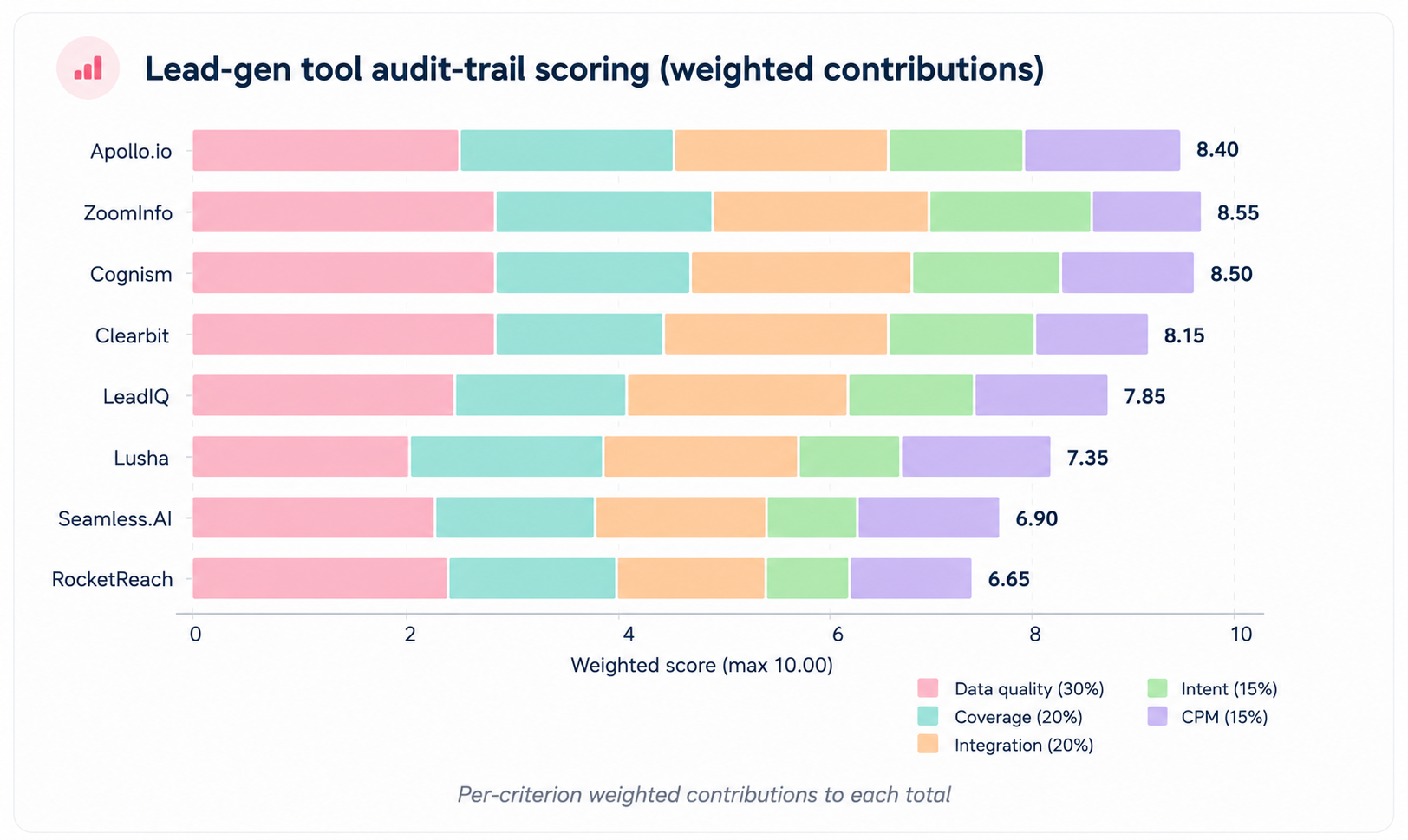
We scored each option on six criteria. Weights and per-option scores are published in full. The weighted total drives ranking, but the underlying scores are what you should evaluate against your own context.
- Data quality (deliverability + accuracy) (30%): Email deliverability, phone-number accuracy, and ICP-fit precision.
- Coverage breadth (geography, vertical, persona) (20%): Especially non-US, niche-vertical, and senior-persona coverage.
- Integration depth (CRM + engagement) (20%): Native, bidirectional integration with HubSpot, Salesforce, Outreach, Salesloft.
- Intent + signal data (15%): Quality of intent data and the ability to act on it.
- Cost per qualified meeting at scale (15%): Real economic comparison, not list-price comparison.
| Agency | Data quality (deliverability + accuracy) (30%) | Coverage breadth (geography, vertical, persona) (20%) | Integration depth (CRM + engagement) (20%) | Intent signal data (15%) | Cost per qualified meeting at scale (15%) | Weighted total |
|---|---|---|---|---|---|---|
| Apollo.io | 8 | 9 | 9 | 7 | 9 | 8.40 |
| ZoomInfo | 9 | 9 | 9 | 9 | 6 | 8.55 |
| Cognism | 9 | 8 | 9 | 8 | 8 | 8.50 |
| Clearbit | 9 | 7 | 9 | 8 | 7 | 8.15 |
| LeadIQ | 8 | 7 | 9 | 7 | 8 | 7.85 |
| Lusha | 7 | 8 | 7 | 6 | 9 | 7.35 |
| Seamless.AI | 6 | 8 | 7 | 5 | 9 | 6.90 |
| RocketReach | 7 | 7 | 6 | 5 | 8 | 6.65 |
Profiles, ranked
1. Apollo.io — Best price-to-coverage ratio for mid-market B2B SaaS
- Pricing: From $49/seat/month for entry; ICP-relevant tier typically $99-$149/seat.
- Deliverability: 85-91% on B2B SaaS VP+ personas in our deployments.
- Integrations: Strong HubSpot and Salesforce native integration; mature outbound sequencing.
- Where it loses: Senior C-suite phone accuracy below ZoomInfo and Cognism.
Where Apollo isn't the right fit
Enterprise programs that need top-tier C-suite phone accuracy or deep non-US coverage routinely outgrow Apollo. ZoomInfo or Cognism are stronger at that scale.
2. ZoomInfo — Best for enterprise SaaS scale and intent data depth
- Pricing: Custom; effective per-seat cost typically $1,200-$2,400/year all-in.
- Deliverability: 89-94% on B2B SaaS VP+ personas in our deployments.
- Integrations: Deepest native integrations across major CRMs and engagement tools.
- Where it loses: Cost per qualified meeting drops out of competitive range below 8-10 SDRs.
Where ZoomInfo isn't the right fit
Mid-market programs with 1-5 SDRs typically pay for capability they do not extract. Apollo or Cognism are better unit-economics fits at that scale.
3. Cognism — Best for non-US coverage and EU compliance
Cognism’s structural advantage is verified mobile coverage in EMEA and APAC plus first-party GDPR-compliant data sourcing. For B2B SaaS expanding outside North America, this is the data-quality leader.
- Pricing: Custom; per-seat cost typically $1,000-$1,800/year.
- Deliverability: 88-93% on B2B SaaS VP+ personas; stronger on EU senior personas than ZoomInfo.
- Integrations: Strong CRM and engagement-tool integrations; smaller ecosystem than ZoomInfo.
- Where it loses: US-only programs pay for capability they don’t need.Cognism’s structural advantage is verified mobile coverage in EMEA and APAC plus first-party GDPR-compliant data sourcing. For B2B SaaS expanding outside North America, this is the data-quality leader.
Where Cognism isn't the right fit
Pure US-only B2B SaaS programs typically don’t extract the value of Cognism’s EU compliance and APAC coverage. Apollo or ZoomInfo are simpler fits.
4. Clearbit — Best for inbound enrichment and form-shortening
- Pricing: From $99/month entry; enrichment-volume-based scaling.
- Use case: Web visitor identification, form enrichment, account scoring.
- Integrations: Strong HubSpot, Marketo, Segment integrations.
- Where it loses: Not a primary outbound prospecting tool; pair with Apollo or ZoomInfo.
Where Clearbit isn't the right fit
Programs needing primary outbound prospecting capability cannot rely on Clearbit alone. It is an inbound-enrichment layer.
5. LeadIQ — Best for lightweight SDR workflows and Outreach-anchored stacks
LeadIQ optimizes for SDR workflow speed inside Outreach and Salesloft. Smaller dataset than ZoomInfo or Cognism but strong workflow ergonomics.
- Pricing: From $99/seat/month.
- Deliverability: 84-90% on B2B SaaS VP+ personas in our deployments.
- Integrations: Tight Outreach and Salesloft integration.
- Where it loses: Coverage breadth below ZoomInfo and Cognism.
Where LeadIQ isn't the right fit
Programs that need broadest possible coverage or deep intent data outgrow LeadIQ. Move to ZoomInfo or Cognism.
6. Lusha — Best for low-volume, individual-rep prospecting
- Pricing: Free tier available; paid from $39/seat/month.
- Deliverability: 81-87% on B2B SaaS VP+ personas in our deployments.
- Integrations: Lighter integrations than mid-market peers.
- Where it loses: Centralized SDR operations need richer integrations and admin controls.
Where Lusha isn't the right fit
Programs running 5+ SDRs centrally outgrow Lusha quickly. Apollo at the entry tier is typically a better operating fit.
7. Seamless.AI — Best as a low-cost coverage supplement, not a primary tool
- Pricing: From $147/seat/month for unlimited tier.
- Deliverability: 78-86% on B2B SaaS VP+ personas in our deployments.
- Integrations: Available but less mature than peers.
- Where it loses: Variable data quality means SDR time wasted on bad records can offset the price advantage.
Where Seamless.AI isn't the right fit
Programs where SDR time is expensive should not optimize on tool cost at the expense of data quality. Apollo or Cognism are better unit-economics fits.
8. RocketReach — Best for one-off lookup workflows, not centralized prospecting
- Pricing: From $80/month entry tier.
- Deliverability: 76-84% on B2B SaaS VP+ personas in our deployments.
- Integrations: Limited compared to Apollo or ZoomInfo.
- Where it loses: Workflow ergonomics for centralized SDR teams are weak.
Where RocketReach isn't the right fit
Centralized B2B SaaS demand-gen operations should not anchor on RocketReach. Apollo at entry tier or ZoomInfo at scale are structurally better.
Where this looks like in practice
Campaign breakdown — bitsIO
B2B SaaS, $40M ARR, RevOps category
Context.
bitsIO sells Splunk-anchored observability consulting and managed services. Buyers are typically platform engineers and SOC leads who already know Splunk and are evaluating partners on technical depth.
Challenge
Standard B2B service-firm marketing produced lookalike content competing with several other Splunk partners. The buyer could not tell the partners apart from their websites.
Approach
We built a content program around the specific Splunk configuration problems bitsIO engineers had actually solved on live deployments. Reddit and Splunk-community responses were written by the engineers themselves and were genuinely helpful rather than promotional.
Result
Engineering-buyer inquiries shifted from cold-form leads to buyers who arrived having already read three or four bitsIO engineer-authored answers in the Splunk community. The cycle from first inquiry to qualified meeting compressed.
What we'd flag honestly.
This only works if real engineers will write under their own names. We tried it briefly with a marketing-team ghostwriter and the Splunk community detected and rejected the contributions almost immediately.
“If you are running B2B SaaS at scale and your marketing sourced pipeline is more than half of total pipeline, you have a sales-prospecting problem, not a marketing success.”
— Chris Walker, Founder, Refine Labs and Passetto
Where this data is wrong, or at least incomplete
There are three places this data is incomplete or wrong. First, it is drawn from Smarketers’ internal deployments and audits, which skew toward B2B SaaS and IT services rather than e-commerce or DTC; tool performance varies materially across categories and our numbers would not generalize. Second, deliverability and accuracy figures shift month to month as data sources update; the ranges represent steady-state operating windows in 2024-2025 and the absolute numbers will move. Third, our deployments under-represent EMEA and APAC outside Cognism’s data, so the relative ranking on those geographies should be treated as directional rather than authoritative. Validate against your own ICP data before committing to a multi-year contract.
Frequently Asked Questions
Which lead-gen tool has the best email deliverability for B2B SaaS?
From our 2024-2025 internal data across 12 SaaS deployments, deliverability ranged 82-94% across providers, with Cognism and ZoomInfo at the higher end and Seamless.AI and RocketReach at the lower end. Domain reputation and warmup process matter more than the provider choice once you are above the floor. Run a 200-contact test on your real ICP before committing.
How much should B2B SaaS pay for lead-gen tooling?
Per-seat pricing ranges from $40 (Apollo entry) to $1,200+ (ZoomInfo enterprise). The right comparison is cost per actual qualified meeting, not per contact. Our 2024-2025 data shows $110-$340 per qualified meeting once you factor in tool cost, SDR time, and conversion rates. Pricing decisions should be made on that metric.
Do you actually need a paid lead-gen tool or is LinkedIn enough?
LinkedIn alone produces roughly 60% of the email accuracy and less than half the contact coverage of paid tools. The honest answer is that paid tooling pays for itself if the SDR cost per outreach is high enough that wasted touches are expensive. For a 1-2 SDR team, the math is borderline. For 5+ SDRs, paid tooling clearly wins on unit economics.
Can ZoomInfo and Cognism be replaced with Apollo for cost reasons?
For mid-market B2B SaaS targeting US and Canada, often yes. The 5-10% deliverability gap and 10-20% phone-accuracy gap are absorbable for many programs. For enterprise SaaS or programs targeting senior C-suite specifically, the gap typically isn’t absorbable and the tool downgrade shows up in pipeline math within a quarter.
How should you validate a tool before committing?
Schema helps AI engines identify entities and extract structured answers, but schema alone does not drive citation. FAQ schema and How To schema make your content easier to extract. Article and Organization schema help entity disambiguation. Schema is necessary but not sufficient.

Enoch Pakanati
CEO