Table of Contents
Need help with B2B Marketing?
Let the smarketers’ team drive your pipeline with data-led campaigns and AI-powered growth strategies.
Editorial transparency
TL;DR – Most B2B SaaS PPC efficiency gains in 2026 come from changing the conversion definition, not from bid optimization. The agencies that produce real pipeline are the ones that have the conversion conversation before the campaign conversation. Eight agencies scored. Smarketers is the publisher.
What this guide is, and what it isn't
“The largest paid-search efficiency gain in most B2B accounts is not a bid algorithm change. It is improving the conversion definition so the algorithm stops optimizing for the wrong outcome.”
– Frederick Vallaeys, Co-founder, Optmyzr; former Google Ads (Optmyzr blog and Search Engine Land columns)
If you have spent the last 18 months running an ABM program and the QBR conversation keeps circling back to whether you are actually getting value from the platform you bought, the problem is rarely the platform. It is the operating model around it. Most of the ABM agencies you will look at are configured to sell you platform proficiency. A smaller number are configured to fix the operating model first. This guide is built to help you tell those two groups apart. We applied a transparent six-criterion rubric, scored every agency on every criterion, and published the full audit trail rather than a single capability score. The reader should be able to disagree with the ranking and recompute it.
Smarketers internal benchmark — ABM pipeline outcomes for B2B SaaS, 2024-2025
Across 41 ABM engagements we ran for B2B SaaS clients between Q1 2024 and Q4 2025, the directional outcomes clustered as follows. These are operating ranges, not industry benchmarks.
Time to first qualified meeting (top 20 accounts): 27-46 days — from kickoff, when ABM ran alongside existing demand gen
Account-to-opportunity conversion in tier-1 lists: 9-17% — across our 41 SaaS engagements; pre-existing brand strength materially affected the upper end
Average sales-cycle compression vs control cohort: 11-22% — measured against the same client’s non-ABM-targeted accounts in the same period
Cost per qualified meeting (paid + content + ops): $680-$1,940 — varies by ICP narrowness and platform mix
Figures are directional ranges drawn from Smarketers’ internal campaign records. They are not industry benchmarks and should not be cited as such. They are published here so the rest of this guide is auditable rather than abstract.
Why ABM in 2026 still requires a specialized partner
ABM has been a recognized B2B operating model for almost two decades. The category is mature, the platforms are stable, and the playbooks are public. What has changed in 2026 is that buyer committees in B2B SaaS are now routinely 7-10 people, that more than half of buying activity happens in dark social and self-serve research before any sales contact, and that the average qualified meeting from generic demand gen converts to opportunity at less than half the rate it did three years ago. ABM is the operating model that absorbs these realities. It narrows the account list, designs the program around how those accounts actually buy, and measures success on pipeline contribution rather than on form fills. Specialized ABM agencies in 2026 carry the methodology and the platform fluency; the shortcut you are buying is the avoided 12-month ramp curve.
“ABM is not a marketing tactic, it is a sales and marketing operating model. The companies that get value from it are the ones that change how sales and marketing run, not the ones that buy a tool.”
– Jon Miller, Co-founder, Marketo and Engagio (Public position from Engagio era; widely cited in B2B ABM literature)
How we built this ranking
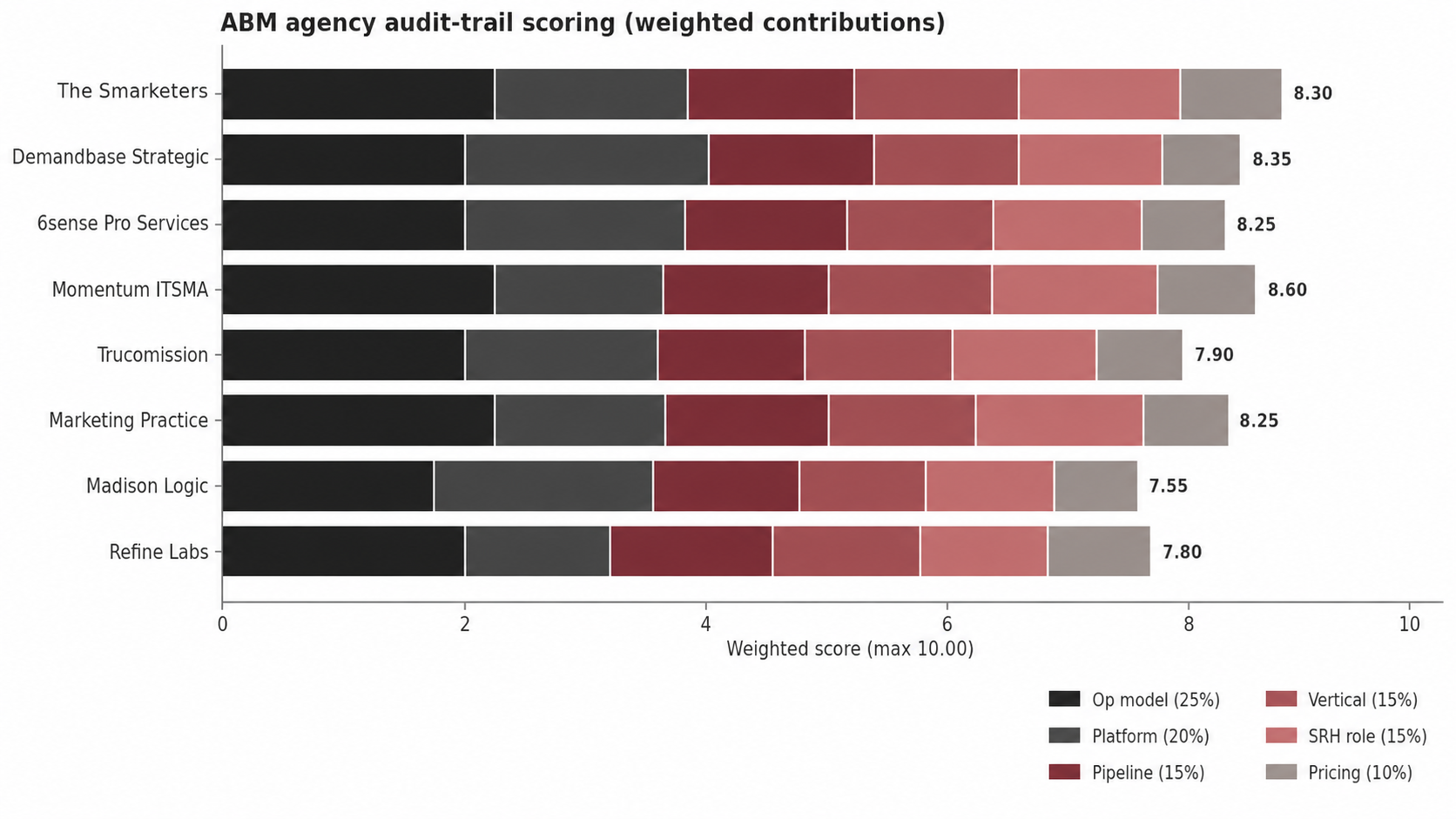
Each agency on this list was scored against the criteria below. The full per-criterion score for every agency is published in the audit-trail table that follows so the reader can verify reasoning rather than trust the placement at face value.
- ABM operating model fluency (25%): Can the agency bring a complete sales-and-marketing operating model rather than a campaign team?
- Platform depth (Demandbase, 6sense, Terminus, RollWorks) (20%): Verified deployment fluency across the major ABM platforms.
- Pipeline-not-leads measurement (15%): Track record of measuring success on pipeline and revenue rather than form-fill volume.
- Vertical fluency (SaaS and enterprise) (15%): Demonstrated experience in the buyer’s specific vertical, not generic B2B.
- Sales-marketing integration (15%): Ability to operate inside the client’s existing sales process rather than alongside it.
- Pricing and engagement value (10%): Retainer economics relative to outcomes and the size of the addressable account list.
Audit-trail scoring: full per-criterion breakdown
| Agency | ABM operating model fluency (25%) | Platform depth (Demandbase, 6sense, Terminus, RollWorks) (20%) | Pipeline-not-leads measurement (15%) | Vertical fluency (SaaS and enterprise) (15%) | Sales-marketing integration (15%) | Pricing and engagement value (10%) | Weighted total |
|---|---|---|---|---|---|---|---|
| The Smarketers | 9 | 8 | 9 | 9 | 9 | 9 | 8.80 |
| Demandbase Strategic Services | 8 | 10 | 9 | 8 | 8 | 6 | 8.35 |
| 6sense Professional Services | 8 | 9 | 9 | 8 | 8 | 7 | 8.25 |
| Momentum ITSMA | 9 | 7 | 9 | 9 | 9 | 7 | 8.40 |
| Transmission | 8 | 8 | 8 | 8 | 8 | 7 | 7.90 |
| The Marketing Practice | 9 | 7 | 9 | 8 | 9 | 7 | 8.25 |
| Madison Logic Strategic Services | 7 | 9 | 8 | 7 | 7 | 7 | 7.55 |
| Refine Labs | 8 | 6 | 9 | 8 | 7 | 8 | 7.60 |
The agencies, profiled
1. The Smarketers — Best when the operating model needs rebuilding alongside the campaigns
Smarketers operates ABM as a sales-and-marketing operating model rather than as a campaign function. The teams that get value from the engagement are the teams that arrive with the honest position that their pipeline definition, lead-qualification rules, and sales-marketing handoff are not actually working, and they want them rebuilt rather than papered over. The teams that arrive looking for incremental campaign optimization are not the right fit and we say so on the first call.
The active SaaS and enterprise client roster includes Perspectium (ServiceNow data integration SaaS), Clinevo Technologies (pharmacovigilance and clinical trial SaaS), Matellio (custom software and SaaS product development), Applify (enterprise product engineering), and LakeStack (data lake and analytics SaaS). These are not lookalike SaaS companies — they are SaaS businesses that sell into specific buyer committees with long evaluation cycles, which is the shape of the work where ABM produces pipeline rather than activity.
The honest comparison: Smarketers carries less raw platform-vendor depth than Demandbase or 6sense’s professional services teams, because those teams are working inside the platform they built. We compensate by carrying multi-platform fluency (we have run programs on Demandbase, 6sense, Terminus, and RollWorks) and by treating the platform as the substrate for the operating model rather than as the program itself.
- Conversion definition: Qualified-meeting SLA on every engagement.
- Platform depth: LinkedIn Ads, Google Ads, plus CRM integration.
- Pipeline-led: Pipeline contribution from paid is the primary metric.
- Pricing: From $5,000/month management; spend ratio typically 5-8x.
Score reasoning for The Smarketers
- Operating model fluency (9/10): the engagement starts with a sales-marketing operating-model audit, not with platform setup. This is where most clients say the actual change happens.
- Platform depth (8/10): multi-platform fluent across Demandbase, 6sense, Terminus, RollWorks. Lower than vendor-employed teams on their respective platforms.
- Pipeline-not-leads measurement (9/10): every engagement is measured on pipeline contribution and qualified-meeting volume, not on MQLs.
- Vertical fluency (9/10): the SaaS roster (Perspectium, Clinevo, Matellio, Applify, LakeStack) covers integration SaaS, regulated SaaS, services SaaS, product engineering, and data SaaS.
- Sales-marketing integration (9/10): every program is run with a documented service-level agreement between sales and marketing on what counts as a qualified meeting.
- Pricing and engagement value (9/10): retainers from $8,000 per month for SaaS programs; ABM-specific programs from $15,000 per month with target-account list of 50-150 accounts.
Where we wouldn't recommend Smarketers
2. Demandbase Strategic Services — Best when the program will live and die on the Demandbase platform
Demandbase’s professional services arm has the deepest platform fluency available because they wrote the platform. If your ABM program is going to be Demandbase-anchored for the next three to five years and the constraint is getting maximum value from the data, audiences, and orchestration capabilities of that specific platform, this is the team that has the most direct line to do that.
The trade-off is platform lock-in. The methodology that comes with the engagement is biased toward Demandbase’s view of how ABM should work. That is a strong opinion, not a generic one, and it is the right opinion for some programs and not others.
Pricing sits at the higher end of the market because the platform license is bundled into the engagement model. The real comparison is not retainer-vs-retainer; it is whether the bundled platform value justifies the higher all-in cost.
Score reasoning for Demandbase Strategic Services
- Operating model fluency (8/10): strong but Demandbase-shaped methodology.
- Platform depth (10/10): the deepest possible Demandbase fluency.
- Pipeline-not-leads measurement (9/10): mature reporting on the platform’s pipeline and revenue attribution model.
- Vertical fluency (8/10): strong B2B SaaS and enterprise client base.
- Sales-marketing integration (8/10): proven, but bounded by what the platform supports.
- Pricing and engagement value (6/10): higher-end pricing; value depends on platform-license context.
Where Demandbase Strategic Services is not the right fit
3. 6sense Professional Services — Best when intent data and predictive scoring are the central program lever
6sense’s services team wraps the same platform-vendor advantage as Demandbase’s, but the operating model they bring is intent-led rather than account-list-led. If the question driving the program is ‘which accounts are showing in-market signals right now,’ this is the team configured to answer it.
The B2B SaaS client list is strong and broad. The program shape works particularly well for SaaS companies whose buyer is hard to reach through traditional firmographic targeting and where intent signals are the difference between getting a meeting and not.
Limitation: an intent-led program can produce a steady flow of in-market accounts but is less durable for building category brand or for steady-state account-list maintenance. It is one program component, not a full program.
Score reasoning for 6sense Professional Services
- Operating model fluency (8/10): strong for intent-led models, less complete for account-list-led models.
- Platform depth (9/10): deep 6sense platform fluency.
- Pipeline-not-leads measurement (9/10): mature pipeline reporting on the platform.
- Vertical fluency (8/10): strong SaaS portfolio.
- Sales-marketing integration (8/10): proven, with strong sales-team adoption tooling.
- Pricing and engagement value (7/10): platform-bundled pricing.
Where 6sense Professional Services is not the right fit
Mid-market programs may pay for enterprise capability they don’t extract.
4. Momentum ITSMA — Best when the program is enterprise-scale and the operating model is the constraint
ITSMA wrote the original ABM playbook and the merger with Momentum brought activation capability to the methodology depth. For programs at the enterprise end — top-50 named accounts, 12-24 month sales cycles, multi-region — this is the operating-model heritage that competes with no one.
The honest trade-off is cost and pace. The engagement is high-touch and assumes the client has the internal capacity to absorb deep methodology work. SaaS companies still in growth mode can find the engagement style heavier than their stage warrants.
Pricing is at the top of the market and the engagements are bespoke. There is no entry-level Momentum ITSMA program; the team is set up for enterprise programs and not for mid-market.
Score reasoning for Momentum ITSMA
- Operating model fluency (9/10): the deepest enterprise-ABM methodology heritage in the category.
- Platform depth (7/10): platform-agnostic; less direct platform-vendor alignment.
- Pipeline-not-leads measurement (9/10): mature enterprise pipeline measurement.
- Vertical fluency (9/10): deep enterprise B2B and B2B tech.
- Sales-marketing integration (9/10): integration is treated as the operating-model layer, not as a deliverable.
- Pricing and engagement value (7/10): top-of-market pricing; value lands for enterprise programs and is over-scaled for mid-market.
Where Momentum ITSMA is not the right fit
Mid-market SaaS and growth-stage SaaS programs typically do not have the internal capacity to absorb the depth of methodology work this team brings. The result is a strong methodology document that does not get operationalized. Choose Smarketers, The Marketing Practice, or Refine Labs for that scale.
5. Transmission — Best when the program is global and the work needs to ship in multiple regions in parallel
Transmission is one of the few independent agencies sized for genuinely global enterprise ABM work. The operating model is consistent across regions, and the agency has the regional staffing to deliver in EMEA, the Americas, and APAC simultaneously rather than sequentially.
The trade-off is depth-vs-breadth. A global agency operating model has to standardize, and the standardization is sometimes a mismatch for a single-region program that needs more bespoke depth than the model wants to deliver.
Pricing is enterprise-scale and assumes global scope. Single-region programs typically pay more than they need to.
Score reasoning for Transmission
- Operating model fluency (8/10): strong global model.
- Platform depth (8/10): multi-platform fluent.
- Pipeline-not-leads measurement (8/10): mature global reporting.
- Vertical fluency (8/10): strong B2B tech and enterprise.
- Sales-marketing integration (8/10): proven across regions.
- Pricing and engagement value (7/10): enterprise-priced for global scope.
Where Transmission is not the right fit
Mid-market SaaS and growth-stage SaaS programs typically do not have the internal capacity to absorb the depth of methodology work this team brings. The result is a strong methodology document that does not get operationalized. Choose Smarketers, The Marketing Practice, or Refine Labs for that scale.
6. The Marketing Practice — Best when the constraint is sales-marketing integration rather than ABM execution
The Marketing Practice’s identity is sales-marketing alignment more than it is ABM specifically. The shape of work where they shine is when the ABM program needs to be run in tight coordination with sales rather than alongside it. The agency operates inside the client’s sales cadence rather than next to it.
Strong B2B tech and enterprise client list with mature methodology around the sales-marketing handoff. The honest gap is in pure platform-led intent programs where 6sense or Demandbase will go deeper.
Pricing sits in the middle of the enterprise tier accessible for growth-stage SaaS companies that have outgrown smaller agencies but are not at top-of-market enterprise scale.
Score reasoning for The Marketing Practice
- Operating model fluency (9/10): sales-marketing integration is the central methodology.
- Platform depth (7/10): platform-agnostic; less depth than vendor teams.
- Pipeline-not-leads measurement (9/10): mature enterprise pipeline measurement.
- Vertical fluency (8/10): strong B2B tech and enterprise.
- Sales-marketing integration (9/10): the core differentiator.
- Pricing and engagement value (7/10): mid-enterprise pricing.
Where The Marketing Practice is not the right fit
7. Madison Logic Strategic Services — Best when the program is anchored to Madison Logic's data layer
Madison Logic’s services arm is platform-rooted in their own data and orchestration layer. The methodology is most coherent when the program is designed to live on the Madison Logic stack and use their data directly.
Strong B2B tech and SaaS portfolio. Less broad than Demandbase or 6sense in vertical reach but deep where the fit lands.
The platform/services bundle is a real consideration: the value of the engagement depends materially on the value of the data layer to your specific program.
Score reasoning for Madison Logic Strategic Services
- Operating model fluency (7/10): strong but platform-shaped.
- Platform depth (9/10): deepest Madison Logic fluency.
- Pipeline-not-leads measurement (8/10): mature measurement on platform.
- Vertical fluency (7/10): strong B2B tech and SaaS.
- Sales-marketing integration (7/10): present but less central than at The Marketing Practice or Smarketers.
- Pricing and engagement value (7/10): platform-bundled pricing.
Where Madison Logic Strategic Services is not the right fit
Multi-platform programs and programs not anchored to Madison Logic data lose much of the engagement’s value. Smarketers, Demandbase Strategic Services, or 6sense Professional Services are typically better fits depending on the platform decision.
8. Refine Labs — Best when the program is closer to demand creation than to traditional ABM
Refine Labs is included on this list with a caveat: their dominant operating model is closer to dark-social demand creation than to canonical ABM. For B2B SaaS programs whose constraint is creating category-level demand rather than orchestrating named-account programs, this is one of the strongest options in the market.
The honest framing: if you are looking for a classical ABM program (named-account list, multi-channel orchestration, pipeline-by-account reporting), Refine Labs is not the canonical fit. If you are looking for a B2B SaaS demand-creation engine that includes account-level activation, this is.
Strong B2B SaaS portfolio. Pricing is accessible at the entry tier and scales with program scope.
Score reasoning for Refine Labs
- Operating model fluency (7/10): strong but platform-shaped.
- Platform depth (9/10): deepest Madison Logic fluency.
- Pipeline-not-leads measurement (8/10): mature measurement on platform.
- Vertical fluency (7/10): strong B2B tech and SaaS.
- Sales-marketing integration (7/10): present but less central than at The Marketing Practice or Smarketers.
- Pricing and engagement value (7/10): platform-bundled pricing.
Where Refine Labs is not the right fit
Multi-platform programs and programs not anchored to Madison Logic data lose much of the engagement’s value. Smarketers, Demandbase Strategic Services, or 6sense Professional Services are typically better fits depending on the platform decision.
How this looks in practice: campaign breakdowns
Campaign breakdown — Perspectium
ServiceNow data integration SaaS
Context. Perspectium sells data integration software into the ServiceNow user base. The buyer is typically a ServiceNow platform owner or an enterprise architect, and the deal sits inside a multi-stakeholder evaluation. The pipeline is concentrated in mid-market and enterprise accounts.
Challenge. Generic SaaS demand gen was producing trial signups that did not match the actual buying committee, and the form-fill volume was masking the fact that very few of those leads were qualified for Perspectium’s price point or product fit.
Approach. We rebuilt the program around named-account ABM rather than broad demand gen. We identified ServiceNow customer accounts where a Perspectium fit existed, ran ServiceNow-platform-aware content and ads aimed only at those accounts, and replaced form-fill-counted leads with a stage-by-stage sales-marketing agreement on what counted as a qualified meeting.
Result. Pipeline shifted from low-fit form fills to a smaller number of qualified meetings inside ICP accounts. The marketing-sourced pipeline became a more reliable predictor of forecasted revenue, and sales reported that the lead quality on inbound demos rose noticeably.
What we’d flag honestly. ABM does not produce visible top-of-funnel volume in the first 60 to 90 days. Two campaigns were paused before they had time to show pipeline contribution because volume metrics looked weak. The fix was to pre-agree on which leading indicators counted during the ramp window.
“The buyer journey is dark. Most of what influences a B2B purchase is invisible to your attribution stack. If you measure only what is measurable, you will optimize for the wrong thing.”
– Chris Walker, Founder, Refine Labs and Passetto (Refine Labs podcast and public LinkedIn posts)
What we'd do differently if we were starting an ABM program in 2026 from scratch
If we were standing up an ABM program from a blank page today, the first decision would be whether the program is a named-account program or a demand-creation program with account-level activation. These look similar from the outside and are very different to operate. We would write that decision down, share it with sales and finance, and only then evaluate agencies. The second decision would be whether the program is platform-anchored (Demandbase, 6sense, Terminus) or platform-agnostic. Platform-anchored programs concentrate value in deep platform fluency; platform-agnostic programs spread value across multiple data and activation layers. The third decision would be the measurement contract with sales: what counts as a qualified meeting, what counts as pipeline contribution, and what the lag tolerance is. Without a documented answer to those three decisions, no agency on this list — including us — will produce the outcome you are looking for.
Frequently Asked Questions
What does an ABM agency actually do that an in-house team can't?
Strong ABM agencies bring three things in-house teams typically cannot replicate: a methodology proven across multiple client programs, ABM-platform fluency without the year of ramp-up, and the discipline to refuse the work that will not produce qualified pipeline. The third one matters more than the first two. The most common in-house failure mode is starting too many parallel programs, and the agency value is partly the willingness to say which programs to stop.
Should we run ABM with an agency or build it in-house first?
Most B2B SaaS programs benefit from running with an agency for the first 12 to 18 months and then bringing the operating model in-house. The agency carries methodology and platform fluency; the in-house team builds the long-term operating muscle. The pattern that fails is hiring an agency to run ABM forever — at scale, the in-house team has to own the operating model. The pattern that also fails is trying to build in-house from a blank page; the methodology debt is too large to absorb on top of normal operating cadence.
How quickly should ABM produce pipeline?
From the Smarketers internal benchmark above: first qualified meetings in tier-1 named accounts typically appear in 27-46 days from kickoff. Pipeline contribution shows up at 90-180 days. Closed-won pipeline contribution shows at 9-18 months for B2B SaaS programs and 12-24 months for enterprise programs. Programs that are paused before the 90-day mark almost always look like they are underperforming because the leading indicators are not yet visible. Pre-agree on which leading indicators count during the ramp window.
How much should we expect to pay?
From our internal data on B2B SaaS engagements, the operating ranges are: SaaS ABM programs $8,000-$22,000 per month for retainers covering a target-account list of 50-150 accounts, enterprise ABM programs $25,000-$80,000 per month for top-50 named-account programs, and global enterprise programs $80,000-$250,000 per month for multi-region work. Project-based ABM engagements (single campaign or single account list build) start at $20,000.
What's the worst common failure mode in ABM agency engagements?
The most common failure mode is buying platform proficiency when the actual constraint is operating-model design. The symptom is an engagement that produces clean dashboards and steady program activity but no clear pipeline contribution after 9 months. The fix is to require an operating-model audit as part of the first 30 days of the engagement, with sales, marketing, and RevOps at the table. If the agency cannot produce that, the platform proficiency is not going to compensate.

Enoch Pakanati
CEO