Table of Contents
Need help with B2B Marketing?
Let the smarketers’ team drive your pipeline with data-led campaigns and AI-powered growth strategies.
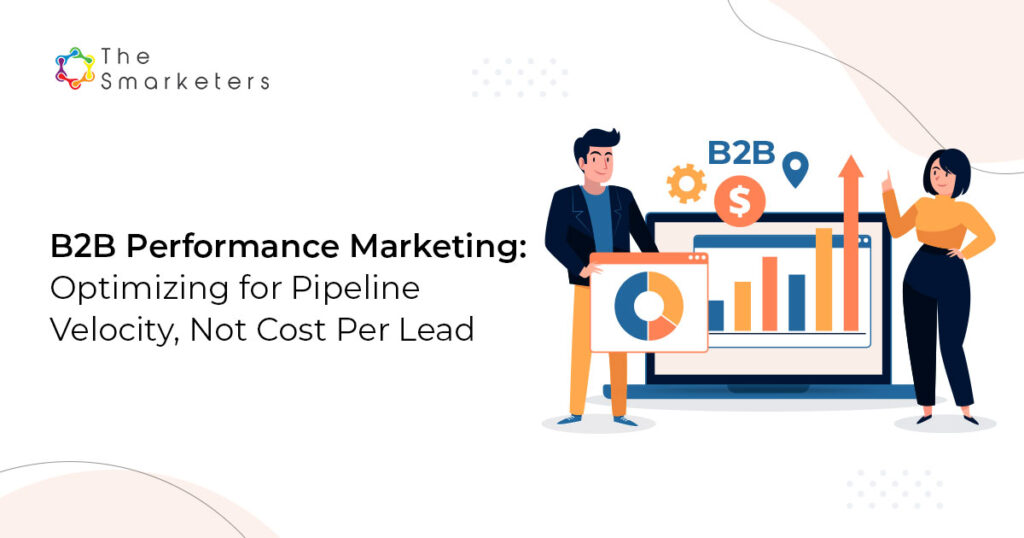
Cost per lead is the most misleading number in B2B marketing. It rewards volume, punishes quality, and tells you nothing about whether the marketing spend produced revenue. Yet most demand generation teams still report on CPL as the primary efficiency metric, because it is easy to calculate and it is what the finance team asks for.
Pipeline velocity is a harder number to report on. It requires joined-up data across marketing, sales, and customer success. It forces marketers to answer for deal cycle length, win rate, and deal size, not just how many forms were filled. But it is the only number that honestly answers the question the CFO is actually asking: what happens to every dollar I give marketing?
This guide is a full rebuild of the B2B performance marketing model around pipeline velocity. It covers the formula, the five levers that actually move it, the attribution architecture required to measure it, and the campaign patterns that consistently improve it.
READ THIS IF
You are a VP Marketing or CRO who has been asked to justify marketing spend with revenue-level evidence. You have a CPL number you report on monthly, and a growing sense that it does not explain what is actually happening in the pipeline.
The CPL Trap: Why Cheap Leads Cost More
CPL optimization creates a predictable failure pattern. Marketing is measured on leads generated divided by spend. The cheapest leads come from broad-audience channels with low intent. Volume goes up, the CPL number improves, and marketing hits its target. Meanwhile, the sales team spends the same number of hours working a larger pile of low-intent leads, conversion rates fall, and the CFO wonders why marketing spend went up while revenue stayed flat.
The math of the CPL trap
A B2B team doubling its lead volume at a 40% lower CPL sounds like a win. But if the MQL-to-SQL rate drops from 25% to 10% because the leads are lower intent, and the SQL-to-closed-won rate drops from 20% to 14% because AEs are burned out working poor leads, the revenue result is worse despite the better CPL. We see this pattern quarterly.
| Scenario | Before (CPL-focused) | After (more leads, lower CPL) |
|---|---|---|
| Leads generated | 1,000 | 2,000 |
| CPL | $200 | $120 |
| Marketing spend | $200,000 | $240,000 |
| MQL-to-SQL conversion | 25% | 10% |
| SQL-to-won conversion | 20% | 14% |
| Closed won deals | 50 | 28 |
| Avg deal size | $45,000 | $38,000 |
| Revenue generated | $2,250,000 | $1,064,000 |
| Marketing ROI | 11.25x | 4.43x |
72%
of high-performing B2B marketing teams have moved their primary efficiency metric from CPL to a revenue-based metric (pipeline velocity, CPQM, or cost per closed-won), per Forrester B2B Marketing Performance Benchmarks (2024).
The Pipeline Velocity Formula
Pipeline velocity is the dollars of new pipeline generated per unit of time. The full formula has four inputs, and each of them is a lever marketing can move.
PIPELINE VELOCITY FORMULA
Velocity ($ per day) = (Number of Opportunities × Average Deal Size × Win Rate) ÷ Sales Cycle Length
The elegance of the formula is that every lever compounds. A 20% lift in opportunities, a 15% lift in deal size, a 10% lift in win rate, and a 20% reduction in cycle length each feel modest. Multiplied together, they produce an 82% lift in velocity. That is the compounding effect good marketing teams understand and poor ones ignore.

Lever 1: Opportunity volume
The most visible lever and the one most often over-optimized. Opportunity volume is moved by channel mix (where you find accounts), ICP targeting (which accounts you pursue), and offer design (what gets the meeting). The trap is pursuing volume at the cost of the other three levers. A 20% lift in opportunities from tighter ICP targeting is worth far more than a 50% lift from broader targeting, because it preserves deal size and win rate.
Lever 2: Average deal size
The lever most B2B marketing teams never work. Deal size is moved by segmentation (pursuing larger accounts), positioning (being sold as a strategic investment rather than a tactical tool), multi-product attach (expanding the initial sale), and pricing confidence (not discounting to close). Marketing influences all four through the content and campaigns it runs.
Lever 3: Win rate
The lever that reveals the quality of marketing-generated pipeline. Win rate moves when leads are better qualified at handoff, when the sales team arrives with richer context, when marketing supplies the sales team with late-stage content that addresses procurement and legal objections, and when the buying committee has been warmed before the demo. Customer reference content, comparison pages, and ROI calculators all move win rate.
Lever 4: Sales cycle length
The lever that reveals how well marketing sets up the deal. Cycle length shortens when the buyer is pre-educated (through content), when the internal champion is supplied with the materials they need to sell internally (champion enablement), and when objection-handling content is surfaced at the right moment. Cycle length extension is almost always a signal that the buyer is unsure, which is a content problem before it becomes a sales problem.

The Attribution Architecture Pipeline Velocity Requires
Single-touch attribution (first-touch or last-touch) cannot measure pipeline velocity. Both models pick one touchpoint and assign 100% of the credit to it, which is wrong for B2B deals that routinely involve 12 to 18 touchpoints across 6 to 8 buyers over 4 to 9 months. Measuring velocity requires multi-touch attribution, and the specific model matters less than the discipline of measuring the full journey.
Attribution models ranked by B2B suitability
| Model | How it works | Best for | Known weakness |
|---|---|---|---|
| First-touch | 100% credit to first touchpoint | Awareness measurement only | Ignores conversion work |
| Last-touch | 100% to last touchpoint | Direct response channels | Ignores nurture work |
| Linear | Equal credit to every touchpoint | Long cycles with steady nurture | Treats all touches as equal |
| U-shape (position-based) | 40% first, 40% last, 20% middle | Balanced awareness and conversion | Undercounts long middle |
| W-shape | 30% first, 30% MQL creation, 30% opportunity creation, 10% middle | B2B with defined stage gates | Complex to implement |
| Data-driven | ML-assigned credit based on observed lift | Mature teams with rich data | Requires 6+ months of clean data |
Most B2B teams run W-shape or data-driven attribution in production. The starting point for a team rebuilding performance measurement is U-shape, which is simple enough to implement in any CRM and produces materially better decisions than first-touch or last-touch.
Campaign Patterns That Move Velocity
The mistake most performance marketing teams make is treating each campaign as a lever on a single metric. Demand gen campaigns optimize for opportunities. Content campaigns optimize for engagement. Retargeting optimizes for conversion rate. Each team hits its number. Velocity does not move.
High-performing teams build campaigns that hit multiple levers at once. The patterns below are the ones we see consistently move all four velocity inputs.
Pattern 1: The ICP-specific ROI calculator
A free tool that asks for the buyer’s company size, current process, and key metric, then outputs a customized ROI estimate. Moves opportunities (captures late-stage intent), deal size (presents the ROI of the larger configuration), win rate (gives the champion a financial case to defend internally), and cycle length (skips two discovery calls by pre-quantifying value).
Pattern 2: The competitive comparison page
A directly comparable feature matrix against the two or three named competitors the buyer is most likely considering. Moves win rate (wins the bake-off by being on the page when the buyer searches) and cycle length (answers the “how do you compare?” question before sales has to).
Pattern 3: The buying committee enablement kit
A bundle of one-pagers addressed to each member of the typical buying committee (finance, security, end user, legal). Marketing delivers to the champion. The champion walks it into procurement. Moves cycle length (removes the “I need to get security to review this” delay) and win rate (addresses objections before they surface).
Pattern 4: The late-stage customer reference program
Structured reference calls, case study assets, and peer community access surfaced to deals in the 60-to-80-percent closed stage. Moves win rate (the single most powerful lever on a mid-cycle deal) and deal size (customers buy more confidently from teams that can prove outcomes).
Pattern 5: The win-back sequence
A structured 90-day sequence for stalled opportunities. Moves opportunities (resurrects deals that would otherwise be written off) and win rate (you are no longer the unknown vendor in the next cycle).
34%
average reduction in B2B sales cycle length among teams that implemented a structured buying committee enablement program in 2024, per Gartner Buyer Enablement Study.
The Reporting Cadence That Makes Velocity Visible
Pipeline velocity is not a weekly metric. It is built from inputs that move on different time horizons. Teams that try to track velocity weekly make bad decisions, because the noise at that cadence overwhelms the signal. The cadence that works is monthly for the inputs and quarterly for the composite metric, with a rolling 90-day view to smooth out deal cycle variability.
Monthly inputs to track
- New opportunities created, segmented by source and ICP tier
- Average deal size of new opportunities (not of closed-won, which lags)
- MQL-to-SQL conversion rate and SQL-to-opp conversion rate
- Pipeline-to-revenue conversion rate on deals now closed
- Median days in stage for active opportunities
Quarterly composite to track
- Pipeline velocity dollars per day, trailing 90-day
- Cost per qualified meeting (CPQM) by channel
- Cost per closed won deal (CPCW) by channel
- Marketing-sourced pipeline as % of total pipeline
- Pipeline-to-plan coverage ratio for the next two quarters

The Organizational Conditions for Pipeline Velocity to Move
The performance marketing rebuild fails more often than it succeeds, and the failure pattern is organizational rather than analytical. Three conditions determine whether velocity actually moves.
Condition 1: A shared data model between marketing and sales
Marketing and sales cannot debate velocity if they disagree on what an opportunity is. The rebuild starts with an agreed-upon opportunity stage definition, an agreed-upon ICP segment taxonomy, and an agreed-upon closed-won definition. Typically 4 to 8 weeks of joint work before any measurement change is introduced.
Condition 2: CFO-level alignment on what marketing is measured on
If the CFO continues to ask for CPL in board reports, the rest of the organization keeps optimizing for CPL. The shift requires a formal reporting change at the top. Most CFOs are open to it when the new metric has clearer revenue linkage, but the conversation has to happen before the marketing team changes its internal dashboards.
Condition 3: Tolerance for a 6-month noisy transition
Velocity gets worse before it gets better. Some low-intent channels that were padding CPL numbers get cut, and opportunity volume dips. New high-intent channels take a quarter or two to ramp. Leadership that cannot hold the line through the transition reverts to CPL and loses 12 months of work.
CLIENT SPOTLIGHT
B2B Analytics Platform ($52M ARR)
The Challenge
The marketing team had been hitting its CPL target for 8 consecutive quarters at $180 per lead, down from $230 two years earlier. Board reporting showed marketing as efficient. Yet new ARR had grown only 11% over the same period despite a 40% budget increase. Sales cycle on marketing-sourced deals had stretched from 95 days to 148 days. Close rate on marketing-qualified opportunities had fallen from 22% to 13%. The cheaper leads were driving the worse outcomes.
The Result
We rebuilt the measurement model around pipeline velocity, cut three volume-oriented channels (display network, broad-keyword paid search, generic content syndication), and reallocated spend to ICP-targeted LinkedIn campaigns, analyst co-marketing, and customer reference programs. Velocity grew from $2,400 per day to $7,900 per day over 14 months. Total marketing spend stayed flat. New ARR grew 38% year-over-year. The CFO now reports pipeline velocity in board decks.
Frequently Asked Questions
How is pipeline velocity calculated?
Pipeline velocity is the dollar value of pipeline generated per unit of time, typically reported as dollars per day. The formula is: (Number of Opportunities × Average Deal Size × Win Rate) ÷ Sales Cycle Length. All four inputs are levers marketing can move.
Is CPL ever a useful metric?
CPL is useful as one of many inputs if it is tracked alongside lead quality (MQL-to-SQL conversion) and downstream conversion. The mistake is using CPL as the primary efficiency metric. It should be a diagnostic metric, not a target metric.
How long does it take to see pipeline velocity improvements?
The leading indicators (opportunity volume, deal size) show movement in 30 to 60 days. The full composite velocity metric takes 90 to 180 days to settle because it depends on deals closing through the cycle. Budget a six-month horizon before declaring victory.
What is the relationship between pipeline velocity and CAC payback?
Velocity improvements compound into shorter CAC payback. A 20% shorter sales cycle pulls revenue forward, a higher win rate increases customer lifetime value, and a larger deal size raises gross profit per customer. Teams that move velocity typically see CAC payback drop by 3 to 6 months within a year.
Which attribution model is best for measuring velocity?
W-shape attribution or data-driven attribution. For teams without the data maturity for either, U-shape attribution is the best starting point. Avoid first-touch and last-touch single-attribution models for any revenue-facing measurement.
How do we handle channels that do not generate direct attribution (PR, events, SEO)?
Use influence attribution in parallel with direct attribution. Track channels that appear in the buyer journey even if they are not the first or last touch. Also run lift analysis on geos or segments where a channel is active versus inactive. Pure attribution will always under-credit these channels.
Should we cut channels that have a good CPL but a bad pipeline contribution?
Yes, after a one-quarter diagnosis. Low-cost channels that never produce pipeline are consuming time and dollars that would generate more revenue elsewhere. But verify first: some channels appear unattributed because of tracking gaps, not because they are not contributing.
Is your marketing optimizing for the wrong metric?

Enoch Pakanati
CEO