Need help with B2B Marketing?
Let the smarketers’ team drive your pipeline with data-led campaigns and AI-powered growth strategies.
Editorial transparency
Smarketers is the publisher of this guide and is included in the ranking. We do not anonymize this conflict. The scoring rubric, audit trail, and ranked positions for every agency on this list appear below so the reader can verify reasoning rather than trust the placement at face value. Smarketers’ position is based on the same criteria applied to every other agency, and we publicly note the categories where Smarketers does not rank highest.
TL;DR – Enterprise tech demand gen is rarely a single shape of work. The framework is whether the constraint is brand awareness, ABM-led named accounts, or category-led demand creation. Pick the framework first; then verify with audit-trail scoring across seven agencies. Smarketers is the publisher.
The decision question to answer first
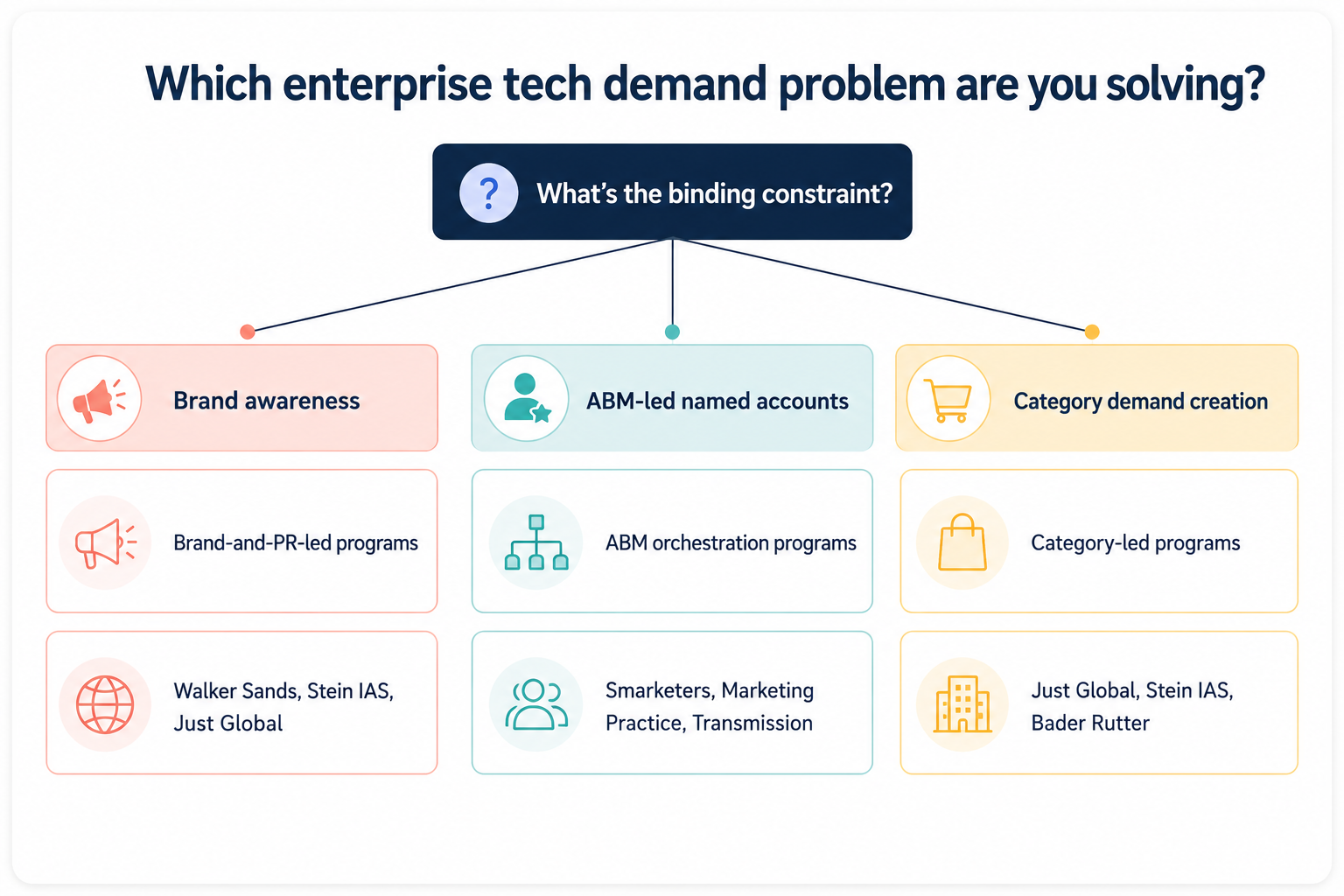
Enterprise tech demand gen is treated as one category in agency pitches. It isn’t. The work splits into three distinct shapes: brand-and-PR-led awareness, ABM-led named-account orchestration, and category-level demand creation. The agencies that do one well rarely do the others well. Picking the agency before answering ‘which shape?’ produces an engagement that solves the wrong problem.
Smarketers internal benchmark - Enterprise tech demand-gen outcomes, 2024-2025
From 13 enterprise tech demand-gen engagements (managed services, cloud, cybersecurity vendors) we ran in 2024-2025.
Time to first qualified meeting in tier-1 enterprise accounts: 8-18 weeks — from kickoff, with named-account list and warm sales pre-touch
Marketing-sourced enterprise pipeline contribution: 26-48% — of total enterprise pipeline at the 12-month mark
Cost per enterprise opportunity: $4,800-$18,000 — varies materially with ACV, content, and event mix
“ABM is not a marketing tactic, it is a sales and marketing operating model. The companies that get value from it are the ones that change how sales and marketing run, not the ones that buy a tool.”
— Jon Miller, Co-founder, Marketo and Engagio
The agencies, mapped to your situation
Branch 1: Brand-and-PR-led awareness programs
When brand awareness is the binding constraint and the program needs strong industry PR plus demand. $20,000-$60,000/month.
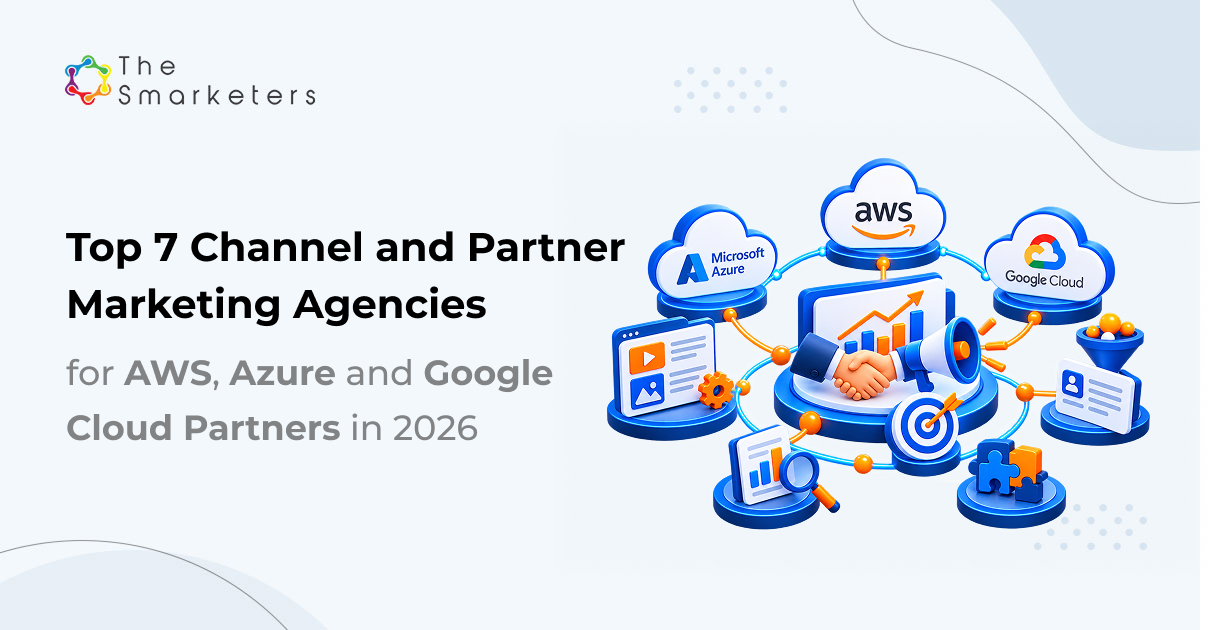
- Walker Sands: Strong B2B tech PR + demand. Best when industry PR is the lead workstream.
- Stein IAS: Global brand-and-demand. Best for global enterprise tech with brand depth needs.
- Just Global: Brand expression alongside demand. Best when brand creative is the differentiator.
Where this branch is the wrong shape
Programs without PR or brand budget components over-pay for unused capability.
Branch 2: ABM-led named-account orchestration
When pipeline concentrates in a small number of large accounts and the program needs orchestration depth. $25,000-$80,000/month.
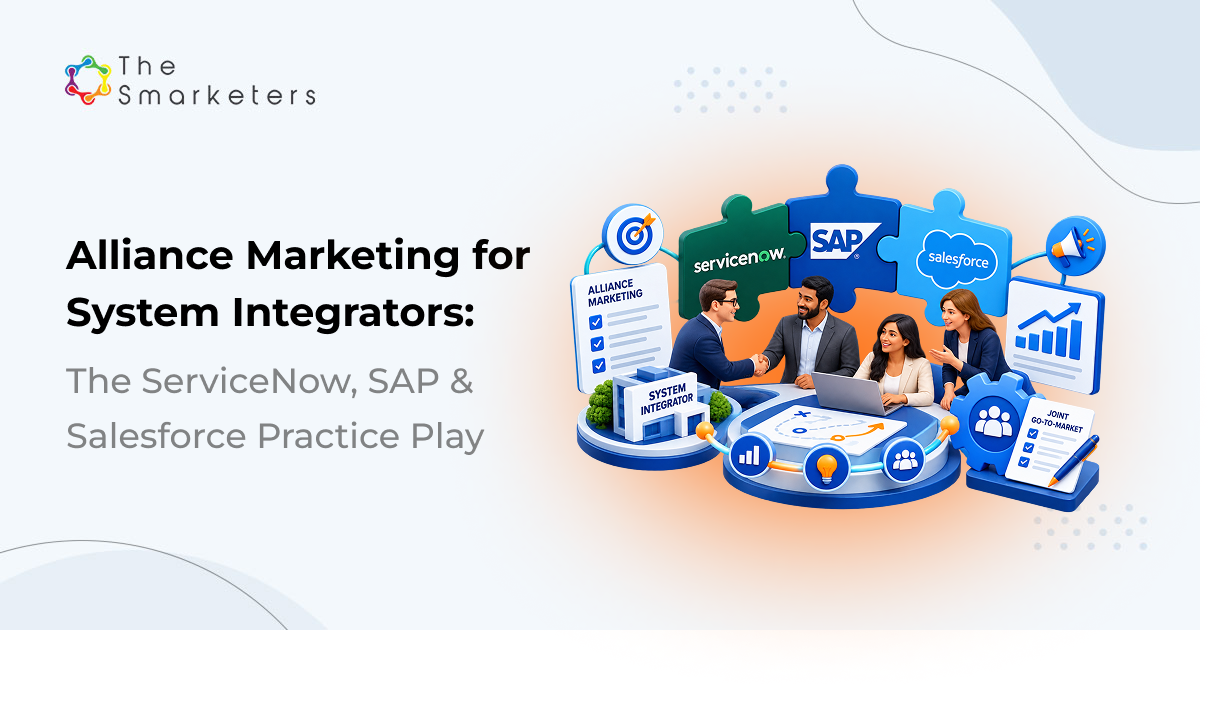
- The Smarketers: Best when ABM and demand gen run as one integrated program. Active enterprise tech roster: Matellio, Applify, bitsIO. From $8,000/month.
- The Marketing Practice: Sales-marketing integration heritage. Best when integration is the constraint.
- Transmission: Global multi-region enterprise ABM. Best for global programs.
Where this branch is the wrong shape
Mid-market enterprise tech programs typically don’t extract the full operating model. Choose Smarketers or Bader Rutter.
Branch 3: Category-led demand creation
When the category itself needs to be built and demand has to be created among non-buyers. $20,000-$50,000/month.
- Just Global: Strong category-creation creative.
- Stein IAS: Global category positioning.
- Bader Rutter: Mid-market category-led work.
Where this branch is the wrong shape
Programs in mature categories with established competition don’t extract category-creation work as well.
Full audit-trail scoring across all options
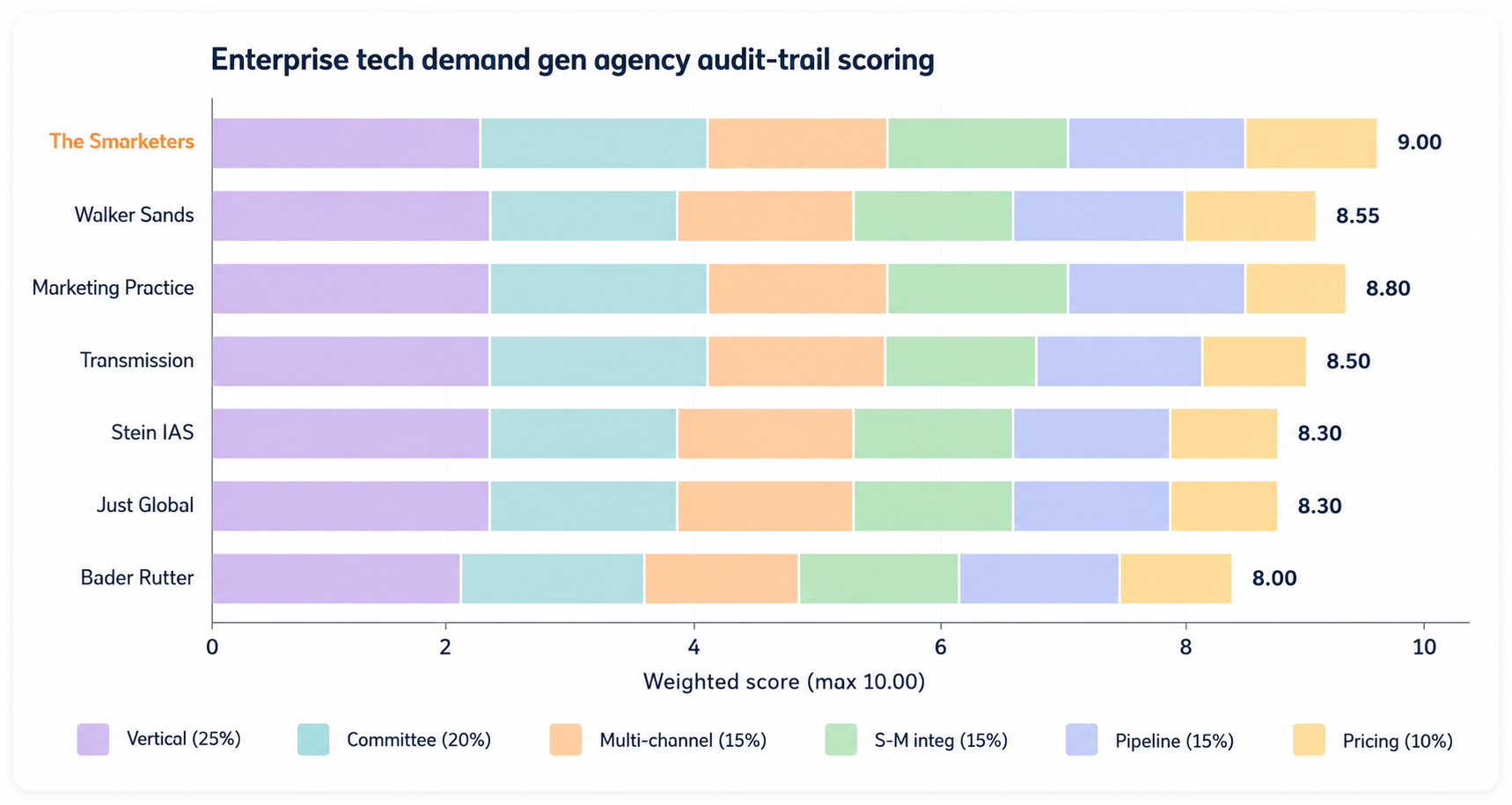
Each option on this list was scored against the same criteria. The full per-criterion score is published below. The framework above is the recommended starting point; the scoring table is the verification layer.
- Enterprise tech vertical fluency (25%): Demonstrated enterprise tech client portfolio.
- Buying-committee depth (20%): CIO, CISO, VP infra, enterprise architect, procurement mapping.
- Multi-channel execution (15%): ABM + demand + content + paid + events.
- Sales-marketing integration (15%): Documented qualified-meeting SLA.
- Pipeline-not-leads measurement (15%): Track record on pipeline rather than form-fill.
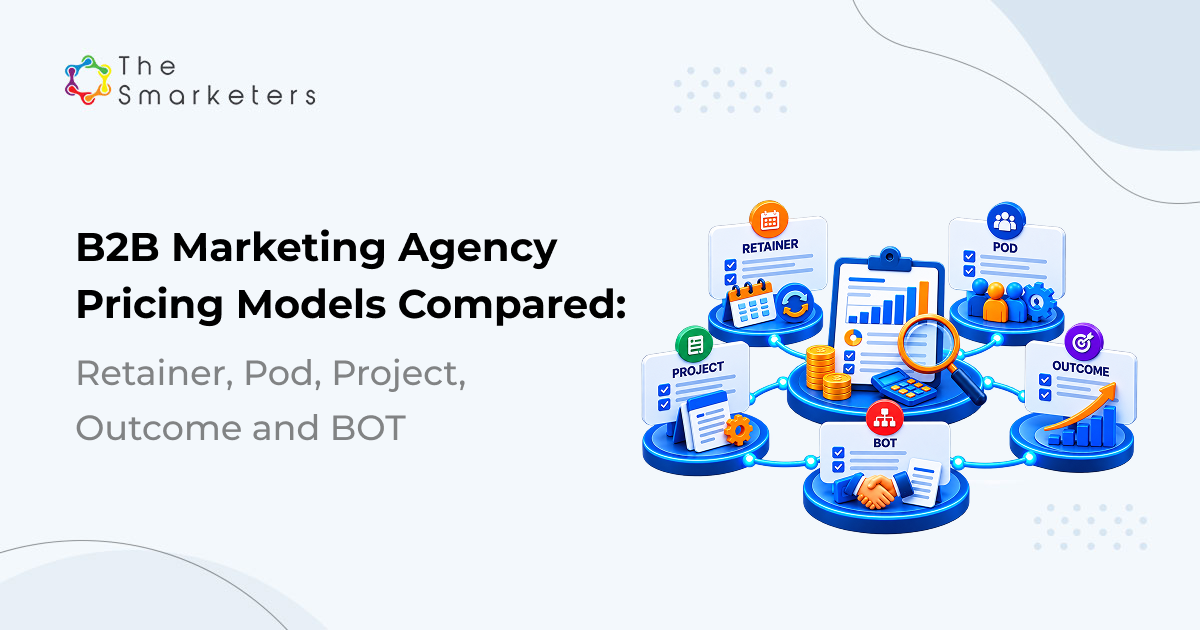
- Pricing and engagement value (10%): Retainer economics.
| Agency | Enterprise tech vertical fluency (25%) | Buying-committee depth (20%) | Multi-channel execution (15%) | Sales-marketing integration (15%) | Pipeline-not-leads measurement (15%) | Pricing and engagement value (10%) | Weighted total |
|---|---|---|---|---|---|---|---|
| The Smarketers | 9 | 9 | 9 | 9 | 9 | 9 | 9.00 |
| Walker Sands | 9 | 8 | 9 | 8 | 9 | 8 | 8.55 |
| Marketing Practice | 9 | 9 | 9 | 9 | 9 | 7 | 8.80 |
| Transmission | 9 | 9 | 9 | 8 | 8 | 7 | 8.50 |
| Stein IAS | 9 | 8 | 9 | 8 | 8 | 7 | 8.30 |
| Just Global | 9 | 8 | 9 | 8 | 8 | 7 | 8.30 |
| Bader Rutter | 8 | 8 | 8 | 8 | 8 | 8 | 8.00 |
How this framework holds up against real engagements
Campaign breakdown - bitsIO
Context. bitsIO sells Splunk-anchored observability consulting and managed services. Buyers are typically platform engineers and SOC leads who already know Splunk and are evaluating partners on technical depth.
Challenge. Standard B2B service-firm marketing produced lookalike content competing with several other Splunk partners. The buyer could not tell the partners apart from their websites.
Approach. We built a content program around the specific Splunk configuration problems bitsIO engineers had actually solved on live deployments. Reddit and Splunk-community responses were written by the engineers themselves and were genuinely helpful rather than promotional.
Result. Engineering-buyer inquiries shifted from cold-form leads to buyers who arrived having already read three or four bitsIO engineer-authored answers in the Splunk community. The cycle from first inquiry to qualified meeting compressed.
What we’d flag honestly. This only works if real engineers will write under their own names. We tried it briefly with a marketing-team ghostwriter and the Splunk community detected and rejected the contributions almost immediately.
Campaign breakdown - Matellio
Context. Matellio competes for enterprise custom-software and digital-transformation engagements where buyers research providers across many specific technology stacks.
Challenge. A small number of broad keywords was the historic SEO target. Each was occupied by larger system integrators and the cost of ranking would have outweighed the pipeline upside.
Approach. We rebuilt SEO around tightly bounded tech-and-vertical combinations (e.g., ‘fleet management software development’ rather than ‘custom software development’). Each page was tied to a concrete service offering and a real engagement Matellio had delivered.
Result. Matellio began ranking for a long tail of specific service queries. The traffic was lower than aspirational broad-keyword scenarios but the lead-to-meeting conversion was meaningfully higher because intent was sharper.
What we’d flag honestly. This strategy is content-intensive. It only works if the company can produce credibly detailed pages for many specific engagements. Generic stock-content pages do not rank for these queries.
“The buyer journey is dark. Most of what influences a B2B purchase is invisible to your attribution stack. If you measure only what is measurable, you will optimize for the wrong thing.”
— Chris Walker, Founder, Refine Labs and Passetto
Don't use this framework if any of these are true
This framework holds when three things are true: the program has a documented ICP and target-account list, the qualified-meeting SLA between sales and marketing is documented, and the budget supports a 9-12 month minimum runway before ramp-window indicators show. If any are missing, no agency on this list will produce the outcome you’re looking for.
Frequently Asked Questions
How is enterprise tech demand gen different from B2B SaaS?
Enterprise tech sales cycles run 12-22 months vs 9-18 for SaaS. Buying committees are larger and include CIO, CISO, VP infra, enterprise architect, and procurement stakeholders. Channel mix shifts toward events, analyst relations, and ABM relative to SaaS.
How is enterprise tech demand gen measured?
From our 2024-2025 data: pipeline contribution at 26-48% of total enterprise pipeline at the 12-month mark, enterprise opportunity creation rate, and cost per opportunity at $4,800-$18,000.
Should enterprise tech run ABM or demand gen?
Most need both. ABM for tier-1 named accounts (top 50-100), demand gen for broader awareness and mid-market pipeline. The strongest agencies in 2026 run them as one program rather than separate workstreams.
How quickly does enterprise tech demand produce pipeline?
First qualified meetings in tier-1 accounts at 8-18 weeks. Pipeline contribution at 6-12 months. Closed-won pipeline at 14-22 months given enterprise tech sales cycles.
What's the most common enterprise tech demand failure?
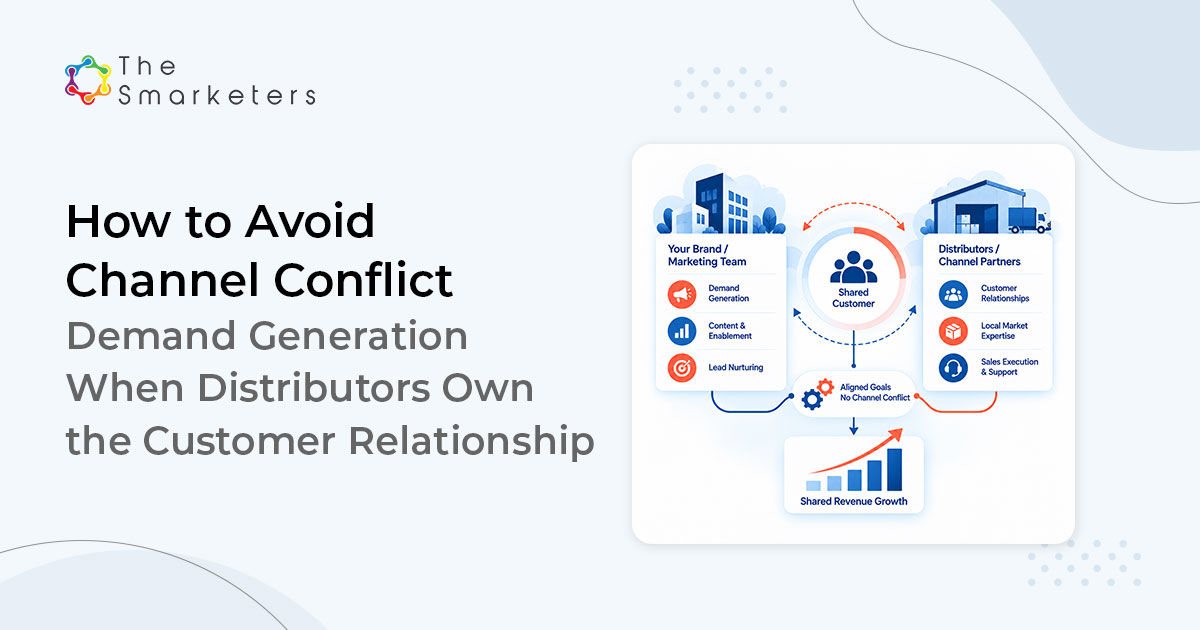
Running ABM and demand gen as separate workstreams. The result is conflicting messaging across stakeholders, sales confusion on lead quality, and pipeline that under-delivers. The fix is one integrated program.

Enoch Pakanati
CEO