Orchestrated AI Agents That Work Together to Execute Complex Marketing Workflows
Single AI tools hit a ceiling fast. We configure multi-agent workflows using Claude Code, N8N, and Relevance AI — specialized agents that collaborate, share context, and coordinate actions across your entire marketing stack. We leverage the best AI infrastructure available, not build from scratch.
A single AI tool can write an email or research an account. But real marketing requires coordination — research informs messaging, messaging drives outreach, outreach generates signals, signals trigger follow-ups. Multi-agent systems handle this entire chain.
Single Tools Can't Coordinate
Your AI writing tool doesn't talk to your outreach tool. Multi-agents share context and trigger each other automatically.
Context Gets Lost Between Steps
Copy-pasting between tools loses nuance. Our agents maintain shared memory across the entire workflow.
Sequential Execution Is Too Slow
Waiting for one step to finish before starting the next wastes time. Agents work in parallel where possible.
No Feedback Loops
When an email gets a reply, your content tool doesn't know. Multi-agents feed outcomes back to improve future actions.
Human Bottlenecks at Every Step
You become the router between tools. The orchestrator handles routing so you focus on strategy.
Scaling Requires More People
With single tools, 2X output needs 2X humans. Multi-agents scale output without scaling headcount.
Multi-Agent Orchestration
We configure specialized AI agents that work together - each handling a specific task in your marketing workflow.
1
Workflow Mapping
Process Audit
Bottleneck ID
Agent Design
2
Agent Configuration
N8N
Relevance AI
Claude Code
APIs
3
Integration & Testing
Data Flows
Quality Gates
Error Handling
4
Deploy & Monitor
Performance Dashboards
Human Oversight
Iteration
Multi-agent systems outperform single-agent setups by 3-5X
A single AI agent trying to do everything produces mediocre results. Specialized agents - one for research, one for writing, one for outreach - each excel at their specific task and hand off to the next.
— Our multi-agent architecture principles
Agent Types in the System
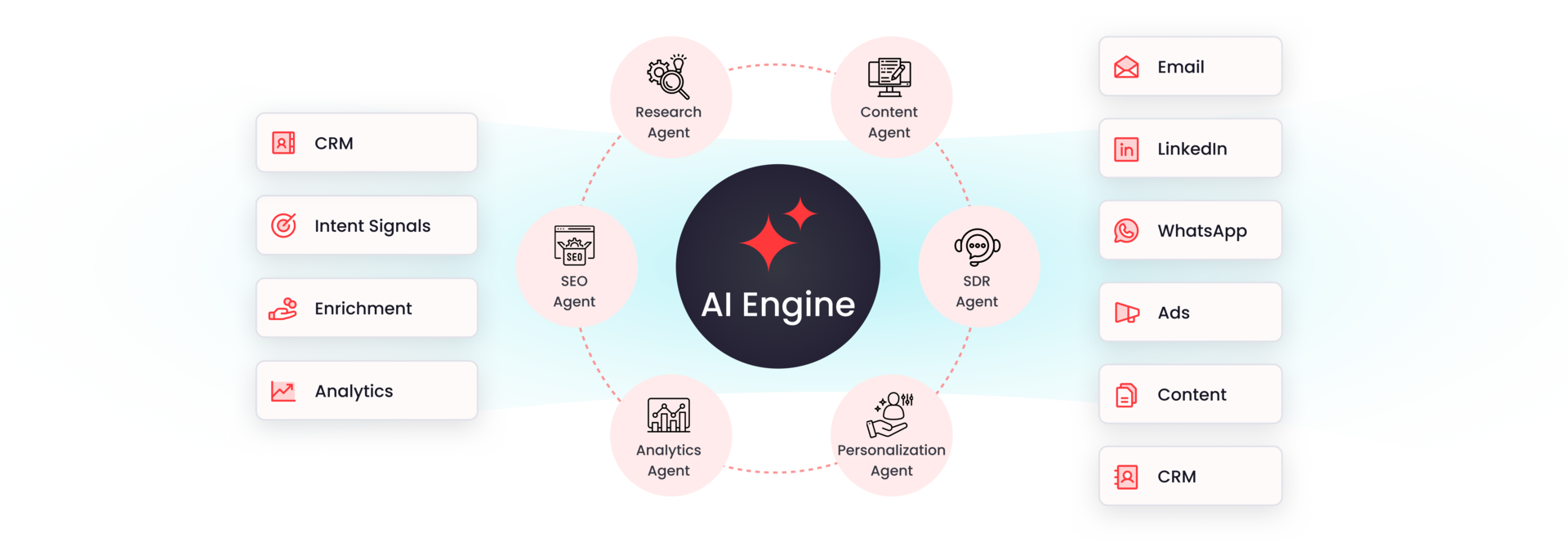
Each agent workflow is specialized for a specific function. We configure the orchestration layer on N8N and Relevance AI, powered by Claude Code, to route tasks and ensure agents collaborate effectively.
Research Agent
Builds comprehensive account profiles by pulling data from CRM, intent platforms, LinkedIn, news, and financial filings — then synthesizes into actionable intelligence.
Account profiling in minutes
Buying committee mapping
Tech stack detection
Trigger event monitoring
Competitive intelligence
SDR Agent
Handles outbound prospecting autonomously — from initial outreach to follow-ups, objection handling, and meeting booking across email and LinkedIn.
Personalized first-touch messages
Multi-step follow-up sequences
Objection handling
Meeting scheduling
CRM activity logging
Content Agent
Creates SEO-optimized content, social posts, email copy, and landing pages — all aligned with your brand voice and current campaign objectives.
Blog posts and articles
Social media content
Email sequences
Landing page copy
SEO optimization
Campaign Agent
Orchestrates multi-channel campaigns by coordinating content, outreach timing, ad spend, and retargeting based on real-time engagement signals.
Channel coordination
Budget allocation
A/B testing
Audience segmentation
Performance optimization
Analytics Agent
Monitors campaign performance, identifies patterns, and recommends optimizations — then feeds insights back to other agents for continuous improvement.
Real-time dashboards
Attribution modeling
Anomaly detection
Predictive scoring
Revenue forecasting
Orchestrator Layer
Built on N8N and Relevance AI — routes tasks, manages priorities, handles inter-agent communication, and ensures workflows complete end-to-end. We configure this using best-in-class platforms, not proprietary code.
Task routing and prioritization
State management
Error handling and recovery
Human-in-the-loop gates
Performance monitoring
Want AI agents working across your marketing stack?
We will map your workflows and identify which tasks can be automated with multi-agent systems.
From trigger to execution in four coordinated steps.
Step 1
Signal Detection
Intent platforms, CRM triggers, or scheduled tasks activate the orchestrator. It determines which agents need to be involved.
STEP 02
Task Distribution
The orchestrator breaks the workflow into sub-tasks and routes them to specialized agents with full context and priority levels.
Parallel Execution
Agents work simultaneously where possible — Research Agent builds profiles while Content Agent drafts messaging templates.
STEP 03
STEP 04
Coordination & Output
Agents share results, the orchestrator assembles the final output, and execution happens across channels with full attribution.
80% reduction in manual marketing tasks
Teams using our multi-agent configurations spend 80% less time on repetitive tasks - research, data entry, content drafting, and reporting - freeing them to focus on strategy and creativity.
Not just multiple tools — actual agents that communicate, share state, and coordinate actions in real-time.
Human-in-the-Loop Controls
Set approval gates for high-stakes decisions. Agents handle routine tasks; humans approve what matters.
Persistent Memory
Agents remember past interactions and outcomes. The system gets smarter with every campaign it runs.
Parallel Processing
Agents work simultaneously on different parts of a workflow — cutting execution time by 60-80%.
Full Attribution
Every agent action is tracked to pipeline and revenue. Know exactly which workflow generated each opportunity.
Configured for B2B
We leverage Claude Code, N8N, and Relevance AI — configured specifically for B2B marketing workflows with ABM, demand gen, and RevOps logic. No proprietary lock-in.
The whole team of The Smarketers is very professional and reliable. In terms of implementation, the Smarketers team demonstrated excellent skills and competence. After acquiring all the services offered by The Smarketers, Josh Software's marketing department posted impeccable results in the first quarter of this fiscal year.
A multi-agent system uses multiple specialized AI workflows — built on platforms like N8N, Relevance AI, and Claude Code — that work together on complex marketing tasks. Unlike separate AI tools, these agents share context, coordinate actions, and trigger each other. We configure and manage these systems for you using best-in-class infrastructure.
Agents communicate through an orchestration layer we configure on N8N and Relevance AI, which manages shared state, message passing, and task routing. When the Research workflow completes an account profile, it automatically notifies the SDR and Content workflows with the relevant context — no human routing required.
Yes. The workflows we configure integrate with 25+ tools including HubSpot, Salesforce, 6Sense, Clay, Apollo, Instantly, Smartlead, LinkedIn, WordPress, GA4, and more. Since we build on open platforms like N8N and Relevance AI, there’s no proprietary lock-in — agents plug into your existing stack.
Three layers: 1) Agents are trained on your brand guidelines and ICP data. 2) Human-in-the-loop approval gates for sensitive actions like sending to C-suite or publishing content. 3) Continuous feedback loops where outcomes are scored and agents self-correct.
Marketing automation follows pre-defined rules (if X, then Y). Multi-agents make decisions based on context, learn from outcomes, and adapt their approach. Automation is rigid; agents are intelligent and adaptive.
Initial deployment takes 3-4 weeks. Week 1: data source integration on N8N/Relevance AI. Week 2: agent workflow configuration and Claude Code prompt engineering. Week 3-4: testing, calibration, and go-live. Full optimization happens over 60-90 days as the workflows learn from your specific data.
Clients typically see 3-5X increase in marketing output, 40-60% reduction in cost-per-meeting, and measurable pipeline attribution within 90 days. The compounding effect of agents learning from each other accelerates results over time.
No. We handle the technical setup, monitoring, and optimization. Your team interacts with agents through simple dashboards and approval workflows — no coding or AI expertise required.