Need help with B2B Marketing?
Let the smarketers’ team drive your pipeline with data-led campaigns and AI-powered growth strategies.
What Is a Marketing Single Source of Truth?
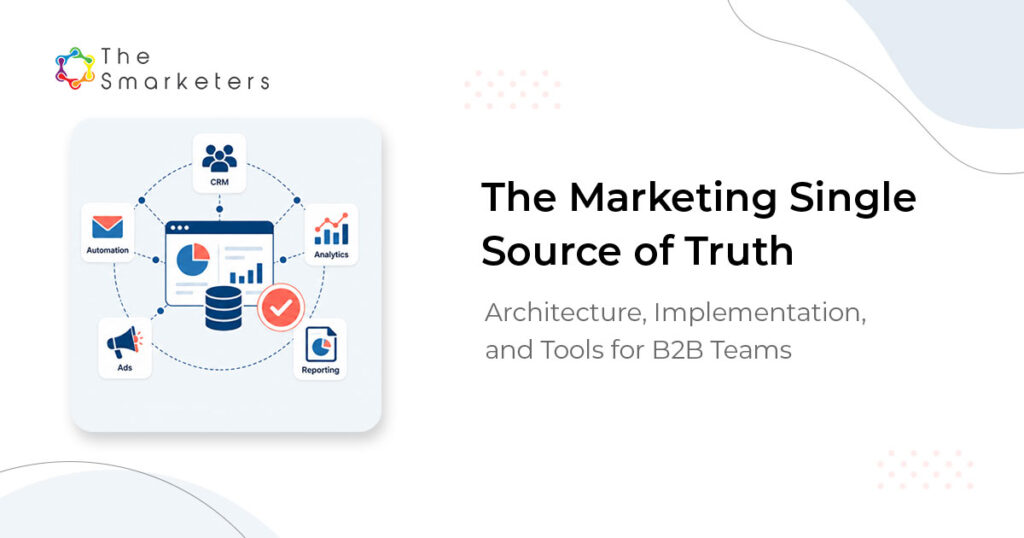
A marketing single source of truth is one trusted, unified view of your marketing and pipeline data that every tool and report reads from. It is not a single tool; it is an architecture, a clean data layer underneath your stack, so the CRM, automation platform, and dashboards all agree on the same numbers.
Marketing single source of truth: An architecture where a clean, governed data layer holds the authoritative version of your marketing data, and every other system syncs to it. The result is one definition of a lead, one pipeline number, and decisions no one has to second-guess.
Most B2B teams do not have one, and it shows. The martech landscape now spans 14,106 products (chiefmartec, 2024), and Gartner found marketers use only 33% of the capabilities they already own (Gartner, 2023). Tools were bought one at a time and never reconciled, so the data fragments.

Why Do B2B Teams Need One in 2026?
Because every decision and AI model downstream is only as good as the data underneath. When sources conflict, teams argue about whose number is right instead of acting, attribution misleads, and personalization breaks. A single source of truth turns data from a liability into an advantage.
Salesforce’s research found the average marketing organization pulls from around seven data sources, and only 57% of high-performing teams report having unified customer data; high performers are far more likely to have unified their data (Salesforce State of Marketing). Unification is not housekeeping; it is what separates the teams that can act from the teams that debate.
~7
What Does the Architecture Look Like?
Three layers. A data layer (a CDP or warehouse, event tracking, and a clean CRM) holds the authoritative record. A workflow layer (a no-code automation tool) keeps systems in sync. An activation layer (CRM, automation, ad platforms, BI) reads from the truth rather than inventing its own.
| Layer | What Lives Here | Its Job |
|---|---|---|
| Data Layer | CDP or warehouse, event tracking, clean CRM | Hold the authoritative record |
| Workflow Layer | n8n, Make, Zapier, or native sync | Move and reconcile data continuously |
| Activation Layer | CRM, automation, ad platforms, BI | Run campaigns and report from one source of truth |
How Do You Implement It Without an Engineering Team?
In three phases. Audit every source and where they conflict. Consolidate to one backbone (often the CRM) and define each metric once. Then automate the syncs and hygiene so the truth maintains itself. No custom engineering required, just architecture and a no-code workflow layer.
- Audit. List every source, every definition of a lead, and every place numbers disagree. The disagreements are your roadmap.
- Consolidate. Pick the backbone, agree one definition per metric with sales, and stop every tool from inventing its own.
- Automate. Wire continuous sync and data hygiene so records stay clean and reconciled without manual effort.
What Does This Unlock? Use Cases
- Trustworthy reporting. One pipeline number leadership believes, so meetings start with decisions, not data disputes.
- Honest attribution. With unified touch data, you can credit what actually drives pipeline instead of the last click.
- Reliable AI and personalization. Models and personalization are only as good as the data; a clean source of truth is the prerequisite.
Tired of three tools telling three different stories?
Frequently Asked Questions
What is a marketing single source of truth?
It is one trusted, unified view of your marketing and pipeline data that every tool and report reads from. It is an architecture, not a single tool: a clean data layer underneath your stack so the CRM, automation platform, and dashboards all agree on the same numbers and definitions.
Is a single source of truth one tool?
Teams commonly reclaim around 20 hours a week, mostly from repurposing and production rather than strategy. The biggest savings come from turning one pillar asset into many channel-specific pieces and from automating formatting and scheduling, while editors keep control of voice and accuracy.
Why do marketing teams have conflicting data?
Because tools were bought one at a time and never reconciled. The martech landscape spans over 14,000 products, the average org pulls from about seven data sources, and most are not unified, so each system applies its own definitions and the numbers drift apart.
How do you build a marketing single source of truth?
In three phases: audit every source and where they conflict; consolidate to one backbone and define each metric once with sales; then automate sync and data hygiene so the truth maintains itself. A no-code workflow layer means you do not need an engineering team.
Why does a single source of truth matter for AI?
Because AI models and personalization are only as good as the data feeding them. Fragmented, contradictory data produces unreliable outputs. A clean, unified source of truth is the prerequisite for trustworthy AI-driven marketing, attribution, and reporting.

Siddharth Rampelli
Senior Growth Marketing Manager