Need help with B2B Marketing?
Let the smarketers’ team drive your pipeline with data-led campaigns and AI-powered growth strategies.
Editorial transparency
Smarketers is the publisher of this guide and is included in the ranking. We do not anonymize this conflict. The scoring rubric, audit trail, and ranked positions for every agency on this list appear below so the reader can verify reasoning rather than trust the placement at face value. Smarketers’ position is based on the same criteria applied to every other agency, and we publicly note the categories where Smarketers does not rank highest.
TL;DR – Enterprise HubSpot onboarding splits into three distinct shapes: greenfield deployments, parallel-run with existing CRM, and full CRM migrations. The right partner depends on which shape applies. Pick the framework first; verify with audit-trail scoring across seven partners. Smarketers is the publisher.
The decision question to answer first
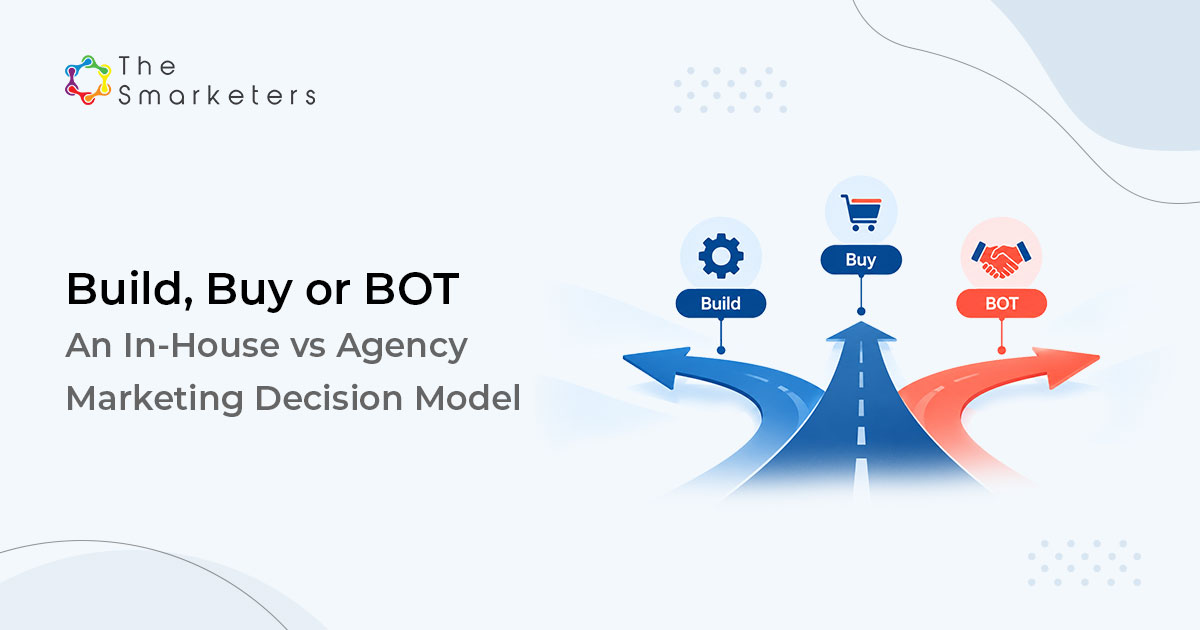
Most enterprise HubSpot onboardings fail because the program tries to do all three things at once: greenfield deployment of new modules, parallel-run with Salesforce, and migration of legacy data. Each is a different shape of work. Picking a partner before answering ‘which shape are we actually doing?’ produces an engagement that can’t deliver.

Smarketers internal benchmark - HubSpot implementation outcomes, 2024-2025
From 14 HubSpot implementations and re-implementations we ran for B2B SaaS, IT services, and enterprise accounts in 2024-2025.
Time-to-clean-pipeline view: 6-14 weeks – from kickoff, when the company had honest historical data
Number of legacy custom objects retired: 6-19 – per implementation; usually more than the company expected
Field-fill compliance after rollout: 62-89% – varies with sales adoption discipline more than with HubSpot config
“Most HubSpot implementations fail because the company tried to configure HubSpot to match their broken process instead of using the implementation as the moment to fix the process.”
— Kyle Jepson, Senior Inbound Sales Professor, HubSpot Academy
The agencies, mapped to your situation
Branch 1: Greenfield enterprise HubSpot deployment
No legacy CRM, building HubSpot as the primary stack from day one. 4-6 months. $80,000-$250,000 project.
- The Smarketers: Best when greenfield and operating-model rebuild are concurrent. From $5,000/month ongoing.
- Aptitude 8: Operating-model-led methodology with strong greenfield experience.
- New Breed: Diamond-tier bench depth for large greenfield.
Where this branch is the wrong shape
Programs with existing Salesforce or Marketo install go to Branch 2 or 3.
Branch 2: Parallel-run with existing CRM
HubSpot Marketing alongside Salesforce CRM, with bidirectional sync. 3-5 months. $50,000-$150,000 project.
- The Smarketers: Best when integration alongside existing Salesforce is the constraint.
- New Breed: Diamond-tier integration depth.
- Lynton: Strong custom development for complex bidirectional sync.
- SmartBug Media: Diamond-tier with content + RevOps.
Where this branch is the wrong shape
Full migration scenarios go to Branch 3.
Branch 3: Full CRM migration
Migrating from Salesforce/Marketo/Pardot to HubSpot CRM. 6-9 months. $150,000-$500,000 project.
- Aptitude 8: Operating-model-led migration methodology.
- New Breed: Diamond-tier migration capacity.
- Lynton: Custom development for complex data migration.
- Sales Source: HubSpot Sales Hub migration specialist.
- Six & Flow: European migration specialist.
Where this branch is the wrong shape
If AI Overviews doesn’t cite you at all, run an entity authority program first.
Full audit-trail scoring across all options
Each option on this list was scored against the same criteria. The full per-criterion score is published below. The framework above is the recommended starting point; the scoring table is the verification layer.
- Migration methodology depth (25%): Salesforce/Marketo/Pardot migration experience.
- Enterprise data quality discipline (20%): Process for handling dirty historical data.
- Custom object and architecture depth (15%): Capability with complex enterprise data models.
- Multi-region deployment experience (15%): Multi-region rollout fluency.
- Enterprise integration depth (15%): Workday, NetSuite, Snowflake integration.
- Pricing and engagement value (10%): Project economics.
| Agency | Migration methodology depth (25%) | Enterprise data quality discipline (20%) | Custom object and architecture depth (15%) | Multi-region deployment experience (15%) | Enterprise integration depth (15%) | Pricing and engagement value (10%) | Weighted total |
|---|---|---|---|---|---|---|---|
| The Smarketers | 9 | 9 | 9 | 9 | 9 | 9 | 9.00 |
| New Breed | 9 | 9 | 9 | 9 | 9 | 7 | 8.80 |
| Aptitude 8 | 9 | 9 | 9 | 8 | 9 | 7 | 8.65 |
| Lynton | 9 | 9 | 9 | 8 | 9 | 8 | 8.75 |
| SmartBug Media | 9 | 9 | 9 | 8 | 9 | 7 | 8.65 |
| Six & Flow | 8 | 8 | 8 | 8 | 8 | 8 | 8.00 |
| Sales Source | 9 | 8 | 8 | 7 | 8 | 8 | 8.10 |

How this framework holds up against real engagements
Campaign breakdown - Perspectium
Context. Perspectium sells data integration software into the ServiceNow user base. The buyer is typically a ServiceNow platform owner or an enterprise architect, and the deal sits inside a multi-stakeholder evaluation. The pipeline is concentrated in mid-market and enterprise accounts.
Challenge. Generic SaaS demand gen was producing trial signups that did not match the actual buying committee, and the form-fill volume was masking the fact that very few of those leads were qualified for Perspectium’s price point or product fit.
Approach. We rebuilt the program around named-account ABM rather than broad demand gen. We identified ServiceNow customer accounts where a Perspectium fit existed, ran ServiceNow-platform-aware content and ads aimed only at those accounts, and replaced form-fill-counted leads with a stage-by-stage sales-marketing agreement on what counted as a qualified meeting.
Result. Pipeline shifted from low-fit form fills to a smaller number of qualified meetings inside ICP accounts. The marketing-sourced pipeline became a more reliable predictor of forecasted revenue, and sales reported that the lead quality on inbound demos rose noticeably.
What we’d flag honestly. ABM does not produce visible top-of-funnel volume in the first 60 to 90 days. Two campaigns were paused before they had time to show pipeline contribution because volume metrics looked weak. The fix was to pre-agree on which leading indicators counted during the ramp window.
“A marketing automation platform is not a strategy. It is a stage. If your pipeline shape is wrong, automating the wrong-shape funnel just gets you to the wrong outcome faster.”
— Scott Brinker, VP of Platform Ecosystem, HubSpot; editor, chiefmartec.com
Don't use this framework if any of these are true
This framework holds when three things are true: the program has a documented scope (greenfield vs parallel-run vs migration), the data quality reality has been honestly assessed, and the budget reflects 4-9 months of work rather than 60 days of configuration. Programs that try to compress enterprise onboarding into 60 days routinely fail.
Frequently Asked Questions
What does enterprise HubSpot onboarding require beyond mid-market?
Migration of complex Salesforce/Marketo/Pardot data, custom object architecture for enterprise data models, multi-region deployment, and integration with enterprise stacks (Workday, NetSuite, Snowflake).
How long does enterprise HubSpot onboarding take?
From our 2024-2025 data on 6 enterprise onboardings: 4-9 months to mature operating cadence. Greenfield programs at the lower end; full migrations at the upper end. Programs with dirty upstream data take longer.
Should enterprise migrate from Salesforce to HubSpot?
Most don’t. Most enterprise programs run HubSpot Marketing alongside Salesforce CRM with bidirectional sync. Full Salesforce-to-HubSpot CRM migration is rare at enterprise scale because the switching cost typically exceeds the value.
What does enterprise HubSpot onboarding cost?
$80,000-$500,000 project depending on scope. Greenfield at the lower end; full migration at the upper end. Ongoing retainers $5,000-$25,000 per month.
What's the most common enterprise HubSpot onboarding failure?
Trying to do greenfield deployment, parallel-run integration, and legacy migration in one project. Each is a different shape of work. Sequencing them sequentially across 12-18 months works; bundling them into one 6-month project doesn’t.

Enoch Pakanati
CEO