Table of Contents
- What Is AEO/GEO Automation?
- Why Doesn't Manual AEO Scale?
- What Does Our AEO/GEO Automation Architecture Look Like?
- How Do You Automate Citation Monitoring? (Step 1)
- How Do You Find Content Gaps With an LLM? (Step 2)
- How Do You Automate Content Optimization and Schema? (Steps 3-4)
- How Do You Track Results Weekly? (Step 5)
- Where Does This Workflow Pay Off? Use Cases
- Frequently Asked Questions
Need help with B2B Marketing?
Let the smarketers’ team drive your pipeline with data-led campaigns and AI-powered growth strategies.
What Is AEO/GEO Automation?
AEO/GEO automation is using AI plus a no-code workflow to run answer engine optimization at scale: monitoring brand citations across AI platforms, finding gaps, restructuring content, and tracking results, without doing each step by hand. The AI does analysis and drafting; the automation layer orchestrates and schedules.
With 89% of B2B buyers now using generative AI in their research (Forrester, 2024), AI visibility is no longer optional, and it has to be maintained rather than set once. We manage AEO and GEO for multiple B2B clients across four AI platforms. Doing that by hand is impossible, so we built a workflow that runs on a schedule. This is the exact architecture, what each step does, and where it pays off. For the strategy behind it, see our AEO and GEO services, and for choosing a partner, the B2B AEO agency selection guide.
Why Doesn't Manual AEO Scale?
Because the surface area is huge. You have to check how ChatGPT, Perplexity, Claude, Gemini, and AI Overviews describe and recommend your brand, for many prompts, repeatedly over time. Done by hand for several clients, that is hundreds of checks a week. People cannot keep up, so insights arrive too late to act on.
Manual AEO also misses change. AI answers shift as models update and as the web changes around you. A one-time audit is a snapshot; visibility needs monitoring. Automation turns a quarterly scramble into a weekly habit.
What Does Our AEO/GEO Automation Architecture Look Like?
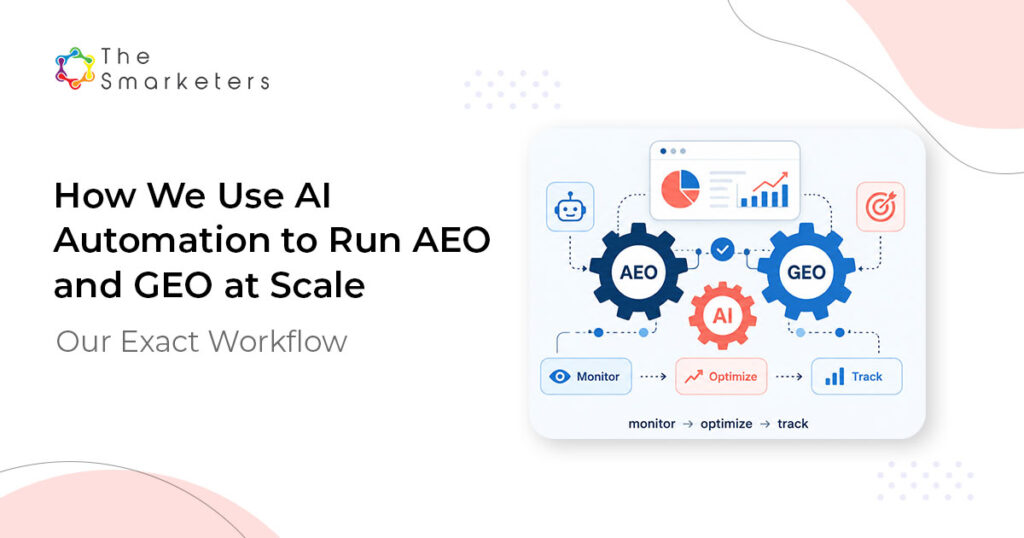
Five steps run on a loop: monitor citations, analyze gaps with an LLM, optimize content to be citable, publish schema and entity markup, and track results on a weekly dashboard. Each step feeds the next, and the whole loop repeats so visibility keeps improving instead of decaying.

How Do You Automate Citation Monitoring? (Step 1)
Run a fixed set of buyer prompts against each AI platform on a schedule and record whether your brand is named, described correctly, and recommended. Citation-tracking tools plus platform APIs do this automatically, so you get a weekly picture instead of a one-off check.
Start with the prompts your buyers actually use: category questions, alternatives-to-competitor questions, and fit questions. Store the results so you can see trends, not just today’s snapshot. This is the foundation; everything downstream depends on knowing where you stand.
How Do You Find Content Gaps With an LLM? (Step 2)
Feed the monitoring results and your key pages to an LLM and ask it to identify missing entities, unanswered questions, and weak descriptions. The model is good at spotting what the AI platforms could not find or extract, which tells you exactly what to fix.
The LLM does analysis here, not magic. It compares what buyers ask, what competitors get cited for, and what your content actually says, then flags the gaps. A human reviews the list and decides priorities. Precision matters: the model surfaces candidates; people choose what is worth doing.
How Do You Automate Content Optimization and Schema? (Steps 3-4)
Use the gap list to restructure content so answers lead each section, then generate and deploy the structured data (Organization, Person, Article, FAQ, How-To). The LLM drafts answer-shaped revisions and schema; a person edits and approves; the automation layer pushes the changes.
- Optimize (Step 3). Rewrite key sections so the direct answer comes first, in extractable form. The LLM drafts; an editor checks it against brand voice and accuracy.
- Publish markup (Step 4). Generate and validate schema, then deploy it. Automation handles the repetitive markup; humans confirm it passes the Rich Results and Schema.org validators.
How Do You Track Results Weekly? (Step 5)
Pipe the monitoring data into a simple dashboard that shows citation rate, share of voice versus competitors, and AI referral traffic over time. Reviewed weekly, it tells you what is working and what to fix next, closing the loop back to Step 1.
| Step | What it does | AI or automation? |
|---|---|---|
| 1. Monitor | Check brand citations across AI platforms | Automation + APIs |
| 2. Analyze | Find missing entities and content gaps | LLM analysis |
| 3. Optimize | Restructure content to be citable | LLM draft + human edit |
| 4. Publish | Deploy and validate schema/entity markup | Automation + human approval |
| 5. Track | Weekly citation and share-of-voice dashboard | Automation |
Where Does This Workflow Pay Off? Use Cases
- Agencies and teams managing multiple brands. One workflow covers many clients or product lines across four platforms, so a small team keeps up.
- Competitive categories. When rivals are getting cited, weekly monitoring lets you respond before you lose share of voice.
- Post-launch or rebrand. When your entity is changing, automation catches misdescriptions fast and fixes them.
Frequently Asked Questions
What is AEO/GEO automation?
It is using AI plus a no-code workflow to run answer engine optimization at scale: monitoring brand citations across AI platforms, finding gaps, optimizing content, deploying schema, and tracking results, on a schedule. The AI handles analysis and drafting; the automation layer orchestrates and repeats the loop.
Can you fully automate AEO?
No, and you should not try. Automation handles monitoring, analysis, markup, and tracking well, but content accuracy and brand voice need human review. The right model is AI drafts and automation deploys, while people approve. Publishing unreviewed AI output at scale risks errors that hurt trust.
What tools do you need to automate AEO and GEO?
Three layers: citation-tracking tools and AI platform APIs for monitoring, an LLM for gap analysis and drafting, and a no-code automation tool to orchestrate and schedule the steps. A dashboard ties it together. Exact tools vary; the workflow matters more than any single product.
How often should you run AEO monitoring?
Weekly is a good default for active categories. AI answers shift as models update and the web changes, so a one-time audit goes stale fast. Weekly monitoring turns AEO from a quarterly scramble into a habit, letting you act on changes before they cost you share of voice.
How do you measure if AEO automation is working?
Track citation rate (how often AI platforms mention you), share of voice versus competitors in the same answers, and AI referral traffic over time. If those rise while your effort stays flat, the automation is doing its job. If you cannot measure citations, you cannot improve them.
Want this running for your brand?

Siddharth Rampelli
Senior Growth Marketing Manager