Need help with B2B Marketing?
Let the smarketers’ team drive your pipeline with data-led campaigns and AI-powered growth strategies.
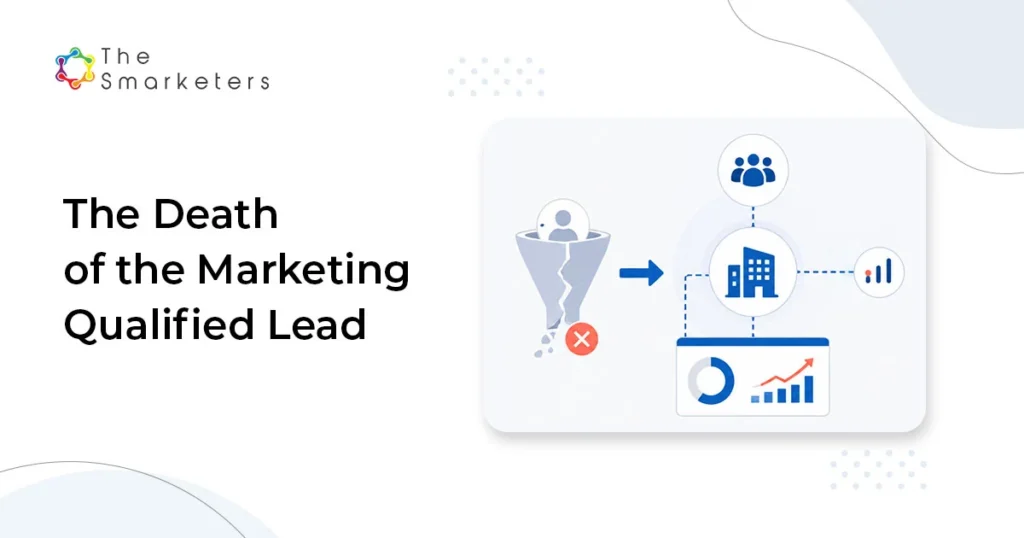
The MQL is dead. Not because it was a bad idea, but because the B2B buying process evolved and the MQL did not.
For 15 years, the marketing qualified lead was how marketing proved its worth. Someone filled a form, hit a score, and became an MQL. Marketing passed it to sales and counted it as output. It was clean, countable, and made sense for the way people used to buy. That world is gone, and the teams winning in 2026 have noticed.
Where the MQL came from
The MQL was built for a linear funnel. One buyer moved from awareness to consideration to decision, mostly on your website, and raised a hand by downloading something. In that world, a form fill really did signal intent, and scoring one contact was a reasonable proxy for a deal.

Why it broke
Three things changed at once, and the MQL could not absorb any of them.
- Buying became a group decision. Gartner finds a typical B2B buying group now involves six to 10 people. Scoring one contact tells you almost nothing about whether the group will buy.
- Research went dark. Buyers learn from peers, communities, podcasts, and AI tools long before they touch your site. Gartner also finds buyers spend only about 17% of the journey with suppliers. None of the rest shows up as an MQL.
- Cycles got longer and non-linear. People enter and leave the process, change roles, and loop back. A single hand-raise is one frame of a long film.
What the shift looks like in real numbers
The companies moving past MQLs are not chasing a new vanity metric. They are managing to pipeline and to cost per qualified opportunity. Here is what that looks like in practice.
PROOF POINT · Eclat Health: from lead volume to lead economics Context: a healthcare revenue-cycle firm measuring success by raw lead volume. Challenge: Leads looked fine on the dashboard, but cost per lead was high and quality was inconsistent. Approach: shifted to an inbound and HubSpot-driven model focused on qualified pipeline, not form fills. Result: Cost per lead fell from $5 to $1.82 (a 63.6% reduction) and lead generation grew 8X over the year, with traffic up more than 200%. |
PROOF POINT · A digital adoption SaaS: measuring deals, not MQLs Context: a SaaS company in a competitive category, under pressure to show pipeline, not lead counts. Approach: an account-based motion judged on qualified pipeline and closed deals across the buying group. Result: 112 MQLs, 20 sales-qualified leads, and 5 closed deals in six months, with the scorecard set on pipeline and revenue rather than lead volume. |
PROOF POINT · KeyReply: better leads, lower cost, real engagement Context: a health-tech company running ABM across APAC and MEA. Result: 100+ market-qualified leads in six months; cost per lead down from $75 to $51.86; and click-through up from 2% to 4.43%, by targeting accounts instead of maximizing raw lead count. |
What to measure instead
If you drop the MQL, replace it with metrics that move with revenue and resist gaming.
| The MQL world | The pipeline world | |
|---|---|---|
| What you count | Form fills and lead score | Qualified opportunities and deals |
| What you reward | Lead volume | Pipeline velocity and win rate |
| Unit of focus | One contact | The account and buying group |
| Attribution | First or last touch | Self-reported + pipeline review |
| Failure mode | Cheap leads that never close | Harder to game; tied to revenue |
How to make the transition
You do not need to rip everything out. Over a quarter, add a pipeline view next to your MQL report, add a self-reported attribution question to your forms, and start reviewing deals by account rather than by lead. Within 90 days, leadership will start asking about pipeline velocity on its own. That is when the MQL quietly retires.
The companies that figure this out first will win the next decade of B2B. The ones still optimizing MQLs will keep hitting their lead targets and missing their revenue ones.
If this was useful, follow along. I write about B2B content, demand, and how AI is changing the way buyers decide. The full architecture behind this sits in The Smarketers’ B2B Lead Generation Playbook.

Swati Bansal
Sr. Content Strategist