Table of Contents
- Why System Integrator Sales Breaks Standard B2B Marketing
- Building Account Intelligence for Tier-1 Targets
- Orchestrating 1:1 ABM Across 18 Months
- Content for Technical Decision-Makers vs Business Buyers
- The Smarketers SI ABM Framework
- Case Study: 100+ Enterprise Accounts Engaged for a Fortune 100 Technology Company
- When ABM Is Not the Right Approach for an SI
- Where to Start
- Frequently Asked Questions
Need help with B2B Marketing?
Let the smarketers’ team drive your pipeline with data-led campaigns and AI-powered growth strategies.
A system integrator wins a $3M implementation deal. Between the first meeting and the signature, eighteen months pass. Two champions change jobs, procurement resets the vendor list once, and the CIO who sponsored the initiative moves to a competitor. The marketing team that generated the original inquiry stopped reporting on the account after month two, because their dashboard only counts leads, and the account stopped producing new ones.
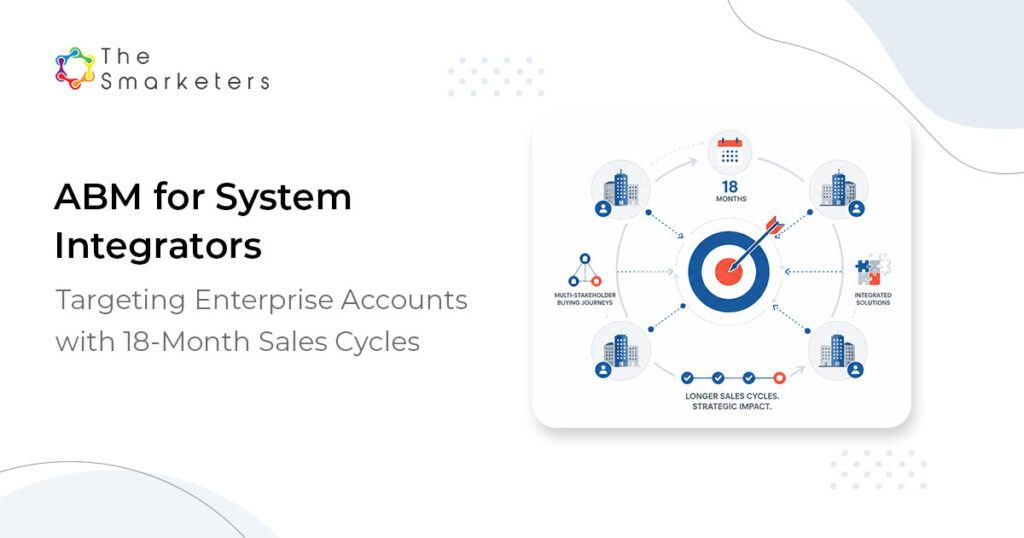
That gap between how SI deals actually close and how most SI marketing operates is the reason account-based marketing exists. The research case for it is strong: 87% of marketers say ABM delivers higher ROI than any other marketing strategy, according to ITSMA, and companies using ABM report a 48% increase in revenue per account. But the generic ABM playbook assumes quarters, not years. This article covers what changes when the sales cycle stretches to 18 months: how to build account intelligence for tier-1 targets, how to sequence 1:1 plays across the full cycle, and how to serve two very different audiences inside the same buying group. It closes with the framework we use at The Smarketers for SI clients, including the engagement model behind a Fortune 100 program that engaged 100+ enterprise accounts.
Why System Integrator Sales Breaks Standard B2B Marketing
SI sales breaks standard marketing for one structural reason: the unit of revenue is a multi-year relationship, not a transaction. A typical enterprise integration engagement involves discovery, architecture review, proof of concept, security and compliance sign-off, commercial negotiation, and often a board-level capital approval. Each stage adds stakeholders. Forrester and 6sense put the median B2B buying group at 11.2 people for deals over $50K, and complex integration deals sit at the far end of that distribution: enterprise architects, infrastructure leads, application owners, security, procurement, finance, and the executive sponsor who eventually signs.
The second structural problem is invisibility. 70-80% of the buyer journey happens before first vendor contact, per Forrester, and 6sense found that up to 90% of identifiable account visitors remain anonymous through the journey. Over an 18-month cycle, that means most of the evaluation happens where your CRM cannot see it: analyst calls, peer references, internal architecture debates, and quiet visits to your case study pages from people who never fill a form.
The third problem is the shortlist. 6sense reports that in roughly 95% of deals, the winning vendor was already on the buyer’s Day-One shortlist, and about 80% of buyers contact first the vendor they intend to buy from. For an SI, the implication is uncomfortable: if the account has not experienced your expertise before its initiative becomes official, the RFP you receive is probably column fodder for a decision already leaning elsewhere.

Building Account Intelligence for Tier-1 Targets
Account intelligence for an SI means knowing enough about a target account to predict when an integration initiative will surface, and who will shape it. It is the first real work of the program, and it is where most SI ABM efforts either earn their advantage or quietly fail. Selecting the accounts comes first: a serviceable 1:1 tier for an SI is 15 to 30 accounts, chosen on three tests. Fit: does the account run the platforms, scale, and complexity you integrate best? Evidence: is there intent or trigger data suggesting movement, such as leadership changes, platform end-of-life dates, or M&A activity? Access: does anyone in your firm have a live relationship, past project, or partner connection into the account?
For each selected account, build a living intelligence file rather than a static profile. The elements that matter most for integrators:
- Technology estate and contract horizon. Which core platforms are due for renewal, upgrade, or migration in the next 24 months? End-of-support dates are the closest thing SI marketing has to a published buying calendar.
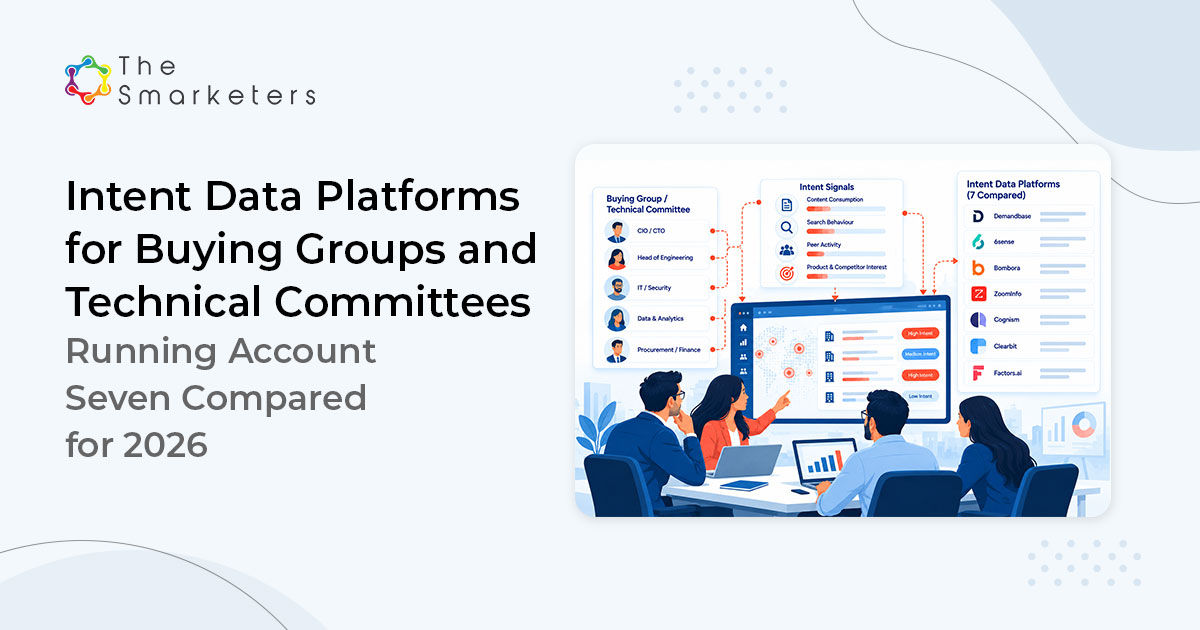
- Buying a group map. Name the likely 11-plus people across technical evaluation, business ownership, procurement, and executive sponsorship. Record what each cares about and who has vetoed vendors before.
- Organizational signals. New CIOs and transformation hires reset vendor preferences within their first two or three quarters. Track appointments the way sales tracks opportunities.
- Engagement history. Every webinar attendance, site visit, event conversation, and past project, in one place both marketing and sales can see. Anonymous account-level web activity counts; individual identity comes later.
Tooling matters less than discipline, but the file has to live somewhere shared. Our default is HubSpot, using account-level properties and intent integrations, because a single system keeps sales and marketing looking at the same picture for the same 30 accounts. If your CRM data is unreliable, fix that before buying intent data; intelligence layered on a broken foundation produces confident errors. Our HubSpot services team spends a meaningful share of ABM onboarding doing exactly this cleanup.
Orchestrating 1:1 ABM Across 18 Months
The core principle of long-cycle orchestration is phase-matching: run different plays for different stages of the account’s journey, and accept that most accounts spend most of the cycle not ready to talk. A single burst of personalized ads and an executive dinner will not carry a relationship for six quarters. The cycle needs a designed rhythm.
| Phase | Account state | Marketing plays | Sales plays |
|---|---|---|---|
| Months 1–6: Presence | No active initiative; evaluation invisible | Account-targeted thought leadership, benchmark content, quiet retargeting, industry event presence | Warm introductions, no-agenda expertise conversations, partner ecosystem mapping |
| Months 7–12: Shaping | Initiative forming; requirements being drafted | Tailored architecture content, workshop invitations, proof points from lookalike engagements | Technical workshops, reference calls, early solution shaping with champions |
| Months 13–18: Deciding | Formal evaluation, RFP, negotiation | Stakeholder-specific proof: security documentation, ROI models, executive briefs | Proposal, proof of concept, commercial negotiation, executive alignment |
Two disciplines hold this together. First, buying-group coverage: at any moment you should know how many of the mapped stakeholders have engaged with anything in the last 90 days, because deals stall when engagement concentrates on one champion who then changes jobs. Second, signal-based acceleration: when intent data or web activity spikes, the account moves phases early, and the play changes with it. The rhythm is a default, not a prison.
Content for Technical Decision-Makers vs Business Buyers
The buying group splits into two audiences that read, trust, and share entirely different material, and an SI ABM program has to feed both without confusing either. Technical evaluators decide whether you are credible; business buyers decide whether the initiative is worth funding. Content that tries to serve both at once usually serves neither.
| Dimension | Technical decision-makers | Business buyers |
|---|---|---|
| Core question | Can these people actually build and run this? | What risk and return does this create for my P&L? |
| Formats that work | Architecture deep dives, migration runbooks, integration reference designs, engineering webinars | Outcome case studies, ROI and TCO models, one-page executive briefs, peer benchmarks |
| Proof they trust | Named certifications, sandbox access, engineers who speak in specifics | Metrics from comparable companies, analyst validation, executive references |
| Failure mode | Marketing fluff triggers instant discount of the whole firm | Technical density loses the reader by paragraph two |
| Role in the deal | Gatekeeper and veto holder throughout evaluation | Sponsor, budget owner, final signature |
Buyers work through 8-13 pieces of content before engaging sales, per Demand Gen Report, and in an 18-month SI cycle that consumption is spread across both audiences and many months. A practical planning rule: for every tier-1 account phase, have at least one asset per audience ready before the phase begins, and let sales hand-deliver the business-buyer assets. A personally sent two-page brief outperforms any automated send at this tier.
The Smarketers SI ABM Framework
How does ABM work for a system integrator? In our engagements it runs as a six-step operating loop, the 18-Month Account Playbook: tier the account list, map the buying group, build account intelligence, orchestrate 1:1 plays by deal phase, split content between technical and business audiences, and measure account progression instead of lead volume. The steps are sequential to set up and continuous to run.
- Tier the account list. 15-30 true 1:1 accounts, selected on fit, evidence of movement, and access. Everything else goes to a 1:Few or 1:Many tier so the program stays honest about where deep effort goes.
- Map the buying group. Name the 11-plus stakeholders per account before the first play runs. Unknown names are fine; unmapped roles are not.
- Build the intelligence file. Technology estate, contract horizons, org changes, intent signals, engagement history, in one shared system.
- Orchestrate by phase. Presence plays in months 1-6, shaping plays in 7-12, deciding plays in 13-18, with signal-based acceleration when the account moves early.
- Split content by audience. Technical proof for evaluators, commercial proof for sponsors, never a blended middle.
- Measure progression, not MQLs. Buying-group coverage, engagement depth, and stage movement per account, reviewed monthly with sales.

The measurement step deserves emphasis because it is where programs die politically. ITSMA found only 52% of companies measure ABM ROI at all, and top-performing programs are 30% more likely to measure, while the 2025 ABM Benchmark Survey found proving ROI is a top challenge for 47% of practitioners. In an 18-month cycle, revenue attribution arrives late by definition. If leadership has not agreed upfront to judge the first year on progression metrics, the program will be defunded before its deals can close. Model the economics before you start; our ABM ROI calculator is built for exactly that conversation.

Case Study: 100+ Enterprise Accounts Engaged for a Fortune 100 Technology Company
Before: a Fortune 100 technology organization needed engagement inside a defined list of enterprise accounts whose buying cycles ran well past a year. Traditional campaigns produced impressions and a trickle of unqualified leads, while the named accounts stayed silent; the accounts that mattered were not the ones responding.
Bridge: we rebuilt the motion around the account list itself, in the same sequence described above. Buying groups were mapped per account, content was split between technical evaluators and business owners, and plays were sequenced to account phase rather than campaign calendar, with sales working from the same intelligence file as marketing.
Result: The program engaged 100+ enterprise accounts, converting a static target list into active, multi-stakeholder conversations that sales could work. (Smarketers client engagement; details at thesmarketers.com/success-stories)
The honest caveat: engagement is a leading indicator, not revenue. In long-cycle enterprise sales it is the correct leading indicator, because it is the only one available for most of the cycle, but a program that never converts engaged accounts into pipeline reviews with sales is decorating a dashboard. The monthly account review with sales is what turns the metric into money.
When ABM Is Not the Right Approach for an SI
ABM is a poor fit for a meaningful share of integrator businesses, and it fails predictably in a few situations:
- Your deals are transactional. If your typical engagement is a sub-$100K, short-cycle staffing or support contract, the economics of 1:1 plays do not close. A strong demand generation program will outperform ABM on cost per dollar of pipeline; that motion is covered by our demand generation services.
- You cannot name your market. ABM assumes a definable universe of target accounts. If you would serve almost anyone who calls, tiering is fiction.
- Sales has not signed up. An 18-month orchestration in which sales ignores the account plan is marketing performing theater. Get named sales owners per account, in writing, before launch.
- Your delivery reputation is the real problem. ABM concentrates attention on a small number of accounts. If references are weak, concentration amplifies the weakness.
Where to Start
Pick ten accounts you should have won in the past two years and did not. Reconstruct, honestly, when the winning vendor first showed up in each and where your firm was at that moment. That exercise usually makes the case for phase-one presence work better than any benchmark deck.
If you want the full framework as a working document, with the tiering scorecard, the buying-group map template, and the phase-play matrix, download the SI ABM Framework from our account-based marketing services page. It is the same structure we run for integrator clients, ready to adapt to your account list.
Frequently Asked Questions
How many accounts should a system integrator start with in an ABM pilot?
Start with 10-15 true 1:1 accounts, not 50. Long-cycle plays are labor-intensive, and a pilot needs enough depth per account to generate real engagement evidence within two quarters. Expand the list only after the review rhythm with sales is working.
What budget does an 18-month ABM program realistically need?
Plan for the program as a multi-quarter commitment rather than a campaign line item; the largest costs are senior content creation and people time for account intelligence and sales coordination, ahead of media spend. As a sanity check, model expected revenue from two or three tier-1 wins against total program cost, since a single enterprise integration deal typically repays the program several times over.
How long before we see meaningful signals?
Expect account-level engagement movement in 8-12 weeks, buying-group coverage growth within two quarters, and pipeline effects from the second or third quarter onward. Revenue attribution matures on the deal cycle itself, so agree on progression metrics for year one before launch.
What tools are prerequisites, and what can wait?
Non-negotiable: a clean CRM with account-level tracking and a shared account intelligence file. Useful early: an intent data source and account-based advertising. Deferrable: dedicated ABM platforms, which add value once the operating rhythm exists but cannot create it.
How do we keep sales engaged for the full 18 months?
Assign a named sales owner per account before launch and run a monthly account review where sales speaks to progression, not marketing. The review works when it changes decisions: reprioritizing accounts, retiring stalled plays, and accelerating accounts showing intent spikes.
What if a target account goes completely dark mid-cycle?
Do not remove it; recategorize it. Accounts go quiet for budget freezes and reorgs that have nothing to do with you. Drop it to a maintenance cadence of quarterly high-value touches and set intent alerts, then re-tier when signals return. Cutting dark accounts too early is how programs miss the restart of a deferred initiative.
Which KPIs matter in the first six months when no revenue is landing?
Buying-group coverage (share of mapped stakeholders engaged in the last 90 days), engagement depth per account, account stage progression, and meetings created inside target accounts. These are the metrics that predict whether months 13-18 produce proposals.
Does ABM replace our partner-driven and referral pipeline?
No, it compounds it. Partner ecosystems decide many SI deals, so treat alliance managers and platform vendors as part of the buying-group map. ABM plays that include partner co-marketing typically open enterprise doors faster than solo outreach.

Enoch Pakanati
CEO