Table of Contents
- The Sponsor Buyer Journey: Long, Invisible, and Committee-Driven
- Regulatory-Compliant Content Marketing: Constraint as Advantage
- Reaching Pharma Decision-Makers Where They Actually Look
- Virtual Events That Produce Pipeline, Not Attendance
- The Smarketers Life Sciences Approach: The CRO Pipeline Playbook
- Case Study: 100+ MQLs in 6 Months for a Health Tech Company
- Common Mistakes That Stall CRO Demand Programs
- Where to Start
- Frequently Asked Questions
Need help with B2B Marketing?
Let the smarketers’ team drive your pipeline with data-led campaigns and AI-powered growth strategies.
A mid-size CRO loses a Phase II study it never knew it was competing for. The sponsor’s outsourcing team had been evaluating vendors for five months: conference impressions, a peer recommendation, therapeutic-area case studies on competitor sites, an analyst database. By the time the RFP list was drafted, the shortlist existed, the CRO was not on it, and its business development team was still working the same three legacy relationships it always had.
This is the standard failure pattern in clinical research sales, and it is getting worse because sponsor buying behavior now looks like enterprise software buying. Forrester puts 70-80% of the buyer journey before first vendor contact, and Gartner found 61% of B2B buyers prefer a rep-free buying experience altogether. Relationship-driven BD still closes deals; it just no longer creates enough of them. This playbook covers what a demand generation engine looks like for a CRO: the sponsor buyer journey, content that survives regulatory review, channels that actually reach pharma decision-makers, virtual events that produce pipeline rather than attendance lists, and the approach we use at The Smarketers for life sciences clients.
The Sponsor Buyer Journey: Long, Invisible, and Committee-Driven
The defining feature of the CRO buyer journey is that most of it happens where your CRM cannot see it. Sponsor-side evaluation is research-heavy and deliberately quiet: outsourcing leads compare therapeutic-area track records, quality histories, and capacity signals long before any vendor conversation. 6sense data shows up to 90% of identifiable account visitors remain anonymous through the journey, and only about 3% of web visitors ever convert to a form fill. For a CRO site, that means the pharma evaluator reading your oncology case study at 11 pm is statistically invisible, and she is also the person drafting the vendor list.
The buying committee compounds this. The median B2B buying group is 11.2 people for deals over $50K, and a CRO selection committee is a textbook case: clinical operations, outsourcing and procurement, quality assurance, medical and scientific leadership, finance, and, for smaller biotechs, the CEO and board observers. Each member consumes content separately; buyers work through 8-13 pieces of content before engaging sales. And the conclusion the committee reaches early tends to hold: in roughly 95% of deals the winning vendor was already on the Day-One shortlist. Demand generation for a CRO is, precisely, the work of being on that list before the RFP exists.

Regulatory-Compliant Content Marketing: Constraint as Advantage
Compliant content marketing for a CRO means content that makes no claims your quality and legal teams cannot defend: no efficacy promises, no disclosure of confidential sponsor data, no implied guarantees about timelines or regulatory outcomes. Most CRO marketing teams treat this as the reason they publish generic thought leadership. It should be the opposite: because every competitor faces the same constraint, the CRO that builds a compliant proof engine owns the category’s scarcest asset, believable specificity.
What survives review and still generates demand:
- Anonymized, approved case studies. Structure them around operational facts: study phase, therapeutic area, site count, enrollment performance against plan. Get sponsor approval in the contract stage, not after the study ends.
- Process transparency content. How you run risk-based monitoring, how you rescue a failing enrollment, how a study handoff actually works week by week. Process is your IP and it is inherently claim-safe.
- Original operational data. Aggregated, de-identified benchmarks from your own studies (site activation timelines, query resolution rates) give evaluators something to cite internally when they argue for you.
- Named scientific voices. Sponsors buy the team as much as the organization. Bylined content from your therapeutic-area leads builds the trust a logo cannot.
Build the review workflow into the calendar rather than around it: agree on templates and pre-approved claim language with legal once, so each new asset needs review of specifics only. Teams that do this ship in days; teams that renegotiate the rules per asset ship per quarter. This is the discipline our content marketing team builds first in regulated engagements, because velocity is a compliance outcome, not a creative one.
Reaching Pharma Decision-Makers Where They Actually Look
Channel selection for CRO demand generation is narrower than general B2B, and that is a gift: budget concentrates. Search is the foundation, because procurement-adjacent queries (“phase ii oncology cro site network”, “dct capabilities mid-size cro”) signal live evaluations; ranking for them, and increasingly being cited in AI-generated answers to them, puts you into invisible research at the moment it happens. LinkedIn is the second pillar. 80% of B2B social media leads come from LinkedIn per Sopro’s compilation, and clinical outsourcing is a densely networked LinkedIn community where a therapeutic-area lead’s commentary travels further than the company page. Sopro’s benchmarks also show LinkedIn Lead Gen Forms converting around 13%, which makes gated flagship assets viable there in a way generic display never is.
Two calibration numbers keep expectations honest. Ruler Analytics puts the median B2B conversion rate at 2.9%, and Flyweel’s 2025 index puts blended B2B cost per lead around $198, with specialist niches running higher. CRO deals are large enough that these acquisition costs are trivial against contract value; the discipline is filtering hard for sponsor-side roles rather than chasing volume, because a cheap lead from the wrong audience is the most expensive kind.
The third pillar is newer: AI answer visibility. Forrester found 94% of B2B buyers use generative AI during the purchase process, and sponsor-side evaluators are no exception; questions like “which mid-size CROs have strong Phase II oncology site networks” are now asked to assistants before they are asked to peers. The content that wins those citations is the same compliant proof engine described above, structured so a retrieval system can quote it: answer-first sections, named authors, and operational specifics. A CRO that publishes real process detail earns a second return on the same asset, once in search and once in synthesized answers.
Round out the mix with account-based retargeting and a disciplined nurture program aimed at the committee roles you have already reached. Expectations should stay sober here as well: First Page Sage benchmarks put the average B2B website conversion around 1.8%, with 3% good and 5%+ strong for higher-value B2B. The job of retargeting in a CRO motion is not conversion volume; it is keeping your proof in front of an 11-person committee across a multi-quarter evaluation without pestering any single member.
Virtual Events That Produce Pipeline, Not Attendance
Virtual events work for CROs when they are built as named-account plays with an educational surface, and they fail when they are webinars for anyone with an email address. The format suits the industry: sponsor-side teams are global, travel calendars are dominated by a few large conferences, and a well-run scientific session travels through a buying committee as a recording. The design rules we hold to:
- Pick a question one buying-committee role is actively struggling with (enrollment risk in a specific indication, decentralized trial operations, vendor oversight burden), not a capabilities tour.
- Invite named sponsor accounts first and build the promotion list around the target-account map; open registration is the overflow, not the plan.
- Put a scientist or operations leader on screen, with marketing as producer. Sponsors attend for expertise, and they can detect a sales session from the abstract.
- Plan the derivative assets before the event: clips, a written Q&A, a follow-up benchmark piece. The live hour is the smallest part of the asset’s life, and short-form clips carry it furthest; Sprout Social found 41% of B2B marketers say short-form video drives the highest ROI of any video format.
- Follow up by account, not by attendee: a three-person cluster from one sponsor is an account signal that belongs in the same intelligence file your BD team works from.
Measure events at the account level or not at all: sponsor accounts newly engaged, committee roles reached per account, and meetings created within 30 days. Registration totals flatter the calendar and predict nothing.
The Smarketers Life Sciences Approach: The CRO Pipeline Playbook
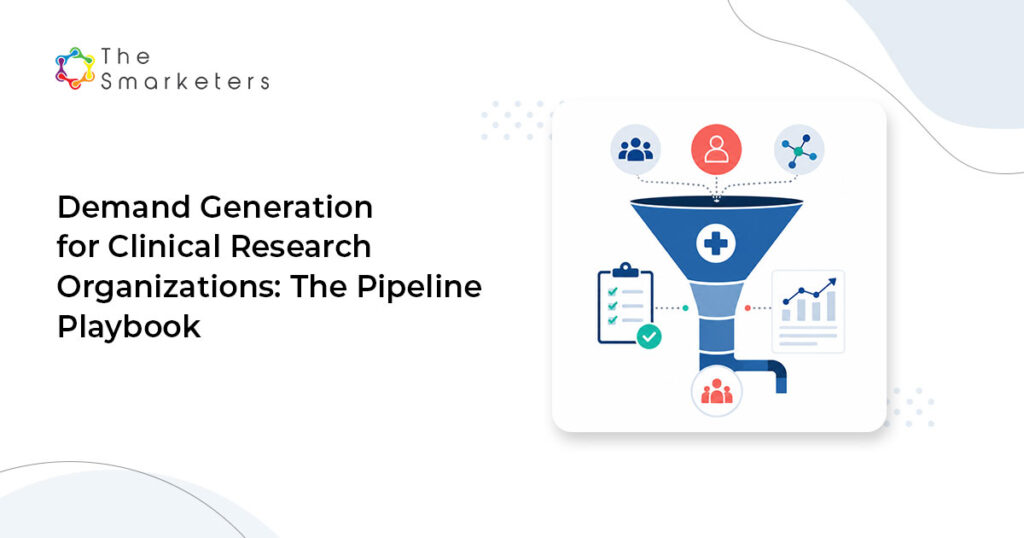
How do CROs generate demand systematically? In our life sciences engagements the answer is a six-step loop we call the CRO Pipeline Playbook: define the sponsor buying group, build compliant proof assets, capture existing demand, create new demand through expert content, run 1:Few ABM on named sponsor accounts, and measure pipeline rather than lead volume. The demand generation engine and the account-based motion are one system; the demand generation program fills the map, and the ABM layer concentrates effort where the map shows heat.

The 1:Few step deserves explanation because it is where most CROs under-invest. A CRO rarely has thousands of realistic buyers; it has a few hundred sponsor organizations matching its phase, therapeutic, and geographic sweet spot. Grouping the priority names into clusters (mid-size oncology biotechs approaching Phase II, for instance) and building cluster-specific campaigns delivers most of 1:1 ABM’s relevance at a fraction of its cost. That is the motion behind the case study below.
Case Study: 100+ MQLs in 6 Months for a Health Tech Company
Before: KeyReply, a health tech platform selling into healthcare enterprises, faced a CRO-shaped problem: a defined, cautious, committee-driven buyer universe, paid campaigns producing leads at a $75 cost per lead, and click-through rates stuck at 2%.
Bridge: we rebuilt the motion as a 1:Few program: named-account clusters, message variants per cluster pain, compliant proof content instead of feature pitches, and continuous creative iteration against account response data.
Result: 100+ MQLs in 6 months, cost per lead down from $75 to $51.86, and CTR up from 2% to 4.43%. (Smarketers client engagement; details at thesmarketers.com/success-stories)

The transferable lesson for CROs is the structure, not the numbers: a small, named buyer universe rewards cluster-level focus fast. The honest caveat is that health tech ad economics differ from clinical services, and a CRO’s equivalent win often shows up as sponsor-account engagement and RFP invitations rather than ad-metric improvements.
Common Mistakes That Stall CRO Demand Programs
- Measuring the program on MQL volume. A CRO needs perhaps twenty right conversations a quarter, not two hundred leads. Volume targets push the budget toward the wrong audience automatically.
- Publishing to the industry instead of the buyer. Content about “the future of clinical trials” earns polite conference nods; content about surviving an FDA inspection finding earns a bookmark from the person who will shortlist you.
- Treating compliance review as the enemy. Teams that route around legal produce claims that get walked back, which costs more trust than it bought. Pre-negotiated claim language is faster and safer.
- Starting paid before proof exists. Media spend pointed at a site with no therapeutic-area evidence converts at the bottom of every benchmark. Sequence proof first, amplification second.
- Ignoring the long cycle in reporting. Sponsor decisions take quarters. A program judged monthly on sourced revenue will be cancelled at precisely the moment it is working invisibly.
When is demand generation not the priority? If a CRO is at delivery capacity with a two-year backlog, or if its pipeline is genuinely dominated by one or two strategic partnerships it intends to keep, brand-level demand work can wait; the investment belongs in reference-ability and expansion within existing sponsors instead.
Where to Start
Audit one thing this week: take your last six won and lost studies and reconstruct when each sponsor first encountered your firm versus when BD first logged the opportunity. The gap between those dates is your invisible journey, and its length tells you how much pipeline is being decided before you show up.
If you want the full playbook applied to your therapeutic mix and account list, explore our life sciences demand generation services. The first working session maps your sponsor universe and shows where the 1:Few clusters are, before any campaign spend is discussed.
Frequently Asked Questions
How long before a CRO demand generation program produces a pipeline?
Expect engagement signals in the first quarter, qualified sponsor conversations in the second, and RFP-stage effects from the second or third quarter onward, tracking the sponsor decision cycle. Agree upfront that year-one success is measured on account engagement and opportunity creation, not closed studies.
What budget should a mid-size CRO plan for?
Plan around capability blocks rather than a percentage rule: a compliant proof engine, a search and AI-visibility foundation, LinkedIn distribution, and one flagship event motion. As a calibration point, blended B2B cost per lead runs around $198 and cost per SQL around $1,357 in recent benchmarks, and single study contracts repay those numbers many times over; underfunding content while overfunding media is the typical error.
Who needs to be involved in content review, and how do we keep it fast?
Legal or quality, a scientific reviewer, and marketing, working from pre-approved templates and claim language agreed once. With that in place, individual asset review should take days. The one-time negotiation of the rules is the real project; do it before the calendar depends on it.
Can we use client study data in our marketing?
Only with explicit sponsor approval and de-identification, which is why approval rights are best negotiated in the master services agreement rather than requested retroactively. Aggregated internal benchmarks across studies, stripped of sponsor identifiers, are usually the safer and equally persuasive alternative.
Does this replace our conference and relationship-driven BD motion?
No; it makes it land on prepared ground. Conferences and relationships convert best when the sponsor has already encountered your proof; demand generation is what ensures the meeting at the booth is the middle of the journey rather than the start.
Which KPIs should a CRO marketing leader report to the board?
Sponsor-account engagement (named accounts showing meaningful activity), opportunity creation and RFP invitations, pipeline value influenced, and cycle velocity. Report lead volume only as an operational diagnostic; it is not the outcome.
Do virtual events still perform in 2026?
Yes, when run as named-account plays with genuine scientific content and account-level follow-up. Attendance is smaller than the webinar era; pipeline relevance per attendee is far higher, and the derivative clips and written assets usually outproduce the live hour.
Should we start with demand generation or ABM?
Start with the shared foundation: buyer-group definition and compliant proof assets serve both. Then run them as one system, demand generation for coverage of the full sponsor universe and 1:Few ABM for the named accounts that justify concentration. Choosing between them is a false choice at CRO deal sizes.

Enoch Pakanati
CEO