Table of Contents
- Why Cold Outreach Keeps Getting Worse
- Why LinkedIn Is Where This Happens
- The Employee Advocacy Framework
- Content Cadence for Sales Teams: The 4C Social Selling Cadence
- Measuring Social Selling ROI
- How The Smarketers Trains Sales Teams on This
- When Social Selling Is Not the Answer
- Where to Start
- Frequently Asked Questions
Need help with B2B Marketing?
Let the smarketers’ team drive your pipeline with data-led campaigns and AI-powered growth strategies.
SDR at a B2B tech company sends 120 cold emails and 40 connection requests in a week. The emails produce two out-of-office replies. The connection requests, sent from a profile that is a résumé with a logo, mostly expire unanswered. Meanwhile, a competitor’s solutions engineer posts a teardown of a common integration mistake, collects 40 comments from exactly the architects and IT directors the SDR was emailing, and books three calls without sending a single pitch.
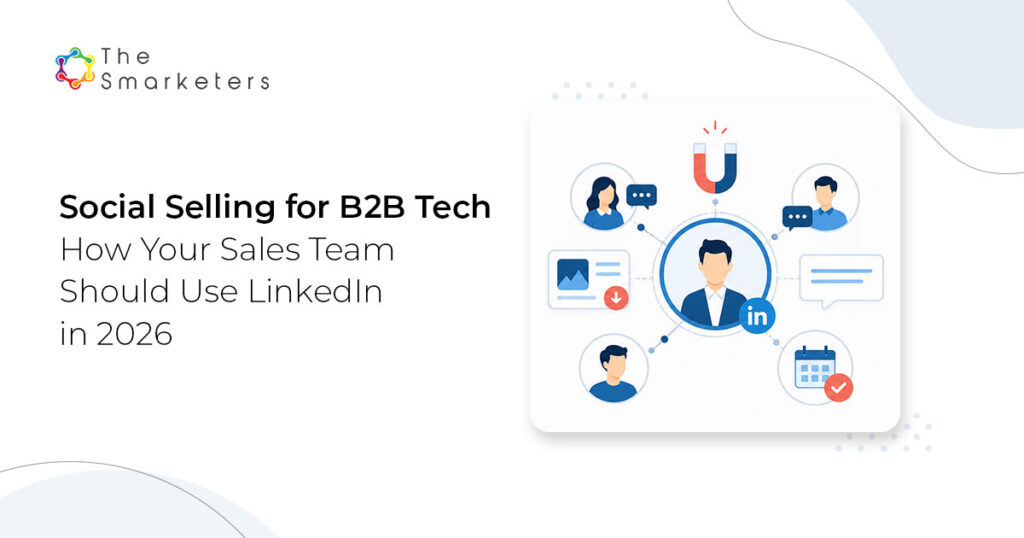
That gap is what social selling actually is: not a new outreach channel, but a different order of operations. Value first, visibility second, conversation third, pitch last. And the buyers have already voted for it. Gartner reports 67% of B2B buyers prefer a rep-free buying experience, and 69% use sales conversations mainly to validate what they already learned elsewhere. If buyers do their forming of opinions in public feeds and AI answers, the selling has to happen where the forming happens.
This article lays out the playbook we train B2B tech sales teams on: why the outbound math keeps getting worse, the employee advocacy structure that fixes it, a weekly cadence reps can sustain, and how to measure the ROI so the program survives its first budget review.
Why Cold Outreach Keeps Getting Worse
The direct answer: cold outreach is not dying because reps got worse; it is dying because buyers changed the rules and tooling flooded the channel. Reply rates on cold sequences have fallen to a fraction of what they were five years ago, and every AI-written email that lands in an inbox trains buyers to ignore the next one. At the same time, buyers consult around seven information sources per purchase, and a cold email from a stranger is rarely one of them.
The behavioral shift shows up most clearly in what buyers do before they respond to anyone: they check the person, not just the company. A rep whose profile shows genuine expertise, useful posts, thoughtful comments, gets a different response rate than a rep whose last activity was reposting the company’s product launch. Forrester-tracked data shows 70 to 80% of the buying journey happens before first vendor contact; social selling is how a salesperson participates in that 70 to 80% instead of waiting outside it.
There is also a new actor in the middle of the journey: the AI assistant. Forrester found 94% of B2B buyers use generative AI during the purchase process, and the sources those tools cite most heavily are community and professional platforms; one study found Reddit, YouTube, and LinkedIn are the most-cited sources across major AI search engines. A rep’s public LinkedIn presence is no longer just visible to the humans who follow them; it feeds the machine layer that briefs buyers before any human conversation. Cold email leaves no such trace. That asymmetry alone justifies moving effort from private inboxes to public feeds.
Why LinkedIn Is Where This Happens
For B2B tech, the platform decision is already made by the data. 80% of B2B social media leads come from LinkedIn, and LinkedIn generates 277% more leads than Facebook and Twitter combined. Its visitor-to-lead conversion rate of 2.74% runs about three times that of Facebook or X, and 93%+ of B2B marketers already use it for content, which means your buyers’ feeds are where your category conversation already lives.

One nuance worth stating: those numbers describe the platform, not any individual tactic. Organic reach favors people over company pages, which is exactly why the rest of this playbook is built around reps and practitioners rather than the brand account. And short-form video deserves a place in the mix: 41% of B2B marketers say short-form video delivers the highest ROI of any video format, and a rep talking through a real problem for 60 seconds routinely outperforms the same insight as text.
Boost your LinkedIn presence with our LinkedIn Post Generator
The Employee Advocacy Framework
What is social selling on LinkedIn, structurally? It is an employee advocacy system with a commercial edge: the company equips its practitioners (sales, solutions, product) to be visible experts, and buying conversations start from that visibility. The structure that makes it sustainable has four roles:
- The practitioners (reps, SEs, consultants): own their voice. They post from personal profiles about problems, patterns, and honest lessons, not product features. Buyers connect with people, not logos.
- The content desk (marketing): supplies raw material weekly: data points, customer questions, teardown ideas, first-draft angles. Reps edit into their own voice; nobody publishes copy-paste corporate text, because feeds punish it.
- The enablement owner: runs the cadence: weekly 30-minute working session, profile reviews, comment targets, and the measurement dashboard. Programs without a named owner decay within a quarter.
- Leadership: participates visibly. When the VP of Sales comments and posts, reps believe the program is real. When leadership only forwards the memo, reps correctly read it as optional.
The trade-off to acknowledge: advocacy hands part of your brand voice to individuals, and some posts will be imperfect. That is the price of credibility. A program that routes every rep post through brand approval produces safe, invisible content, and invisible defeats the purpose.
Also Read: How to Create a Winning Social Media Marketing Strategy
Content Cadence for Sales Teams: The 4C Social Selling Cadence
The cadence question (“what should my reps actually do each week?”) is where most programs fail, because the honest constraint is time: reps carry quota, and any cadence that needs 10 hours a week is fiction. The 4C Cadence is designed to fit inside 30 to 45 minutes a day.
- Connect. 10 to 15 personalized connection requests per week to mapped buying-committee members: people who engaged with relevant content, attendees of the same events, followers of category voices. No pitch in the request.
- Comment. Three to five substantive comments daily where buyers already discuss problems: category hashtags, community posts, competitors’ threads. A good comment adds an example, a caveat, or a number; “Great post!” is invisible.
- Contribute. Two original posts per week per rep: a customer question answered, a pattern noticed across deals, a mistake worth avoiding. Short-form video for one of the two if the rep is comfortable on camera.
- Convert. Move to DMs or a call only when the other person has engaged twice or asked a question. The pitch arrives as a response to interest, which is why it gets answered.

What a realistic week looks like for one rep running the cadence:
| Day | Time | Activity |
|---|---|---|
| Monday | 30 min | Review target-account activity from the weekend; 3 connection requests; 4 comments on threads buyers engaged with. |
| Tuesday | 40 min | Publish Post 1 (customer question answered); reply to every comment within the day. |
| Wednesday | 30 min | 4 comments; 4 connection requests to people who engaged with Post 1. |
| Thursday | 40 min | Publish Post 2 (pattern from deals, or 60-second video); 3 comments. |
| Friday | 30 min | DM follow-ups with the twice-engaged; log conversations and meetings in CRM; flag content ideas for the desk. |
Notice what the week does not contain: no pitch messages to strangers, no automation tools spraying requests, no daily posting. Sustainability beats intensity. A rep who runs this exact week for twelve consecutive weeks will outperform a rep who posts daily for three weeks and quits, which is what unmanaged programs produce.
Measuring Social Selling ROI
Answer first: measure social selling like a pipeline source, not like a media channel. Impressions and follower counts tell you the engine is turning; they do not tell you it is going anywhere. The measurement ladder we implement has four rungs:
| Rung | Metric | What it proves | Cadence |
|---|---|---|---|
| 1. Activity | Cadence adherence per rep (connects, comments, posts) | The program is actually running | Weekly |
| 2. Audience | Connections and engagement within named target accounts | The right people are watching | Monthly |
| 3. Conversation | Inbound DMs, comment-to-call conversions, meetings sourced | Visibility is turning into dialogue | Monthly |
| 4. Pipeline | Opportunities and revenue with social touchpoints, versus cold-sourced | The program pays | Quarterly |
Two benchmarking anchors keep expectations honest. LinkedIn’s Lead Gen Forms convert around 13% when you do run paid capture against a warm audience, and sponsored content click-through benchmarks sit at 0.44 to 0.65%: useful context when someone proposes replacing the advocacy program with ad spend. Paid amplifies a credible presence; it cannot substitute for one.
Be honest about attribution limits from the start, because this is where social selling programs die in budget reviews. A buyer who reads a rep’s posts for two months and then submitted a demo request through the website shows up in your CRM as “inbound, direct.” The social influence is real and invisible. The practical fix is a simple self-reported question (“how did you first hear about us?”) plus tracking opportunity rates in accounts the reps actively work versus matched accounts they do not. That comparison is not laboratory-grade, but it is honest, cheap, and consistently persuasive to a CFO in a way that impression counts never are.
Related Read: LinkedIn Personal Branding For Executives & Founders
How The Smarketers Trains Sales Teams on This
Our training engagements run the playbook above as a 90-day program: profile rebuilds and account mapping in weeks 1 to 2, the 4C cadence with weekly working sessions from week 3, and the measurement ladder live by week 6. We train practitioners in their own voice rather than handing them scripts, because scripted social selling reads as exactly what it is.
What it looks like when it lands: an SAP consulting partner asked us to build a relationship-first outbound motion into their enterprise sales team, combining rebuilt LinkedIn presence with tightly personalized account outreach. Before: generic outreach from unloved profiles, single-digit response rates, and a team skeptical that “posting” was sales work.
Result: The program reached 70% engagement across target accounts, 63% email open rates, and a 41% LinkedIn connection acceptance rate, numbers cold outbound does not reach, because every touch landed on someone who had already seen the sender be useful. (Smarketers client engagement; more at https://thesmarketers.com/success-stories/)

The honest caveat: this took a full quarter of consistent cadence before the numbers moved, and two reps never took to it. Social selling rewards the naturally curious; a team staffed entirely with script-followers will need hiring changes, not just training, to run it well.
When Social Selling Is Not the Answer
Every framework needs its exclusion criteria, and this one has four. Being clear about them up front saves a quarter of wasted training budget and a sales team that resents marketing for the experiment.
- Transactional, low-ACV sales. If deals close in one call at low value, the relationship investment never pays back; optimize inbound and product-led paths instead.
- Buyers who are not on LinkedIn. Some technical audiences live in specialist communities and forums rather than LinkedIn feeds. Go where the discussion is; the principles transfer, the platform may not.
- As a quick fix for this quarter’s gap. Expect a quarter of consistent cadence before meetings attributable to the program appear. A team behind on pipeline right now needs capture-side work first, with social selling built in parallel.
- Without executive participation. If leadership will not model the behavior, save the training budget. The program’s culture is set by what leaders do, not what the enablement deck says.
Where to Start
Run a one-week diagnostic before buying anything: pick five reps, count their current connection acceptance rate, and audit their profiles against one question, “would a buyer learn anything from this person?” The gap you find is the program’s starting line.
If you want the 90-day version with training, cadence, and measurement built for your team, explore our sales enablement and ABM services. We will show you the account-mapping and advocacy structure we used in the engagement above, and give you an honest read on whether your sales motion fits it.
Frequently Asked Questions
How much time does social selling take per rep per day?
Plan for 30 to 45 minutes: comments and connection requests daily, plus two posts a week drafted in the weekly working session. Programs that demand more than an hour a day collapse under quota pressure within weeks.
How long until social selling produces measurable pipeline?
Expect conversations within 3 to 4 weeks, meetings within 6 to 8, and attributable pipeline in about a quarter. The compounding is real but back-loaded, which is why the activity and audience metrics matter early: they prove progress before revenue does.
Should reps post from personal profiles or the company page?
Personal profiles, decisively. Feeds favor people over pages, and buyers connect with practitioners, not logos. The company page has a role as a credibility anchor and content archive, but the reach and the conversations belong to individuals.
Do we need Sales Navigator to run this?
It helps for account mapping and lead lists, but it is not the program. Teams get meaningful results from free profiles plus a disciplined cadence; buy tooling when the manual account-mapping work becomes the bottleneck, not before.
How do we handle compliance and brand risk when reps post freely?
Set guardrails, not gates: a one-page policy covering confidential data, customer naming, and claims that need proof, plus a shared review channel for anything borderline. Pre-approval workflows kill the spontaneity that makes advocacy work.
What content should salespeople post if they are not writers?
Answers to real customer questions, patterns from deals, and honest mistakes; the raw material already exists in their call notes. The content desk should hand each rep two draft angles a week to edit into their own voice, and short-form video works well for reps who talk better than they type.
How is social selling different from employee advocacy?
Advocacy is the broader program (any employee amplifying expertise); social selling is advocacy aimed at revenue, run by customer-facing teams against mapped accounts with conversion steps built in. Every social selling program is advocacy; not every advocacy program sells.
Can we buy engagement with LinkedIn ads instead?
Ads reach people; they do not build the practitioner credibility that makes outreach land. With sponsored content CTRs benchmarked at 0.44 to 0.65%, paid works best amplifying proven organic posts to target accounts, layered on top of an advocacy base rather than instead of one.

Agnihotri Ghosh
Marketing Manager