Table of Contents
- From Cost Arbitrage to Strategic Capability
- What Separates a Strategic ABM Partner from an Execution Shop
- The Smarketers Hybrid ABM Framework: 1:1, 1:Few, 1:Many
- Intent Data and HubSpot: The Operational Backbone
- Global Delivery from India: How It Actually Works, Trade-offs Included
- Case Study: 300% ROI in 7 Months for a Global Software Firm
- When a Local Agency Is the Better Choice
- The Decision, Summarized
- Frequently Asked Questions
Need help with B2B Marketing?
Let the smarketers’ team drive your pipeline with data-led campaigns and AI-powered growth strategies.
A VP of Marketing at an enterprise software company runs an agency review. Three finalists: two agencies within driving distance of headquarters, one in Hyderabad. Five years ago the Indian agency would have been in the deck as the cost option, evaluated on rate cards and little else. In 2026 it is in the deck because a peer company’s ABM program, run from India, outperformed the incumbent agency’s program on pipeline contribution, and the VP wants to know if that result repeats.
That is the shift this article examines. It is a decision-stage guide, so it takes a position and shows its work: what actually changed in Indian B2B agencies, the criteria that separate a strategic ABM partner from a rebadged execution shop, the trade-offs of working across time zones that vendors rarely put in writing, and the cases where a local agency remains the better choice. I run an ABM agency in Hyderabad, so read this as an informed but interesting view, and hold my claims to the same verification standard I recommend below for everyone else’s.
From Cost Arbitrage to Strategic Capability
Enterprise tech companies choose Indian ABM agencies in 2026 primarily for capability, with cost efficiency as the secondary benefit rather than the headline. Three developments drove the change. First, the talent base matured: a decade of global SaaS companies building marketing hubs in Bengaluru, Hyderabad, and Pune produced a generation of marketers who have run enterprise ABM in-house, not just serviced it. Second, the credential gap closed. India-based agencies now hold the same analyst-recognized awards, platform partnerships, and certifications that used to mark out agencies in Boston or London; The Smarketers became India’s first ITSMA-award-winning ABM agency with a Gold award in 2019, and ITSMA’s framework is the standard the discipline itself was built on. Third, ABM work went remote-native. The craft runs on intent data, orchestration platforms, and video workshops; physical distance stopped being a proxy for strategic distance.
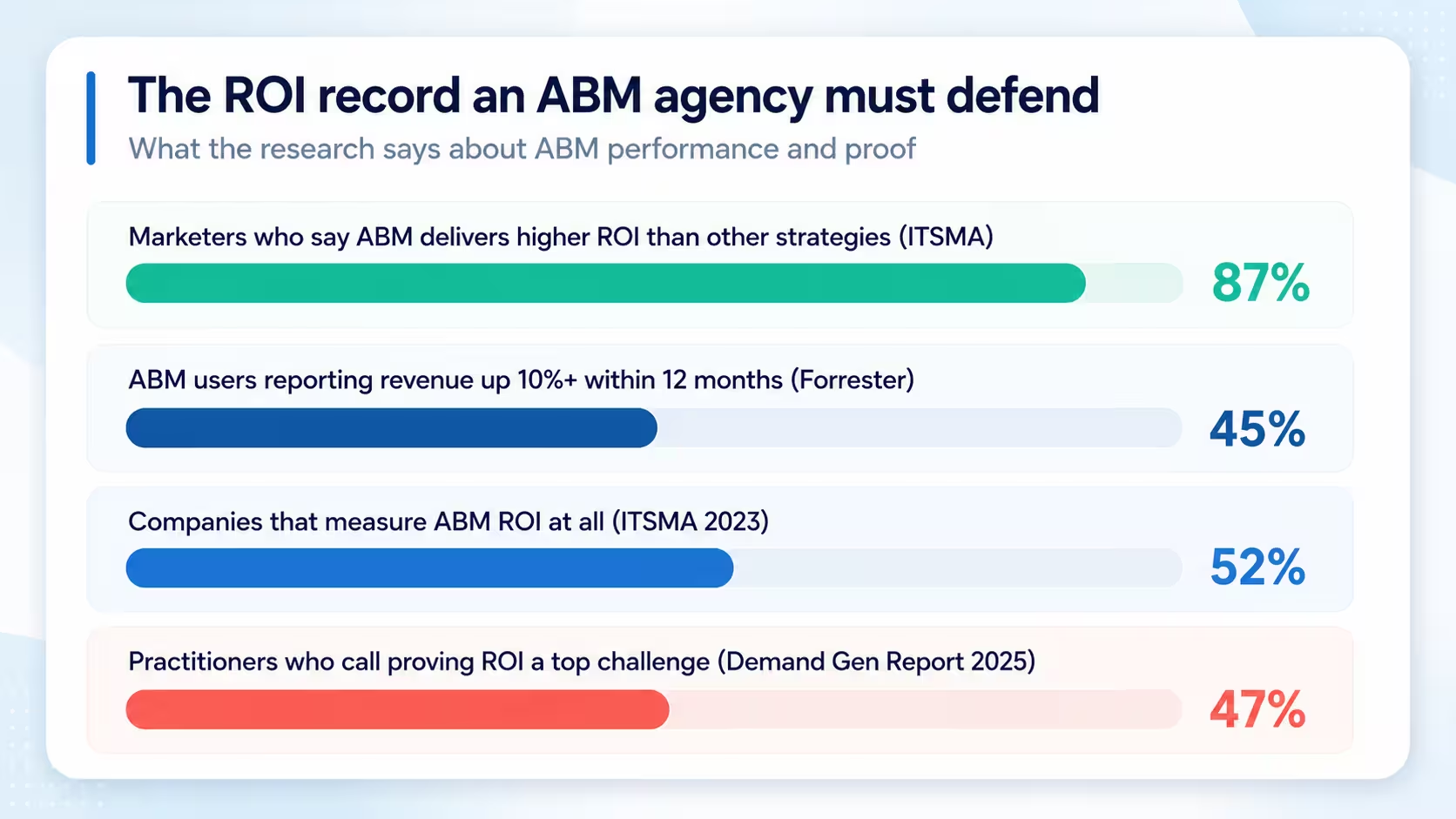
The economics still matter, and pretending otherwise would be dishonest. The same senior-strategist hours cost meaningfully less from India, which lets a program fund more research depth, more content iterations, and more experimentation per dollar. The point is the order of the argument: capability first, economics as multiplier. An agency that opens its pitch with rates is telling you where it believes its own value sits. And the performance bar is public: 87% of marketers say ABM delivers higher ROI than any other marketing strategy per ITSMA, and Forrester reports the ROI advantage most commonly lands 21-50% above other strategies, with 23% of respondents reporting 51-200% higher ROI. Any agency, in any country, should expect to be measured against that.
What Separates a Strategic ABM Partner from an Execution Shop
The evaluation question is not “which agency is best” but “which agency can prove the specific capabilities my program needs.” The eight criteria below are the ones we see sophisticated buyers use, and they apply identically to agencies in Hyderabad, Austin, or Manchester. The right-hand column is the part most evaluations skip: how to verify the claim instead of accepting the slide.
| Criterion | What good looks like | How to verify |
|---|---|---|
| ABM strategy depth | Named methodology covering account selection, tiering, and measurement, not channel tactics wearing an ABM label | Ask them to critique your current account list live; strategists engage, executors ask for the brief |
| Enterprise proof | Case studies with named metrics at companies of your scale and deal complexity | Request two client references you choose from their list, not the two they offer |
| Analyst-recognized credentials | ITSMA or equivalent recognition; documented award year and category | Check the awarding body’s own published lists, not the agency site |
| Platform expertise | Certified partnership tier on your stack (for us: HubSpot Platinum Solutions Partner), with implementation staff, not just badges | Verify tier in the platform’s public partner directory |
| Intent data fluency | Can explain which intent sources they use, their decay windows, and failure modes | Ask what they do when intent signals contradict sales intuition |
| Measurement discipline | Reports account progression and pipeline, offers an ROI model upfront | Ask for a sanitized sample of an actual client dashboard |
| Team continuity | Named team in the contract; low rotation on strategic roles | Ask who worked on their oldest active account 18 months ago and who works on it now |
| Working-model honesty | Puts time-zone overlap, review cadence, and escalation paths in writing before you ask | If the trade-offs section of the proposal is empty, that is the answer |
The Smarketers Hybrid ABM Framework: 1:1, 1:Few, 1:Many
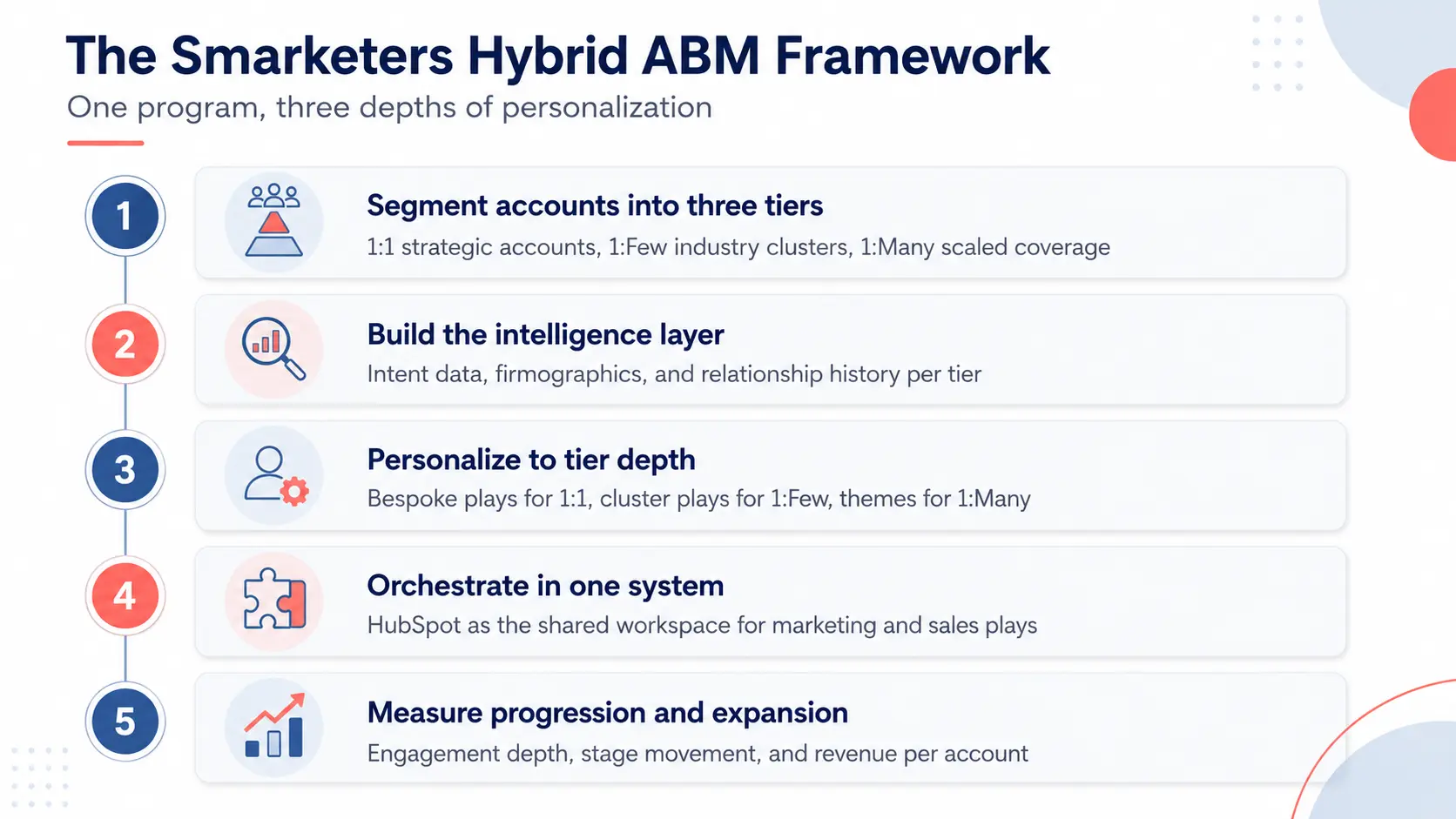
Our own answer to the strategy-depth criterion is the Hybrid ABM Framework: one program running three depths of personalization simultaneously, so coverage and depth stop competing for the same budget. Pure 1:1 programs produce beautiful engagement at a handful of accounts and silence everywhere else; pure 1:Many programs are demand generation with an account filter. The hybrid keeps both honest.
- Segment accounts into three tiers. 1:1 for the strategic accounts that justify bespoke plays, 1:Few for clusters sharing an industry or use case, 1:Many for scaled coverage of the wider target market.
- Build the intelligence layer. Intent data, firmographics, technographics, and relationship history, maintained per tier at the depth the tier earns.
- Personalize to tier depth. Bespoke executive engagement for 1:1, industry-cluster campaigns for 1:Few, thematic always-on coverage for 1:Many.
- Orchestrate in one system. Marketing and sales plays run from the same platform and the same account records, so handoffs are visible.
- Measure progression and expansion. Engagement depth, stage movement, and revenue per account, with accounts moving between tiers as evidence accumulates.
The framework matters for this article’s question because tier movement is where remote delivery proves itself. Moving an account from 1:Many to 1:1 requires marketing and sales to agree on evidence quickly, across companies and continents. When that works routinely, geography has already stopped being the constraint. The research supports the tiered logic too: Forrester finds 45% of B2B marketers using ABM report revenue up 10% or more within 12 months, and the gains concentrate where programs match effort to account value instead of spreading it evenly.
Intent Data and HubSpot: The Operational Backbone
A distributed ABM program lives or dies on shared visibility, which is why the platform question matters more for a remote agency than a local one. Our default backbone is HubSpot: account records, intent integrations, play execution, and reporting in one system that the client, our strategists, and the client’s sales team all see identically. We hold HubSpot Platinum Solutions Partner status, and the practical value of that is unglamorous: implementation muscle memory. Lifecycle-stage hygiene, attribution that survives an audit, workflows that sales actually adopts.
Intent data supplies the timing layer. Third-party intent shows which target accounts are researching your category before they touch your site; first-party signals show what engaged accounts do next. The discipline is in the interpretation: intent spikes decay in weeks, single-source signals mislead, and an agency should be able to tell you, in plain terms, when it ignores its own intent data. When a client’s CRM cannot support this backbone yet, we say so and fix the foundation first, because orchestration on top of dirty data produces confident nonsense at agency prices.
Global Delivery from India: How It Actually Works, Trade-offs Included
The honest version of the time-zone story has two sides. The favorable side: India’s working day ends as the US East Coast day begins and overlaps European mornings for hours, which enables a follow-the-sun rhythm. Briefs closed at a client’s end of day come back worked the next morning; campaign production effectively runs while the client sleeps. For always-on ABM programs with weekly iteration cycles, this is a genuine speed advantage, not spin.
The unfavorable side, which belongs in writing before any contract is signed:
- Live-overlap windows are finite. With US West Coast teams, comfortable shared hours shrink to early mornings. Programs needing long, frequent live workshops feel this. The mitigation is structural: decisions documented asynchronously, live time reserved for judgment calls, and senior strategists, not coordinators, attending the overlap hours.
- In-person presence costs more and takes planning. Field-marketing-heavy motions, executive dinners, and event war rooms are harder to staff from another continent. Agencies handle this with travel windows and local partners, but a program built around monthly in-person events fights the model.
- Context transfer is real work. A remote team needs deliberate onboarding into your positioning, politics, and tone. Expect the first month to include structured immersion; an agency that promises instant fluency is overselling.
- Contractual protections must be explicit. IP assignment, data processing terms, and confidentiality should be specified with the same rigor you would demand domestically. Mature agencies bring this paperwork unprompted.
Case Study: 300% ROI in 7 Months for a Global Software Firm
Before: Josh Software, an engineering services firm selling globally, had credible delivery and an invisible pipeline; marketing activity produced traffic but not qualified enterprise conversations, and leadership needed ROI it could defend internally.
Bridge: we ran the Hybrid ABM Framework from India for a global target list: tiered accounts, intent-informed timing, HubSpot as the shared operating system, and content built for the buying group rather than the persona sheet. Weekly iteration ran on the follow-the-sun rhythm described above.
Result: 300% ROI in 7 months, 500+ MQLs, and 4,000+ new site visitors, reported in the same dashboard the client’s leadership used. (Smarketers client engagement; details at thesmarketers.com/success-stories)
Caveat, stated plainly: one engagement is evidence, not a guarantee, and ROI curves depend on deal size, cycle length, and how ready the client’s sales motion is to receive engaged accounts. Across our portfolio of 40+ ABM programs, roughly 85% have hit their success criteria, which also means some have not; the missed cluster where account selection was rushed or sales ownership was thin.
When a Local Agency Is the Better Choice
A decision guide that never recommends against its author is an advertisement. Choose an agency in your own region when:
- Your ABM motion is field-first. If executive roundtables, on-site briefing centers, and regional events carry your pipeline, an agency that can be in the room weekly earns its premium.
- Regulatory or procurement constraints require it. Some government, defense, and financial-services contracts restrict where vendor work can be performed or where data can be processed. That is a hard constraint, not a preference.
- You need daily co-location with an in-house team. Some organizations run agency staff as embedded team members in the office. Remote embedding works on mature teams; it strains new or low-trust ones.
- Deep local-market nuance is the strategy. If winning depends on relationships inside one city’s buyer community, buy that community knowledge directly.
If none of those four describe your program, the shortlist should be built on the eight criteria above, and where the agency sits on the map becomes one input among many rather than the filter.
The Decision, Summarized
Global enterprise tech chooses Indian ABM agencies in 2026 because the capability argument now stands on its own: analyst-recognized methodologies, platform-certified delivery, and documented enterprise results, with cost efficiency compounding the return rather than excusing the choice. The evaluation discipline is the same one you would apply anywhere: verify credentials at the source, demand a measurement model upfront, and get the working-model trade-offs in writing.
If you are building that evaluation now, download the ABM Playbook from our account-based marketing services page. It contains the tiering model, the evaluation scorecard from this article, and the measurement framework we commit to with our own clients.
Frequently Asked Questions
How much do Indian ABM agencies typically cost compared to US or European agencies?
Expect meaningful savings on comparable seniority, though exact spreads vary too much by scope to quote responsibly. The more useful comparison is value per dollar: ask each finalist what research depth, content volume, and strategist hours your budget buys, and compare those line items directly.
How many hours of live overlap should we expect with a team in India?
With European teams, three to five comfortable shared hours daily; with US East Coast, two to four in the US morning; with US West Coast, roughly one to two, which demands a genuinely asynchronous operating rhythm. Ask the agency which of your standing meetings its senior strategists will personally attend, and get it into the contract.
What should we verify before signing with any ABM agency, Indian or otherwise?
Four things at minimum: award claims against the awarding body’s own published lists, platform partnership tier in the platform’s public directory, two client references you select from their client list, and the named team in the contract. Most bad agency outcomes trace to skipping one of these.
How long does onboarding a remote agency take before the program produces work?
Plan for two to four weeks of structured immersion: positioning, ICP, sales process, tone, and system access. Programs typically ship first plays in the first month and reach full operating rhythm by the end of the first quarter. Onboarding shortcuts show up later as generic content.
Can an agency in India run ABM for accounts we target in other regions?
Yes; modern ABM runs on intent data, digital orchestration, and video-based workshops, none of which require proximity to the account. The exception is field-heavy motions, where you should either pick a local agency or agree explicitly on how in-person moments will be staffed.
What does the 85% success figure actually mean?
It means that across 40+ ABM programs, roughly 85% met the success criteria agreed with the client at kickoff, typically pipeline contribution or account engagement targets. It does not mean 85% of programs tripled ROI. Ask any agency citing a success rate how success was defined and who defined it.
Which KPIs should an ABM agency commit to in the first two quarters?
Quarter one: buying-group coverage, engagement depth in target accounts, and content velocity. Quarter two: account stage progression, meetings created in target accounts, and early pipeline contribution. Revenue attribution matures with your sales cycle; an agency promising closed revenue in 90 days on enterprise deals is promising something it does not control.
How is our data and IP protected when the agency works from another country?
Through the same instruments you would use domestically: IP assignment clauses, data processing agreements aligned to GDPR and your internal standards, access controls on your systems, and confidentiality terms with named enforcement. Ask to see the agency’s standard DPA before procurement asks for it; mature agencies have one ready.

Isha Gulati
Senior Marketing Manager